
v1indicators
Technical analysis indicators for Python
Pandas Series in, pandas Series or DataFrame out — named, typed, and indexed like the input.




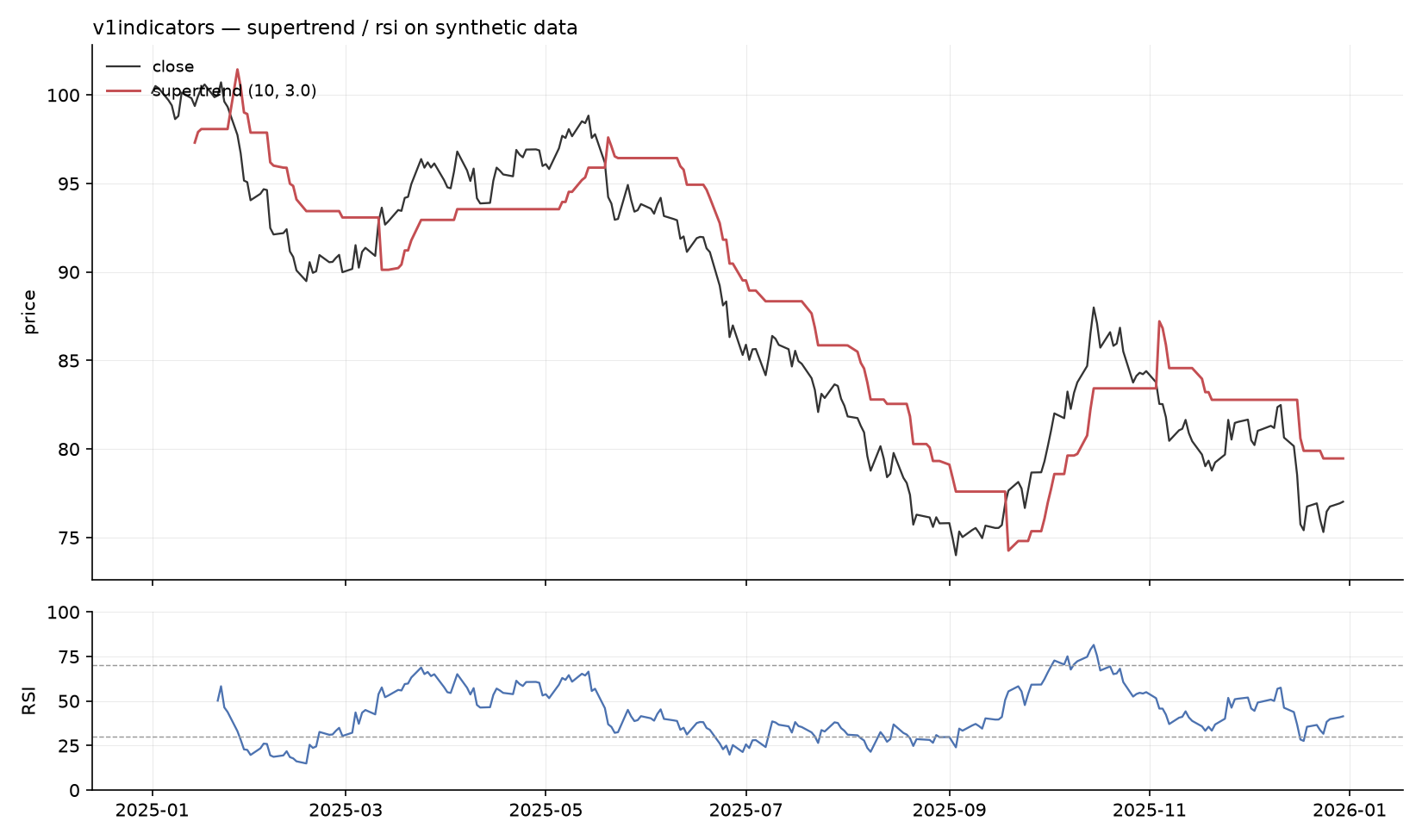
supertrend(high, low, close, length=10, mult=3.0) and rsi(close, length=14)
on synthetic data · generated with matplotlib by
docs/assets/make_example_chart.py
The scope is deliberate: indicator math only. No charting, no broker integrations, no strategy execution framework.
Contents
- Installation
- Quick start
- Correctness guarantees
- What is not verified
- Conventions
- API layout
- Development
Installation
Install from PyPI:
pip install v1indicators
Or install from source for development:
git clone https://github.com/Vatthu/v1indicators.git
cd v1indicators
pip install -e ".[dev]"
Requires Python 3.10+, numpy, pandas, numba.
Quick start
import pandas as pd
from v1indicators import rsi, macd, supertrend

df = pd.read_csv("data.csv")

# single output -> named Series
df["RSI_14"] = rsi(df["close"], length=14)

# multiple outputs -> DataFrame with stable column names
macd_df = macd(df["close"], fast=12, slow=26, signal=9)
st_df = supertrend(df["high"], df["low"], df["close"], length=10, mult=3.0)
| Output kind | Return type | Example columns |
|---|---|---|
| Single value | pd.Series |
RSI_14 |
| Multiple values | pd.DataFrame |
MACD, MACD_SIGNAL, MACD_HIST |
Every output preserves the input index and length.
Correctness guarantees
Enforced by tests and CI (Python 3.10 / 3.12 / 3.14). A regression in any of them fails the build.
| Guarantee | What it means | Enforced by |
|---|---|---|
| No look-ahead bias | Values on the first K bars never change when future bars are appended | test_causality.py · test_causality_params.py |
| Textbook parity | ~30 core indicators match naive reference loops at 1e-9 | test_parity_core.py · test_reference_math.py |
| NaN warmup | Outputs stay NaN until enough history exists | test_warmup_contract.py |
| Calendar correctness | Day/week/month and session levels are right on gapped exchange calendars | test_calendar_sessions.py |
| Interoperability | All outputs align on index and length across nine scenarios | test_interoperability_matrix.py |
No look-ahead bias — how the suite rules out repainting
An indicator that changes its past values when future bars arrive repaints, and any backtest built on it is wrong.
- Every public function is checked on several synthetic datasets.
- The check repeats under non-default parameter values.
- Pivot indicators activate levels only once the pivot is confirmed.
ichimokuemits Chikou asclose - close.shift(kijun)— same information, no future bars.causal=False(retrospective plotting mode) repaints by definition and raises aUserWarning.dpoandvpwere removed: no causal form of either exists.
Textbook parity — what is compared against reference loops
Covers the moving-average family, Bollinger Bands, Donchian, MACD, Stochastic, Williams %R, CMO, Ultimate, Aroon, ADX, PSAR, ATR, Parkinson, Garman-Klass, Choppiness, OBV, AD, CMF, VWAP and rolling statistics — each compared against a plain-Python loop written from its textbook formula.
NaN warmup — how much history each output needs
Outputs are NaN until enough history exists for the value to mean something.
lengthobservations for a single window or ewm stage.- Nested chains add up: TEMA needs
3*(length-1)bars, MACD signalslow+signal-2. - Kernel-based averages (
kama,vidya,mcgd,ssf,hwma,kalman_filter) andpsarseed from the first bars by algorithm definition — feed warmup history.
What is not verified
⚠️ Warning: Six indicators compose the primitives above into trading signals. Their outputs are causal by construction — that is all this library claims about them. Nothing here measures whether their signals predict anything.
| Signal engine | Output |
|---|---|
range_filter_confluence |
gated trend signals with a strength score |
precision_confluence |
preset-aware confluence entries with SL/TP ladder |
dual_score_signals |
dual-score entries with a five-step TP ladder |
htf_reversal_divergence |
higher-timeframe reversal patterns with RSI divergence |
swing_trend_entry |
moving-average touch entries |
swing_leg_profile |
per-swing-leg volume profile |
Validate on your own data before trading any of them.
Conventions
| Situation | Behavior |
|---|---|
| Unsorted input index | ValueError — bar i+1 must follow bar i |
| Boolean flag columns | False when inputs are NaN or insufficient |
| Session/calendar tools | Index-local clock, no timezone conversion; "prior day" = prior trading day |
vwap |
Anchored to the first bar of the input — slice for a session VWAP |
| Short names | kc = keltner, squeeze = squeeze_momentum, uo = ultimate_oscillator, willr = williams_r |
API layout
Import from the root:
from v1indicators import ema, sma, rsi, atr, obv
or from a family module:
from v1indicators.momentum import rsi, stoch
| Family | Symbols | Examples |
|---|---|---|
| overlap | 43 | ema, sma, bbands, donchian, keltner |
| momentum | 52 | rsi, macd, stochastic, williams_r |
| trend | 38 | supertrend, adx, psar, aroon |
| volatility | 13 | atr, parkinson, garman_klass, chop |
| volume | 17 | obv, ad, cmf, vwap, pvt |
| statistics | 11 | stdev, zscore, hurst, entropy |
| levels | 4 | support_resistance, pivot_points |
| performance | 4 | log_return, drawdown |
A second namespace mirrors how indicators are built:
from v1indicators.foundational.overlap import ema   # direct from price/volume
from v1indicators.derived.trend import supertrend   # built on other indicators
Family modules re-export both layers and remain the compatibility surface.
ℹ️ Note: New work incubates in
experimental/in the repository, which is not shipped in the binary PyPI package.
Most indicators take close only; range-based ones take high/low/close; volume indicators add volume. Series must share an index.
Development
Test commands
pytest                                     # full suite (~7 s)
pytest -q tests/test_causality.py          # prefix invariance, all functions
pytest -q tests/test_causality_params.py   # same, non-default parameters
pytest -q tests/test_parity_core.py        # textbook reference parity
pytest -q tests/test_interoperability_matrix.py
🛡️ Guarantees: The causality gates discover public functions automatically: a new repainting indicator fails the suite without a test being written for it.
See CHANGELOG.md for full release history. License: MIT.
1 maintainer

Metadata
1 maintainer
Release files for v1indicators 1.0.1
For a detailed explanation of source distributions (sdists) and built distributions (wheels), please see the package formats documentation.
Source distribution (sdist)
| File | Size | Uploaded | Provenance | |
|---|---|---|---|---|
| v1indicators-1.0.1.tar.gz | 124.7 kB | Without provenance | Details |
Built distribution (wheel)
| File | Interpreter | ABI | Platform | Reset |
|---|---|---|---|---|
| v1indicators-1.0.1-py3-none-any.whl | Python 3 | none | any | Details |
Total release size: 283.8 kB
Release files / v1indicators-1.0.1.tar.gz
| Download URL | v1indicators-1.0.1.tar.gz |
|---|---|
| Size | 124.7 kB |
| Tags | Source |
|
SHA-256 checksum How to use checksums |
2276b92cf4ce0e902de4a37a3e034cb4c84c48ca33f5f1c6eb40ec9432bfa81c
|
|
BLAKE2b-256 checksum How to use checksums |
e16dfaa05951a201d69d91c6d733c3d86cb68e2a20cfbea154ec5a9bf2134ffe
|
| Upload date | |
|
Uploaded using Trusted Publishing? What is trusted publishing? |
No |
| Uploaded via |
twine/7.0.0 CPython/3.12.14
|
Release files / v1indicators-1.0.1-py3-none-any.whl
| Download URL | v1indicators-1.0.1-py3-none-any.whl |
|---|---|
| Size | 159.1 kB |
| Tags | Python 3 |
|
SHA-256 checksum How to use checksums |
23a2e1227d246e45c3bde36bfb3b556fea2e4575d306866033f150346be24626
|
|
BLAKE2b-256 checksum How to use checksums |
ae4e39f14917633336375eedb2ab2987a9789e0eec7aa6c0210bdd2cbe81cbb0
|
| Upload date | |
|
Uploaded using Trusted Publishing? What is trusted publishing? |
No |
| Uploaded via |
twine/7.0.0 CPython/3.12.14
|
Security for v1indicators 1.0.1
Provenance
Provenance describes where a file came from. On PyPI, provenance is shared via attestations, which provide a verifiable record of the build or publishing details. View details, limitations and caveats.
No provenance found
None of the files in this release were uploaded with provenance metadata.
A note on package security
PyPI is a repository for distributing packages, not a service for auditing them. While third-party security researchers and our staff do their best to detect and remove malicious packages, PyPI cannot guarantee the quality, security or suitability of any given package.
To learn more about protecting yourself from malicious actors, visit our package security documentation.














