
This release is a pre-release and may not be stable for production use.

An autonomous agent framework built on top of local and cloud LLMs. VAF runs as a desktop application, a headless server, or a terminal interface on Windows, macOS, and Linux.
Installation · Build on VAF · Documentation · Contributing














Dual-licensed: free under the GNU AGPL-3.0, or a commercial license for proprietary/SaaS use without copyleft (legal@veyllo.io).
Requires: Git to clone, and a container runtime. VAF keeps users, auth, setup and memory in a PostgreSQL/pgvector container, so one is required to finish setup and sign in. All three installers set the engine up for you: Windows installs the free Rancher Desktop, macOS auto-installs the free Colima (or uses Docker Desktop if present), and Linux auto-installs your distro's Docker (systemd + docker group). The installer also provisions Python and Node itself.
Start here
Pick your path:
| You want to… | Go to |
|---|---|
| Run VAF as a desktop app, server, or terminal | Installation below |
| Build on VAF as a library (embed the agent in your app) | docs/EMBEDDING.md · docs/ARCHITECTURE.md |
| Write a tool (extend the agent, ship it as a pip package) | vaf/tools/README.md · docs/EMBEDDING.md |
| Contribute to the engine (the core agent loop) | vaf/core/README.md · docs/ARCHITECTURE.md |
Use it as a library
pip install --pre vaf
import os

from vaf import Agent

agent = Agent(config={"provider": "openai", "api_key_openai": os.environ["OPENAI_API_KEY"]})
print(agent.run("In one short sentence, what is Python?"))
The same code runs on a fully local GGUF model (provider="local" - no key,
nothing leaves the machine) or any supported API provider (veyllo, openai,
anthropic, google, deepseek, openrouter). The base install is slim;
heavy features are opt-in extras like vaf[memory] and vaf[server].
Developer guide: docs/EMBEDDING.md ·
runnable examples: examples/
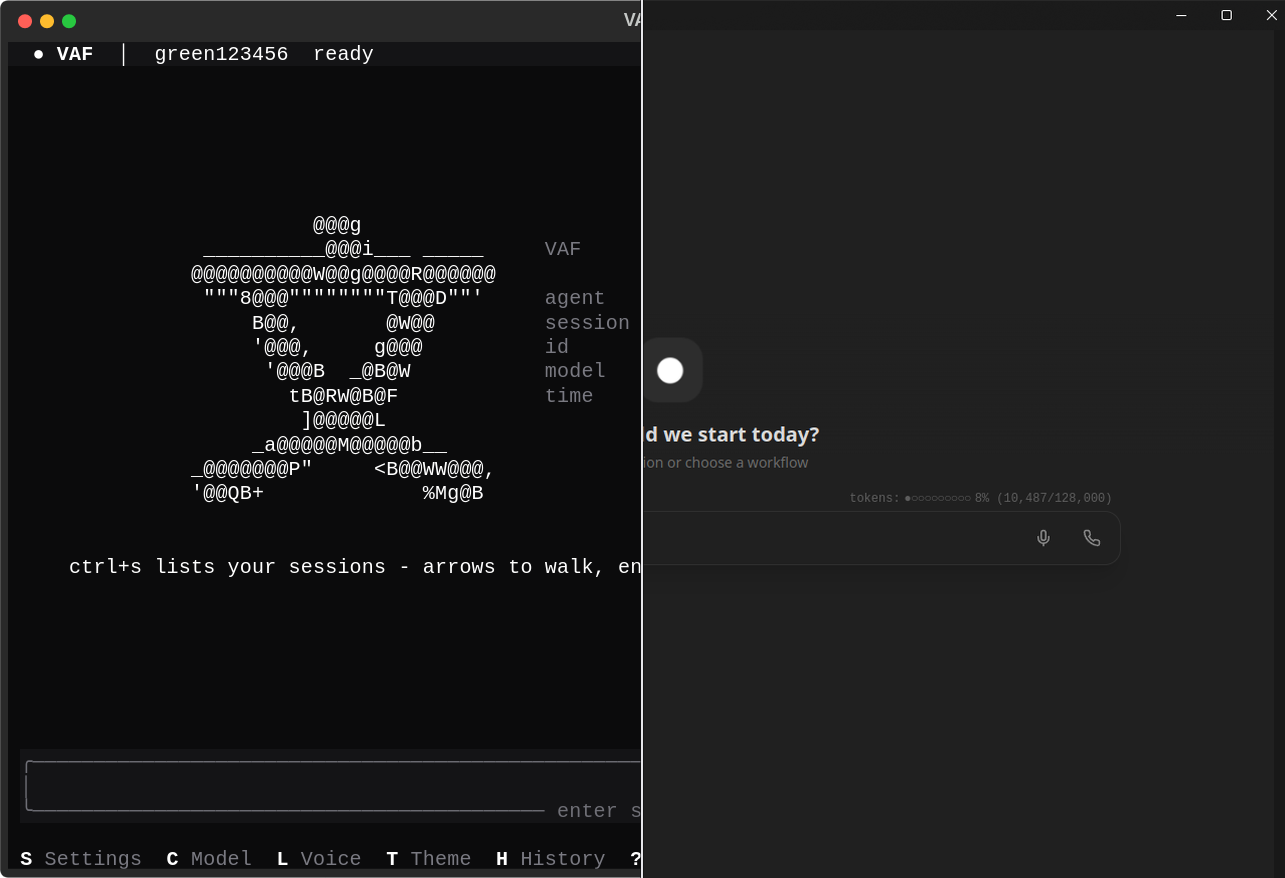
One agent, one session store, one config - in your terminal or in your browser.
Installation
Windows:
git clone https://github.com/Veyllo-Labs/VAF.git
cd VAF
.\install.bat
macOS / Linux:
git clone https://github.com/Veyllo-Labs/VAF.git && cd VAF
chmod +x install.sh && ./install.sh
The installer sets up a Python venv, installs all dependencies, prepares the web UI (built on first launch), sets up a container engine for you (Rancher Desktop on Windows, Colima on macOS, your distro's Docker on Linux, or uses an existing one if present), and adds the vaf command to your shell.
New to this, or never used
git/a terminal? Follow the step-by-step Installation Guide. It covers installing git, where to put the folder, running the installer without admin, and troubleshooting.
On Linux, the installer asks once which installation mode to use (macOS and Windows always install Desktop mode):
[1] Desktop  - personal use, local only, system tray (default)
[2] Server   - always-on service, LAN accessible via HTTPS, starts at boot
Choose [2] Server for home servers, NAS devices, or any headless machine that should be reachable from other devices. See docs/setup/SERVER_MODE.md for details.
Quickstart
Confirm the install works with a one-shot prompt:
vaf prompt "Hello"
Then launch the desktop app (system tray + web UI at http://localhost:3000) with vaf tray, or start an interactive terminal chat with vaf run. See Modes for all the ways to run VAF.
Updating
VAF updates in place to the latest published release:
vaf update           # Stop, fetch the latest release, reinstall, migrate, restart
vaf update check     # Check whether a newer version is available
vaf update only proceeds from a clean checkout, records a rollback point, and reverts automatically if any step fails. A one-line "update available" hint appears at startup (disable via update_check_on_start in config.json). Maintainers cutting releases: see docs/setup/RELEASING.md.
Modes
VAF runs in three modes depending on your use case.
Desktop (recommended for personal use)
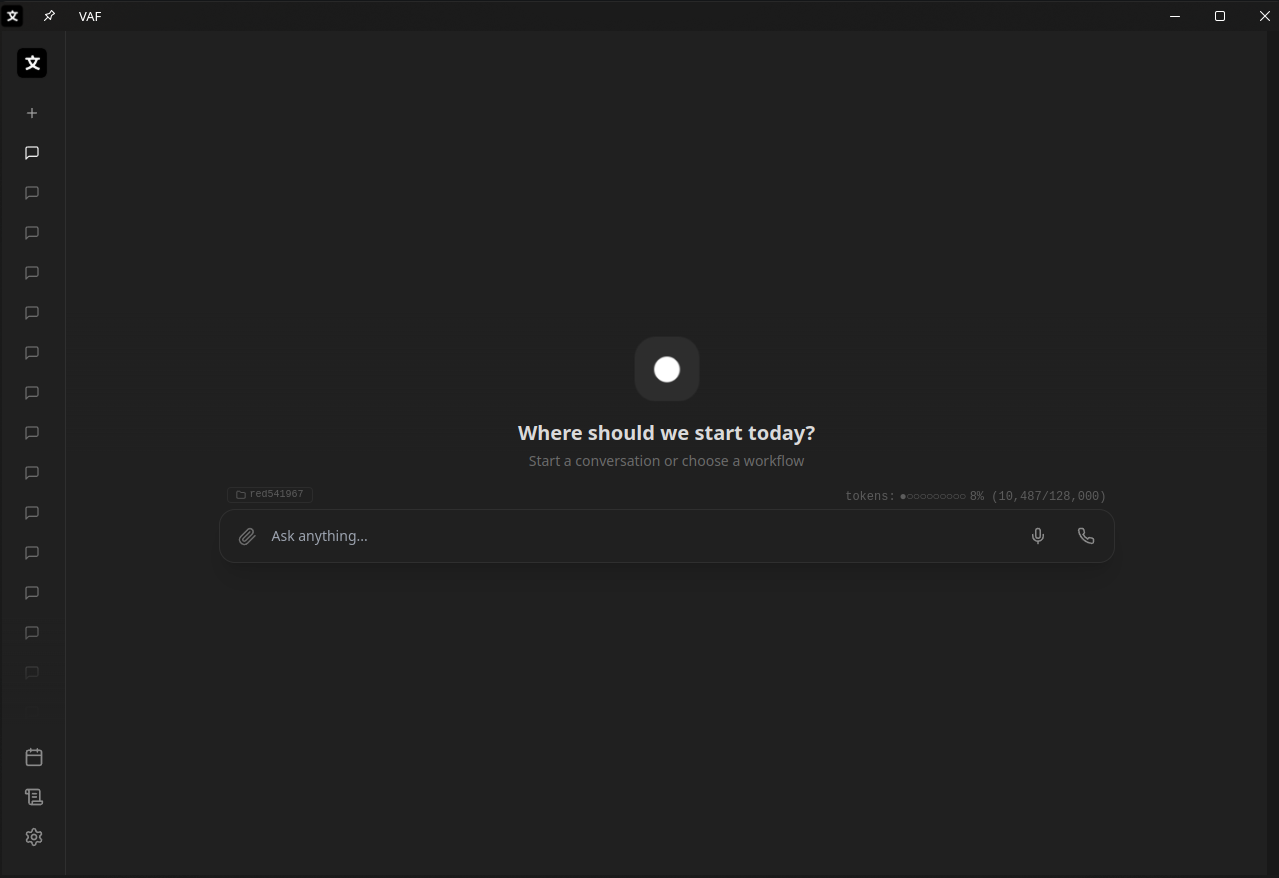
The desktop app: system-tray icon + agent window, web UI at http://localhost:3000. Easiest start: double-click the VAF Agent shortcut the installer created, or run:
vaf tray # Start the desktop app (tray + web UI)
Or manage it as a background service:
vaf start      # Start in background
vaf stop       # Stop cleanly
vaf restart    # Restart
vaf status     # Show status
LAN access (other devices on your network):
vaf server on      # Bind to 0.0.0.0 with HTTPS
vaf server off     # Back to localhost only
vaf server status  # Show active URLs
Server (always-on, starts at boot)
Installed via the [2] Server option. VAF runs as a systemd user service. Use the same commands:
vaf start      # systemctl --user start vaf
vaf stop       # systemctl --user stop vaf
vaf restart    # systemctl --user restart vaf
vaf status     # systemctl --user status vaf
LAN access (HTTPS on port 8443) is always enabled and locked in server mode. See docs/setup/SERVER_MODE.md.
Terminal (CLI)
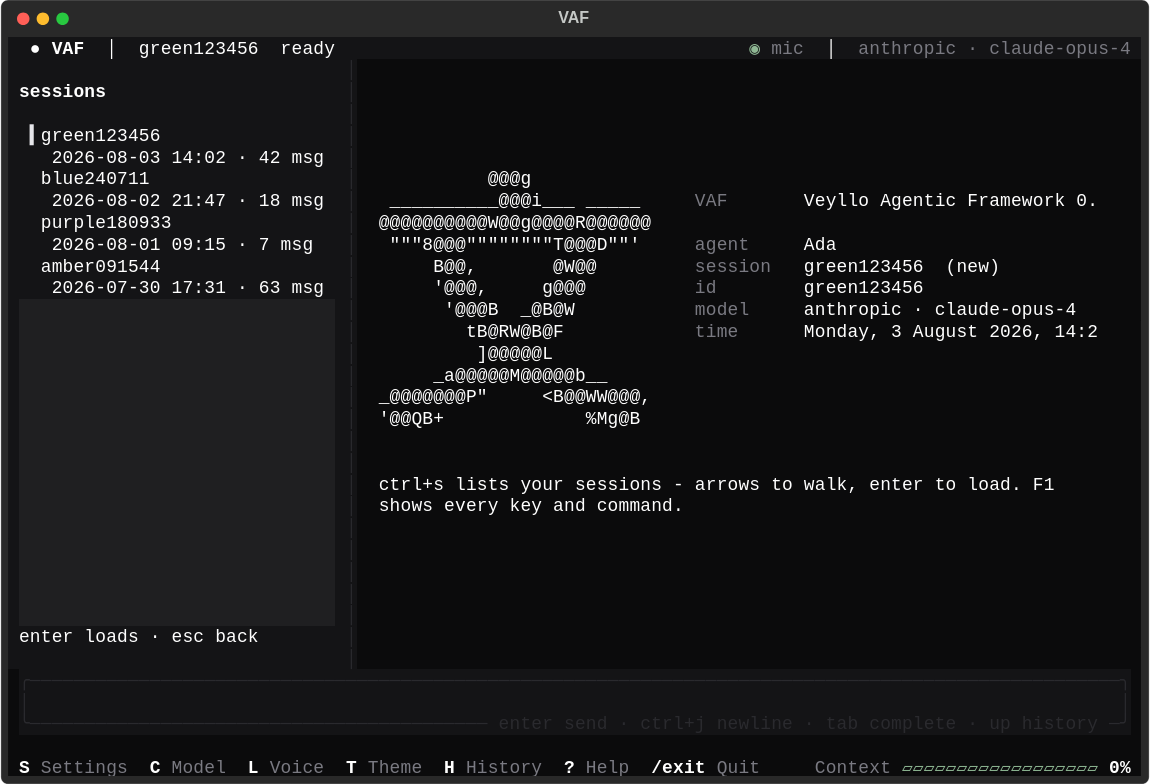
Interactive chat in the terminal with themes, session management, and streaming output.
vaf run                        # Start interactive chat
vaf run --session <id>         # Resume a saved session
vaf run --classic              # Minimal interface (SSH / low-bandwidth)
vaf run --no-web               # Skip starting the web UI
One-shot (non-interactive):
vaf prompt "Explain async/await in Python"
vaf prompt "List modified files" --output-format json
Web UI only
If you want the web interface without the tray:
vaf run --web
Models
VAF works with local GGUF models and cloud APIs. On first start it downloads the default model and the llama-server backend automatically.
Local (privacy-first):
- Any GGUF model (Llama 3, Mistral, Qwen, DeepSeek, etc.)
- GPU acceleration: CUDA on Windows, Vulkan on Linux, Metal on macOS
- Minimum context: 32 768 tokens (enforced; required for tool use)
Cloud APIs:
- Veyllo
- OpenAI
- Anthropic
- DeepSeek
- OpenRouter (100+ models)
Switch provider or model at runtime: press C in the chat, or use /model <name>.
Features
Agent & Tools
- 100+ built-in tools: web search, file system, bash, Python execution, calendar, email, GitHub, and more
- Sub-agents for long-running tasks: Coder, Researcher, Librarian
- Docker sandboxing for untrusted code execution
- Scheduled automations (daily news, reminders, reports)
Memory
- Persistent long-term memory with semantic search (pgvector + Redis)
- Auto-compression when context fills up; full history archived and restorable
- Memory graph visualization in the web UI
Sessions & History
- Named sessions, saved and searchable
- Git-based snapshot/undo for code changes
- Export sessions to Markdown
Integrations
- Telegram, Discord, WhatsApp (bridge mode)
- Google Calendar, Gmail, Google Drive
- GitHub
Developer
- Plugin system: drop a
BaseToolsubclass intovaf/tools/, auto-discovered at startup - Custom workflows: place a
WORKFLOWdict in~/.vaf/workflows/*.py, auto-loaded - MCP (Model Context Protocol) client support
CLI Reference
vaf start            # Start background service (or: systemctl in server mode)
vaf stop             # Stop background service
vaf restart          # Restart background service
vaf status           # Show service status

vaf run              # Interactive chat (TUI)
vaf prompt "..."     # One-shot prompt
vaf tray             # Background service + web UI (foreground)
vaf server on|off|status

vaf update           # Update to the latest release
vaf update check     # Check if a newer release is available

vaf session list|load|delete|export|search
vaf snapshot create|list|restore|undo
vaf automation list|create|run|enable|disable|delete

vaf scaffold new <template> <name>   # Project templates
vaf generate api|function|class|test|component
vaf automate test|build|lint|format|check
vaf debug explain|trace|fix
vaf git commit --auto

vaf models list|set
vaf theme <name>
vaf install-gpu      # Re-detect and install GPU backend
vaf info             # System info
vaf --version
Configuration
All user data lives in ~/.vaf/:
~/.vaf/
├── config.json        # Settings (provider, model, n_ctx, ...)
├── sessions/          # Saved conversations
├── context_archive/   # Compressed conversation history
├── snapshots/         # Code undo history
├── automations/       # Scheduled tasks
└── workflows/         # Custom workflow plugins (*.py)
Key config options (config.json):
| Key | Default | Description |
|---|---|---|
provider |
local |
local, veyllo, openai, anthropic, google, deepseek, openrouter |
n_ctx |
32768 |
Context window (minimum 32 768 for tool use) |
gpu_layers |
99 |
Layers to offload to GPU (0 = CPU only) |
web_ui_enabled |
true |
Start web UI alongside the agent |
persist_server |
false |
Keep llama-server running after VAF exits |
What VAF sends, and where
VAF collects no usage data and reports nothing to Veyllo. There is no analytics
SDK, no crash reporter, and no identifier tied to you or your installation. Your
conversations, memory, credentials and files stay in ~/.vaf/ and in your own database
container.
By default VAF makes exactly one outbound request of its own: a version check against
the public GitHub releases API at startup, so it can print a one-line "update available"
hint. It sends no data about you or your usage - GitHub sees the request the way it sees
any anonymous API call. Turn it off with update_check_on_start: false.
Everything else that leaves your machine is something you configured, and it goes to that provider, not to us:
| If you configure... | Then this goes there |
|---|---|
provider: local |
nothing - the model runs on your machine |
A cloud provider (openai, anthropic, google, deepseek, openrouter, veyllo) |
your prompts and tool results, to that provider |
| Web search, mail, calendar, messaging integrations | the requests those features make, to those services |
So "no telemetry" means what it says: we receive nothing. It does not mean an agent you point at a cloud model works without talking to that cloud.
Extending VAF
Custom tool - create vaf/tools/my_tool.py:
from vaf.tools.base import BaseTool

class MyTool(BaseTool):
    name = "my_tool"
    description = "One-line description the agent uses to decide when to call this."
    parameters = {
        "type": "object",
        "properties": {
            "query": {"type": "string"}
        },
        "required": ["query"]
    }

    def run(self, **kwargs) -> str:
        return f"result for {kwargs['query']}"
Custom workflow - create ~/.vaf/workflows/my_workflow.py:
WORKFLOW = {
    "name": "My Workflow",
    "triggers": ["my keyword"],
    "variables": {"topic": "What to process"},
    "steps": [
        {"tool": "web_search", "input": "{topic}", "output": "results"},
        {"tool": "coding_agent", "input": "Based on {results}, write code for {topic}", "output": "code"},
    ],
}
Both are auto-discovered at startup, no registration needed.
Platform Notes
| Windows | macOS | Linux | |
|---|---|---|---|
| Desktop mode | Tray icon | Menu bar icon | Headless (no icon) |
| GPU backend | CUDA | Metal | Vulkan |
| Web UI | localhost:3000 |
localhost:3000 |
localhost:3000 |
| Install | install.bat |
install.sh |
install.sh |
Linux headless mode requires no display server. See docs/setup/LINUX_SETUP.md for details.
Documentation
| Topic | Doc |
|---|---|
| Build on VAF (embed as a library) | docs/EMBEDDING.md |
| Runnable examples (quickstart, events, custom tool) | examples/ |
| FAQ for developers | docs/FAQ.md |
| Architecture (framework vs. harness) | docs/ARCHITECTURE.md |
| Configuration reference (all config keys) | docs/setup/CONFIG_SCHEMA.md |
| Engine reference (CoreAgent contracts) | docs/CORE_AGENT.md |
| Observability (events, NDJSON scripting) | docs/OBSERVABILITY.md |
| Debugging & logging | docs/DEBUGGING.md |
| Write a tool (BaseTool, pip packaging) | vaf/tools/README.md |
| Server mode (LAN, autostart) | docs/setup/SERVER_MODE.md |
| Linux setup & GPU | docs/setup/LINUX_SETUP.md |
| LLM backend (local vs API) | docs/llm/PROVIDER_MODES.md |
| Voice agent (live call) | docs/agents/VOICE_AGENT.md |
| Memory system | docs/memory/MEMORY_SYSTEM.md |
| Web UI & API reference | docs/web-ui/WEB_UI.md |
| Context management | docs/memory/CONTEXT_MANAGEMENT.md |
| Automations | docs/platform/AUTOMATIONS.md |
| Docker services | docs/setup/DOCKER_SERVICES.md |
| Telegram / Discord / WhatsApp | docs/integrations/TELEGRAM_INTEGRATION.md |
| Workflows | vaf/workflows/README.md |
License
VAF is dual-licensed:
- Open source - GNU AGPL-3.0-or-later: free to use, modify, and distribute. If you distribute VAF or run a modified version as a network service (SaaS), you must make your source available under the AGPL. Unmodified internal use (even commercial) triggers no disclosure. Building Plugins, Tools, and Workflows on top of VAF is explicitly permitted (Section 7 additional permission).
- Commercial license: for embedding VAF in a closed-source product or running a proprietary SaaS without AGPL copyleft. See COMMERCIAL.md.
See LICENSING.md for the full dual-licensing explanation (English & German) and how to choose.
Legal notice: under Section 7(b) of the AGPL, VAF carries a short legal notice stating its origin and the obligations the AGPL imposes. Forks must keep this notice in their source code; it never has to be displayed to end users.
This notice adds no restrictions of its own - it restates the AGPL, and the AGPL still applies in full: if you run a modified version of VAF as a network service, you owe that service's users your complete source code (Section 13).
The commercial license is exactly what removes this obligation. See the "Preservation of Legal Notices" section in LICENSING.md.
Trademarks & brand: "VAF", "Veyllo", the VAF logo, and the agent avatar (the living-dot visual identity and its animated states) are trademarks and brand assets of Veyllo GmbH and are not covered by the code license. See the "Trademarks and Brand Assets" section in LICENSING.md.
For commercial and OEM licensing, contact legal@veyllo.io · https://veyllo.io.
1 maintainer

Download files
Download the file for your platform. If you're not sure which to choose, learn more about installing packages.
Source Distribution
Built Distribution
Filter files by name, interpreter, ABI, and platform.
If you're not sure about the file name format, learn more about wheel file names.
Copy a direct link to the current filters
File details
Details for the file vaf-0.1.0a21.tar.gz.
File metadata
- Download URL: vaf-0.1.0a21.tar.gz
- Upload date:
- Size: 5.1 MB
- Tags: Source
- Uploaded using Trusted Publishing? Yes
- Uploaded via: twine/7.0.0 CPython/3.13.14
File hashes
| Algorithm | Hash digest | |
|---|---|---|
| SHA256 |
59b166e2b8f85d536e67c65e55d152be9e542a5cd4d92493af294862d252df97
|
|
| MD5 |
40cd3104ac675971e3d0a9882c4503b8
|
|
| BLAKE2b-256 |
3bc37e203cd30d0333a7e8d1e80815fea6351684c90bad4dacc524e4aed5cd3f
|
Provenance
The following attestation bundles were made for vaf-0.1.0a21.tar.gz:
Publisher:
release.yml on Veyllo-Labs/VAF
-
Statement:
-
Statement type:
https://in-toto.io/Statement/v1 -
Predicate type:
https://docs.pypi.org/attestations/publish/v1 -
Subject name:
vaf-0.1.0a21.tar.gz -
Subject digest:
59b166e2b8f85d536e67c65e55d152be9e542a5cd4d92493af294862d252df97 - Sigstore transparency entry: 2386424893
- Sigstore integration time:
-
Permalink:
Veyllo-Labs/VAF@b1ca8c10b7edd0020b50586aab3a6c162ca25179 -
Branch / Tag:
refs/tags/v0.1.0a21 - Owner: https://github.com/Veyllo-Labs
-
Access:
public
-
Token Issuer:
https://token.actions.githubusercontent.com -
Runner Environment:
github-hosted -
Publication workflow:
release.yml@b1ca8c10b7edd0020b50586aab3a6c162ca25179 -
Trigger Event:
push
-
Statement type:
File details
Details for the file vaf-0.1.0a21-py3-none-any.whl.
File metadata
- Download URL: vaf-0.1.0a21-py3-none-any.whl
- Upload date:
- Size: 4.5 MB
- Tags: Python 3
- Uploaded using Trusted Publishing? Yes
- Uploaded via: twine/7.0.0 CPython/3.13.14
File hashes
| Algorithm | Hash digest | |
|---|---|---|
| SHA256 |
51a09d4892092ea2e2d19f985f2034838817d2248e220a301136e196d846c810
|
|
| MD5 |
47d36afba1fd46971da6225780ed9ae6
|
|
| BLAKE2b-256 |
c0a5ff0aa39087d33ed3abd973a86de387cb099dd7aea14a887961c6b744021f
|
Provenance
The following attestation bundles were made for vaf-0.1.0a21-py3-none-any.whl:
Publisher:
release.yml on Veyllo-Labs/VAF
-
Statement:
-
Statement type:
https://in-toto.io/Statement/v1 -
Predicate type:
https://docs.pypi.org/attestations/publish/v1 -
Subject name:
vaf-0.1.0a21-py3-none-any.whl -
Subject digest:
51a09d4892092ea2e2d19f985f2034838817d2248e220a301136e196d846c810 - Sigstore transparency entry: 2386424970
- Sigstore integration time:
-
Permalink:
Veyllo-Labs/VAF@b1ca8c10b7edd0020b50586aab3a6c162ca25179 -
Branch / Tag:
refs/tags/v0.1.0a21 - Owner: https://github.com/Veyllo-Labs
-
Access:
public
-
Token Issuer:
https://token.actions.githubusercontent.com -
Runner Environment:
github-hosted -
Publication workflow:
release.yml@b1ca8c10b7edd0020b50586aab3a6c162ca25179 -
Trigger Event:
push
-
Statement type:







