

VAFT — Versatile Analysis Framework for Tokamak
English | 한국어 · PyPI · License
Connecting nuclear fusion knowledge across disciplines for integrated tokamak research
VAFT is a scientific framework for organizing and analyzing tokamak data using IMAS structures. It connects experimental data, reconstructed plasma states, simulation results, and analysis workflows through shared data structures and recorded processing history.
What VAFT connects
VAFT maps device-specific diagnostics and machine data into the common data model defined by the IMAS Data Dictionary. OMAS provides a Python interface to those structures. VAFT uses the standardized records for processing and visualization and to exchange data with established physics codes such as EFIT and CHEASE. Native diagnostic files and solver outputs remain available alongside those records.
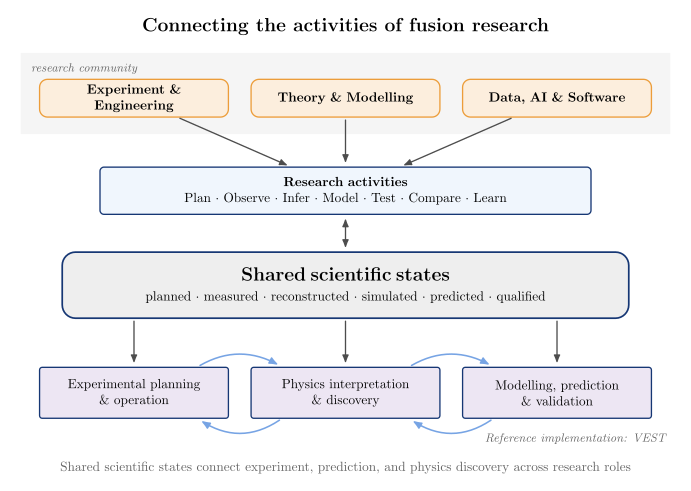
The diagram places experiments, theory and modeling, and data-driven studies around measured, reconstructed, and simulated plasma states. VAFT lets researchers exchange and compare those states without replacing their specialized physics codes.
Explore the diagram and its detailed version.
Four enabling perspectives
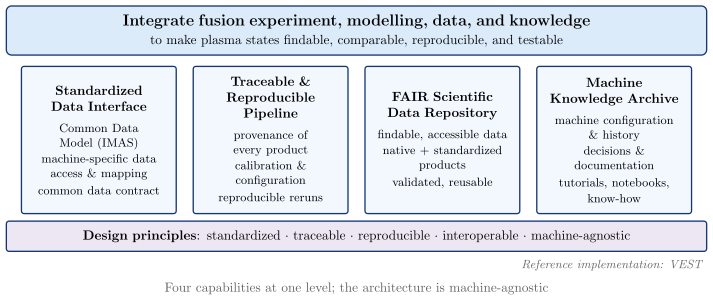
These four capabilities work together rather than as successive stages. IMAS mappings provide a common interface; recorded configurations make processing traceable; and the repository and archive retain the data and machine context needed to interpret a result. For researchers, they address four practical needs:
- Representation: map diagnostic channels, device geometry, equilibria, and profiles to named IMAS structures while retaining source and flux conventions.
- Research infrastructure: keep native files and standardized shot records accessible, alongside notebooks and device configuration history.
- Credibility: record calibrations, mapping versions, solver settings, and quality checks so workflows are traceable and reproducible and results are verifiable.
- Research practice and portability: use the same data paths for reconstruction, modeling, and plotting; adapt those workflows to another device by supplying its mappings.
How results are produced
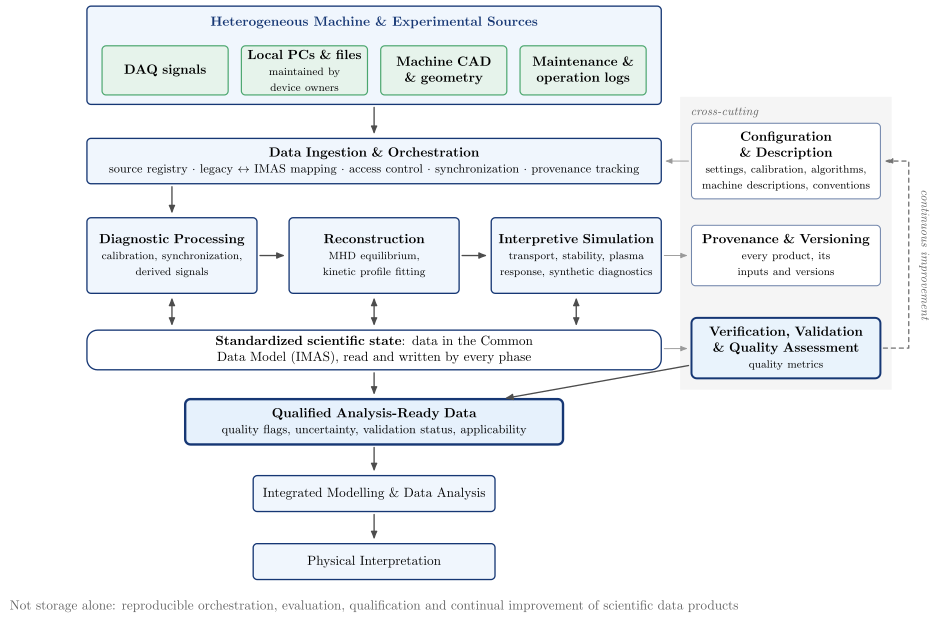
Machine descriptions and diagnostic measurements are registered and mapped to IMAS data structures. Diagnostic processing, equilibrium reconstruction, and simulation read and write those structures; the workflow records configurations and provenance and checks data quality before results are reused in analysis.
Research with VAFT
Start with offline sample data, then explore shots and diagnostics or reconstruct equilibria and fit profiles. The research notebooks and workflow guide show complete examples.
Architecture across devices
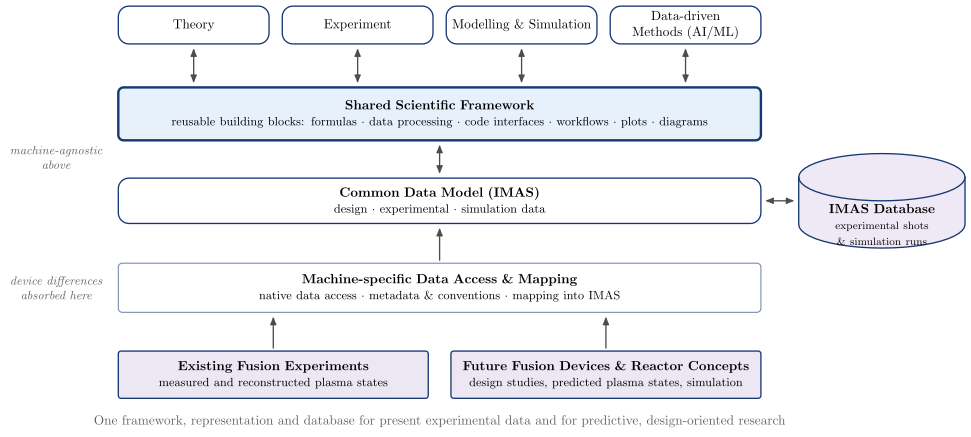
The architecture separates device-specific data access and mapping from the common IMAS data model and the analysis tools above it. Connecting another device requires its own data access and mappings.
VEST reference implementation
The VEST tokamak at Seoul National University provides the concrete reference implementation. The diagram follows one shot from VEST through experimental data processing into a per-shot database.
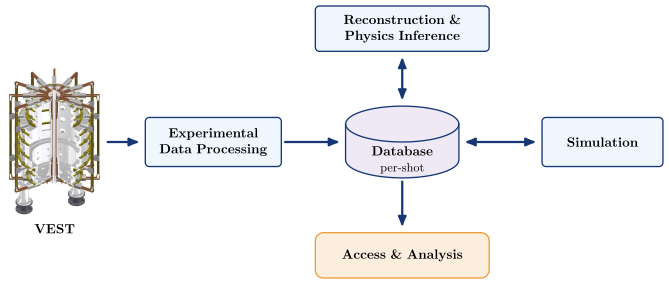
Reconstruction and physics inference, as well as simulation, read from and write to that database. VAFT provides access and analysis below it; the detailed VEST platform diagram shows the processing and research components inside each stage.
Quick start
Install the published package, then inspect the packaged VEST sample without database credentials or external fusion codes:
pip install vaft
import vaft

ods = vaft.omas.sample_ods()
print(sorted(ods.keys()))
For a plotted first result, follow Start here. For source installation or platform setup, see install/README.md.
Learn more
1 maintainer

Metadata
1 maintainer
Release files for vaft 0.8.0
For a detailed explanation of source distributions (sdists) and built distributions (wheels), please see the package formats documentation.
Source distribution (sdist)
| File | Size | Uploaded | |
|---|---|---|---|
| vaft-0.8.0.tar.gz | 27.4 MB | Details |
Built distribution (wheel)
| File | Interpreter | ABI | Platform | Reset |
|---|---|---|---|---|
| vaft-0.8.0-py3-none-any.whl | Python 3 | none | any | Details |
Total release size: 44.9 MB
Release files / vaft-0.8.0.tar.gz
| Download URL | vaft-0.8.0.tar.gz |
|---|---|
| Size | 27.4 MB |
| Tags | Source |
|
SHA-256 checksum How to use checksums |
b47971a9e052381e12512675c941d67e9d21d7ca3f0415dd9512b4403a68daa1
|
|
BLAKE2b-256 checksum How to use checksums |
bd32796fff91333a557d0d73850e5c546b1ef106f6c5429c69b87ec7782335ec
|
| Upload date | |
|
Uploaded using Trusted Publishing? What is trusted publishing? |
Yes |
| Uploaded via |
twine/7.0.0 CPython/3.13.14
|
Provenance
Provenance describes where a file came from. On PyPI, provenance is shared via attestations, which provide a verifiable record of the build or publishing details. View details, limitations and caveats.


PyPI Publish Attestation
PyPI verified that this artifact, at this checksum, originated from the publisher listed below.
Signed by GitHub Actions, verified by PyPI on Oct 9, 2026.
Transparency logRelease files / vaft-0.8.0-py3-none-any.whl
| Download URL | vaft-0.8.0-py3-none-any.whl |
|---|---|
| Size | 17.5 MB |
| Tags | Python 3 |
|
SHA-256 checksum How to use checksums |
75cf070c208c94b4647d6591a375bdeedeca84393dec60c462317ce1a50437a6
|
|
BLAKE2b-256 checksum How to use checksums |
671276ff031c263e90dbf60b5d6d631b57d75907b813f6c81e0080105824cf27
|
| Upload date | |
|
Uploaded using Trusted Publishing? What is trusted publishing? |
Yes |
| Uploaded via |
twine/7.0.0 CPython/3.13.14
|
Provenance
Provenance describes where a file came from. On PyPI, provenance is shared via attestations, which provide a verifiable record of the build or publishing details. View details, limitations and caveats.
PyPI Publish Attestation
PyPI verified that this artifact, at this checksum, originated from the publisher listed below.
Signed by GitHub Actions, verified by PyPI on Oct 9, 2026.
Transparency log













