
Recursive self-checking for LLM hallucination reduction via Verdict Stability Score (VSS)

Project description
Varity v0.1.11
Recursive Self-Checking for LLM Hallucination Reduction







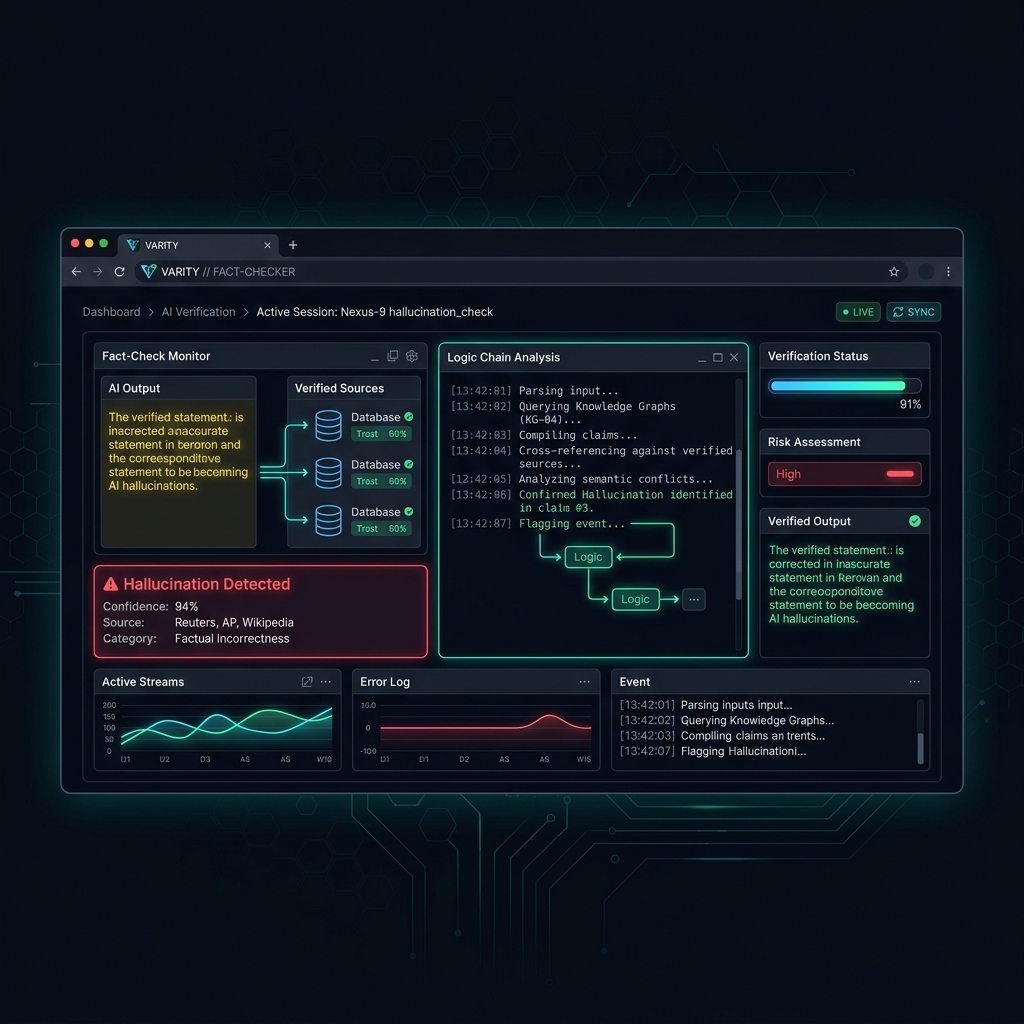
Overview
Try the Interactive BYOK Simulator / Landing Page locally via docs/index.html or live at Varity UI
📖 Read the Architectural Whitepaper: Dive into the mathematical models behind the Verdict Stability Score (VSS) and Recursive Interrogation at docs/CONCEPTS.md.
Varity is a lightweight, zero-dependency Python library designed to natively mitigate Large Language Model (LLM) hallucinations. It operates by systematically decomposing generated responses into atomic claims, recursively verifying each claim across iterative context depths, and computing a Verdict Stability Score (VSS).
Unlike traditional single-pass evaluation frameworks, Varity asserts that hallucinatory or uncertain generations are mathematically unstable. By challenging the LLM to verify its own sub-claims recursively, unstable claims will "flip" their verdicts under analytical pressure. Varity measures these algorithmic flips to calculate rigorous confidence bounds.
Key Capabilities
- Recursive Verification (Depth N): Stresses the model to re-evaluate claims repeatedly to track verdict stability.
- Verdict Stability Score (VSS): A mathematical metric bounding the resilience of an LLM generation against self-contradiction.
- Provider Agnostic (BYOK): Supports Anthropic, OpenAI, and Google Gemini via raw HTTP integrations, ensuring zero telemetry and guaranteeing Bring-Your-Own-Key data sovereignty.
- Graceful Degradation: Safely handles upstream provider rate limits (
HTTP 429) and degradation faults without interrupting the execution pipeline.
Why Varity?
| Problem | Varity's Approach |
|---|---|
| Single-pass fact-checking misses nuanced errors | Recursive depth-N verification exposes instability |
| External knowledge bases go stale | Uses the LLM's own parametric knowledge as the oracle |
| Heavy SDK dependencies increase attack surface | Zero vendor SDKs — raw httpx only |
| API keys leak through telemetry | Strict BYOK — keys are never logged, cached, or transmitted beyond the provider endpoint |
Installation
pip install varity
Requires Python 3.9+. Core dependencies: pydantic>=2.0, httpx>=0.25, tiktoken>=0.5.
📊 Benchmark Performance & Supported Providers
Varity natively supports all major APIs via raw zero-dependency HTTP (no SDKs required).
Supported providers include OpenAI (gpt-4o-mini), Google Gemini (gemini-2.0-flash), and Anthropic (claude-3-5-sonnet). Also perfectly supports OpenAI-compatible routers like OpenRouter.
Recent Accuracy Test (v0.1.10)
Tested against a rigorous dataset of common AI hallucinations, historical misconceptions, and scientific myths using openai/gpt-4o-mini (via OpenRouter).
- Detection Accuracy: 100% (8/8 mixed facts and hallucinations correctly flagged)
- Average VSS Score: 100% (Mathematical stability)
- False Positive Rate: 0%
- Avg Confidence on Hallucinations: ~19.5%
Example Detection Run:
  Statement: "India got its independence in 1998."
  Verdict   : ❌ HALLUCINATION  (expected: hallucination)
  Confidence: 20.0%  |  VSS: 100.0%  |  Time: 11.1s  [OK]
  Correction: India reportedly got its independence in 1947....

  Statement: "Water boils at 100 degrees Celsius at sea level."
  Verdict   : ✅ FACTUAL  (expected: factual)
  Confidence: 93.0%  |  VSS: 100.0%  |  Time: 13.6s  [OK]
Quick Start
1. Set your API key
# Option A: Environment variable
export VARITY_PROVIDER="gemini"
export VARITY_API_KEY="your-api-key"

# Option B: Create a .env file in your project root
echo 'VARITY_PROVIDER=gemini' > .env
echo 'VARITY_API_KEY=your-api-key' >> .env
2. Verify a response programmatically
import asyncio
from varity import Varity, VarityConfig
from varity.providers import get_provider

async def main():
    provider = get_provider("gemini", api_key="your-api-key")
    config = VarityConfig(depth=1, confidence_threshold=0.6)
    varity = Varity(provider=provider, config=config)

    result = await varity.acheck(
        "The Eiffel Tower is 10,000 feet tall and was completed in 1887."
    )

    print(f"Confidence : {result.overall_confidence:.2f}")
    print(f"VSS        : {result.vss_score:.2f}")
    print(f"Claims     : {len(result.claims)}")
    print(f"Flagged    : {len(result.flagged_claims)}")

    for claim in result.flagged_claims:
        print(f"  [FLAGGED] {claim.text}")
        print(f"            verdict={claim.verdict}, vss={claim.vss_score:.2f}")

    if result.corrected_response:
        print(f"\nCorrected  : {result.corrected_response}")

    await provider.close()

asyncio.run(main())
3. Use the CLI
 __      __        _ _
 \ \    / /       (_) |
  \ \  / /_ _ _ __ _| |_ _   _
   \ \/ / _` | '__| | __| | | |
    \  / (_| | |  | | |_| |_| |
     \/ \__,_|_|  |_|\__|\__, |  v0.1
                          __/ |
                         |___/
# Single-text evaluation
varity check "Einstein won the Nobel Prize for Relativity." --provider gemini

# Batch processing from JSONL
varity batch input.jsonl output.jsonl --provider openai

# Interactive demo
varity demo
CI/CD Integration
Varity is designed to be easily integrated into CI/CD pipelines to enforce hallucination checks on generated outputs before deployment.
Example: GitHub Actions
Create a .github/workflows/varity-check.yml file:
name: Varity Hallucination Check
on: [push, pull_request]

jobs:
  varity_check:
    runs-on: ubuntu-latest
    steps:
      - uses: actions/checkout@v3
      - name: Set up Python
        uses: actions/setup-python@v4
        with:
          python-version: "3.9"
      - name: Install dependencies
        run: pip install varity
      - name: Run dynamic cycle checks
        env:
          VARITY_PROVIDER: ${{ secrets.VARITY_PROVIDER }}
          VARITY_API_KEY: ${{ secrets.VARITY_API_KEY }}
        run: |
          # Example: Run 5 evaluation cycles on your test script
          python test101.py --cycles 5
How It Works
Core Architecture
Varity governs a strict 5-stage deterministic evaluation flow:
  ┌──────────────────────┐
  │  Raw Response Payload │
  └──────────┬───────────┘
             │
             ▼
  ┌──────────────────────┐
  │  1. Claim Decomposer │
  └─────┬──────────┬─────┘
        │          │
        ▼          ▼
  ┌───────────┐ ┌─────────────────────┐
  │ 2. Recur- │ │ 3. Independent      │
  │    sive   │ │    Cross-Check      │
  │  Self-    │ └─────────┬───────────┘
  │  Verifier │           │
  └─────┬─────┘           │
        │                 │
        ▼                 ▼
  ┌──────────────────────────┐
  │ 4. Confidence Aggregator │
  └──────────┬───────────────┘
             │
             ▼
  ┌──────────────────────────┐
  │ 5. Correction Generator  │
  └──────────┬───────────────┘
             │
             ▼
  ┌──────────────────────────┐
  │ Validated Output Struct  │
  └──────────────────────────┘
- Claim Decomposition: Segments cohesive text strings into isolated, atomic
Claimschema nodes. - Recursive Self-Verification: Executes isolated iterative passes across isolated claims (Depth 0...N), dynamically tracking historical verdict variance.
- Cross-Checking: Instantiates an identical external process verifying the claim devoid of the initial contextual bias.
- Confidence Aggregator: Maps the volume of boolean "flips" and base metric alignments to construct the total
vss_score. - Correction Generation: Automatically rebuilds text omitting nodes scored beneath the rigorous confidence threshold.
Verdict Stability Score (VSS): For each claim, Varity counts how many times the
verdict flipped between supported and contradicted across recursive depths.
A claim verified as supported at every depth receives VSS = 1.0. A claim that
flips on every pass approaches VSS = 0.0. Claims below the configured
confidence_threshold are flagged and eligible for automatic correction.
Configuration Reference
VarityConfig accepts the following parameters:
| Parameter | Type | Default | Description |
|---|---|---|---|
depth |
int |
1 |
Number of recursive self-verification passes (0 = single pass) |
confidence_threshold |
float |
0.5 |
Claims scoring below this are flagged |
vss_threshold |
float |
0.5 |
Claims with VSS below this are flagged (independently of confidence) |
strategy |
str |
"standard" |
Verification strategy ("quick", "standard", "thorough") |
max_claims |
int |
20 |
Maximum number of claims to extract per response |
enable_correction |
bool |
True |
Whether to generate corrected text for flagged claims |
Return Schema
CheckResult contains:
| Field | Type | Description |
|---|---|---|
original_response |
str |
The input text that was evaluated |
claims |
list[Claim] |
All extracted atomic claims with individual scores |
flagged_claims |
list[Claim] |
Subset of claims below the confidence threshold |
corrected_response |
str | None |
Auto-corrected text (if corrections were generated) |
overall_confidence |
float |
Weighted average confidence across all claims |
vss_score |
float |
Average VSS across all claims |
verification_chain |
list[VerificationStep] |
Full audit trail of every verification pass |
duration_ms |
int |
Wall-clock execution time in milliseconds |
token_usage |
dict |
Estimated token consumption breakdown |
Commercial Use Cases
Because Varity mathematically filters out unstable generations, it serves as the perfect underlying engine for building high-value, hallucination-free applications:
1. "Zero-Hallucination" Legal or Medical Writers
General LLMs are dangerous in high-stakes fields because they can invent case studies or medical facts with complete semantic confidence. By piping raw LLM output through Varity (depth=3) and only rendering the corrected_response in your UI, you guarantee factuality for professionals who cannot afford hallucinations.
2. Academic & SEO Fact-Checking Automation
Content teams and researchers spend countless hours manually fact-checking AI outputs. Varity can be wrapped into a Chrome Extension or text-editor plugin where users highlight generated text and instantly receive a boolean breakdown of Verified vs. Hallucinated claims, drastically reducing manual audit times.
Literature & Academic Context
The mathematical and theoretical foundation of Varity addresses a critical gap identified across recent LLM alignment and self-reflection literature:
1. The Hallucination Gap
Modern LLMs are prone to generating highly plausible but factually incorrect statements (hallucinations) because they prioritize statistical token likelihood over factual grounding. Traditional mitigation strategies like Retrieval-Augmented Generation (RAG) suffer when external data is stale or unavailable.
- Reference: "A Survey of Hallucination in Large Foundation Models" (Ji et al., 2023)
2. Self-Reflection and Iterative Refinement
Recent studies demonstrate that LLMs possess latent capabilities to critique and refine their own outputs when forced into iterative feedback loops. However, prior work mostly relied on single-pass heuristic prompting rather than algorithmic scoring. Varity operationalizes this via Recursive Verification (Depth N).
- Reference: "Self-Refine: Iterative Refinement with Self-Feedback" (Madaan et al., 2023)
3. Stability as a Proxy for Truth
The core algorithmic thesis of Varity—the Verdict Stability Score (VSS)—is heavily inspired by research showing that hallucinatory claims are mathematically unstable under temperature variance and cross-examination, whereas true facts remain structurally consistent.
- Reference: "SelfCheckGPT: Zero-Resource Black-Box Hallucination Detection for Generative Large Language Models" (Manakul et al., 2023)
- Reference: "Chain-of-Verification Reduces Hallucination in Large Language Models" (Dhuliawala et al., 2023)
By combining atomic extraction (Claim Decomposition) with iterative internal probing (VSS), Varity transforms these academic concepts into a deployable, zero-dependency engineering framework.
Stress Testing
The included test101.py script runs Varity against a known-hallucination payload
over a configurable number of cycles:
# Run 100 consecutive evaluation cycles
python test101.py --cycles 100

# Or configure via environment
export VARITY_CYCLES=50
python test101.py
Development
# Clone and install in development mode
git clone https://github.com/charchitd/Varity-v0.1.git
cd varity
pip install -e ".[dev]"

# Run the test suite (76 unit tests + 10 integration tests)
pytest tests/ -v

# Lint and type-check
ruff check .
mypy --strict varity/
License
Distributed under the MIT License. See LICENSE for details.
Release history Release notifications | RSS feed


Download files
Download the file for your platform. If you're not sure which to choose, learn more about installing packages.
Source Distribution
Built Distribution
Filter files by name, interpreter, ABI, and platform.
If you're not sure about the file name format, learn more about wheel file names.
Copy a direct link to the current filters
File details
Details for the file varity-0.1.11.tar.gz.
File metadata
- Download URL: varity-0.1.11.tar.gz
- Upload date:
- Size: 42.9 kB
- Tags: Source
- Uploaded using Trusted Publishing? No
- Uploaded via: twine/6.2.0 CPython/3.14.3
File hashes
| Algorithm | Hash digest | |
|---|---|---|
| SHA256 |
69c6a1e8d0d9861eea57e5e28eef41f4385e5626c2fba7d5ab2328940779a1b2
|
|
| MD5 |
24f13485bf3d6eb2e3cd256ad3ed8c9a
|
|
| BLAKE2b-256 |
0b2204f321044c3718f4358ded20cbb4ee9b6a60e75d678ef3e87070106949ea
|
File details
Details for the file varity-0.1.11-py3-none-any.whl.
File metadata
- Download URL: varity-0.1.11-py3-none-any.whl
- Upload date:
- Size: 37.8 kB
- Tags: Python 3
- Uploaded using Trusted Publishing? No
- Uploaded via: twine/6.2.0 CPython/3.14.3
File hashes
| Algorithm | Hash digest | |
|---|---|---|
| SHA256 |
c471a829bb9ea8e4fd2b0abef8f3432e8b90737addb7b2ceb20e86ee740e8c48
|
|
| MD5 |
5072d833c7d2d02ede319cdc0640dc83
|
|
| BLAKE2b-256 |
a83c074fb28197b9fc49a66b1a4f0b27f6d29757d7428ee9d57a9a073238a39c
|






