

VCF ARTificial — blow out every possible variant of a transcript region as a ready-to-annotate VCF.
뿌뿡 (ppu-ppung) 💨 — for MAVE, saturation genome editing (SGE), deep mutational scanning (DMS) and SpliceAI scans.



💨 What it does
Give VCFART a reference genome (hg19 / hg38), a transcript (NM_007294.4) and a range written the way
you already think about it (c.5075-100_c.5152+100, exon17:100, chr17:43063774-43064051).
It writes:
| file | content |
|---|---|
PREFIX.vcf |
every variant, VCF 4.2, sorted, left-normalized, de-duplicated, REF checked against your FASTA |
PREFIX.tsv |
one row per variant: HGVS c., HGVS p., consequence, exon/intron, generator, region label |
PREFIX.oligos.fa |
(optional, --oligo) mutant sequences in transcript orientation, with your adapters — an oligo-pool order sheet |
The VCF goes straight into SpliceAI, ANNOVAR, VEP, CADD, AlphaMissense lookups, bcftools … so you can score a whole MAVE library in silico before (or after) the wet lab.
✨ Features
- Transcript-aware coordinates — full HGVS c./n. numbering: CDS, 5′/3′ UTR (
c.-30,c.*12), intronic offsets (c.5075-1,c.-30+5), positions beyond the transcript; minus-strand genes handled (no more manual complementing of bases). - Mutation generators
snv— all 3 alternative bases at every position (default)del— deletions of any lengths (--del-sizes 1,2,3)ins— insertions of every k-mer between every pair of bases (--ins-sizes 1)codon— DMS-style codon swaps: one codon per amino acid + Ter + a synonymous control (--codon-set aa), all 63 codons (all) or NNK (nnk); codon choice by human usage or fewest nucleotide edits (--codon-pick min-edit)
- Correct indel bookkeeping — VCF records are left-normalized with an anchor base; equivalent edits
(e.g. deleting any C of
CCCCCC) collapse into one record; HGVS follows the 3′ rule (c.24del,c.13_15dup). - Annotation per variant — HGVS c., predicted HGVS p. (
p.Trp6Ter,p.Glu5del,p.Glu3LysfsTer?,p.Ter9GlnextTer5,p.Met1?), Sequence Ontology consequences (splice donor/acceptor, donor 5th base, polypyrimidine tract, splice region, missense, …) and region (intron8,exon9). - Oligo library output — mutant window sequence per variant (+ WT), optional padding and 5′/3′ adapters.
- Uses what you already have — ANNOVAR
humandb/hg38_refGene.txtworks as-is; UCSCrefGene/ncbiRefSeqtables; RefSeq or GENCODE GTF (ENST IDs).chr16vs16naming is matched automatically. - Safety checks — warns when the CDS does not start with ATG / end with a stop or when introns lack GT-AG motifs (= genome build and annotation do not match).
- Zero dependencies — pure Python ≥ 3.9 standard library; reads/creates the
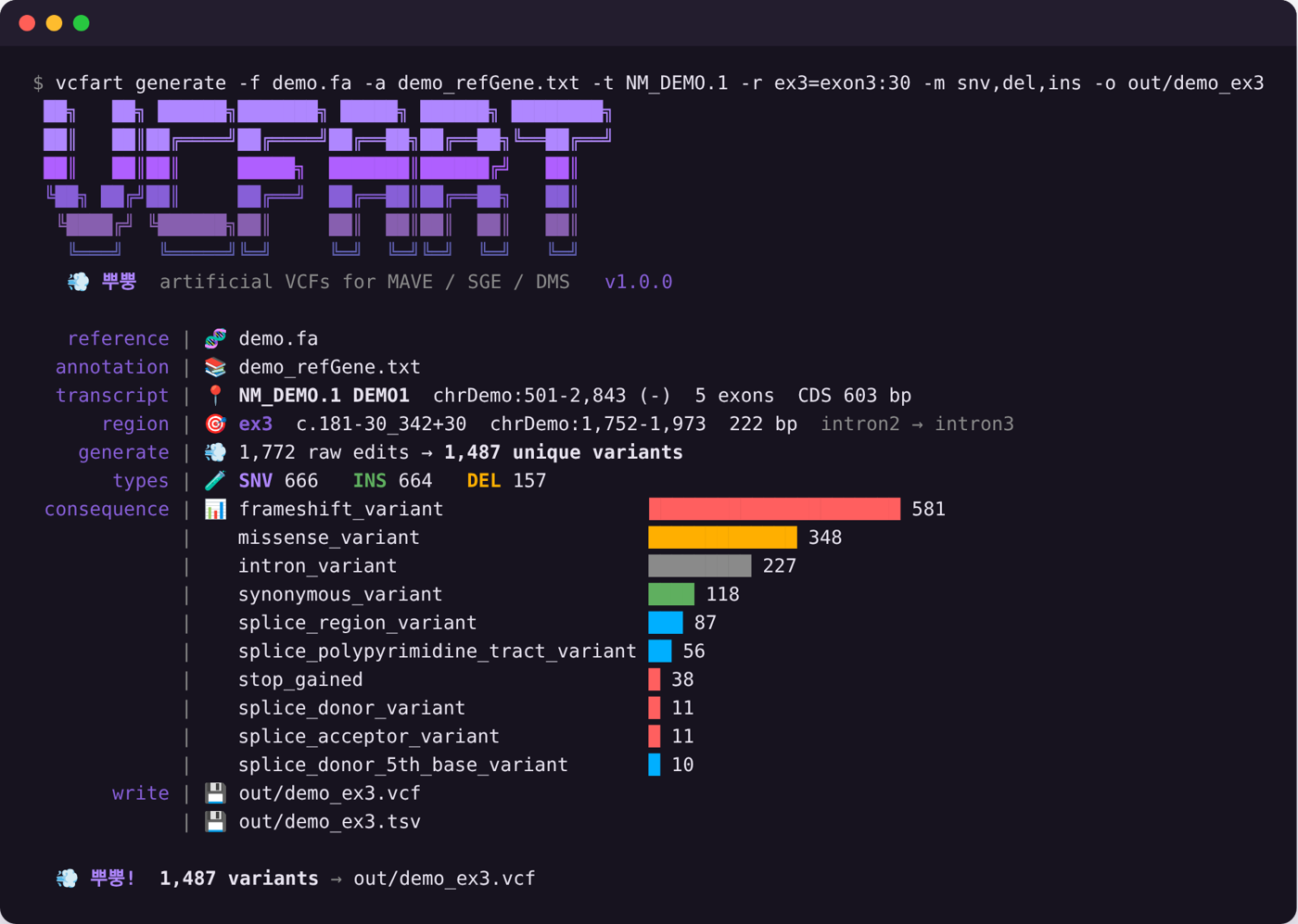
.faiindex itself. - Readable runs — MultiQC-style coloured log with a consequence bar chart; colour turns off when
piped, with
--no-colororNO_COLOR=1.
📦 Install
python -m pip install vcfart
vcfart --version

# development version
python -m pip install git+https://github.com/CleanCham-lab/VCFART.git
🚀 Quick start (10 seconds, bundled demo genome)
git clone https://github.com/CleanCham-lab/VCFART.git && cd VCFART/examples
./run_demo.sh          # writes examples/out/*.vcf / *.tsv / *.oligos.fa
🧬 Real data
# 1. transcript table — reuse ANNOVAR's, or download once from UCSC
vcfart fetch-annotation -b hg38          # -> ~/.vcfart/hg38.ncbiRefSeq.txt.gz
#   (behind an SSL-inspecting proxy: add --insecure, or wget the URL it prints)

# 2. look at the exon/intron map in c. and genomic coordinates
vcfart info -b hg38 -t NM_007294.4 -f hg38.fa

# 3. generate: BRCA1 exon 17 (c.5075-c.5152) with 100 bp of each flanking intron
vcfart generate -f hg38.fa -b hg38 -t NM_007294.4 \
    -r int16=c.5075-100_c.5075-1 \
    -r ex17=c.5075_c.5152 \
    -r int17=c.5152+1_c.5152+100 \
    -o BRCA1_ex17

# same region, short form (exon numbers follow your transcript model -- check with `vcfart info`)
vcfart generate -f hg38.fa -a humandb/hg38_refGene.txt -t NM_007294 -r exon17:100 -o BRCA1_ex17
🎯 Region syntax (-r, repeatable, optional LABEL= prefix)
| form | meaning |
|---|---|
c.5075-100_c.5075-1 or c.5075-100_5075-1 |
HGVS c. range (intronic offsets, c.-N, c.*N allowed) |
c.5075 |
a single position |
n.10_n.250 |
non-coding transcripts (NR_ / lncRNA) |
g.43063774_43064051 or chr17:43,063,774-43,064,051 |
genomic, 1-based inclusive |
exon17, exon17:100, exon17:100:50 |
exon (transcript order), + flank on both sides, + 5′ and 3′ flank |
intron16 |
whole intron |
cds |
c.1 … end of the stop codon (use with --exonic-only for a CDS-only scan) |
A range is a contiguous stretch of the genome, so c.1_c.600 across several exons includes the introns in
between (VCFART tells you). Add --exonic-only for cDNA-style saturation of exonic bases only.
⚙️ Main options (vcfart generate -h for all)
| option | default | |
|---|---|---|
-m snv,del,ins,codon |
snv |
mutation generators to run |
--del-sizes / --ins-sizes |
1 |
indel lengths (comma-separated) |
--codon-set aa|all|nnk · --codon-pick usage|min-edit |
aa · usage |
codon mode |
--exonic-only |
off | keep only exonic positions (cDNA / CDS saturation) |
--sites-only |
off | drop the dummy FORMAT/GT sample column (default writes GT=0/1, ANNOVAR-friendly) |
--id hgvs|index|none |
hgvs |
VCF ID column (c.5075-1G>C by default) |
--oligo --oligo-pad N --adapter5 SEQ --adapter3 SEQ |
off | oligo library FASTA |
--oligo-strand transcript|plus |
transcript |
oligo orientation |
--chrom |
— | choose the locus if a transcript maps to several (PAR, alt contigs) |
🏷️ VCF INFO fields
VA_TX, VA_GENE, VA_HGVSc, VA_HGVSp (= written as %3D, as VEP does), VA_CSQ,
VA_REGION, VA_TYPE (SNV/MNV/DEL/INS/DELINS), VA_ORIGIN (generator), VA_SET (region label).
🔗 Downstream examples
spliceai -I BRCA1_ex17.vcf -O BRCA1_ex17.spliceai.vcf -R hg38.fa -A grch38
perl table_annovar.pl BRCA1_ex17.vcf humandb/ -buildver hg38 -out BRCA1_ex17 \
     -protocol refGene -operation g -vcfinput -remove -nastring .
vep -i BRCA1_ex17.vcf --fasta hg38.fa --cache --hgvs --everything -o BRCA1_ex17.vep.txt
📏 Conventions (read once)
- VCF records are left-aligned (bcftools-norm style) with the preceding base as anchor for indels.
Variants that are identical at the sequence level are written once;
VA_SET/VA_ORIGINlist every region/generator that produced them. - HGVS c. is described on the genomic sequence with the 3′ rule applied along the transcript, including across exon/intron borders (an insertion generated in the intron next to an exon can be reported with exonic coordinates when the resulting sequence is identical). The TSV keeps the region label it was generated from.
- HGVS p. is a prediction from the reference CDS (no splicing effect is modelled — that is what
SpliceAI is for). Variants that change a splice site or cross an exon/intron border get
p.?. - Codon mode skips codons split by an intron (reported in the log).
- Positions with
Nin the reference are skipped. - Use the same genome build for FASTA and annotation — VCFART warns loudly if they disagree.
✅ Validation
- Reproduces the authors' original in-house MAVE scripts base-for-base: on a 444-bp intron–exon–intron
target of a minus-strand gene (hg38), all 1,332 SNVs have identical POS/REF/ALT and c. labels. The same
loop logic runs in the test suite on a synthetic block (
tests/test_prototype_regression.py). - Real hg38 run (
hg38.fa+ ANNOVARhg38_refGene.txt): all 6,669 CDS SNVs of DRC1 (NM_145038, plus strand) agree with ANNOVAR refGene c./p. annotation, including 9 start-loss and 8 stop-loss variants (examples/compare_annovar.py). - Every CDS SNV of synthetic plus- and minus-strand genes is checked against an independent translation (missense / synonymous / nonsense / stop-loss extension / start-loss).
- Random indels: raw, left-normalized and HGVS-shifted representations produce the identical genome.
python -m pip install pytest && python -m pytest

# cross-check your own output against ANNOVAR
perl table_annovar.pl X.vcf humandb/ -buildver hg38 -out X_annovar -remove \
     -protocol refGene -operation g -nastring . -vcfinput
python examples/compare_annovar.py X.tsv X_annovar.hg38_multianno.txt
🧰 Related tools
VCFART is deliberately small and CLI-first. If you need a full SGE oligo-design pipeline with PAM/protection
edits, have a look at VaLiAnT (Wellcome Sanger); for R/Bioconductor-based
all-SNV simulation across MANE transcripts see rvarsim; for MAVE read-level variant calling see
satmut_utils.
📖 Citation
If VCFART helps your work, please cite the repository (see CITATION.cff).
📄 License
MIT © 2026 Seung Won Chae
👤 Author
Seung Won Chae — Molecular Diagnostics Laboratory, Department of Laboratory Medicine, Seoul National University Hospital · Seoul National University Cancer Research Institute
1 maintainer

Metadata
1 maintainer
Release files for vcfart 1.0.1
For a detailed explanation of source distributions (sdists) and built distributions (wheels), please see the package formats documentation.
Source distribution (sdist)
| File | Size | Uploaded | Provenance | Actions |
|---|---|---|---|---|
| vcfart-1.0.1.tar.gz | 51.3 kB | With provenance | Details for vcfart-1.0.1.tar.gz |
Built distribution (wheel)
| File | Interpreter | ABI | Platform | Actions Reset |
|---|---|---|---|---|
| vcfart-1.0.1-py3-none-any.whl | Python 3 | none | any | Details for vcfart-1.0.1-py3-none-any.whl |
Total release size: 85.7 kB
Release files / vcfart-1.0.1.tar.gz
| Download URL | vcfart-1.0.1.tar.gz |
|---|---|
| Size | 51.3 kB |
| Tags | Source |
|
SHA-256 checksum How to use checksums |
1465c12edc4c28fc756274231ed21a531d8dcdd8f17554af6077d6c04f56b12a
|
|
BLAKE2b-256 checksum How to use checksums |
cd607d3e401f8c22100b81c45ef187012da73babca9cb7d625a074c04b30e67c
|
| Upload date | |
|
Uploaded using Trusted Publishing? What is trusted publishing? |
Yes |
| Uploaded via |
twine/7.0.0 CPython/3.13.16
|
Provenance
Provenance describes where a file came from. On PyPI, provenance is shared via attestations, which provide a verifiable record of the build or publishing details. View details, limitations and caveats.


PyPI Publish Attestation
PyPI verified that this artifact, at this checksum, originated from the publisher listed below.
Signed by GitHub Actions, verified by PyPI on Nov 13, 2026.
Transparency logRelease files / vcfart-1.0.1-py3-none-any.whl
| Download URL | vcfart-1.0.1-py3-none-any.whl |
|---|---|
| Size | 34.3 kB |
| Tags | Python 3 |
|
SHA-256 checksum How to use checksums |
8212702d0785f26626b9405958c9396f9897fc3640a33fb33f99be92f0661aed
|
|
BLAKE2b-256 checksum How to use checksums |
17f458eecbbe192a96624eb423f7c36fc3fbe7c30747cb08664ee86c571baeff
|
| Upload date | |
|
Uploaded using Trusted Publishing? What is trusted publishing? |
Yes |
| Uploaded via |
twine/7.0.0 CPython/3.13.16
|
Provenance
Provenance describes where a file came from. On PyPI, provenance is shared via attestations, which provide a verifiable record of the build or publishing details. View details, limitations and caveats.
PyPI Publish Attestation
PyPI verified that this artifact, at this checksum, originated from the publisher listed below.
Signed by GitHub Actions, verified by PyPI on Nov 13, 2026.
Transparency logSecurity for vcfart 1.0.1
Provenance
Provenance describes where a file came from. On PyPI, provenance is shared via attestations, which provide a verifiable record of the build or publishing details. View details, limitations and caveats.
Full provenance
Both files in this release have been uploaded with provenance metadata.
Attestation for vcfart-1.0.1.tar.gz
PyPI Publish Attestation
PyPI verified that this artifact, at this checksum, originated from the publisher listed below.
Signed by GitHub Actions, verified by PyPI on Nov 13, 2026.
Transparency logA note on package security
PyPI is a repository for distributing packages, not a service for auditing them. While third-party security researchers and our staff do their best to detect and remove malicious packages, PyPI cannot guarantee the quality, security or suitability of any given package.
To learn more about protecting yourself from malicious actors, visit our package security documentation.













