
A lightweight, open-source vector-database migration & infrastructure CLI (Alembic for vector databases).
Verified details
These details have been verified by PyPIProject links
GitHub Statistics
Maintainers

Project description

Alembic for vector databases.
Migrate, sync, and re-embed vector data across stores with blue-green
zero-downtime cutovers — all driven by one declarative vector.config.yaml.





vecbee is an open-source command-line tool for vector-database migrations — it re-embeds, re-chunks, and moves embedding data between vector stores (Qdrant, a local SQLite store, and more) with blue-green, zero-downtime cutovers, driven by a single declarative
vector.config.yaml. Think Alembic or Flyway, but for vector databases and RAG pipelines.
Why vecbee?
Relational databases have had migration tooling for decades — Alembic, Flyway, Rails migrations. Vector databases have had almost nothing. When your embedding model changes, your chunking strategy improves, or you outgrow your vector store, you're left writing one-off scripts, praying nothing breaks, and taking downtime while you rebuild an index.
vecbee treats vector migrations like the versioned, reviewable, reversible operations they should be. It re-embeds and re-chunks into a shadow collection, verifies it, then does an atomic alias swap — your application never queries a half-built index, and if something's wrong you roll back with one command.
pip install vecbee
vecbee init      # scaffolds a runnable project — zero API keys, zero infra
vecbee up        # runs the full pipeline for $0 (mock embeddings + local store)
That first up runs end-to-end with no paid API calls and no external services, so you
can see exactly what vecbee does before pointing it at anything real.
Features
- 🐝 Blue-green zero-downtime cutovers — migrations build a shadow collection and flip a stable alias atomically. Readers never see a partial index.
- ⏪ Reversible —
vecbee downreverts the most recently applied migration. - 🔀 Three migration modes —
sql_chunk_embed(chunk + embed rows from any SQL source),re_embed(re-embed existing content with a new model), andpure_copy(move vectors verbatim, zero embedding calls). - 📈 Incremental sync — an
updated_atwatermark means re-runs only process changed rows, not the whole table. - 🔎 Drift detection —
vecbee statusreconciles applied migration history against your local migration files and reports drift before you touch production. - 🧾 Dead-letter queue — every failed record is written to
dlq/as self-describing JSONL. Nothing is ever silently dropped. - 🔁 Resumable & rate-limit aware — upsert-by-source-id makes runs idempotent; exponential
backoff handles
429s from embedding APIs. - 🧩 Pluggable — sources, targets, and embedding providers are swappable drivers; third-party plugins register via a standard entry-point group.
- 💸 Zero-cost default path —
mockprovider +localSQLite store means CI and first-run cost nothing and need no network. - 🎛️ Declarative — one
vector.config.yamlis the whole contract. No imperative glue code.
Quickstart
1. Install
pip install vecbee
# optional extras for real targets/providers:
pip install "vecbee[qdrant]"      # Qdrant vector target
pip install "vecbee[postgres]"    # Postgres/asyncpg source
2. Scaffold a project
vecbee init
This writes a runnable vector.config.yaml (wired to the mock provider + local store),
a sample SQL source fixture, and a migrations/ directory.
3. Run the pipeline — for $0
vecbee up
up chunks and embeds the sample data into a shadow collection, then atomically swaps the
docs alias to it. No API keys, no Docker, no cost.
4. Point it at your own data
Edit the source block in vector.config.yaml to your real database, swap provider.driver
to a real embedding API, and re-run vecbee up.
How it works
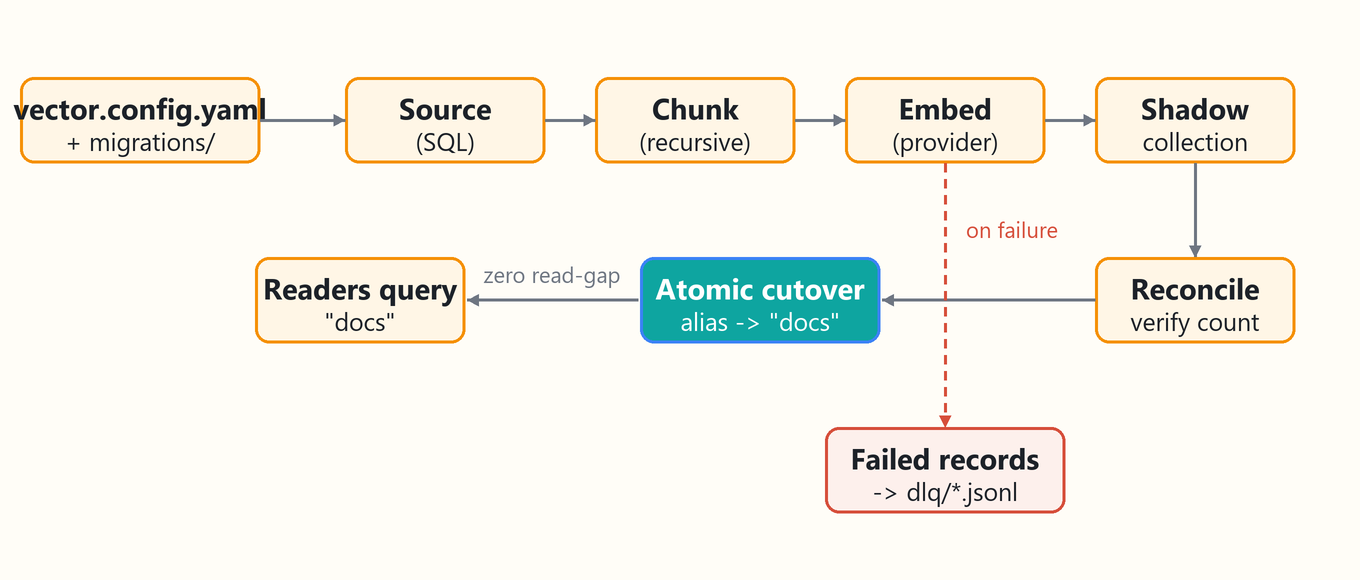
The alias (collection: in your config) is the stable name your application queries.
A migration never mutates the live collection in place — it builds a new shadow collection
and, only once written and reconciled, repoints the alias. That repoint is the cutover.
Commands
| Command | What it does |
|---|---|
vecbee init |
Scaffold a runnable project (vector.config.yaml + sample fixtures + migrations/). |
vecbee status |
Reconcile applied migration history vs. local migration files; report drift. |
vecbee up |
Blue-green migration into a shadow collection + atomic cutover. |
vecbee down |
Revert the most recently applied migration. |
vecbee run-ext <name> |
Load and run one extension standalone (no args → list discoverable extensions). |
vecbee --version |
Print the installed version. |
Configuration
vecbee init generates this annotated starter. Every block below already works end-to-end
against the zero-cost defaults; edit source to migrate your own data.
source:
  driver: sql                       # read rows from any SQLAlchemy-supported database
  dsn: "sqlite+aiosqlite:///./.vecbee/sample_data/sample_sql_source.db"
  table: documents
  updated_at_column: updated_at     # enables incremental sync

target:
  driver: local                     # zero-infra SQLite store with real atomic alias-swap
  collection: docs                  # the stable alias your application queries
  path: "./.vecbee/local_target.db"

provider:
  driver: mock                      # deterministic, zero-cost, offline embeddings
  dimensions: 8

chunker:
  driver: recursive                 # langchain-text-splitters RecursiveCharacterTextSplitter
  chunk_size: 1000
  chunk_overlap: 200

state_store:
  dsn: "sqlite+aiosqlite:///./.vecbee/state.db"   # tracks migration history

migrations:
  dir: "./migrations"               # your NNNN_<slug>.yaml migration files

dlq:
  path: "./dlq"                     # failed records land here as JSONL

concurrency: 8                      # in-flight records
batch_size: 64                      # records per batch
Values support ${ENV_VAR} interpolation for secrets (see .env.example).
Drivers & providers
| Kind | Driver | Notes |
|---|---|---|
| Source | sql |
Any SQLAlchemy dialect (SQLite, Postgres via [postgres], …). |
| Source | vector_local |
Read vectors back out of a local store (e.g. for pure_copy). |
| Target | local |
Zero-infra SQLite store with WAL-backed atomic alias swap. |
| Target | qdrant |
Real Qdrant target (pip install "vecbee[qdrant]"). |
| Provider | mock |
Deterministic offline embeddings — $0, CI-safe. |
| Provider | openai_compat |
Any OpenAI-compatible embeddings endpoint (key-gated). |
| Chunker | recursive |
RecursiveCharacterTextSplitter with configurable size/overlap. |
Architecture
vecbee enforces one hard rule: engine/ is pure domain logic and must never import
display/ or Rich. The engine emits plain dataclasses; display/ is the only place Rich
is used to render them. This boundary is enforced in CI by
import-linter, so the core stays testable,
scriptable, and free of presentation concerns.
src/vecbee/
├── abc/         # provider / source / target / hooks interfaces (the contracts)
├── engine/      # pure orchestration: pipeline, reconciler, drift, dlq, backoff, modes
├── drivers/     # concrete sources, targets, providers, chunker
├── config/      # vector.config.yaml loading, validation, secrets
├── cli/         # Typer commands (init / status / up / down / run-ext)
├── display/     # Rich rendering — the ONLY place Rich is imported
├── plugins/     # entry-point discovery for third-party drivers
└── state/       # migration-history persistence
Extending vecbee
Third-party drivers register under the vecbee.plugins entry-point group. In your plugin
package's pyproject.toml:
[project.entry-points."vecbee.plugins"]
my_target = "my_pkg.my_module:MyTargetDriver"
Then vecbee run-ext will discover it, and it becomes usable as a driver: in config.
Development
git clone https://github.com/Caoquyen1913/vecbee.git
cd vecbee
pip install -e ".[dev,qdrant]"

ruff check .        # lint
mypy                # strict type-check on engine/abc/config
lint-imports        # enforce the engine ↛ display boundary
pytest              # full test suite
The optional Qdrant integration check runs against a real dockerized Qdrant:
docker compose up -d qdrant
QDRANT_URL=http://localhost:6333 python scripts/qdrant_integration_check.py
docker compose down
vecbee vs. a hand-rolled migration script
| Hand-rolled script | vecbee | |
|---|---|---|
| Zero-downtime cutover | Manual, error-prone | ✅ Atomic alias swap, built in |
| Rollback | Rewrite/rerun by hand | ✅ vecbee down |
| Failed records | Often silently lost | ✅ Dead-letter queue (JSONL) |
| Resume after crash | Usually restart from zero | ✅ Idempotent upsert-by-source-id |
| Rate-limit handling | Ad-hoc sleep() |
✅ Exponential backoff |
| Drift / history | None | ✅ vecbee status reconciles history |
| Config | Scattered in code | ✅ One declarative vector.config.yaml |
| Cost to try | — | ✅ $0 mock + local default path |
FAQ
What is vecbee? vecbee is an open-source Python CLI for migrating vector-database data — re-embedding, re-chunking, and moving embeddings between vector stores with blue-green, zero-downtime cutovers. It's often described as "Alembic for vector databases."
Is vecbee like Alembic or Flyway, but for vector databases? Yes. Alembic and Flyway version and migrate relational schemas; vecbee versions and migrates vector data — the embeddings, chunks, and collections that power RAG and semantic search.
Which vector databases does vecbee support? Today: Qdrant and a zero-infrastructure local SQLite-backed vector store (with real atomic alias-swap semantics). More targets are on the roadmap, and the driver/plugin system lets you add your own (Pinecone, Weaviate, pgvector, …).
How does vecbee achieve zero-downtime migrations? It uses a blue-green cutover: the migration writes into a new shadow collection, verifies it by reconciling record counts, then atomically repoints a stable alias. Readers always query the alias, so they never observe a partial or half-rebuilt index.
When should I use vecbee instead of a custom re-embedding script? When you care about not taking downtime, being able to roll back, not losing failed records, resuming after a crash, and having a reviewable migration history — vecbee gives you all of that out of the box instead of reimplementing it per script.
Does vecbee need an API key or a paid service to try?
No. The default path uses a mock embedding provider and a local SQLite store, so
vecbee init && vecbee up runs end-to-end with zero API keys, zero network, and zero cost.
What embedding providers does vecbee work with?
A deterministic mock provider (for CI and first runs) and any OpenAI-compatible embeddings
endpoint via the openai_compat driver. More providers can be added as plugins.
Is vecbee free and open source?
Yes — Apache-2.0 licensed, installable from PyPI with pip install vecbee.
Project status
Alpha (0.1.x). The interface is exercised by a large passing test suite and every
acceptance criterion, but has no real-world usage history yet. Expect the API to stabilize
toward 0.2.0. Feedback and issues are very welcome.
Contributing
Contributions are welcome! Please open an issue to discuss substantial changes first. Before
submitting a PR, make sure ruff, mypy, lint-imports, and pytest all pass locally
(they're gated in CI). See PUBLISHING.md for the release process.
License
Apache-2.0 © Kawin Tran (@Caoquyen1913) and AI Outsourcing Studio.
Project details
Verified details
These details have been verified by PyPIProject links
GitHub Statistics
Maintainers
Release history Release notifications | RSS feed


Download files
Download the file for your platform. If you're not sure which to choose, learn more about installing packages.
Source Distribution
Built Distribution
Filter files by name, interpreter, ABI, and platform.
If you're not sure about the file name format, learn more about wheel file names.
Copy a direct link to the current filters
File details
Details for the file vecbee-0.1.1.tar.gz.
File metadata
- Download URL: vecbee-0.1.1.tar.gz
- Upload date:
- Size: 457.6 kB
- Tags: Source
- Uploaded using Trusted Publishing? Yes
- Uploaded via: twine/6.1.0 CPython/3.13.12
File hashes
| Algorithm | Hash digest | |
|---|---|---|
| SHA256 |
eb59924e098d2b60d8623a9d0437f2429dad62a73f4cdb98f3102923a8671637
|
|
| MD5 |
e6f8e7ec995a362b879a77621be78122
|
|
| BLAKE2b-256 |
678467eb98a53807f2a8aefc5a83d7c83c0786672d00cba4fb3ddcf9fc9c8584
|
Provenance
The following attestation bundles were made for vecbee-0.1.1.tar.gz:
Publisher:
release.yml on Caoquyen1913/vecbee
-
Statement:
-
Statement type:
https://in-toto.io/Statement/v1 -
Predicate type:
https://docs.pypi.org/attestations/publish/v1 -
Subject name:
vecbee-0.1.1.tar.gz -
Subject digest:
eb59924e098d2b60d8623a9d0437f2429dad62a73f4cdb98f3102923a8671637 - Sigstore transparency entry: 2145555425
- Sigstore integration time:
-
Permalink:
Caoquyen1913/vecbee@7f766ed6b823b0b245c394de8ed08ebc48bfeaee -
Branch / Tag:
refs/tags/v0.1.1 - Owner: https://github.com/Caoquyen1913
-
Access:
public
-
Token Issuer:
https://token.actions.githubusercontent.com -
Runner Environment:
github-hosted -
Publication workflow:
release.yml@7f766ed6b823b0b245c394de8ed08ebc48bfeaee -
Trigger Event:
push
-
Statement type:
File details
Details for the file vecbee-0.1.1-py3-none-any.whl.
File metadata
- Download URL: vecbee-0.1.1-py3-none-any.whl
- Upload date:
- Size: 146.9 kB
- Tags: Python 3
- Uploaded using Trusted Publishing? Yes
- Uploaded via: twine/6.1.0 CPython/3.13.12
File hashes
| Algorithm | Hash digest | |
|---|---|---|
| SHA256 |
94c555e9da43d8ae93265ef4e4b2fc21576ee990003ea730f6c6682399d1b0af
|
|
| MD5 |
564c39a71ea73b5cce1cc99712ccb5a6
|
|
| BLAKE2b-256 |
20697da7193c2438ac5093bbe3f3fcccd92b1d4311d1e2439762544500c9ae80
|
Provenance
The following attestation bundles were made for vecbee-0.1.1-py3-none-any.whl:
Publisher:
release.yml on Caoquyen1913/vecbee
-
Statement:
-
Statement type:
https://in-toto.io/Statement/v1 -
Predicate type:
https://docs.pypi.org/attestations/publish/v1 -
Subject name:
vecbee-0.1.1-py3-none-any.whl -
Subject digest:
94c555e9da43d8ae93265ef4e4b2fc21576ee990003ea730f6c6682399d1b0af - Sigstore transparency entry: 2145555478
- Sigstore integration time:
-
Permalink:
Caoquyen1913/vecbee@7f766ed6b823b0b245c394de8ed08ebc48bfeaee -
Branch / Tag:
refs/tags/v0.1.1 - Owner: https://github.com/Caoquyen1913
-
Access:
public
-
Token Issuer:
https://token.actions.githubusercontent.com -
Runner Environment:
github-hosted -
Publication workflow:
release.yml@7f766ed6b823b0b245c394de8ed08ebc48bfeaee -
Trigger Event:
push
-
Statement type:






