

Safe, observable embedding migrations for any vector store, with any embedding model.






Why
Every team running RAG or semantic search eventually wants a better or cheaper embedding model, different dimensions, new chunking, or a different vector store. Today each of those is a one-off project: a re-embed script, rate-limit workarounds, a new index, a manual cutover, and no real answer to two questions:
- Is the new model actually better on our data?
- What's actually in our index right now? Which model made these vectors? Is it mixed? Do we still have the text to re-embed it?
VecShift answers those first, then makes the migration itself safe and repeatable.
What it will do
| Command | Purpose | Status |
|---|---|---|
vecshift fingerprint |
Print a stable tag identifying an embedding configuration's vector space | ✅ Available |
vecshift doctor |
Inspect an index: mixed models or sizes, zero and unnormalized vectors, duplicates, missing text, indexing and change-tracking gaps | ✅ pgvector and Supabase |
vecshift bench |
Compare embedding models on a sample of your data: recall, latency, cost, storage | ✅ Available |
vecshift init / plan |
Write a migration job, then check it and estimate tokens, cost, time, and storage | ✅ Available |
vecshift apply |
Re-embed into a side-by-side column with resume, a spend cap, live-write sync, and a concurrent index build | ✅ pgvector and Supabase |
vecshift eval |
Compare old and new vectors on your data, per language, with latency vs accuracy, and a go/no-go verdict | ✅ pgvector and Supabase |
vecshift cutover / rollback |
Switch searches to the new vectors under the same name, with instant rollback | ✅ pgvector and Supabase |
Initial targets are pgvector and Qdrant, with an OpenAI-compatible embedding provider (which covers OpenAI, vLLM, Ollama, TEI, and most hosted inference) plus a free mock provider for trying things out.
Design principles
- Look before you leap. Read-only diagnosis and benchmarking come before any write.
- Never lose data. Idempotent upserts guarded by
updated_at, checkpoints, a dead-letter queue. - Know your vector space. Every vector carries a fingerprint of the model configuration that produced it, so mixed or stale vectors are detectable.
- Data stays home. Runs inside your network. Nothing leaves except to the embedding provider you choose.
- Free first run. Mock embeddings and a local store, so you can try it without an API key.
Install
Requires Python 3.11 or newer.
pip install vecshift          # or: uv tool install vecshift
vecshift --help
Or run it without installing, with uv or Docker:
uvx vecshift --help
docker run --rm -e VECSHIFT_DSN ghcr.io/osamamu64/vecshift doctor --table public.documents
Try it in two minutes
The demo runs a whole migration on a sample table of English and Arabic articles: check the index, plan, re-embed without locking the table, compare old and new, then switch. It runs offline with vecshift's built-in test model, so there's no API key and nothing leaves your machine.
git clone https://github.com/Osamamu64/vecshift.git
cd vecshift/demo
docker compose up --build --abort-on-container-exit
The reports land in demo/out/. See the demo guide for what each step
shows.
Usage
Check an existing pgvector or Supabase index
doctor is read-only and never downloads your vectors, so it's safe against production.
export VECSHIFT_DSN='postgresql://postgres.<project-ref>:<password>@<region>.pooler.supabase.com:5432/postgres'
vecshift doctor --table public.documents
Abridged output:
vecshift doctor · pgvector via Supabase session pooler
Target  public.documents.embedding  vector
Rows    ~1,001 (inspected 1,001, full table)

✖ ERROR    Vectors of different sizes in one index
           Sampled vectors have 2 different sizes: 1536 (901), 3072 (100). They
           come from different models and can't be compared with each other.
✖ ERROR    Vectors from more than one model
           `metadata->>'model'` records 2 different models: text-embedding-ada-002
           (900), text-embedding-3-small (100). ...
⚠ WARNING  No way to track writes during a migration
           There's no logical replication and no updated-at timestamp column, ...
✔ OK       Source text available
           Every sampled row has text in `content`, so the index can be re-embedded.
Add --html report.html for a shareable dashboard of the same results, --json for scripts,
or --fail-on error to fail a CI job.
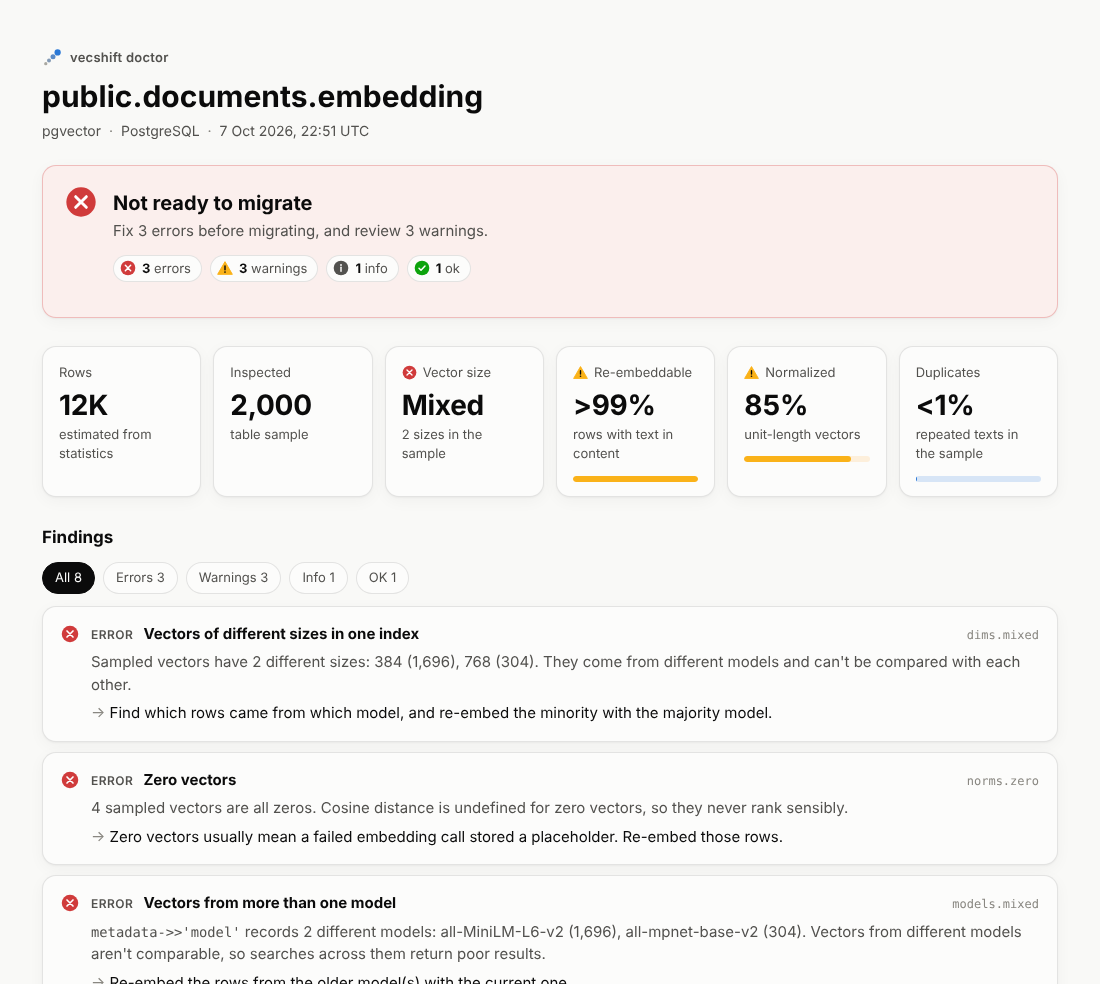
The HTML report is a single file that works offline and follows your light or dark theme. It holds statistics only, never vectors or row text, so it's safe to attach to a ticket. See the pgvector and Supabase guide for connection strings, row-level security, and a read-only role recipe.
Find the best embedding model for your data
vecshift bench --docs docs.jsonl \
  -m openai/text-embedding-3-small -m openai/text-embedding-3-large,dims=256 \
  -m ollama/nomic-embed-text --html leaderboard.html
It samples your documents (from a JSONL file or a pgvector table), builds queries with
known answers, and ranks each model by retrieval quality, query latency, cost per million
documents, and storage. It asks before sending anything to a paid API, and caches
embeddings so re-runs are cheap. Run it with no -m for a free, offline first try. See
the benchmarking guide.
Plan a migration
vecshift init
At a terminal, init walks you through it: paste your connection string (hidden as you
type), pick the vector column and the text it came from, choose the new model, and set a
spending limit. It writes a commented vecshift.yaml, can save the connection string to
a private .env file if you want it to, and shows the plan. For scripts, pass everything
as flags:
vecshift init --table public.documents --model openai/text-embedding-3-large,dims=1024
vecshift plan
plan checks the job against the database without changing anything: the SQL it would
run, rows, tokens, cost, duration, and storage, plus anything that would make the
migration fail.
Run it
vecshift apply
apply adds the new column next to the old one, embeds every row, and builds the index
concurrently, while your application keeps reading and writing. It stops cleanly on
Ctrl-C, at your budget, or part way with --until 50, and running it again resumes.
vecshift status            # where it stands, and what to run next
vecshift eval              # better on your data, and how fast? GO / NO-GO
vecshift cutover --check   # safe to switch?
vecshift cutover           # searches use the new vectors, under the same column name
vecshift rollback          # undo, instantly
Your application's SQL doesn't change: cutover gives the new vectors the column name it already uses, in one transaction. Switch the model your app embeds queries with at the same time. See Running a migration and Evaluating a migration.
Tested at scale
The full workflow has been run on a 2-million-row table (PostgreSQL 17, 4 vCPUs, 15 GB of RAM) while an application kept updating and inserting rows about 14 times a second:
| Step | Time | Application writes meanwhile |
|---|---|---|
apply: embed 2 million rows |
depends on your embedding model and its rate limits | 60K+ writes, p99 36 ms, no errors |
apply: catch up and build the HNSW index |
4.6 min | p99 33 ms, no errors |
cutover, including rows changed during the run |
30 s | longest pause 0.29 s |
rollback |
1.7 s | longest pause 0.99 s |
eval, 200 queries |
29 s | p99 13 ms |
Details in Running a migration.
Fingerprint an embedding configuration
Get the fingerprint of an embedding configuration:
$ vecshift fingerprint --provider openai --model text-embedding-3-small --dimensions 1536
openai/text-embedding-3-small@1536#a3ac94a82eca
Any change to the provider, model, dimensions, version, task type, prefix, or normalization produces a different tag, because it's a different vector space.
Documentation
- Demo: a full migration on sample data, offline, with Docker
- Running a migration: the job file,
plan,apply,cutover, androllback - Evaluating a migration: quality per language, latency vs accuracy, and the verdict
- Benchmarking embedding models: sources, model specs, query types, and metrics
- pgvector and Supabase: connecting, what
doctorchecks, and safety - Architecture: the canonical record, plugin contracts, and capability flags
- Roadmap: what's being built, in what order, and why
- Security model: what vecshift sends, stores, and touches
- Prior art: related tools and how VecShift relates to them
Contributing
Contributions are welcome, especially new connectors and embedding providers once the contracts settle. Start with CONTRIBUTING.md. Everyone taking part is expected to follow the Code of Conduct.
To report a security issue, see SECURITY.md. Please don't open a public issue.
License
Licensed under the Apache License 2.0.
1 maintainer

Metadata
1 maintainer
Release files for vecshift 0.3.0
For a detailed explanation of source distributions (sdists) and built distributions (wheels), please see the package formats documentation.
Source distribution (sdist)
| File | Size | Uploaded | |
|---|---|---|---|
| vecshift-0.3.0.tar.gz | 537.9 kB | Details |
Built distribution (wheel)
| File | Interpreter | ABI | Platform | Reset |
|---|---|---|---|---|
| vecshift-0.3.0-py3-none-any.whl | Python 3 | none | any | Details |
Total release size: 702.1 kB
Release files / vecshift-0.3.0.tar.gz
| Download URL | vecshift-0.3.0.tar.gz |
|---|---|
| Size | 537.9 kB |
| Tags | Source |
|
SHA-256 checksum How to use checksums |
759a476c56ade24441f0092e730db4936b869209be5d22c1a04b55688f0402b5
|
|
BLAKE2b-256 checksum How to use checksums |
c41f1f49ec582460774c8e583bd3c9819b28a6cd455083e535428ddc09413592
|
| Upload date | |
|
Uploaded using Trusted Publishing? What is trusted publishing? |
Yes |
| Uploaded via |
twine/7.0.0 CPython/3.13.14
|
Provenance
Provenance describes where a file came from. On PyPI, provenance is shared via attestations, which provide a verifiable record of the build or publishing details. View details, limitations and caveats.


PyPI Publish Attestation
PyPI verified that this artifact, at this checksum, originated from the publisher listed below.
Signed by GitHub Actions, verified by PyPI on Oct 10, 2026.
Transparency logRelease files / vecshift-0.3.0-py3-none-any.whl
| Download URL | vecshift-0.3.0-py3-none-any.whl |
|---|---|
| Size | 164.1 kB |
| Tags | Python 3 |
|
SHA-256 checksum How to use checksums |
317855bc3e097613f3a5f0a8d380473d7bf8297f8b9070e8c669978edf217f61
|
|
BLAKE2b-256 checksum How to use checksums |
d4d4634dcce5a17a53d8d8caf7b5cb56bf47e09b3307b89573aff047b7f22541
|
| Upload date | |
|
Uploaded using Trusted Publishing? What is trusted publishing? |
Yes |
| Uploaded via |
twine/7.0.0 CPython/3.13.14
|
Provenance
Provenance describes where a file came from. On PyPI, provenance is shared via attestations, which provide a verifiable record of the build or publishing details. View details, limitations and caveats.
PyPI Publish Attestation
PyPI verified that this artifact, at this checksum, originated from the publisher listed below.
Signed by GitHub Actions, verified by PyPI on Oct 10, 2026.
Transparency log













