

Convert raster images (PNG, JPG, etc.) into simplified SVG vector graphics using k-means colour quantization and contour tracing.
Installation
Requires Python 3.11+.
uv sync
Usage
uv run vectorify generate <filepath> <output> [options]
Example
uv run vectorify generate photo.png ./output.svg --n_colors 8 --smooth 2 --simplify 0.5
Update README images
Regenerate all example SVGs, PNGs, and grid images used in this README:
uv run vectorify update-readme
Arguments
| Argument | Type | Description |
|---|---|---|
filepath |
string | Path to the input image |
out_dir |
string | Directory for the output SVG |
Options
| Option | Type | Default | Description |
|---|---|---|---|
--n_colors |
int | 8 | Number of colours to quantize the image into |
--median_size |
float | 5 | Median filter kernel size for label smoothing (0 = disabled) |
--min_region |
float | 50 | Minimum connected region size in pixels (0 = disabled) |
--smooth |
float | 2 | Gaussian smoothing sigma applied to contours (0 = disabled) |
--simplify |
float | 0.5 | RDP simplification epsilon in pixels (0 = disabled) |
--buffer |
float | 1 | Outward normal offset to expand shapes and fill gaps |
Configuration
buffer
Expands each shape outward along its edge normals by the given pixel amount. Eliminates sub-pixel gaps between adjacent colour regions caused by smoothing or simplification.

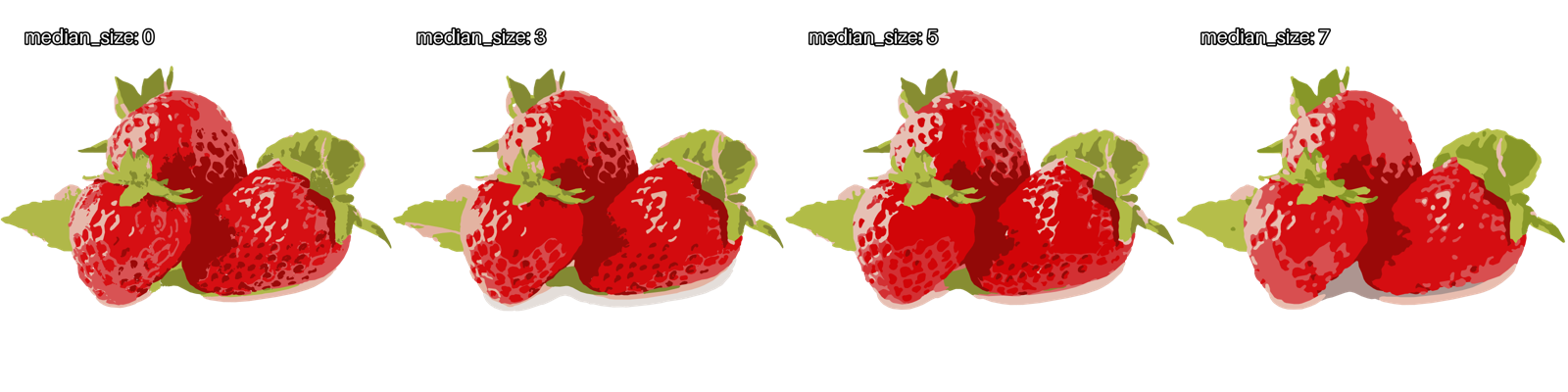
median_size
Applies a median filter of this kernel size to the label map. Fills small holes, removes straggler pixels, and smooths region boundaries. Larger values produce more aggressive cleanup.
min_region
Removes connected components smaller than this many pixels, replacing them with their most common neighbouring colour. Catches isolated specks that the median filter misses.

n_colors
Number of distinct colours the image is quantized into via k-means clustering. Lower values produce a more simplified, poster-like result.

simplify
Epsilon value for the Ramer-Douglas-Peucker algorithm. Reduces the number of vertices in each contour path. Higher values = fewer vertices = simpler shapes.

smooth
Gaussian smoothing sigma applied to contour vertices. Rounds off jagged pixel-aligned edges into flowing curves. Applied before simplification.

1 maintainer

Metadata
1 maintainer
Release files for vectorify 0.1.3
For a detailed explanation of source distributions (sdists) and built distributions (wheels), please see the package formats documentation.
Source distribution (sdist)
| File | Size | Uploaded | Provenance | |
|---|---|---|---|---|
| vectorify-0.1.3.tar.gz | 5.3 MB | Without provenance | Details |
Built distribution (wheel)
| File | Interpreter | ABI | Platform | Reset |
|---|---|---|---|---|
| vectorify-0.1.3-py3-none-any.whl | Python 3 | none | any | Details |
Total release size: 5.4 MB
Release files / vectorify-0.1.3.tar.gz
| Download URL | vectorify-0.1.3.tar.gz |
|---|---|
| Size | 5.3 MB |
| Tags | Source |
|
SHA-256 checksum How to use checksums |
53ae8b0e1584a75835d250a44b6bb4834b87c87c152ffe61c43980006e2b4c5a
|
|
BLAKE2b-256 checksum How to use checksums |
ed5daba7ae57c6d81975ef83f31bbc7e9d3f78c6f29d8374f7cd2dc3a358502e
|
| Upload date | |
|
Uploaded using Trusted Publishing? What is trusted publishing? |
No |
| Uploaded via |
twine/6.2.0 CPython/3.11.3
|
Release files / vectorify-0.1.3-py3-none-any.whl
| Download URL | vectorify-0.1.3-py3-none-any.whl |
|---|---|
| Size | 8.8 kB |
| Tags | Python 3 |
|
SHA-256 checksum How to use checksums |
cfc93d7813be6cce8cece54597003e0a924d2f6282ba6b0dba13d41183f985c3
|
|
BLAKE2b-256 checksum How to use checksums |
81e238a009a6889da7abfe41d475abc67ad124e7a3cfa3806b6a18fc5f5b907c
|
| Upload date | |
|
Uploaded using Trusted Publishing? What is trusted publishing? |
No |
| Uploaded via |
twine/6.2.0 CPython/3.11.3
|
Security for vectorify 0.1.3
Provenance
Provenance describes where a file came from. On PyPI, provenance is shared via attestations, which provide a verifiable record of the build or publishing details. View details, limitations and caveats.
No provenance found
None of the files in this release were uploaded with provenance metadata.
A note on package security
PyPI is a repository for distributing packages, not a service for auditing them. While third-party security researchers and our staff do their best to detect and remove malicious packages, PyPI cannot guarantee the quality, security or suitability of any given package.
To learn more about protecting yourself from malicious actors, visit our package security documentation.














