
Reasoning-based Document Engine

Project description

Reasoning-based Document Engine
Reason, don't vector · Structure, not chunks · Agents, not embeddings · Exact, not synthesized






Vectorless is a reasoning-native document engine written in Rust. It compiles documents into navigable trees, then dispatches multiple agents to find exactly what's relevant across your PDFs, Markdown, reports, contracts. No embeddings, no chunking, no approximate nearest neighbors. Every retrieval is a reasoning act.
Light up a star and shine with us! ⭐
Three Rules
- Reason, don't vector. Retrieval is a reasoning act, not a similarity computation.
- Model fails, we fail. No heuristic fallbacks, no silent degradation.
- No thought, no answer. Only reasoned output counts as an answer.
Why Vectorless
Traditional RAG systems split documents into chunks, embed them into vectors, and retrieve by similarity. Vectorless takes a different approach: it preserves document structure as a navigable tree and lets agents reason through it.
| Embedding-Based RAG | Vectorless | |
|---|---|---|
| Indexing | Chunk → embed → vector store | Parse → compile → document tree |
| Retrieval | Cosine similarity (approximate) | Multi-agent navigation (exact) |
| Structure | Destroyed by chunking | Preserved as first-class tree |
| Query handling | Keyword/similarity match | Intent classification + decomposition |
| Multi-hop reasoning | Not supported | Orchestrator replans dynamically |
| Output | Retrieved chunks | Original text passages, exact |
| Failure mode | Silent degradation | Explicit — no reasoning, no answer |
How It Works
Four-Artifact Index Architecture
When a document is indexed, the compile pipeline builds four artifacts:
Content Layer          Navigation Layer              Reasoning Index            Document Card
DocumentTree          NavigationIndex               ReasoningIndex            DocCard
(TreeNode)            (NavEntry, ChildRoute)        (topic_paths, hot_nodes)  (title, overview,
      │                      │                              │                 question hints)
      │                      │                              │                    │
 Agent reads           Agent reads every            Agent's targeted        Orchestrator reads
 only on cat           decision round               search tool (grep)      for multi-doc routing
- Content Layer — The raw document tree. The agent only accesses this when reading specific paragraphs (
cat). - Navigation Layer — Each non-leaf node stores an overview, question hints, and child routes (title + description). The agent reads this every round to decide where to go next.
- Reasoning Index — Keyword-topic mappings with weights. Provides the agent's
greptool with structured keyword data for targeted search within a document. - DocCard — A compact document-level summary. The Orchestrator reads DocCards to decide which documents to navigate in multi-document queries, without loading full documents.
This separation means the agent makes routing decisions from lightweight metadata, not by scanning full content.
Agent-Based Retrieval
Engine.query("What drove the revenue decline?")
  │
  ├─ Query Understanding ── intent, concepts, strategy (LLM)
  │
  ├─ Orchestrator ── analyzes query, dispatches Workers
  │   │
  │   ├─ Worker 1 ── ls → cd "Financials" → ls → cd "Revenue" → cat
  │   └─ Worker 2 ── ls → cd "Risk Factors" → grep "decline" → cat
  │   │
  │   └─ evaluate ── insufficient? → replan → dispatch new paths → loop
  │
  └─ Fusion ── dedup, LLM-scored relevance, return with source attribution
Worker navigation commands:
| Command | Action | Reads |
|---|---|---|
ls |
List child sections | Navigation Layer (ChildRoute) |
cd |
Enter a child section | Navigation Layer |
cat |
Read content at current node | Content Layer (DocumentTree) |
grep |
Search by keyword | Reasoning Index (topic_paths) |
The Orchestrator evaluates Worker results after each round. If evidence is insufficient, it replans — adjusting strategy, dispatching new paths, or deepening exploration. This continues until enough evidence is collected.
Quick Start
pip install vectorless
import asyncio
from vectorless import Engine, IndexContext, QueryContext

async def main():
    engine = Engine(api_key="sk-...", model="gpt-4o", endpoint="https://api.openai.com/v1")

    # Index a document
    result = await engine.index(IndexContext.from_path("./report.pdf"))
    doc_id = result.doc_id

    # Query
    result = await engine.query(
        QueryContext("What is the total revenue?").with_doc_ids([doc_id])
    )
    print(result.single().content)

asyncio.run(main())
Key Features
- Rust Core — The entire engine (indexing, retrieval, agent, storage) is implemented in Rust for performance and reliability. Python SDK via PyO3 bindings and a CLI are also provided.
- Multi-Agent Retrieval — Every query is handled by multiple cooperating agents: an Orchestrator plans and evaluates, Workers navigate documents. Each retrieval is a reasoning act — not a similarity score, but a sequence of LLM decisions about where to look, what to read, and when to stop.
- Zero Vectors — No embedding model, no vector store, no similarity search. This eliminates a class of failure modes: wrong chunk boundaries, stale embeddings, and similarity-score false positives.
- Tree Navigation — Documents are compiled into hierarchical trees that preserve the original structure — headings, sections, paragraphs, lists. Workers navigate this tree the way a human would: scan the table of contents, jump to the relevant section, read the passage.
- Document-Exact Output — Returns original text passages from the source document. No synthesis, no rewriting, no hallucinated content. What you get is what was written.
- Multi-Document Orchestration — Query across multiple documents with a single call. The Orchestrator dispatches Workers, evaluates evidence, and fuses results. When one document is insufficient, it replans and expands the search scope.
- Query Understanding — Every query passes through LLM-based intent classification, concept extraction, and strategy selection. Complex queries are decomposed into sub-queries. The system adapts its navigation strategy based on whether the query is factual, analytical, comparative, or navigational.
- Checkpointable Pipeline — The 8-stage compile pipeline writes checkpoints at each stage. If indexing is interrupted (LLM rate limit, network failure), it resumes from the last completed stage — no wasted work.
- Incremental Updates — Content fingerprinting detects changes at the node level. Re-indexing a modified document only recompiles the changed sections and their dependents.
Supported Documents
- PDF — Full text extraction with page metadata
- Markdown — Structure-aware parsing (headings, lists, code blocks)
Resources
- Documentation — Guides, architecture, API reference
- Rust API Docs — Auto-generated crate documentation
- PyPI — Python package
- Crates.io — Rust crate
- Examples — Complete usage patterns for Python and Rust
Contributing
Contributions welcome! If you find this useful, please ⭐ the repo — it helps others discover it.
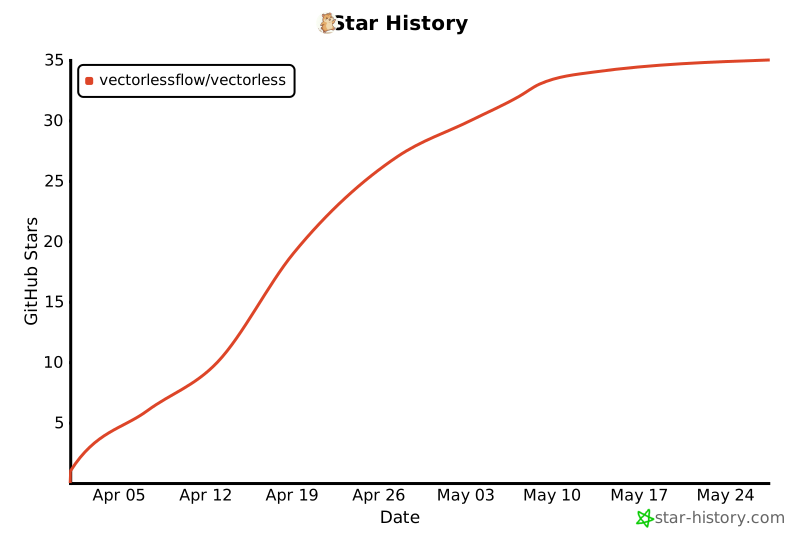
Star History
License
Apache License 2.0
Release history Release notifications | RSS feed


Download files
Download the file for your platform. If you're not sure which to choose, learn more about installing packages.
Source Distribution
Built Distribution
Filter files by name, interpreter, ABI, and platform.
If you're not sure about the file name format, learn more about wheel file names.
Copy a direct link to the current filters
File details
Details for the file vectorless-0.1.11.tar.gz.
File metadata
- Download URL: vectorless-0.1.11.tar.gz
- Upload date:
- Size: 311.2 kB
- Tags: Source
- Uploaded using Trusted Publishing? No
- Uploaded via: maturin/1.12.6
File hashes
| Algorithm | Hash digest | |
|---|---|---|
| SHA256 |
1df2e9de40f392a203768b3aa2ca325bc205c638d11dd3323ffbc4fab924864b
|
|
| MD5 |
46fbb36213fac828a96e7b56c5fca394
|
|
| BLAKE2b-256 |
d8163ce19190fc71ca536da30b9964d8a135094a4e4e9db18fb185fbdddc69a1
|
File details
Details for the file vectorless-0.1.11-cp310-cp310-manylinux_2_34_x86_64.whl.
File metadata
- Download URL: vectorless-0.1.11-cp310-cp310-manylinux_2_34_x86_64.whl
- Upload date:
- Size: 5.2 MB
- Tags: CPython 3.10, manylinux: glibc 2.34+ x86-64
- Uploaded using Trusted Publishing? No
- Uploaded via: maturin/1.12.6
File hashes
| Algorithm | Hash digest | |
|---|---|---|
| SHA256 |
6bcd9f9376a9d59612b2471a424431d58b61b38bb3dd810a2473a32e2e87001e
|
|
| MD5 |
de8c26f645b651f3f5f15dd4ca64d3c8
|
|
| BLAKE2b-256 |
89a050fbb12d9bab5d00476d0ec97e494f5ba3e8dc093cdab329f05506c8a5f7
|






