
veil
Reversible PII masking for LLM calls. Mask personal data before the prompt leaves your network, let the model reason over consistent surrogates, and restore the originals in the answer — streaming included.



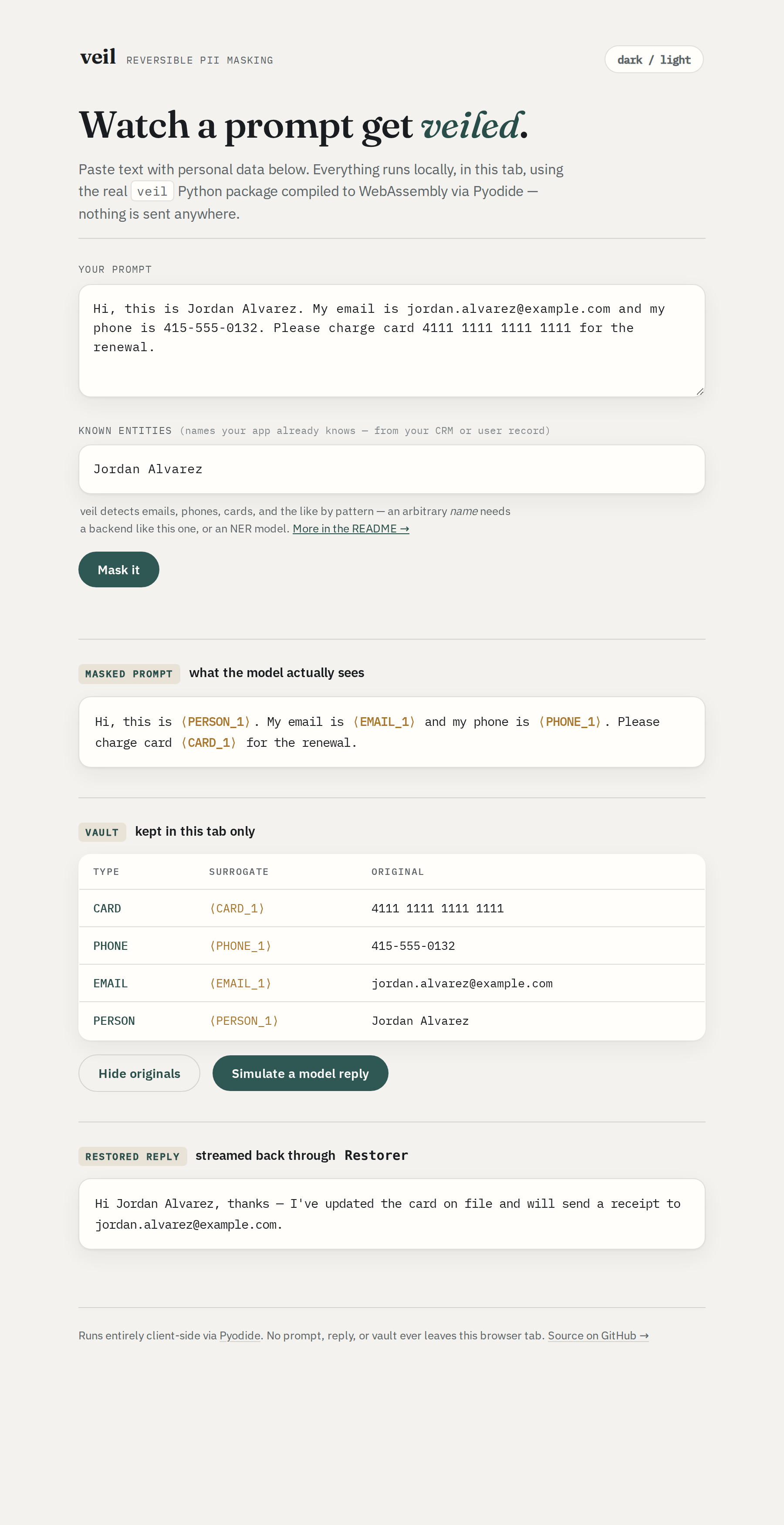
Try the live demo → — runs the
real Python package in your browser via Pyodide,
nothing leaves the page. (web/; see Web demo below.)
Why this exists
Teams in healthcare, legal, finance, and support want to use hosted LLMs,
but their prompts contain customer names, emails, phone numbers, card
numbers, account IDs, and API keys. The usual answer is "redact it" —
replace the value with [REDACTED]. That breaks the response: the model
can't say "Dear [REDACTED], your order [REDACTED] ships tomorrow."
Reversible pseudonymization fixes that instead: replace each sensitive value with a consistent surrogate, let the model reason over the surrogates, and map them back in the response. The model never sees the real data; the human on the other end never sees a redaction. The part almost nobody handles is doing that restoration on a stream of tokens, where a surrogate can be split across chunk boundaries — that's most of what this repository is about.
How it works
flowchart LR
    A["Prompt\n(has real PII)"] -->|"Masker.mask()"| B["Masked prompt\n(surrogates only)"]
    B --> C["LLM"]
    C --> D["Response\n(surrogates only)"]
    D -->|"Masker.restore()\nor Restorer.feed()"| E["Restored response\n(real PII back)"]
    B -.->|"stores mapping"| V[("Vault")]
    E -.->|"looks up mapping"| V
- Detect. Regex-and-validation detectors (Luhn, mod-97, structural checks) find emails, phone numbers, cards, IBANs, SSNs, IPs, credential-bearing URLs, API keys, and dates of birth. A pluggable backend finds names/orgs/locations — see "Names, orgs, and locations" under Features below.
- Mask. Each detected value gets a surrogate — either a placeholder
token (
⟨EMAIL_1⟩) or a realistic fake (user1@example.com) — and the(original, surrogate)pair is recorded in aVault. The same original always maps to the same surrogate for the life of the vault. - Send. The masked text goes to the LLM. It never sees the real values.
- Restore. The response comes back full of surrogates.
restore_exact/restore_tolerantswap them back for a buffered response;Restorer.feed()does it token-by-token for a stream.
The streaming problem, concretely
Say the vault maps ⟨EMAIL_1⟩ to alice@example.com, and the model
streams its reply in small chunks:
chunk 1: "Sure, I'll email ⟨EM"
chunk 2: "AIL_1⟩ right away."
A restorer that looks at each chunk in isolation emits ⟨EM verbatim (the
placeholder leaks into what the user sees) and then has no memory of it
when AIL_1⟩ arrives in the next chunk. veil.restore.Restorer instead
recognizes that ⟨EM is a valid prefix of a known surrogate, holds back
only that trailing fragment, and completes the match once AIL_1⟩
arrives — emitting alice@example.com right away. with nothing leaked
and no extra latency beyond the one held-back fragment. It's built on a
trie over the vault's surrogate strings (see veil/restore.py), and
Hypothesis property tests prove that any way you split a given text
into chunks produces output identical to restoring it unsplit
(tests/test_restore_streaming.py).
Quickstart
pip install veil-pii
from veil import Masker

masker = Masker()
masked = masker.mask("Email alice@example.com about invoice #4471.")
print(masked)  # "Email ⟨EMAIL_1⟩ about invoice #4471."

# ... send `masked` to your LLM of choice, get `reply` back ...
reply = "Sure, I've noted it for ⟨EMAIL_1⟩."
print(masker.restore(reply))  # "Sure, I've noted it for alice@example.com."
With the Anthropic SDK
pip install "veil-pii[anthropic]"
from anthropic import Anthropic
from veil.integrations.anthropic import AnthropicVeil

client = AnthropicVeil(Anthropic())

response = client.create(
    model="claude-opus-5-5",
    max_tokens=1024,
    messages=[{"role": "user", "content": "Email alice@example.com about invoice #4471."}],
)
print(response.content[0].text)  # the real address, restored — Claude only ever saw a surrogate

# Streaming:
with client.stream(model="claude-opus-5-5", max_tokens=1024, messages=[...]) as stream:
    for text in stream.text_stream:  # already restored, split-token-safe
        print(text, end="", flush=True)
With the OpenAI SDK
veil.integrations.openai.OpenAIVeil (the openai extra) wraps both of
OpenAI's APIs: create / stream for Chat Completions, and
create_response / stream_response for the Responses API.
from openai import OpenAI
from veil.integrations.openai import OpenAIVeil

client = OpenAIVeil(OpenAI())

response = client.create_response(
    model="gpt-6-sol",
    instructions="You draft customer emails.",
    input="Email alice@example.com about invoice #4471.",
)
print(response.output_text)  # restored; the model only saw ⟨EMAIL_1⟩

for event in client.stream_response(model="gpt-6-sol", input=[...]):
    if event.type == "response.output_text.delta":
        print(event.delta, end="", flush=True)  # restored, split-token-safe
For the Responses API, veil masks instructions and every message,
function_call, function_call_output and custom tool item in input. It
restores message text, refusals, tool-call arguments and reasoning summaries
in output, and response.output_text with them, since the SDK computes it
from output. Reasoning items pass through untouched. In a stream, text and
argument deltas are restored as they arrive, and any text held back because
it might begin a surrogate is released, as one more delta event, before the
matching .done event. With previous_response_id the server keeps the
masked history, so keep the same OpenAIVeil (and its vault) for the whole
conversation. Tested against the openai SDK's own response and event types.
Multi-turn conversations and tool calls
Keep your history the normal way: append the assistant turn veil handed
you (real values restored, including in the tool_use input your code is
about to execute) and send the whole list on the next call. The wrapper
remembers the exact blocks the model produced for everything it restored,
and swaps them back in before the request leaves, so:
- No real value goes back to the provider. Restored tool-call arguments are the easy thing to leak: they are real by design, because your code has to act on them.
- The history the API sees never changes. Re-masking a restored turn only approximates the original (a support address the model wrote itself looks like PII and would get a fresh surrogate). Any difference is an edit to an earlier turn: the prompt cache restarts from there, and on current Claude models every later thinking block's signature stops matching its conversation, which accounts that enforce the check reject with a 400. Thinking blocks are never masked or restored for the same reason.
A turn veil didn't produce (or one you edited) is masked like any other
message. OpenAI tool-call arguments arrive as a JSON string; veil parses
them before restoring, so a surrogate the model wrote with \u27e8-style
escapes is still found, and restored values are escaped so the arguments
stay valid JSON.
Features
- Detectors (
veil.detectors): email, phone (NANP, or international with an explicit+country code — no unprefixed generic fallback; see the module docstring for why), payment card (Luhn + issuer ranges), IBAN (mod-97 + per-country length), US SSN (excluding never-issued ranges), IPv4/IPv6 (a dotted quad labelled as a version is left alone), credential-bearing URLs of any scheme (includingpostgres:///redis://-style connection strings), PEM private key blocks, API keys/secrets (AKIA…,ghp_…,github_pat_…,xox…,sk_live_…,sk-ant-…,sk-…, plus a Shannon-entropy heuristic), context-gated date-of-birth, and an opt-in US street-address heuristic. - Names, orgs, and locations via a pluggable
NameBackend: a first-classKnownEntitiesBackend(you already know the customer's name from your own database — this is the most reliable option in practice) and an optionalSpacyBackend. - Surrogates: placeholder tokens or realistic format-preserving fakes
(fake names,
example.com/example.orgemails per RFC 2606,555-01xxNANP phone numbers, Luhn-valid test-range card numbers), consistent within a session. - Restore: exact (byte-for-byte) and tolerant (case changes,
possessives, a surrogate split across a line wrap) — see
veil/restore.pyfor exactly what "tolerant" does and doesn't cover. - Streaming restore:
Restorer.feed(chunk) -> str/.flush() -> str, proven equal to non-streamed restore under arbitrary chunking. - Leak audit (
veil.audit): checks outgoing text for original values that should never reappear, and flags new PII the model introduced. - Vault: in-memory by default, JSON-serializable, optional Fernet
encryption at rest (
veil-pii[vault-crypto]) — see the threat model inveil/vault.py. - CLI:
veil mask,veil restore,veil audit. - SDK integrations: thin wrappers for the Anthropic Messages API and OpenAI's Chat Completions and Responses APIs that mask every outgoing message (tool calls included), restore responses and streams, and replay earlier assistant turns exactly as the model produced them.
- Zero runtime dependencies in the core. Everything above the detectors/surrogates/restore/vault/CLI layer is an optional extra.
CLI
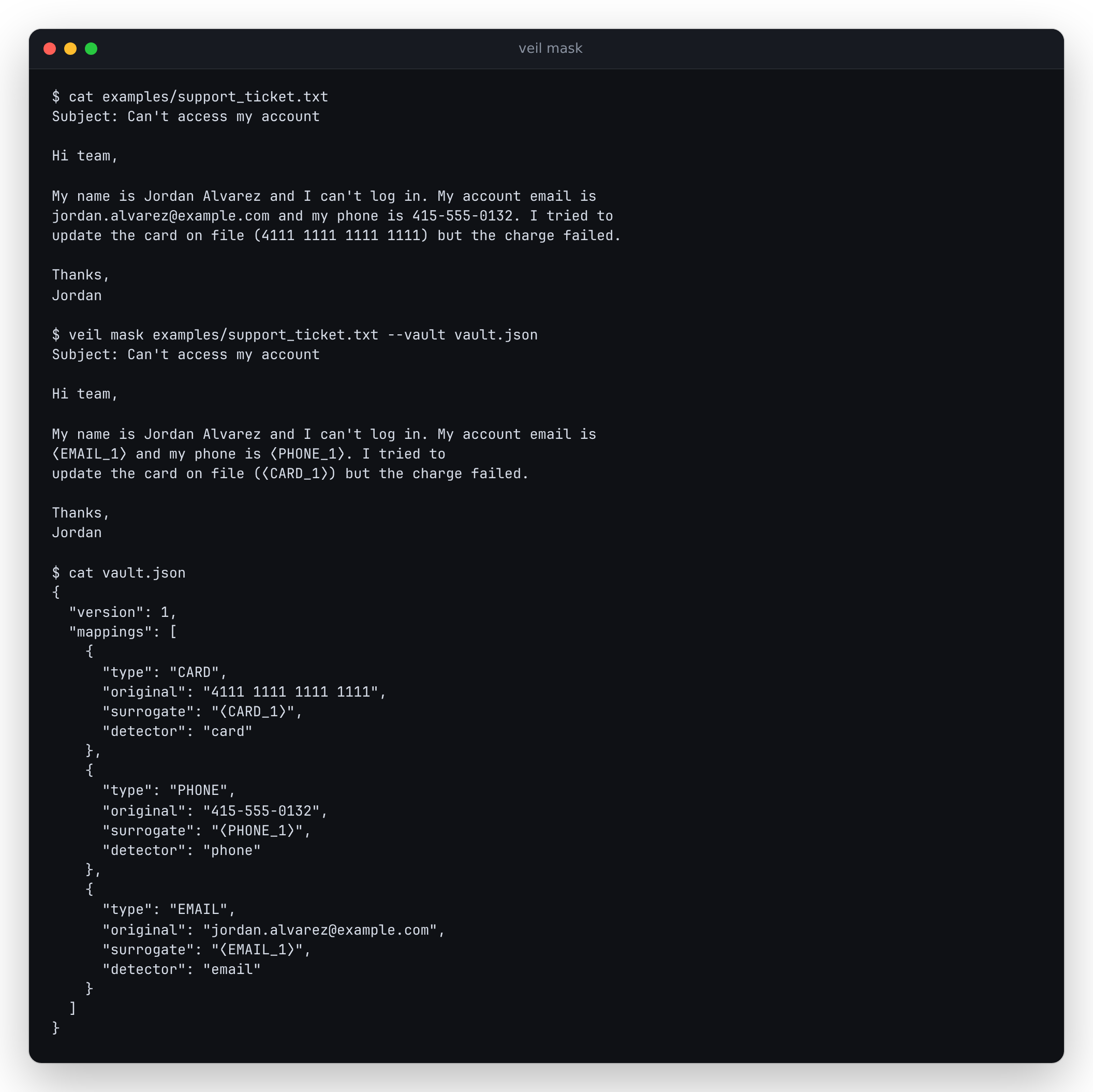
$ veil mask examples/support_ticket.txt --vault vault.json
Subject: Can't access my account
...
My account email is ⟨EMAIL_1⟩ and my phone is ⟨PHONE_1⟩. I tried to
update the card on file (⟨CARD_1⟩) but the charge failed.
...

$ veil restore masked_reply.txt --vault vault.json
$ veil audit outgoing_reply.txt --vault vault.json   # exit 1 if anything leaked
Web demo
antonsoo.github.io/veil runs the
actual veil Python package in the browser via
Pyodide (loaded from cdn.jsdelivr.net) — the
web/scripts/copy-veil-src.mjs build step bundles src/veil's real
source (zero runtime dependencies makes this possible with no wheel
build) so the demo is never a JS reimplementation drifting from the
library. Paste a prompt, optionally list names your app already knows
(wired to KnownEntitiesBackend), mask it, and watch a simulated reply
stream back through the real Restorer, one random-sized chunk at a
time — dark mode:
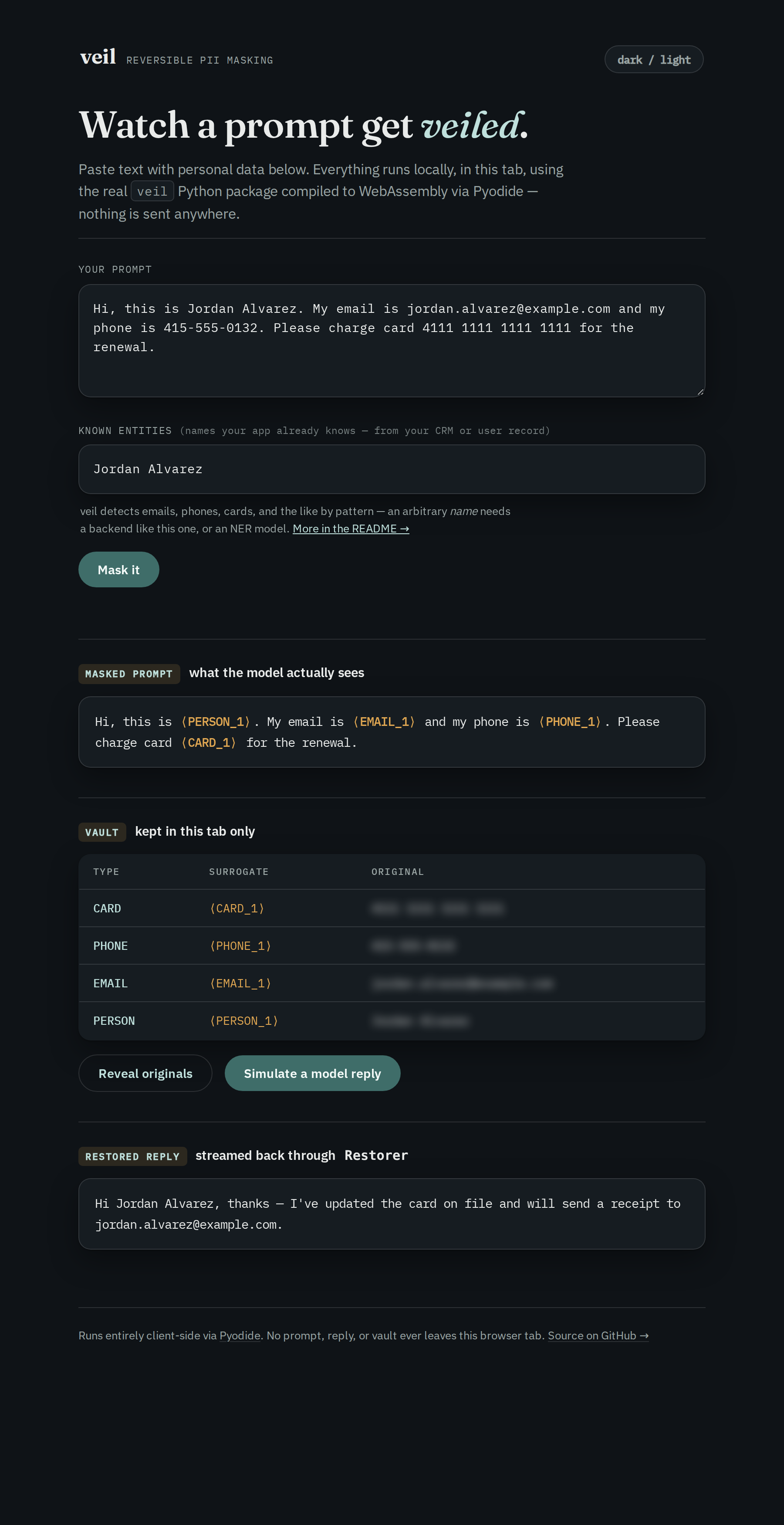
Everything — Pyodide, the package source, the whole interaction — stays
in that browser tab; nothing is sent anywhere, which the page itself
says. Built with Vite + TypeScript in web/; npm run dev there for
local development.
Measured results
Measured on this machine (14 vCPU WSL2 Linux, 48 GB RAM) by running
scripts/evaluate.py against benchmarks/corpus.jsonl — a 240-document,
6-category synthetic corpus generated by scripts/generate_corpus.py
with a fixed seed (reproduce with
uv run python scripts/generate_corpus.py 40 > benchmarks/corpus.jsonl).
| Detector | Precision | Recall | F1 |
|---|---|---|---|
| Address (heuristic) | 1.000 | 1.000 | 1.000 |
| Card | 1.000 | 1.000 | 1.000 |
| DOB | 1.000 | 1.000 | 1.000 |
| 1.000 | 1.000 | 1.000 | |
| IBAN | 1.000 | 1.000 | 1.000 |
| IPv4 | 1.000 | 1.000 | 1.000 |
| Phone | 1.000 | 1.000 | 1.000 |
| Secret | 1.000 | 1.000 | 1.000 |
| SSN | 1.000 | 1.000 | 1.000 |
| Total | 1.000 | 1.000 | 1.000 |
Benign false positives: 0.00 per 1,000 words, measured over the
corpus's clean_negative and benign_numbers categories (80 documents,
4,155 words of ordinary business text with zero PII, deliberately
saturated with the numeric shapes that most look like phone numbers or
SSNs: ISO/DMY dates, times, #order-1234 and INV-/ticket IDs, ZIP+4,
carrier tracking numbers, prices, room numbers, and version/build
strings — the exact categories a naive digit-group detector over-masks).
0.00 here means specifically "no false positive on these known-tricky
shapes", not "no false positives on arbitrary text" — see below.
Masking throughput: ~1.6-2.1 MB/s (single-threaded, all nine
detectors run on every document; varies run to run — see elapsed_s in
the script's output).
Streaming-restore overhead: within roughly ±20% of non-streamed restore at a 24-character chunk size, on the same corpus — noise-level on this machine, not a meaningful cost.
Read the "1.000" row honestly — see Accuracy and
limitations. This corpus was built to
independently verify each detector's validated claims (a real Luhn
check, a real mod-97 check, real NANP/E.164 structure, real never-issued
SSN ranges — see How it works), so a clean score mostly
means those checks are implemented correctly, not that real-world text is
this easy. The corpus generator and the benign-numbers check both found
and fixed real precision bugs during development — most recently the
phone detector masking an ISO date and an order number as phone numbers
in ordinary support text, and the SSN detector matching a ZIP+4 code
(22156-7224 parses as area+group+serial if separators aren't required
to be consistent). See the git history for fix: detector false positives found via synthetic corpus evaluation and the phone/SSN
over-masking fix that followed it.
Accuracy and limitations
- Detection is never perfect. Every regex-and-validation detector here
has a documented failure mode in its own module docstring (e.g.
veil/detectors/phone.pyexplains exactly which phone formats it deliberately won't match, and why). Read those before relying on this for a compliance-sensitive workload. - Names need a backend. Out of the box, veil does not detect person,
organization, or location names — those require
KnownEntitiesBackend(recommended: you almost always already know the customer's identity) or an optional, unbenchmarked spaCy backend. Seeveil/backends/spacy_backend.pyfor why we don't claim an NER accuracy number we haven't measured. - US-centric. Phone (NANP), SSN, and the address heuristic assume US formats primarily; IBAN and E.164 phone cover international cases, but there's no general international address, national-ID, or VAT-number detector yet.
- Realistic surrogates can leak structure. A format-preserving fake
IBAN still reveals the real one's country; a fake card still reveals
its network. See the trade-off discussion in
veil/surrogates.py. - The vault is the whole game. Anyone who reads the vault can
de-anonymize the masked text — see the threat model in
veil/vault.pybefore deciding where (or whether) to persist one. - Synthetic benchmarks overstate real-world performance. The corpus above is clean, well-formatted, English-language, and generated by the same kind of logic the detectors use to validate — it is a correctness check, not a claim about messy real-world text (typos, non-US formats, mixed languages, OCR noise).
Development
git clone https://github.com/antonsoo/veil
cd veil
uv sync --group dev
uv run pytest          # 194 tests, including Hypothesis property tests
uv run ruff check .    # lint
uv run mypy            # typecheck (strict)
Correctness is checked against independent oracles where one exists: the
Luhn checksum for cards, ISO 7064 mod-97 for IBAN (verified against
published Wikipedia example IBANs for GB/DE/FR), and the stdlib
ipaddress module for IP parsing — see the module docstrings in
veil/detectors/ for details, and tests/ for the corresponding tests.
Contributing
See CONTRIBUTING.md.
License
MIT © 2026 Anton Soloviev
Part of Officina, a set of small open-source tools by Anton Soloviev.
1 maintainer

Metadata
1 maintainer
Release files for veil-pii 0.3.1
For a detailed explanation of source distributions (sdists) and built distributions (wheels), please see the package formats documentation.
Source distribution (sdist)
| File | Size | Uploaded | |
|---|---|---|---|
| veil_pii-0.3.1.tar.gz | 50.9 kB | Details |
Built distribution (wheel)
| File | Interpreter | ABI | Platform | Reset |
|---|---|---|---|---|
| veil_pii-0.3.1-py3-none-any.whl | Python 3 | none | any | Details |
Total release size: 107.7 kB
Release files / veil_pii-0.3.1.tar.gz
| Download URL | veil_pii-0.3.1.tar.gz |
|---|---|
| Size | 50.9 kB |
| Tags | Source |
|
SHA-256 checksum How to use checksums |
12036acf0078785e791d9d8f108a3a164099fd258603f8513ec6bb27ef89e558
|
|
BLAKE2b-256 checksum How to use checksums |
775d4d39f3c743f514b34d72c1437639ee4292a4cfdd39b958019f23be549cb2
|
| Upload date | |
|
Uploaded using Trusted Publishing? What is trusted publishing? |
No |
| Uploaded via |
uv/0.12.21 {"installer":{"name":"uv","version":"0.12.21","subcommand":["publish"]},"python":null,"implementation":{"name":null,"version":null},"distro":{"name":"Ubuntu","version":"24.04","id":"noble","libc":null},"system":{"name":null,"release":null},"cpu":null,"openssl_version":null,"setuptools_version":null,"rustc_version":null,"ci":null}
|
Release files / veil_pii-0.3.1-py3-none-any.whl
| Download URL | veil_pii-0.3.1-py3-none-any.whl |
|---|---|
| Size | 56.8 kB |
| Tags | Python 3 |
|
SHA-256 checksum How to use checksums |
357d7937bc9aae29b9eea5adfc60fc988a670034b997ffdd99dcc993ec5c188b
|
|
BLAKE2b-256 checksum How to use checksums |
2ff4c026118bcb44b46f0133a385614f7a1642d45fc06785df693ea15f1a3f64
|
| Upload date | |
|
Uploaded using Trusted Publishing? What is trusted publishing? |
No |
| Uploaded via |
uv/0.12.21 {"installer":{"name":"uv","version":"0.12.21","subcommand":["publish"]},"python":null,"implementation":{"name":null,"version":null},"distro":{"name":"Ubuntu","version":"24.04","id":"noble","libc":null},"system":{"name":null,"release":null},"cpu":null,"openssl_version":null,"setuptools_version":null,"rustc_version":null,"ci":null}
|













