

A local-first zero-trust Model Context Protocol (MCP) privacy firewall & context-diet gateway.




Description
Veilgate is an enterprise-grade, local-first proxy and security gateway that sits transparently between AI client hosts (Claude Desktop, Cursor, Antigravity, LangGraph) and upstream Model Context Protocol (MCP) tool servers.
As agentic AI workflows adopt dozens of autonomous MCP tools, developers face critical security and efficiency risks:
- Unchecked Data Exfiltration: Upstream tools can leak corporate databases, PII, and financial accounts directly into public LLM context windows.
- Confused Deputy Attacks: Tainted prompt data can trick LLMs into re-routing sensitive secrets into unmonitored external network sinks (email, webhooks, cURL).
- Rug-Pull Tool Mutation: Malicious or compromised servers can stealthily alter tool schemas and descriptions after initial approval.
- Context Window Token Bloat: Unbounded tool definitions consume 40–70% of prompt token limits before reasoning even begins.
Veilgate eliminates these risks with a zero-trust, fail-closed security architecture:
- Lossless Context Diet: Dynamically prunes bloated schemas and applies BM25 adaptive ranking to keep prompts lean and fast.
- Cryptographic Data Minimization: Intercepts sensitive PII/secrets, stores them locally in an AES-256-GCM vault, and injects format-preserving synthetic tokens (
<vg:TYPE:ID>) into LLM prompts. - Taint-Aware Egress Enforcement: Tracks data origin and halts unauthorized token re-hydration into external sinks.
- Interactive Human-in-the-Loop (HITL) Review: Prompts developers via terminal or the sleek web dashboard with
⚡ Allow Once,🛡️ Allow Always, or✕ Deny. - Tamper-Evident SHA-256 Audit Trail: Cryptographically hash-chains every discovery, call, token transformation, and approval in a local SQLite WAL ledger.
System Architecture
flowchart TD
    subgraph ClientHost["AI Client Host (Claude Desktop / Cursor / CLI)"]
        LLM["AI Agent / LLM Engine"]
    end

    subgraph VeilgateGateway["Veilgate Zero-Trust Privacy Firewall"]
        Proxy["FastMCP MITM Proxy Router"]

        subgraph Pipeline["Firewall Security Pipeline"]
            RugPull["1. Rug-Pull & Fingerprint Guard"]
            Diet["2. Lossless Context-Diet & BM25 Ranker"]
            ACL["3. Zero-Trust ACL & Egress Inspector"]
            HITL["4. Interactive HITL Review Queue"]
            Taint["5. Taint Tracker & Vault Minimizer"]
        end

        Vault[("Local AES-GCM Vault & Stash")]
        Audit[("Tamper-Evident Audit Ledger (SHA-256)")]
        Policy[("policy.yaml & policy.learned.yaml")]
    end

    subgraph UpstreamMCP["Upstream MCP Ecosystem"]
        ServerA["Database MCP (invoicedb)"]
        ServerB["Egress MCP (mailer / web)"]
        ServerC["Filesystem / CLI Tools"]
    end

    LLM <-->|"MCP stdio / SSE"| Proxy
    Proxy --> Pipeline
    Pipeline --> Vault
    Pipeline --> Audit
    Pipeline --> Policy
    HITL <-->|"WebSocket / REST API"| Dashboard["Local Web Dashboard (Port 8765)"]
    Pipeline <-->|"Safe Filtered Calls"| UpstreamMCP
Repository Layout
| Path | Responsibility |
|---|---|
src/veilgate/config/ |
Declarative Pydantic settings, constants, and layered policy compilers (policy.yaml, policy.learned.yaml). |
src/veilgate/middleware/ |
FastMCP interceptor middlewares for discovery filtering, tool calls, and structured error routing. |
src/veilgate/pipeline.py |
Central FirewallPipeline orchestrating ACL, taint tracking, vault minimization, and audit hashing. |
src/veilgate/services/ |
Modular domain services: AclService, ApprovalService, TaintService, MinimizerService, DietService, CatalogService. |
src/veilgate/security/ |
Cryptographic primitives: AES-256-GCM envelope encryption, OS keyring integration, and blind hashing. |
src/veilgate/repositories/ |
Async SQLite repositories for sessions, tool catalog entries, approval states, and immutable audit logs. |
src/veilgate/dashboard/ |
Local FastAPI & Jinja2 monitoring dashboard featuring live metrics, interactive HITL approval queue, and audit trail stream. |
src/veilgate/cli.py |
Rich Typer CLI powering run, dashboard, init, adopt, keygen, and audit. |
tests/ |
Comprehensive test suite containing unit tests, hypothesis property tests, and the A1–A16 security attack catalog. |
Prerequisites
| Requirement | Minimum Version | Description |
|---|---|---|
| Python | >= 3.11 |
Modern async runtime supporting typed Pydantic models. |
| uv (Recommended) | >= 0.5.0 |
Ultra-fast package installer and virtualenv manager. |
| SQLite | >= 3.35 |
Built-in WAL mode database for local-first cryptographic storage. |
Installing uv
# macOS / Linux
curl -LsSf https://astral.sh/uv/install.sh | sh

# Windows (PowerShell)
powershell -ExecutionPolicy ByPass -c "irm https://astral.sh/uv/install.ps1 | iex"
Installation
Install Veilgate directly from PyPI:
# Standard installation
pip install veilgate

# With web observability dashboard extras
pip install "veilgate[dashboard]"

# Or run directly via uv without installing:
uvx veilgate --help
Project Setup (Contributing / Development)
Clone the repository and synchronize dependencies into an isolated virtual environment:
# Clone repository
git clone https://github.com/OmH3/Veilgate.git
cd veilgate

# Install with development and dashboard extras
uv sync --extra dev --extra dashboard

# Alternatively with standard pip
python -m venv .venv
source .venv/bin/activate  # On Windows: .venv\Scripts\activate
pip install -e ".[dev,dashboard]"
Generate your master cryptographic key:
uv run veilgate keygen
Quickstart & CLI Commands
1. Initialize a New Policy
Generate a baseline policy.yaml pre-configured with recommended security rules and PII detectors:
uv run veilgate init
2. Adopt Existing MCP Configurations
Instantly migrate existing Claude Desktop, Cursor, or Cline MCP configs into Veilgate:
uv run veilgate adopt --client claude-desktop
3. Run the Veilgate Firewall Proxy
Start the proxy gateway in foreground mode:
uv run veilgate run --config policy.yaml
4. Launch the Live Observability Dashboard
Start the local review and monitoring dashboard:
uv run veilgate dashboard --config policy.yaml --port 8765
Open http://localhost:8765 in your browser.
Interactive Human-in-the-Loop (HITL) Approvals
Veilgate treats egress and unallowed tools with zero trust. Whenever an agent attempts to invoke a tool that lacks pre-approved authorization or touches external networks, execution is automatically paused and queued for developer review:
Decision Matrix
| Action | Decision State | Behavior & Security Guarantee |
|---|---|---|
⚡ Allow Once |
APPROVED |
Permits this single tool call to proceed upstream. Leaves the policy unchanged so future invocations require fresh approval. |
🛡️ Allow Always |
APPROVED_AND_SAVED |
Permits execution and permanently appends a new grant rule to policy.learned.yaml. Subsequent invocations execute instantly without prompting. |
✕ Deny |
DENIED |
Immediately aborts the invocation with ApprovalDeniedError. Zero upstream data is transmitted, and the denial is logged to the audit ledger. |
Live Web Dashboard & Observability
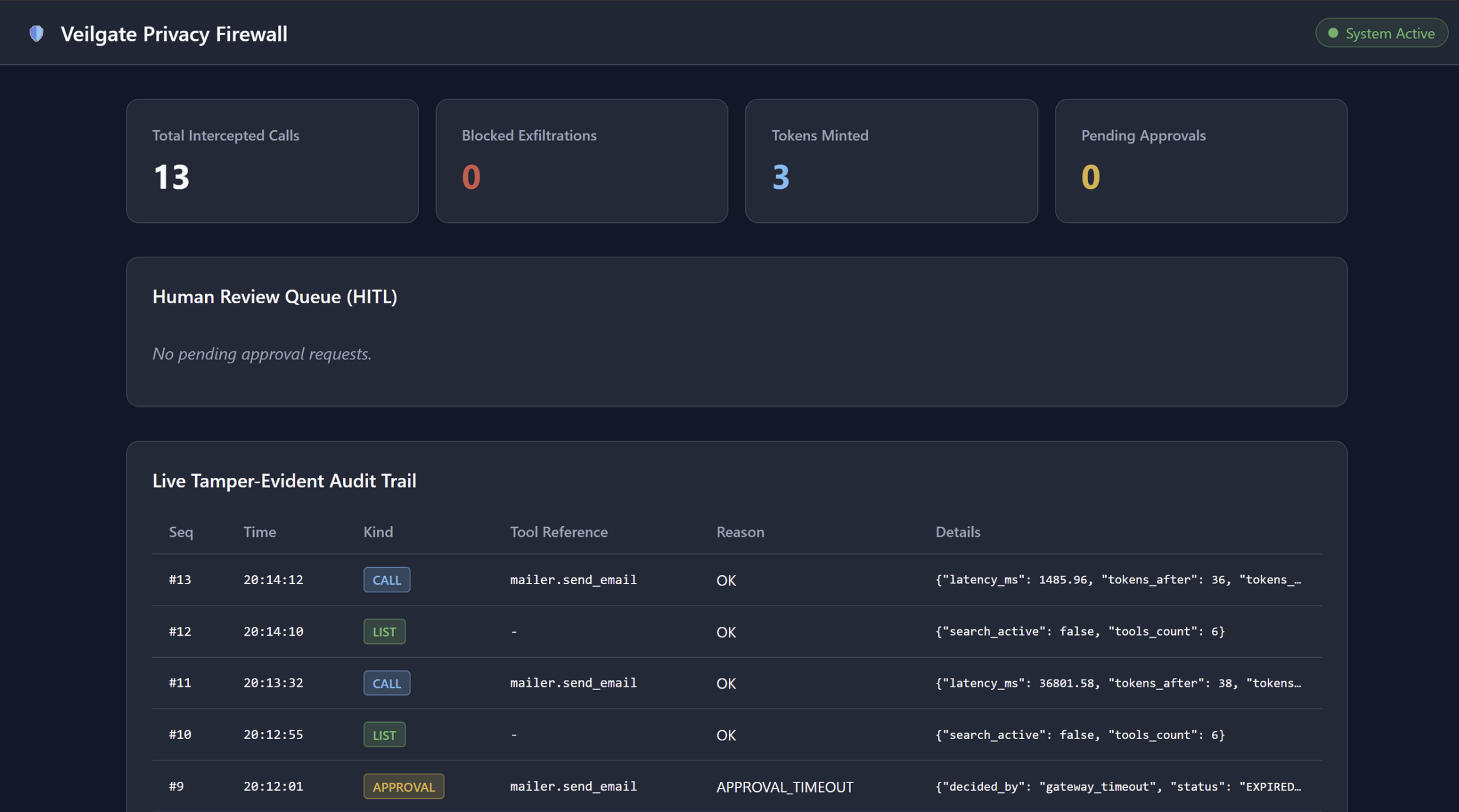
The local-first dashboard (http://localhost:8765) gives developers complete visibility into agentic operations:
- Minimization Metrics:
- Total Intercepted Calls: Lifetime count of all MCP tool executions.
- Blocked Exfiltrations: Real-time count of blocked unauthorized calls or taint policy violations.
- Tokens Minted: Number of sensitive values safely anonymized into
<vg:TYPE:ID>. - Pending Approvals: Real-time count of calls awaiting human review.
- Interactive Review Queue:
- Visual cards detailing the tool name, session ID, reason code, and sanitized argument preview.
- Action buttons with real-time feedback.
- Tamper-Evident Audit Stream:
- Live stream of all gateway events chronologically ordered.
- Cryptographic SHA-256 hashes linking each row to its predecessor (
prev_hash).
Audit Verification & Security
Veilgate maintains an append-only, tamper-evident cryptographic ledger:
# Verify integrity of all audit events
uv run veilgate audit verify

# Export audit trail to JSONL for SIEM ingestion
uv run veilgate audit export --output audit_export.jsonl

# Inspect details of a specific tool
uv run veilgate explain mailer.send_email
Running Tests
Veilgate maintains exhaustive test coverage across unit contracts and real-world attack vectors:
# Run all unit tests
uv run pytest tests/unit -q

# Run security attack suite (A1-A16 catalog)
uv run pytest tests/security -q

# Run test suite with coverage report
uv run pytest --cov=src/veilgate --cov-report=term-missing
Publishing to PyPI
Veilgate uses standard modern PyPA packaging powered by hatchling and twine:
# 1. Clean previous build artifacts
rm -rf dist build *.egg-info

# 2. Build sdist and wheel
uv run python -m build

# 3. Validate packages
uv run twine check dist/*

# 4. Upload to TestPyPI (optional verification)
uv run twine upload --repository testpypi dist/*

# 5. Upload to official PyPI
uv run twine upload dist/*
Resources & Support
- Documentation: https://github.com/OmH3/Veilgate
- Model Context Protocol Specification: https://modelcontextprotocol.io
- Issues & Bug Reports: https://github.com/OmH3/Veilgate/issues
- Discussions & Community: Discord Community
License
Veilgate is open-source software licensed under the MIT License.
1 maintainer

Metadata
1 maintainer
Release files for veilgate 0.1.2
For a detailed explanation of source distributions (sdists) and built distributions (wheels), please see the package formats documentation.
Source distribution (sdist)
| File | Size | Uploaded | Provenance | |
|---|---|---|---|---|
| veilgate-0.1.2.tar.gz | 696.8 kB | With provenance | Details |
Built distribution (wheel)
| File | Interpreter | ABI | Platform | Reset |
|---|---|---|---|---|
| veilgate-0.1.2-py3-none-any.whl | Python 3 | none | any | Details |
Total release size: 806.5 kB
Release files / veilgate-0.1.2.tar.gz
| Download URL | veilgate-0.1.2.tar.gz |
|---|---|
| Size | 696.8 kB |
| Tags | Source |
|
SHA-256 checksum How to use checksums |
e86480b851af1dbf9923206486bd39704a1542919210d91fad8e3121e08e3664
|
|
BLAKE2b-256 checksum How to use checksums |
aaaa0f9b05da01a7e29b134b291887cf91489729176e63ecd938584ff2a91b0d
|
| Upload date | |
|
Uploaded using Trusted Publishing? What is trusted publishing? |
Yes |
| Uploaded via |
twine/7.0.0 CPython/3.13.16
|
Provenance
Provenance describes where a file came from. On PyPI, provenance is shared via attestations, which provide a verifiable record of the build or publishing details. View details, limitations and caveats.


PyPI Publish Attestation
PyPI verified that this artifact, at this checksum, originated from the publisher listed below.
Signed by GitHub Actions, verified by PyPI on Oct 24, 2026.
Transparency logRelease files / veilgate-0.1.2-py3-none-any.whl
| Download URL | veilgate-0.1.2-py3-none-any.whl |
|---|---|
| Size | 109.8 kB |
| Tags | Python 3 |
|
SHA-256 checksum How to use checksums |
639aa4e4c1704e2e6adba1426758d888dce4d6c17a09e1f361ca838ecf68148e
|
|
BLAKE2b-256 checksum How to use checksums |
a2af0f3a30f2e69292b766c5d367fd23e6b7a0b4c054635a242cfb31de6823c2
|
| Upload date | |
|
Uploaded using Trusted Publishing? What is trusted publishing? |
Yes |
| Uploaded via |
twine/7.0.0 CPython/3.13.16
|
Provenance
Provenance describes where a file came from. On PyPI, provenance is shared via attestations, which provide a verifiable record of the build or publishing details. View details, limitations and caveats.
PyPI Publish Attestation
PyPI verified that this artifact, at this checksum, originated from the publisher listed below.
Signed by GitHub Actions, verified by PyPI on Oct 24, 2026.
Transparency logSecurity for veilgate 0.1.2
Provenance
Provenance describes where a file came from. On PyPI, provenance is shared via attestations, which provide a verifiable record of the build or publishing details. View details, limitations and caveats.
Full provenance
All 2 files in this release have been uploaded with provenance metadata.
Attestation for veilgate-0.1.2.tar.gz
PyPI Publish Attestation
PyPI verified that this artifact, at this checksum, originated from the publisher listed below.
Signed by GitHub Actions, verified by PyPI on Oct 24, 2026.
Transparency logA note on package security
PyPI is a repository for distributing packages, not a service for auditing them. While third-party security researchers and our staff do their best to detect and remove malicious packages, PyPI cannot guarantee the quality, security or suitability of any given package.
To learn more about protecting yourself from malicious actors, visit our package security documentation.














