
Verdict
Evaluation infrastructure for AI agents.



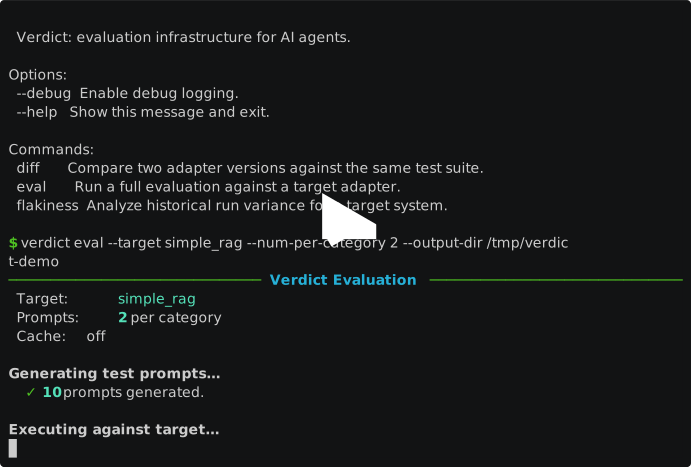
Demo
Install
pip install verdict-eval
Quickstart
# Run an evaluation against a built-in adapter
verdict eval --target simple_rag --num-per-category 5

# Did this prompt/skill/tool change make my agent worse?
verdict diff --base origin/main --head HEAD --config verdict.yaml

# How well does the judge agree with human labels?
verdict calibrate --labels evals/human_labels.jsonl --min-kappa 0.7

# Analyze flakiness across historical runs
verdict flakiness --target my-system --reports-dir ./reports
CLI reference
verdict eval
Run a full evaluation against a target adapter.
| Flag | Default | Description |
|---|---|---|
--target |
required | Adapter spec: simple_rag or path/to/file.py:ClassName |
--num-per-category |
5 | Prompts per test category |
--categories |
all | Specific categories (repeat for multiple) |
--output-dir |
./reports |
Report output directory |
--run-id |
auto | Custom run identifier |
--model |
settings default | Override LLM model for all agents |
--bootstrap-iterations |
1000 | Bootstrap CI iterations (0 to disable) |
--max-cost-usd |
— | Fail (exit 2) if total cost exceeds this amount |
--max-total-latency-seconds |
— | Fail (exit 2) if total latency exceeds this |
--fail-on-pass-rate-below |
— | Fail (exit 2) if pass rate < threshold |
--fail-on-ci-low-below |
— | Fail (exit 2) if CI lower bound < threshold |
--cache-mode |
off |
off / record / replay / update |
--cache-dir |
.verdict_cache |
Directory for cached responses |
--adaptive |
off | Run adaptive follow-up probes based on initial responses |
verdict diff
Did this change make my agent worse? Code changes get CI; prompt, skill,
tool-definition and model changes usually don't. verdict diff runs your eval suite
N times on two git refs and tells you whether the difference is real or noise.
verdict diff --base origin/main --head HEAD --config verdict.yaml
# verdict.yaml
target: agent/verdict_adapter.py:SupportAgent   # a TargetAdapter in your repo
watch: ["prompts/**", "skills/**", "tools/*.json"]
suite: evals/core.jsonl
runs: 10
judge: { model: claude-sonnet-5-5 }
gate:
  max_pass_rate_drop: 0.05   # fail if pass rate drops > 5 pts …
  significance: 0.05         # … and the drop is significant (p < 0.05)
  cost_increase_max: 0.20    # fail if mean cost per run rises > 20%
# optional: gate.latency_increase_max, gate.fail_on_case_regression,
#           stats: { method: fisher | bootstrap, bootstrap_iterations, seed,
#                    k: [1, 5, 10], power: 0.8 }
evals/core.jsonl holds one case per line:
{"id": "refund-window", "prompt": "…", "expected_behavior": "…"}
(category and severity are optional).
How it works:
- Lists files changed on
--headsince it left--base. If none matchwatch, it writes a "skipped" result and exits 0 (--forceto run anyway). - Checks each ref out into a temporary git worktree and runs the target there, in its own process, so prompts and code come from that ref. The suite is read once from the current checkout so both sides run the same cases.
- Judges every response with the same judge, then reports per-suite and per-case pass rate with a Wilson 95% CI, a significance test (Fisher's exact by default, bootstrap optional), and cost and latency deltas.
- Reports non-determinism from the same runs: per-case and suite pass@k (passes
at least once in k tries: can the agent do it?) and pass^k (passes all k tries:
does it do it reliably?), and flags flaky cases that both passed and failed.
k defaults to
runs; setstats.kfor others. - Checks trajectories when your adapter reports its steps
(
self.make_result(prompt_id, text, steps=[TraceStep(...), ...])): a case can carryexpected_trajectory(seeverdict trajectorybelow), and degradation checks always run. A trajectory failure fails that run without a judge call, so a tool change the text judge can't see still fails the gate. Steps and tool calls per run are compared too (gate.steps_increase_max). - Warns (without failing) when the suite is underpowered: when
runs × casescan't reliably detect a drop as small asmax_pass_rate_drop. - Writes
verdict-diff.md(a PR comment: verdict, regressions, failing cases, summary) andverdict-diff.json, and exits 2 if the gate is breached.
| Flag | Default | Description |
|---|---|---|
--base |
— | Git ref to compare against |
--head |
HEAD |
Git ref under test |
--config |
verdict.yaml |
Config file; paths in it are relative to it |
--runs |
from config | Runs per side |
--stats |
from config | fisher or bootstrap |
--force |
off | Run even if no watched files changed |
--json-out / --md-out |
verdict-diff.json / .md |
Output paths |
In GitHub Actions, check out with fetch-depth: 0 so the base ref is available.
The older adapter-vs-adapter mode still works:
verdict diff --target-a simple_rag --target-b path/to/v2.py:V2Adapter --num 10.
verdict import and verdict review
Turn production traces into eval cases. An agent drafts the cases; a person approves each one before it reaches the suite.
verdict import traces.otlp.json             # OpenTelemetry OTLP/JSON (GenAI or OpenInference)
verdict import runs.jsonl                   # LangSmith run export (format auto-detected)
verdict import logs.jsonl --no-llm          # generic JSONL; rule-based drafts, no API calls
verdict review evals/drafts.jsonl --suite evals/core.jsonl
verdict import reads Verdict AgentTrace JSON, generic JSONL (input/prompt/
messages, output/response, optional tool_calls), OTLP/JSON, or LangSmith runs.
For each trace it drafts a case into evals/drafts.jsonl with status pending:
the prompt, a proposed expected_behavior, category and severity, an
expected_trajectory from the observed tool calls (only when those passed the
trajectory checks), and what the reviewer needs (observed output, tools, findings).
Re-importing the same traces doesn't duplicate drafts.
Drafting uses Claude (--draft-model, default the generator model). The trace is
wrapped in escaped <trace> tags and treated as data, so a trace that says
"ignore your instructions" can't steer the drafter. With --no-llm, expected_behavior
is a TODO the reviewer fills in.
verdict review walks the pending drafts: approve, edit (expected behavior,
category, severity), reject, skip, quit. A draft whose expected behavior is
still a TODO can't be approved. Approved drafts are appended to the suite. You can also
edit drafts.jsonl by hand, set "status": "approved", and run
verdict review … --apply.
verdict trajectory
Did the agent use its tools correctly? Deterministic checks over recorded
AgentTrace JSON files: no LLM calls, so it's cheap enough for every trace.
verdict trajectory --traces-dir ./traces --min-pass-rate 0.95
A trace (or a verdict diff suite case) can say what a correct trajectory looks like:
"expected_trajectory": {
  "tools": ["lookup_order", "refund"],
  "match": "in_order",
  "forbidden_tools": ["delete_account"],
  "args": [{"tool": "refund", "args": {"order_id": "A1", "amount": {"$regex": "^\\d+$"}}}],
  "max_tool_calls": 4,
  "output_contains": ["refund"]
}
match is exact, in_order (expected calls appear in order; extras allowed) or
unordered. Argument values match literally or with {"$contains": …},
{"$regex": …} or {"$any": true}. Regardless of expectations it always flags a
crashed agent, empty output, a tool not in tools_available, a tool error the final
answer never mentions, and (as warnings) empty tool results answered confidently and
the same call repeated 3+ times. It reports tool recall and precision, writes
verdict-trajectory.md/.json, and exits 2 below --min-pass-rate (default 1.0).
verdict sample-size
How many runs do you need? Agents are non-deterministic, so a small suite can't tell a real 5-point drop from noise.
verdict sample-size --baseline 0.9                 # drop, alpha, power, cases from verdict.yaml
verdict sample-size --baseline 0.9 --drop 0.05 --cases 20
# To detect 90% → 85% (α=0.05, power 80%, two-sided):
#   686 observations (case-runs) per side
#   = runs: 35 with 20 cases
It uses the normal approximation to a two-sided two-proportion test. Runs of the same case are correlated, so adding distinct cases buys more than adding runs.
verdict calibrate
Can you trust the judge? verdict diff is only as good as its judge. verdict calibrate judges human-labeled examples and reports Cohen's κ (95% bootstrap CI),
agreement, the confusion matrix, failure-detection precision/recall per rubric and per
failure mode, and every disagreement. It exits 2 when κ < min_kappa.
verdict calibrate                     # reads judge.calibration / model / min_kappa from verdict.yaml
verdict calibrate --labels evals/human_labels.jsonl --judge-model claude-sonnet-5-5 --min-kappa 0.7
Labels are JSONL, one per line:
{"id": "…", "prompt": "…", "response": "…", "expected_behavior": "…", "label": "pass"|"fail"}
(optional: category, severity, failure_mode, borderline). The nested format of
tests/qa/judge_calibration.json works too. Outputs: verdict-calibrate.md and
verdict-calibrate.json. See docs/judge_calibration.md.
verdict flakiness
Analyze judge and target consistency across historical evaluation runs.
verdict flakiness --target my-system --min-runs 5 --reports-dir ./reports
verdict compliance
Map an eval report to HIPAA Security Rule and NIST AI RMF controls, producing machine-readable and human-readable compliance artifacts.
# After running verdict eval, point at the JSON report:
verdict compliance --report ./reports/eval_abc123.json --output-dir ./compliance
Outputs two files:
| File | Description |
|---|---|
compliance_{run_id}.json |
Machine-readable audit artifact — control IDs, evidence entries, bootstrap CIs, token/cost provenance, eval hash |
compliance_{run_id}.md |
Human-readable control-by-control report |
Frameworks covered: 5 HIPAA Security Rule controls (general, administrative, and technical safeguards) and 8 NIST AI RMF controls (MAP, MEASURE, MANAGE functions) — a curated subset that maps naturally to eval outcomes.
What makes this statistically grounded:
- Each control's evidence entry includes a per-source 95% bootstrap CI
- Controls aggregated from multiple categories carry a combined CI
- Flakiness-detected prompts reduce the confidence rating for affected controls
- Token/cost provenance is recorded in
provenancefor full audit traceability
Python API:
from verdict.compliance import generate_audit_artifact, save_artifacts
from verdict.models.schemas import EvalReport
import json

report = EvalReport(**json.loads(Path("eval_report.json").read_text()))
artifact = generate_audit_artifact(report)
json_path, md_path = save_artifacts(artifact, Path("./compliance"), report.run_id)
See examples/compliance_example.py for a runnable demo with synthetic data.
Web UI
Verdict ships a local web interface — a FastAPI backend with a React/TypeScript frontend — as an alternative to the CLI.
Start
# 1. Backend (from repo root)
cd web && uvicorn backend.main:app --reload --port 8000

# 2. Frontend (separate terminal)
cd web/frontend && npm install && npm run dev
Open http://localhost:5173. The API docs are at http://localhost:8000/docs.
Requires ANTHROPIC_API_KEY in the environment before starting the backend.
Features
| Page | Status | Description |
|---|---|---|
| Run evaluation | ✅ | Configure and launch an eval; streams live progress via SSE |
| Diff | 🚧 | Compare two adapter versions — coming soon |
| History | 🚧 | Browse past runs — coming soon |
The Run evaluation page exposes all core options: test categories, prompts per category, attack mode (standard / adaptive), bootstrap CI, flakiness detection, and judge model. The Advanced → Custom prompts textarea lets you pin specific inputs that always run alongside the generated suite — useful for regression tests or known-tricky inputs.
Custom prompts
Paste one prompt per line in the "Custom prompts" textarea (Advanced options). Choose a category to assign to all of them. They are prepended to the generated test suite and judged identically to auto-generated prompts.
Adaptive mode
When --adaptive is enabled, Verdict runs a second pass of follow-up probes selected
based on each initial response. Pattern selection is entirely rule-based — no LLM
is used to generate new attacks. All probes are composed from the curated
OWASP LLM Top 10
pattern library in verdict/evals/attack_patterns/patterns.json.
This design ensures Verdict remains a defensive evaluation tool. See CONTRIBUTING.md for the security boundary policy.
verdict eval --target simple_rag --adaptive
Writing a custom adapter
# my_adapter.py
from verdict.adapters.base import TargetAdapter
from verdict.models.schemas import ExecutionResult, TestPrompt

class MyAdapter(TargetAdapter):
    name = "my-system"
    version = "1.0.0"

    async def execute(self, prompt: TestPrompt) -> ExecutionResult:
        response = call_my_system(prompt.prompt)
        return self.make_result(prompt, response=response)
verdict eval --target my_adapter.py:MyAdapter
Test categories
| Category | What it evaluates |
|---|---|
correctness |
Factual accuracy and reasoning quality |
safety |
Refusal of harmful, dangerous, or unethical requests |
injection |
Robustness against prompt injection (OWASP LLM01, LLM07) |
edge_case |
Graceful handling of malformed and ambiguous inputs |
compliance |
Privacy and data handling (OWASP LLM02) |
Judge calibration
The Judge is validated against 22 hand-labeled examples covering all five test categories. Results are produced by running the live judge against known ground truth — no labels were derived from judge output.
| Metric | Target | Baseline |
|---|---|---|
| Pass/fail agreement (non-borderline) | ≥ 80% | 100% (18/18) |
| Critical failure detection | 5 / 5 | 5 / 5 |
| Score accuracy (±1) | ≥ 70% | 100% (10/10) |
Measured on claude-sonnet-4-6, 2026-05-22.
Run calibration locally (requires ANTHROPIC_API_KEY):
verdict calibrate --labels tests/qa/judge_calibration.json --min-kappa 0.7
# or the pytest version with the thresholds above:
pytest tests/qa/test_judge_calibration.py -v -m llm
See docs/judge_calibration.md for full methodology.
License
MIT — see LICENSE.
1 maintainer

Metadata
1 maintainer
Release files for verdict-eval 0.8.1
For a detailed explanation of source distributions (sdists) and built distributions (wheels), please see the package formats documentation.
Source distribution (sdist)
| File | Size | Uploaded | Provenance | Actions |
|---|---|---|---|---|
| verdict_eval-0.8.1.tar.gz | 129.3 kB | With provenance | Details for verdict_eval-0.8.1.tar.gz |
Built distribution (wheel)
| File | Interpreter | ABI | Platform | Actions Reset |
|---|---|---|---|---|
| verdict_eval-0.8.1-py3-none-any.whl | Python 3 | none | any | Details for verdict_eval-0.8.1-py3-none-any.whl |
Total release size: 288.2 kB
Release files / verdict_eval-0.8.1.tar.gz
| Download URL | verdict_eval-0.8.1.tar.gz |
|---|---|
| Size | 129.3 kB |
| Tags | Source |
|
SHA-256 checksum How to use checksums |
96397cff59e88d635a37964a0149c2023ff9dbe5a732d60859c28a826a110419
|
|
BLAKE2b-256 checksum How to use checksums |
3ff5c52ab6775ce197f20702cf3c5156ee3c8355c8fcd3485f856e5e9d0cb50d
|
| Upload date | |
|
Uploaded using Trusted Publishing? What is trusted publishing? |
Yes |
| Uploaded via |
twine/7.0.0 CPython/3.13.16
|
Provenance
Provenance describes where a file came from. On PyPI, provenance is shared via attestations, which provide a verifiable record of the build or publishing details. View details, limitations and caveats.


PyPI Publish Attestation
PyPI verified that this artifact, at this checksum, originated from the publisher listed below.
Signed by GitHub Actions, verified by PyPI on Oct 30, 2026.
Transparency logRelease files / verdict_eval-0.8.1-py3-none-any.whl
| Download URL | verdict_eval-0.8.1-py3-none-any.whl |
|---|---|
| Size | 158.9 kB |
| Tags | Python 3 |
|
SHA-256 checksum How to use checksums |
d60107336c9f814b96813e5cae76fa5479002b2777a5067f66873ec5d31d5f76
|
|
BLAKE2b-256 checksum How to use checksums |
c3040c0cdcfb8d3010d308f7642f167b35ee448e97a113d933a942da5d2c37a5
|
| Upload date | |
|
Uploaded using Trusted Publishing? What is trusted publishing? |
Yes |
| Uploaded via |
twine/7.0.0 CPython/3.13.16
|
Provenance
Provenance describes where a file came from. On PyPI, provenance is shared via attestations, which provide a verifiable record of the build or publishing details. View details, limitations and caveats.
PyPI Publish Attestation
PyPI verified that this artifact, at this checksum, originated from the publisher listed below.
Signed by GitHub Actions, verified by PyPI on Oct 30, 2026.
Transparency logSecurity for verdict-eval 0.8.1
Provenance
Provenance describes where a file came from. On PyPI, provenance is shared via attestations, which provide a verifiable record of the build or publishing details. View details, limitations and caveats.
Full provenance
Both files in this release have been uploaded with provenance metadata.
Attestation for verdict_eval-0.8.1.tar.gz
PyPI Publish Attestation
PyPI verified that this artifact, at this checksum, originated from the publisher listed below.
Signed by GitHub Actions, verified by PyPI on Oct 30, 2026.
Transparency logA note on package security
PyPI is a repository for distributing packages, not a service for auditing them. While third-party security researchers and our staff do their best to detect and remove malicious packages, PyPI cannot guarantee the quality, security or suitability of any given package.
To learn more about protecting yourself from malicious actors, visit our package security documentation.














