
vibelint
Find the mistakes AI leaves behind in your code.
Your ai assistant writes code that imports cleanly, reads well, and looks finished. Some of it does nothing. vibelint runs over a Python project like a test suite and reports every place the model invented an API, left a function unwritten, swallowed an error, or produced a test that cannot fail.
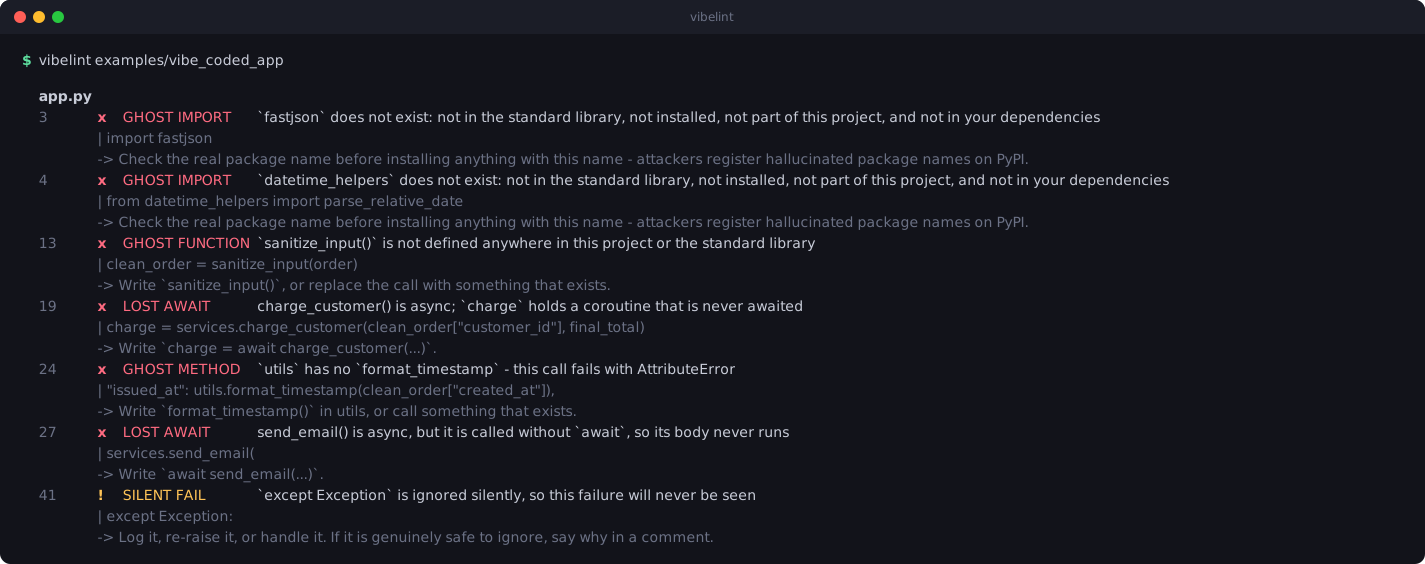
In full (not --quiet) it shows the offending line and what to do about it:
$ vibelint examples/vibe_coded_app

  app.py
      3  x  GHOST IMPORT      `fastjson` does not exist: not in the standard library, not
                              installed, not part of this project, and not in your dependencies
         |  import fastjson
         -> Check the real package name before installing anything with this name -
            attackers register hallucinated package names on PyPI.

     13  x  GHOST FUNCTION    `sanitize_input()` is not defined anywhere in this project
         |  clean_order = sanitize_input(order)

     27  x  LOST AWAIT        send_email() is async, but it is called without `await`,
                              so its body never runs
         |  services.send_email(
         -> Write `await send_email(...)`.

  tests/test_orders.py
     14  x  TEST THEATER      test_truncate_long_text() runs code but never asserts anything,
                              so it can only fail if the code crashes
     21  x  FAKE ASSERT       `assert 1 == 1` is true no matter what the code does

  ────────────────────────────────────────────────────────────
  25 flops  ·  15 critical  ·  10 warning  ·  5 of 5 files affected
  checked in 0.18s
Why this is not just another linter
Existing linters check style and syntax — things a human gets wrong. Generated code fails differently. It is syntactically perfect and semantically hollow.
Nothing else catches these, because until recently nothing wrote them at scale:
- A test that sets up an elaborate scenario and then asserts nothing.
- A function with a thorough docstring describing behaviour it does not have.
client.send_json()— a method name so plausible you never think to check it exists.# In a real implementation, you would validate the token here— shipped to production.
Install
pip install vibelint
Zero dependencies. Python 3.9+. Windows, macOS and Linux. It never runs, imports, or evaluates the code it analyses — everything is read from the syntax tree.
If pip or vibelint isn't found
macOS / Linux — the system Python has no pip command, only the module,
and installed scripts land somewhere not on PATH:
python3 -m pip install --user vibelint
python3 -m vibelint .                     # always works
To type vibelint directly, add the script directory to your shell:
echo 'export PATH="$HOME/Library/Python/3.9/bin:$PATH"' >> ~/.zshrc # macOS
Windows — use the launcher if pip isn't on PATH:
py -m pip install vibelint
py -m vibelint .
python -m vibelint is equivalent to the vibelint command everywhere, so it
is the reliable form when PATH is uncooperative.
Use
vibelint                   # check the current directory
vibelint src/              # check one directory
vibelint app.py            # check a single file

vibelint --only VC040      # only test-theater findings
vibelint --ignore VC030    # hide a rule you disagree with
vibelint --json            # machine-readable, for CI
vibelint --list            # describe every check
Silence a single line:
result = risky()  # vibelint: ignore
result = risky()  # noqa: VC030
Exit codes: 0 clean, 1 findings at or above --fail-on (default warning), 2 usage error.
What it catches
| Code | Check | What it means |
|---|---|---|
VC001 |
GHOST IMPORT | Package does not exist anywhere — not stdlib, not installed, not declared, not local |
VC002 |
GHOST FUNCTION | A call to a function that was never written |
VC003 |
GHOST METHOD | A method that does not exist on the module it is called on |
VC010 |
PLACEHOLDER | A function with a docstring and no implementation |
VC011 |
MODEL CONFESSION | A comment where the model admits the code is not real |
VC020 |
FAKE VALUE | Placeholder credentials wired into live code |
VC021 |
FAKE ENDPOINT | example.com used as a real service |
VC022 |
FAKE FALLBACK | os.getenv("KEY", "your-key-here") — fails silently in production |
VC030 |
SILENT FAIL | Errors caught and discarded |
VC031 |
SWALLOWED RETURN | return inside finally, which throws away the exception |
VC040 |
TEST THEATER | A test that asserts nothing and cannot fail |
VC041 |
FAKE ASSERT | assert True — true regardless of the code |
VC042 |
MOCK TAUTOLOGY | A test that only asserts on values it mocked itself |
VC050 |
LOST AWAIT | An async function called without await, so it never runs |
VC051 |
BLOCKING ASYNC | time.sleep() inside async def, freezing the event loop |
It stays quiet on good code
A linter that cries wolf gets uninstalled. Every rule is calibrated against real, mature, human-written code rather than tuned only to catch things.
Across 241 files of pip and setuptools source, vibelint reports 2 critical findings. Nearly all of the remaining output is VC030 — real error-swallowing that is genuinely there.
Getting to that number meant teaching the checks about how Python is actually written:
raise NotImplementedErrorin a base class is informal abstract, not an unfinished job.except KeyboardInterrupt:with a real handler body is correct; only discarding it is a bug.try: import tomllib / except ImportError: import tomliis a compatibility shim, not a hallucination.- A package in
requirements.txtbut not installed is your setup, not the model's invention. - Vendored directories are somebody else's code and are skipped.
Speed
The whole Python standard library - 680 files, 306,000 lines - takes about 27 seconds on a laptop, or roughly 11,000 lines a second. A normal project is a fraction of that: a few thousand lines finishes before you lift your hand off the keyboard.
Each file is parsed once and its nodes bucketed by type, so adding a sixteenth check costs almost nothing - the tree is already walked.
In CI
- name: vibelint
  run: |
    pip install vibelint
    vibelint . --fail-on critical
How it works
- Index — parse every file and record what the project genuinely defines: functions, classes, methods, class hierarchies, async definitions.
- Check — walk each file once, bucket the nodes by type, and run all fifteen rules against that shared view.
- Report — group findings by file, ranked by severity, each with the offending line and a concrete fix.
The index is what makes ghost detection possible: no single file can tell you whether helpers.format_date() is real, but the whole project can.
Roadmap
- JavaScript / TypeScript. The flops are identical in every language — only the parser is Python-specific, and the checks are deliberately separated from parsing.
- Editor integration, so findings appear as you accept a suggestion rather than afterwards.
- Config file for per-project severity overrides.
Contributing
A new rule is one Check subclass and one line in the registry. The bar for merging: it must fire on generated code and stay silent on pip and setuptools.
git clone <repo> && cd vibelint
pip install -e ".[dev]"
python -m pytest tests/ -q
vibelint examples/vibe_coded_app     # should report 25 flops
The README demo and the social card are both generated from the tool's real output, so they cannot drift from what it actually prints:
python3 tools/make_demo.py      # -> demo.svg
python3 tools/make_social.py    # -> social-preview.png  (macOS)
License
MIT
1 maintainer

Metadata
1 maintainer
Release files for vibelint 0.3.1
For a detailed explanation of source distributions (sdists) and built distributions (wheels), please see the package formats documentation.
Source distribution (sdist)
| File | Size | Uploaded | |
|---|---|---|---|
| vibelint-0.3.1.tar.gz | 63.8 kB | Details |
Built distribution (wheel)
| File | Interpreter | ABI | Platform | Reset |
|---|---|---|---|---|
| vibelint-0.3.1-py3-none-any.whl | Python 3 | none | any | Details |
Total release size: 118.7 kB
Release files / vibelint-0.3.1.tar.gz
| Download URL | vibelint-0.3.1.tar.gz |
|---|---|
| Size | 63.8 kB |
| Tags | Source |
|
SHA-256 checksum How to use checksums |
d3318471236d721886b052e5b887a982f9750a765df23bd278fb9d0a1c0444c7
|
|
BLAKE2b-256 checksum How to use checksums |
a1e40c92d5fca7aa2b5142d1550caba9442d5bcc3459133c9669d061748304ad
|
| Upload date | |
|
Uploaded using Trusted Publishing? What is trusted publishing? |
No |
| Uploaded via |
twine/6.2.0 CPython/3.9.6
|
Release files / vibelint-0.3.1-py3-none-any.whl
| Download URL | vibelint-0.3.1-py3-none-any.whl |
|---|---|
| Size | 55.0 kB |
| Tags | Python 3 |
|
SHA-256 checksum How to use checksums |
e056e47432d40e8a8cf887a96f16d39c1a2f54bd51f41223b14e31bae22e1a10
|
|
BLAKE2b-256 checksum How to use checksums |
c2c4f4a58788879c1db56e3157a65e727cfbf09c4ed799e0a82bf880bf20cdbf
|
| Upload date | |
|
Uploaded using Trusted Publishing? What is trusted publishing? |
No |
| Uploaded via |
twine/6.2.0 CPython/3.9.6
|














