
VibeNet: Music Emotion Prediction
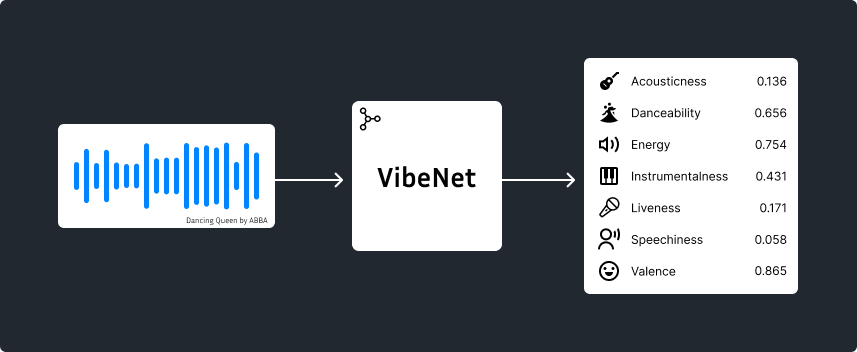
A while ago I canceled my Spotify subscription and began building my own offline music library. But something I always missed was Spotify's ability to generate smart playlists like Morning Mix or Driving Vibes. Spotify doesn't publish how its algorithm creates these playlists, so I set out to build my own system.
VibeNet is a lightweight all-in-one Python package, Beets plugin, and command-line tool that predicts musical emotions and attributes (valence, energy, danceability, acousticness, etc.) directly from raw audio. It utilizes a distilled EfficientNet student model trained with teacher-student distillation on the Free Music Archive (FMA) dataset.
To get started, install the VibeNet package.
pip install vibenet
Then, follow the quick links below.
Quick Links
There are a few different ways to use VibeNet depending on your intended use case.
- Beets plugin - By far the best option for using VibeNet to tag and classify your personal music collection
- MusicBrainz Picard - Coming soon!
- Python package - Best if you want to build on top VibeNet or you need the maximum flexibility
- Command line (CLI) - Best for one-off labeling tasks and general usage.
What attributes are predicted?
VibeNet predicts 7 continuous attributes for each audio track: acousticness, danceability, energy, instrumentalness, liveness, speechiness, and valence.
Some features (like acousticness, instrumentalness, and liveness) are likelihoods: they represent probabilities of that characteristic being present (e.g. probability the track is acoustic). Others (like danceability, energy, valence) are continuous descriptors: they describe how much of the quality the track has.
For example, an acousticness value of 0.85 doesn't mean that 85% of the track is composed of acoustic instruments. It means that it's highly likely that the recording is acoustic and not electronic.
Conversely, an energy value of 0.15 doesn't mean that it's highly unlikely that the song is energetic. It reflects a degree of the quality itself, meaning that the track is overall perceived as having very low intensity.
Below is a table describing each attribute in more detail:
| Attribute | Type | Description |
|---|---|---|
| Acousticness | Likelihood | A measure of how likely a track is to be acoustic rather than electronically produced. High values indicate recordings that rely on natural, unprocessed sound sources (e.g. solo guitar, piano ballad, etc.). Low values indicate tracks that are primarily electronic or produced with synthetic instrumentation (e.g. EDM, trap, etc.) |
| Instrumentalness | Likelihood | Predicts whether a track contains no vocals. Higher values suggest that the track contains no vocal content (e.g. symphonies), while lower values indicate the the presence of sung or spoken vocals (e.g. rap). |
| Liveness | Likelihood | A measure of how likely the track is to be a recording of a live performance. Higher values suggest the presence of live-performance characteristics (crowd noise, reverberation, stage acoustics), while lower values suggest a studio recording. |
| Danceability | Descriptor | Describes how suitable a track is for dancing. Tracks with higher values (closer to 1.0) tend to feel more danceable while, lower values (closer to 0.0) may feel less danceable. |
| Energy | Descriptor | Also known as arousal. Measures the perceived intensity and activity level of a track. Higher values indicate tracks that feel fast, loud, and powerful, while lower values indicate tracks that feel calm, soft, or subdued. |
| Valence | Descriptor | Measures the musical positivity conveyed by a track. Higher values indicate tracks that sound more positive (e.g. happy, cheerful, euphoric), while lower values indicate tracks that sound more negative (e.g. sad, depressed, angry). |
| Speechiness | Descriptor | Measures the presence of spoken words in a track. Higher values indicate that the recording is more speech-like (e.g. podcasts), while lower values suggest that the audio is more musical, with singing or purely instrumental content. Mid-range values often correspond to tracks that mix both elements, such as spoken-word poetry layered over music. |
Usage
Beets Plugin
This option is best for tagging a large music library, for example if you want to create playlists organized by mood.
beets is a powerful program for managing your music library. If you have a large collection of mp3/flac files, you're probably already familiar with this tool. If you aren't, I would recommend you first visit https://beets.io and take a moment to learn your way around the tool.
Click to expand
Installation
Install the VibeNet package into the same virtual environment as your beets installation
pip install vibenet
and activate the plugin by adding it to your beets configuration (Run beet config -e to edit your config file)
plugins:
    - vibenet
Configuration
To configure the plugin, make a vibenet: section in your beets configuration file. For example:
vibenet:
    auto: yes
    force: no
    threads: 0
- auto: Enable VibeNet during
beet import. Default:yes - force: Perform prediction on tracks that already have all fields. Default:
no - threads: The number of CPU threads to use for inference. Default: all available threads
Usage
By default, the plugin tags files automatically during import. You can optionally run the vibenet command manually. For a list of all CLI options:
beet vibenet --help
Once your files are tagged, you can do some pretty cool things with beets. For example, if I wanted to find all songs by ABBA with a high valence score:
beet ls artist:=ABBA valence:0.7..
Or to build a party playlist of upbeat tracks:
beet ls valence:0.6.. energy:0.7..
Or maybe a calm but inspirational study playlist composed of instrumental tracks:
beet ls instrumentalness:0.9.. energy:..0.3 valence:0.8..
To get the most out of beets, you should understand how its query strings work.
Python package
You can use VibeNet as a module in your own Python projects.
Click to expand
Installation
Install the VibeNet package.
pip install vibenet
Usage
Check the Model class in vibenet/core.py for full details. Below are a few examples:
Inference on a single audio file
from vibenet import load_model

model = load_model()
print(model.predict("Dancing Queen.flac"))
[InferenceResult(acousticness=0.34442428835652833, danceability=0.6195424795150757, energy=0.7037929892539978, instrumentalness=0.7138845214492101, liveness=0.1604615680649649, speechiness=0.04466772451996803, valence=0.8822445869445801)]
Inference on multiple audio files
from vibenet import load_model

model = load_model()
print(model.predict(["Dancing Queen.flac", "Money, Money, Money.flac"]))
[InferenceResult(acousticness=0.34442428835652833, danceability=0.6195424795150757, energy=0.7037929892539978, instrumentalness=0.7138845214492101, liveness=0.1604615680649649, speechiness=0.04466772451996803, valence=0.8822445869445801), InferenceResult(acousticness=0.6901674220217361, danceability=0.6556591987609863, energy=0.4812447428703308, instrumentalness=0.7523727231956888, liveness=0.14662341130452025, speechiness=0.06765997409820557, valence=0.9115567207336426)]
The input to the predict method can be an array of file paths or raw waveforms (np.ndarray). If the inputs are waveforms, the sample rate must be provided as well. The output of the predict method is an array of InferenceResult, with the index of each output corresponding to the respective index in the input.
Command Line
The VibeNet package includes a command line script as well.
Click to expand
Installation
Install the VibeNet package.
pip install vibenet
Usage
Use vibenet --help to get a full explanation of usage format. Below are a few examples:
Output predictions for a single file
$ vibenet '02 Dancing Queen.flac'
Predicting ━━━━━━━━━━━━━━━━━━━━━━━━━━━━━━━━━━━━━━━━ 100% 0:00:00
┏━━━━━━━━━━━━━━━━━━┳━━━━━━━━━━━━━━┳━━━━━━━━━━━━━━┳━━━━━━━━┳━━━━━━━━━━━━━━━━━━┳━━━━━━━━━━┳━━━━━━━━━━━━━┳━━━━━━━━━┓
┃ path             ┃ acousticness ┃ danceability ┃ energy ┃ instrumentalness ┃ liveness ┃ speechiness ┃ valence ┃
┡━━━━━━━━━━━━━━━━━━╇━━━━━━━━━━━━━━╇━━━━━━━━━━━━━━╇━━━━━━━━╇━━━━━━━━━━━━━━━━━━╇━━━━━━━━━━╇━━━━━━━━━━━━━╇━━━━━━━━━┩
│ 02 Dancing       │ 0.344        │ 0.620        │ 0.704  │ 0.714            │ 0.160    │ 0.045       │ 0.882   │
│ Queen.flac       │              │              │        │                  │          │             │         │
└──────────────────┴──────────────┴──────────────┴────────┴──────────────────┴──────────┴─────────────┴─────────┘
Process a whole directory, and output the results in CSV format
$ vibenet -f csv *
Predicting ━━━━━━━━━━━━━━━━━━━━━━━━━━━━━━━━━━━━━━━━ 100% 0:00:00
path,acousticness,danceability,energy,instrumentalness,liveness,speechiness,valence
04 Dum Dum Diddle.flac,0.4607604851395908,0.6557254791259766,0.4954206943511963,0.5706152901750524,0.14939714126869905,0.04425659030675888,0.9304299354553223
10 Arrival.flac,0.7492030794013365,0.3940376341342926,0.3149440884590149,0.909781333152513,0.16115917859422296,0.06442416459321976,0.07757408916950226
01 When I Kissed the Teacher.flac,0.4503387044857127,0.574401319026947,0.6448520421981812,0.3958653381113854,0.1827700968370561,0.039843928068876266,0.8254069089889526
07 That’s Me.flac,0.18465114617230102,0.6521217226982117,0.6456546187400818,0.6775099224832243,0.17600368615142495,0.057180166244506836,0.8024619817733765
"06 Money, Money, Money.flac",0.6901674220217361,0.6556591987609863,0.4812447428703308,0.7523727231956888,0.14662341130452025,0.06765997409820557,0.9115567207336426
09 Tiger.flac,0.3625403656002167,0.5708804130554199,0.6882965564727783,0.6308650228026009,0.179473740246014,0.044405993074178696,0.8011720180511475
08 Why Did It Have to Be Me.flac,0.8084378055338943,0.5141943693161011,0.5882516503334045,0.7828053421798725,0.16900709319657073,0.03991405665874481,0.8868117332458496
"05 Knowing Me, Knowing You.flac",0.20703727138284786,0.6520654559135437,0.5237798690795898,0.44584756563169287,0.16008894555350467,0.05200740322470665,0.8240906000137329
"03 My Love, My Life.flac",0.803182653487076,0.4552169442176819,0.23595675826072693,0.6472388734467308,0.1453882503527327,0.03054790198802948,0.1411082148551941
02 Dancing Queen.flac,0.34442428835652833,0.6195424795150757,0.7037929892539978,0.7138845214492101,0.1604615680649649,0.04466772451996803,0.8822445869445801
How it works
A more detailed explanation is coming soon! All scripts/notebooks used to train the model are provided in this GitHub repository.
References
Training was completed on an NVIDIA A100 GPU.
The FMA dataset was used to train the teacher model, with labels provided by Echonest.
The embeddings from PANNs were used to form the backbone for the teacher model.
VGGish (by Google) was also experimented with as a potential backbone model.
The EfficientNet model was used as the backbone for the student model, with implementation provided by the torchvision package.
1 maintainer

Metadata
1 maintainer
Release files for vibenet 0.1.0
For a detailed explanation of source distributions (sdists) and built distributions (wheels), please see the package formats documentation.
Source distribution (sdist)
| File | Size | Uploaded | |
|---|---|---|---|
| vibenet-0.1.0.tar.gz | 16.4 MB | Details |
Built distribution (wheel)
| File | Interpreter | ABI | Platform | Reset |
|---|---|---|---|---|
| vibenet-0.1.0-py3-none-any.whl | Python 3 | none | any | Details |
Total release size: 32.7 MB
Release files / vibenet-0.1.0.tar.gz
| Download URL | vibenet-0.1.0.tar.gz |
|---|---|
| Size | 16.4 MB |
| Tags | Source |
|
SHA-256 checksum How to use checksums |
a1fcfb47cbacef341f90ca2e3dbff22f44c964d23e9a6a2c4cfd1a9bca94dd20
|
|
BLAKE2b-256 checksum How to use checksums |
d2a391b00723d1bda354dd879fbe9ad24cc393780825eec5723de686d20c94e0
|
| Upload date | |
|
Uploaded using Trusted Publishing? What is trusted publishing? |
No |
| Uploaded via |
twine/6.1.0 CPython/3.13.5
|
Release files / vibenet-0.1.0-py3-none-any.whl
| Download URL | vibenet-0.1.0-py3-none-any.whl |
|---|---|
| Size | 16.4 MB |
| Tags | Python 3 |
|
SHA-256 checksum How to use checksums |
3474fd65a9723f0f58f511e77d1641ea937f11b8d75e906bcda2da9cad3094f5
|
|
BLAKE2b-256 checksum How to use checksums |
656d74efa43636d1003d00e8c60f8a5cbb2f5d05b3482929bade384e0fe57787
|
| Upload date | |
|
Uploaded using Trusted Publishing? What is trusted publishing? |
No |
| Uploaded via |
twine/6.1.0 CPython/3.13.5
|














