
vit-keras
This is a Keras implementation of the models described in An Image is Worth 16x16 Words: Transformes For Image Recognition at Scale. It is based on an earlier implementation from tuvovan, modified to match the Flax implementation in the official repository.
The weights here are ported over from the weights provided in the official repository. See utils.load_weights_numpy to see how this is done (it's not pretty, but it does the job).
Usage
Install this package using pip install vit-keras
You can use the model out-of-the-box with ImageNet 2012 classes using something like the following. The weights will be downloaded automatically.
from vit_keras import vit, utils

image_size = 384
classes = utils.get_imagenet_classes()
model = vit.vit_b16(
    image_size=image_size,
    activation='sigmoid',
    pretrained=True,
    include_top=True,
    pretrained_top=True
)
url = 'https://upload.wikimedia.org/wikipedia/commons/d/d7/Granny_smith_and_cross_section.jpg'
image = utils.read(url, image_size)
X = vit.preprocess_inputs(image).reshape(1, image_size, image_size, 3)
y = model.predict(X)
print(classes[y[0].argmax()]) # Granny smith
You can fine-tune using a model loaded as follows.
image_size = 224
model = vit.vit_l32(
    image_size=image_size,
    activation='sigmoid',
    pretrained=True,
    include_top=True,
    pretrained_top=False,
    classes=200
)
# Train this model on your data as desired.
Visualizing Attention Maps
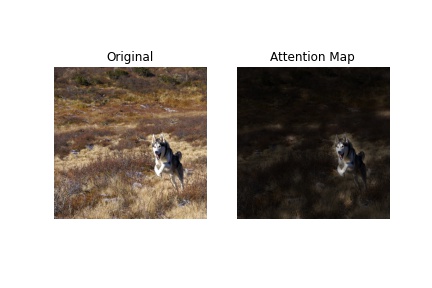
There's some functionality for plotting attention maps for a given image and model. See example below. I'm not sure I'm doing this correctly (the official repository didn't have example code). Feedback /corrections welcome!
import numpy as np
import matplotlib.pyplot as plt
from vit_keras import vit, utils, visualize

# Load a model
image_size = 384
classes = utils.get_imagenet_classes()
model = vit.vit_b16(
    image_size=image_size,
    activation='sigmoid',
    pretrained=True,
    include_top=True,
    pretrained_top=True
)
classes = utils.get_imagenet_classes()

# Get an image and compute the attention map
url = 'https://upload.wikimedia.org/wikipedia/commons/b/bc/Free%21_%283987584939%29.jpg'
image = utils.read(url, image_size)
attention_map = visualize.attention_map(model=model, image=image)
print('Prediction:', classes[
    model.predict(vit.preprocess_inputs(image)[np.newaxis])[0].argmax()]
)  # Prediction: Eskimo dog, husky

# Plot results
fig, (ax1, ax2) = plt.subplots(ncols=2)
ax1.axis('off')
ax2.axis('off')
ax1.set_title('Original')
ax2.set_title('Attention Map')
_ = ax1.imshow(image)
_ = ax2.imshow(attention_map)
1 maintainer

Metadata
1 maintainer
Release files for vit-keras 0.2.0
For a detailed explanation of source distributions (sdists) and built distributions (wheels), please see the package formats documentation.
Source distribution (sdist)
| File | Size | Uploaded | Provenance | Actions |
|---|---|---|---|---|
| vit_keras-0.2.0.tar.gz | 140.9 kB | Without provenance | Details for vit_keras-0.2.0.tar.gz |
Built distribution (wheel)
| File | Interpreter | ABI | Platform | Actions Reset |
|---|---|---|---|---|
| vit_keras-0.2.0-py3-none-any.whl | Python 3 | none | any | Details for vit_keras-0.2.0-py3-none-any.whl |
Total release size: 165.5 kB
Release files / vit_keras-0.2.0.tar.gz
| Download URL | vit_keras-0.2.0.tar.gz |
|---|---|
| Size | 140.9 kB |
| Tags | Source |
|
SHA-256 checksum How to use checksums |
fcff0397f94187823cbf8f5a453b7836b1cd365a7c9e6c422c2e959f8babb1dc
|
|
BLAKE2b-256 checksum How to use checksums |
d29c2cc182b43a0924aa23f03a5b4d22052d5353dfb06ee2bbc9ba6ee4dc2026
|
| Upload date | |
|
Uploaded using Trusted Publishing? What is trusted publishing? |
No |
| Uploaded via |
twine/6.1.0 CPython/3.11.6
|
Release files / vit_keras-0.2.0-py3-none-any.whl
| Download URL | vit_keras-0.2.0-py3-none-any.whl |
|---|---|
| Size | 24.6 kB |
| Tags | Python 3 |
|
SHA-256 checksum How to use checksums |
a1a48b8cbe01895d420cb2b4e96512e7839022347c8733a8fb223fb8fec7510d
|
|
BLAKE2b-256 checksum How to use checksums |
660db2ea088fd10306b9914229e6eb7e82cb02ac0daaa3e81aff7412b75c278b
|
| Upload date | |
|
Uploaded using Trusted Publishing? What is trusted publishing? |
No |
| Uploaded via |
twine/6.1.0 CPython/3.11.6
|
Security for vit-keras 0.2.0
Provenance
Provenance describes where a file came from. On PyPI, provenance is shared via attestations, which provide a verifiable record of the build or publishing details. View details, limitations and caveats.
No provenance found
None of the files in this release were uploaded with provenance metadata.
A note on package security
PyPI is a repository for distributing packages, not a service for auditing them. While third-party security researchers and our staff do their best to detect and remove malicious packages, PyPI cannot guarantee the quality, security or suitability of any given package.
To learn more about protecting yourself from malicious actors, visit our package security documentation.














