

Versatile Modeling Of Deformation


Authors: Mario Angarita, Ronni Grapenthin, Scott Henderson, Michael Christoffersen and Kyle Anderson
What is VMOD?
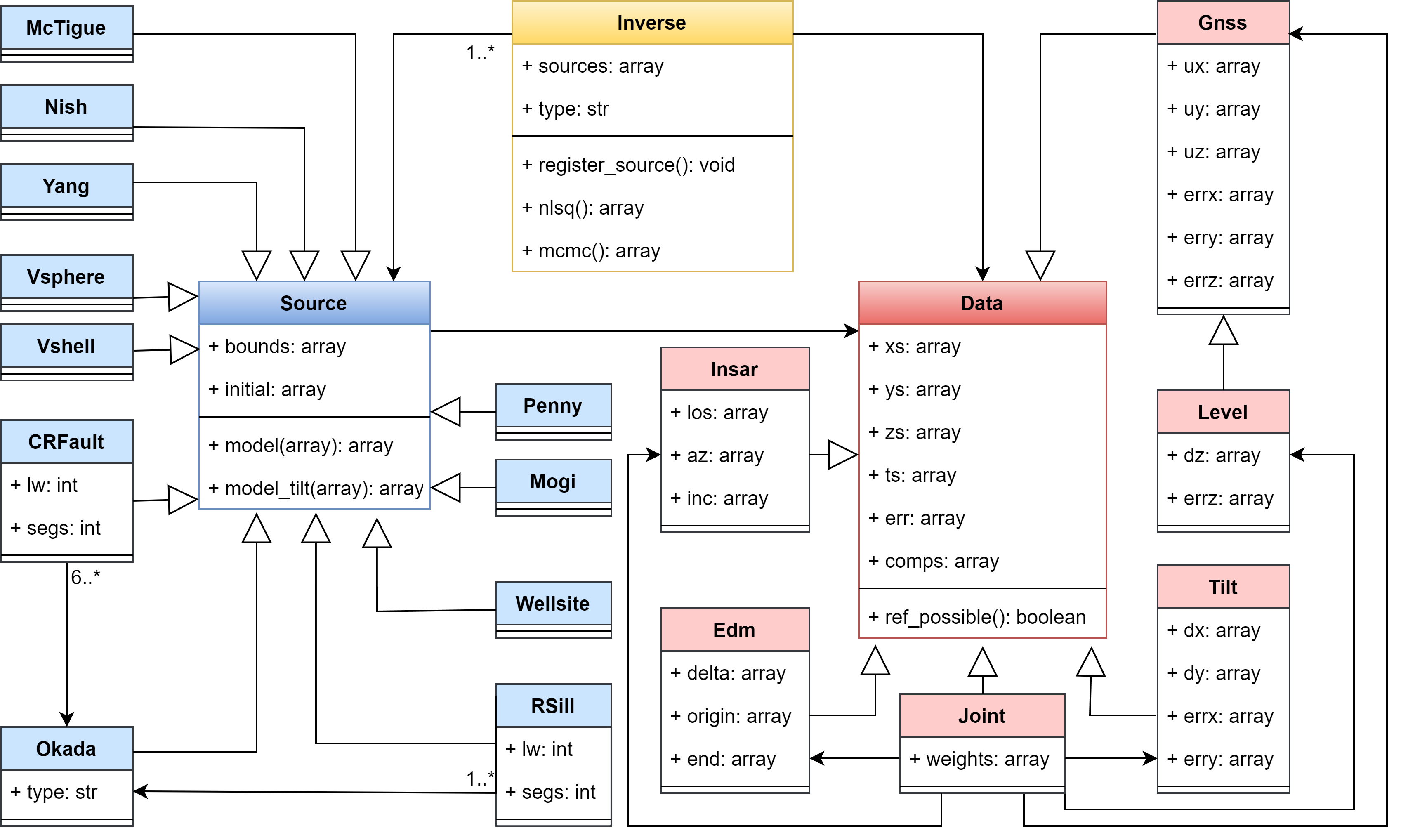
VMOD is a python-based object oriented framework. Its main purpose is to model multiple types of geodetic data including:
- GNSS
- InSAR
- Level
- EDM
- Tilt
These observations can be interpreted with one or more analytical models that represent pressurized sources such as:
- Pressurized sphere in elastic medium
- Pressurized sphere in viscoelastic medium
- Pressurized sphere in a viscoelastic shell in elastic medium
- Pressurized prolate spheroid in elastic medium
- Dislocation (Fault/Sill) in elastic medium
- Penny shaped crack in elastic medium
- Point source in elastic medium
- Wellsite in porelastic medium
- Ring fault in elastic medium
- Regularized fault/sill in elastic medium
- Open conduit in elastic medium
The framework offers two different inversion techniques to solve for the source parameters:
- Non-linear least squares
- Bayesian approach
The inversions can include one or multiple data types in the inversion and the model can be composed by multiple sources. The user can customize or inherit current models to create complexer geometries.
Standard Installation
We recommend using Anaconda or Miniconda to create an environment in which to install VMOD to prevent dependency conflicts.
conda env create --file=environment.yml
conda activate vmod
python -m jupyterlab
Then run one of the notebooks.
Run an inversion:
In this repository we included several notebooks to show the steps necessary to run an inversion using GNSS, InSAR, and joint datasets. We also included an example for an InSAR dataset on Unimak Island.
Stress calculations:
VMOD allows to calculate Coulomb stress changes for forward models in the notebook Coulomb stress changes and the magnitude and orientation of principal stresses
Add new datatype:
Users wishing to include a new datatype should clone the source repository and create a new file in the data folder. This file should contain a new class that inherit from the 'Data' class and that has the functions to initialize the attributes, adding the components belonging to the datatype and a function to derive the components from 3d displacements. For example, in the Insar class we defined the following functions:
class Insar(Data):
    def __init__():
        ...
    def add_los(self, los):
        ...
    def from_model3d(self, func):
        ...
Add new model:
Users wishing to include a new model should clone the source repository and create a new file in the source folder. This file should contain a new class that inherit from the 'Source' class and that has a function returning the names of the parameters in your model and a function that gives the implementation of your model and return the 3d displacement. If you want to use this model with data that has a temporal dependency you should include the function 'model_t' that implements a time-dependant model. As an option you can include additional functions that return tilt displacements with the function 'model_tilt' or if it has a temporal dependency 'model_tilt_t'. For example, here we show the required functions in our Mogi model:
class Mogi(Source):
    def set_parnames(self):
        ...
    def model(self, params):
        ...
Publications:
A list of publications where VMOD has been used:
- Grapenthin, R., Cheng, Y., Angarita, M., Tan, D., Meyer, F. J., Fee, D., & Wech, A. (2022). Return from Dormancy: Rapid inflation and seismic unrest driven by transcrustal magma transfer at Mt. Edgecumbe (L’úx Shaa) Volcano, Alaska. Geophysical Research Letters, 49(20), e2022GL099464. https://doi.org/10.1029/2022GL099464
- Grapenthin, R., Kyle, P., Aster, R. C., Angarita, M., Wilson, T., & Chaput, J. (2022). Deformation at the open-vent Erebus volcano, Antarctica, from more than 20 years of GNSS observations. Journal of Volcanology and Geothermal Research, 432, 107703. https://doi.org/10.1016/j.jvolgeores.2022.107703
- Graves, E. J., et al. "InSAR-observed surface deformation in New Mexico’s Permian Basin shows threats and opportunities presented by leaky injection wells." Scientific Reports 13.1 (2023): 17308. https://doi.org/10.1038/s41598-023-42696-9
3 maintainers


Metadata
3 maintainers
Release files for vmod-geodesy 2.0.0
For a detailed explanation of source distributions (sdists) and built distributions (wheels), please see the package formats documentation.
Source distribution (sdist)
| File | Size | Uploaded | |
|---|---|---|---|
| vmod_geodesy-2.0.0.tar.gz | 59.9 kB | Details |
Built distribution (wheel)
| File | Interpreter | ABI | Platform | Reset |
|---|---|---|---|---|
| vmod_geodesy-2.0.0-py3-none-any.whl | Python 3 | none | any | Details |
Total release size: 131.3 kB
Release files / vmod_geodesy-2.0.0.tar.gz
| Download URL | vmod_geodesy-2.0.0.tar.gz |
|---|---|
| Size | 59.9 kB |
| Tags | Source |
|
SHA-256 checksum How to use checksums |
e988962371673de31524898769c24b9bc242bde50600f79683ed223908da98d3
|
|
BLAKE2b-256 checksum How to use checksums |
c3dda770f2795b6baf79d0754531d1afa2a8fffa1e115f0acb1dc13284479428
|
| Upload date | |
|
Uploaded using Trusted Publishing? What is trusted publishing? |
Yes |
| Uploaded via |
twine/6.1.0 CPython/3.13.7
|
Provenance
Provenance describes where a file came from. On PyPI, provenance is shared via attestations, which provide a verifiable record of the build or publishing details. View details, limitations and caveats.


PyPI Publish Attestation
PyPI verified that this artifact, at this checksum, originated from the publisher listed below.
Signed by GitHub Actions, verified by PyPI on Nov 13, 2025.
Transparency logRelease files / vmod_geodesy-2.0.0-py3-none-any.whl
| Download URL | vmod_geodesy-2.0.0-py3-none-any.whl |
|---|---|
| Size | 71.4 kB |
| Tags | Python 3 |
|
SHA-256 checksum How to use checksums |
c68b7a5d41c73f212920f22e70538eadfd3103b1aa207abc85caf91433b9c5f2
|
|
BLAKE2b-256 checksum How to use checksums |
4acd67dfe20cc12af3b33bcdaf12001130520ffef625f1472cfbe98e626563fb
|
| Upload date | |
|
Uploaded using Trusted Publishing? What is trusted publishing? |
Yes |
| Uploaded via |
twine/6.1.0 CPython/3.13.7
|
Provenance
Provenance describes where a file came from. On PyPI, provenance is shared via attestations, which provide a verifiable record of the build or publishing details. View details, limitations and caveats.
PyPI Publish Attestation
PyPI verified that this artifact, at this checksum, originated from the publisher listed below.
Signed by GitHub Actions, verified by PyPI on Nov 13, 2025.
Transparency log













