
VMware-NSX
Inspect and manage VMware NSX networking through focused tools.
English · 简体中文
Community-maintained · MIT · Not an official VMware/Broadcom product.
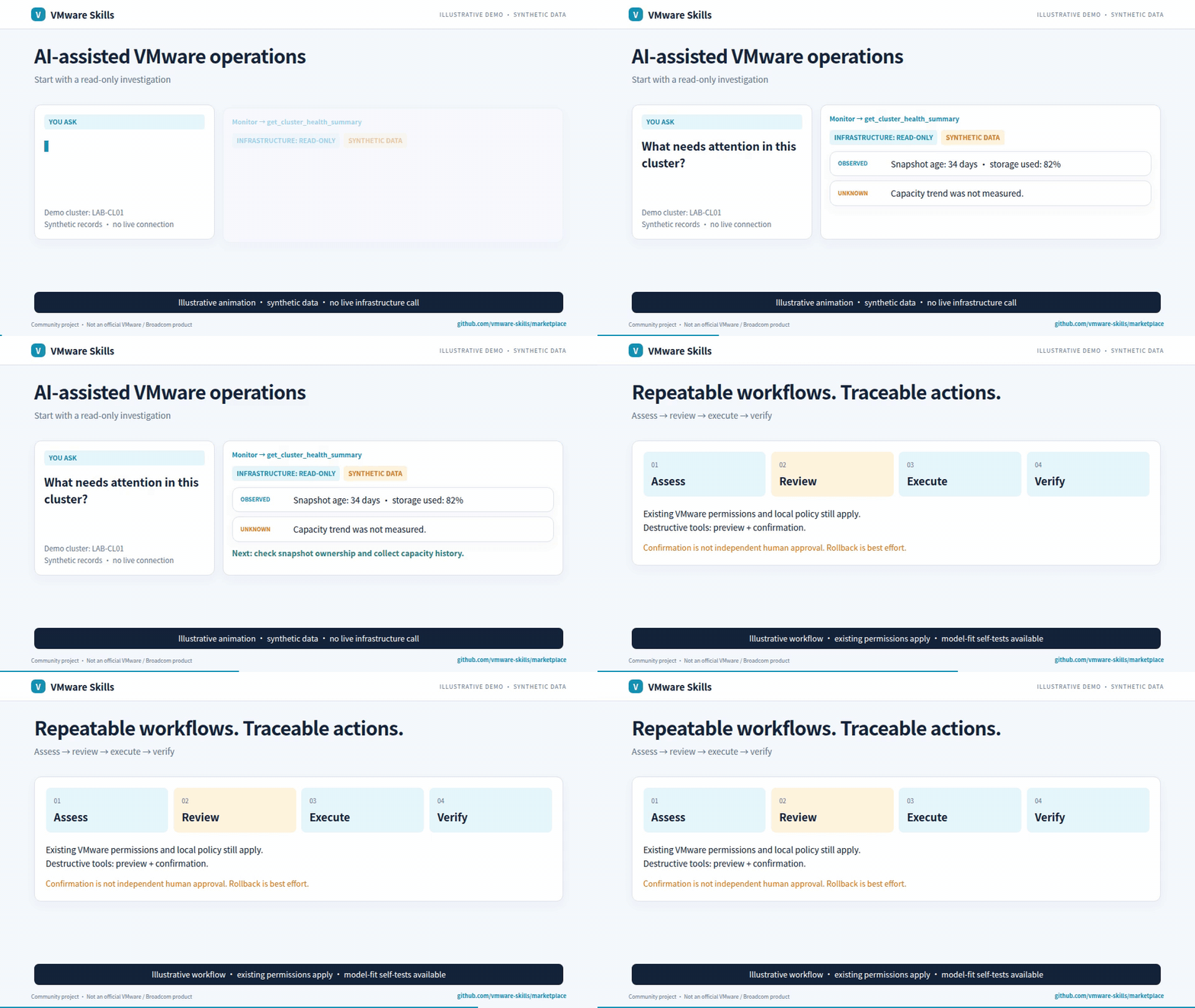
Synthetic-data GIF; video includes redacted historical screenshots. Download the AI-narrated family introduction (~3 min)
Why use it?
- Work with segments, gateways, NAT and IP pools.
- Inspect BGP, routes and fabric health.
- Keep configuration actions explicit and auditable.
Get started
Install the published CLI and inspect its commands:
uv tool install vmware-nsx-mgmt==1.15.4
vmware-nsx --help
Requires uv and Python >=3.10. Configure targets and credentials locally before remote queries. Setup guide.
One-click installs, after local setup: Claude Desktop extension (.mcpb) · Install in VS Code. Both run the same pinned 1.15.4 server. The desktop extension starts with read-only tools; change Tools to offer to all for writes.
For agent-host installation, use the setup guide and Cursor, Codex, Gemini CLI, Cline and local-model examples.
Choose a model with the shared model-fit workflow: compare the same tasks, review quality and safety, then select the smallest tested passing configuration per task group; this is not a production guarantee.
Know the boundaries
Includes network configuration writes. VMware NSX permissions and local Policy remain in force; destructive gates do not replace independent authorization.
Go deeper
- Capabilities
- CLI reference
- Agent guardrails
- Detailed usage and architecture
- MCP launch configuration
- Canonical skill instructions
Part of VMware Skills: 15 skills, 14 MCP servers and one shared Policy library. If it helps your work, star the family portal.
MCP result contract
Offset-capable listings expose next_offset; stop when it is null rather than looping on truncated. Failed calls provide structuredContent.vmware_error through Policy 1.26.0. Existing text, legacy flags, success values and confirmation checks remain unchanged. See the contract.
1 maintainer

Metadata
1 maintainer
Release files for vmware-nsx-mgmt 1.15.4
For a detailed explanation of source distributions (sdists) and built distributions (wheels), please see the package formats documentation.
Source distribution (sdist)
| File | Size | Uploaded | Provenance | Actions |
|---|---|---|---|---|
| vmware_nsx_mgmt-1.15.4.tar.gz | 619.2 kB | Without provenance | Details for vmware_nsx_mgmt-1.15.4.tar.gz |
Built distribution (wheel)
| File | Interpreter | ABI | Platform | Actions Reset |
|---|---|---|---|---|
| vmware_nsx_mgmt-1.15.4-py3-none-any.whl | Python 3 | none | any | Details for vmware_nsx_mgmt-1.15.4-py3-none-any.whl |
Total release size: 727.1 kB
Release files / vmware_nsx_mgmt-1.15.4.tar.gz
| Download URL | vmware_nsx_mgmt-1.15.4.tar.gz |
|---|---|
| Size | 619.2 kB |
| Tags | Source |
|
SHA-256 checksum How to use checksums |
718f58dedcb2b69e413a368931ecd0f64caadfb76ad06a23cd0623a703d2ec91
|
|
BLAKE2b-256 checksum How to use checksums |
d55840f7ca7128f1f5adebdf56b23a72b5e42af0bab9119f7845b0f46e8f406c
|
| Upload date | |
|
Uploaded using Trusted Publishing? What is trusted publishing? |
No |
| Uploaded via |
twine/7.0.0 CPython/3.13.12
|
Release files / vmware_nsx_mgmt-1.15.4-py3-none-any.whl
| Download URL | vmware_nsx_mgmt-1.15.4-py3-none-any.whl |
|---|---|
| Size | 107.9 kB |
| Tags | Python 3 |
|
SHA-256 checksum How to use checksums |
0950ddb854bb2fd46952f8aac9409e74587ebf0acc0ae9c1f099e26e02a22759
|
|
BLAKE2b-256 checksum How to use checksums |
28d0fcb6268500f6ba6767a9e431539610d826824fa6454a76b49494c457ec9a
|
| Upload date | |
|
Uploaded using Trusted Publishing? What is trusted publishing? |
No |
| Uploaded via |
twine/7.0.0 CPython/3.13.12
|
Security for vmware-nsx-mgmt 1.15.4
Provenance
Provenance describes where a file came from. On PyPI, provenance is shared via attestations, which provide a verifiable record of the build or publishing details. View details, limitations and caveats.
No provenance found
None of the files in this release were uploaded with provenance metadata.
A note on package security
PyPI is a repository for distributing packages, not a service for auditing them. While third-party security researchers and our staff do their best to detect and remove malicious packages, PyPI cannot guarantee the quality, security or suitability of any given package.
To learn more about protecting yourself from malicious actors, visit our package security documentation.














