
Cost tracking and reconciliation for LiveKit voice agents: modality-aware unit accounting (audio-minutes, tokens, characters) backed by voice-prices.

Project description





from livekit.agents import AgentSession
from livekit.plugins import deepgram, openai, cartesia
import voicegateway

session = AgentSession(
    stt=deepgram.STT(model="nova-3"),
    llm=openai.LLM(model="gpt-4o-mini"),
    tts=cartesia.TTS(model="sonic-3"),
)
voicegateway.attach(session)   # one line. profile every call.
# logged per call: provider, model, tokens, $cost, latency, session_id
The open-source profiler for voice agents. Add one line and every STT, LLM, and TTS call is priced and timed: cost to the cent, latency p50/p95, and conversation quality. attach() takes a LiveKit AgentSession or a Pipecat PipelineTask; import voicegateway pulls neither framework until you use it. Prices come from voice-prices and reconcile against your real provider invoices with one command. Self-hosted. Your keys. No data leaves your infra.
Using Pipecat? Same one line.
from pipecat.pipeline.task import PipelineTask
import voicegateway

task = PipelineTask(pipeline)
voicegateway.attach(task)   # profile every call, Pipecat
Why VoiceGateway
Voice AI vendors hide three numbers. VoiceGateway exposes them, per call.
- Is it working? Latency p50/p95 across the STT → LLM → TTS loop, interruption rate, dead air, talk-over: the metrics text stacks never have to think about.
- What does it cost? STT bills by audio seconds, LLM by tokens, TTS by characters. Every call is broken down by modality and totaled to the cent.
voicegw reconcilechecks recorded numbers against your actual provider invoices. - How do I make it cheaper? See cost per provider and model so you know what to change. Cap daily spend and fall back on errors with
guard(). Attribute cost per tenant so agency clients see only their own usage.
Building a text-only LLM app with no voice component? LiteLLM is the better fit. See the decision tree.
One more line: guard()
attach() watches. guard() acts. Wrap one provider to cap spend, fall back on errors, and rate-limit. It returns a drop-in of the same type, so it slots into your session unchanged.
llm = voicegateway.guard(
    openai.LLM(model="gpt-4o-mini"),
    fallback=[openai.LLM(model="gpt-4o")],   # on a primary error
    budget="$5.00/day",                       # hard stop past the cap
    rate_limit="60/min",
)
guard() writes no metrics and attach() never double-counts, so use both together.
Features
| Capability | What it gives you |
|---|---|
| Framework-neutral | One attach() for LiveKit or Pipecat. Your keys, your plugins, no lock-in |
| Voice-conversation metrics | Per-minute cost, latency p50/p95, interruptions, dead air, talk-over |
| Conversation replay | Scrub any past call: STT chunks, LLM tokens, TTS frames with timing and cost |
| Spend control | guard(): daily budget cap, fallback on error, rate limit, per project |
| Reconciliation | voicegw reconcile checks recorded cost against your real provider invoices |
| Terminal UI | voicegw tui opens a vim-key Textual UI for SSH-in inspection |
| Multi-tenant attribution | Per-tenant cost, scoped API keys per team, agency-ready |
| Fleet collector | One-line installer. N agents push to one collector. Slice costs by agent, project, tenant |
Full release history: CHANGELOG.md.
Quick start
# Single node: local SQLite + the dashboard at http://localhost:8080
pip install "voicegateway[dashboard]"
voicegw init && voicegw serve
Add the one voicegateway.attach(session) line from the snippet above to your agent and every call is tracked. Provider plugins install with your framework (pip install "voicegateway[livekit,deepgram,openai,cartesia]" or "voicegateway[pipecat]"). The full extras matrix, the zero-install uvx path, and the OS daemon installer (LaunchAgent / systemd / Scheduled Task) are in the get-started docs. Python 3.11+.
The dashboard
A self-hosted web UI at http://localhost:8080. Bundled. No SaaS account. No data leaves your stack.
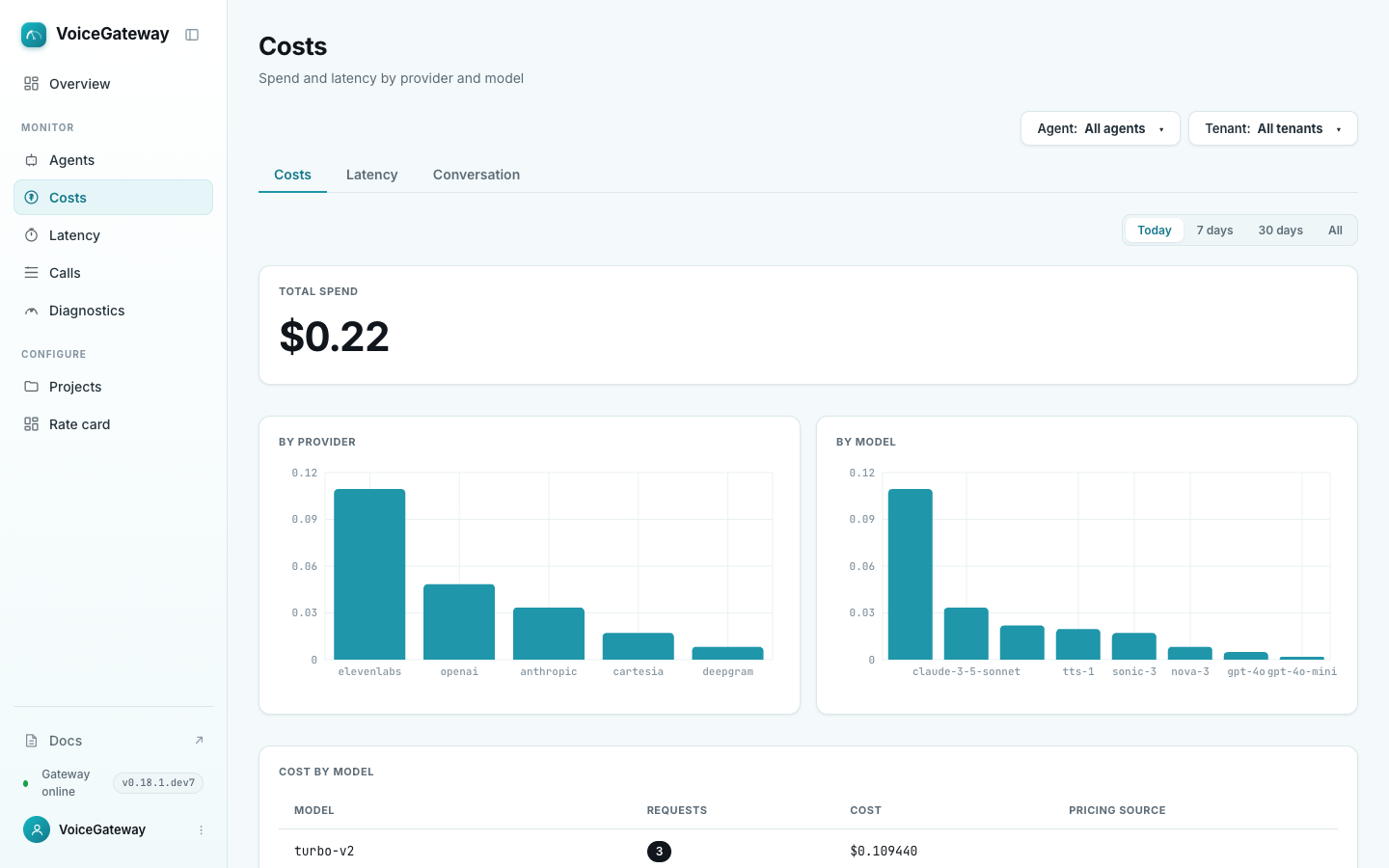
Total spend, cost by provider and model, latency p50/p95, per-call replay, and one-key light/dark.
Overview with a 7-day spend and requests trend, Agents (per-agent cost, model stack, worker memory), Costs (per provider / model / project / tenant, plus latency p50/p95), Calls (replay any conversation), Latency, and Diagnostics (probe your LiveKit deployment). Configure projects and a rate card for billing reconciliation. One-key light/dark theme. White-label it per project: upload a logo, set an accent color and product name, and the whole UI re-skins.
Fleet collector
Run one shared collector on your VPS. Every agent on your fleet pushes telemetry to it: one dashboard, one cost view, across all of them.
curl -fsSL https://voicegateway.dev/collector.sh | bash
The script installs Docker if needed, generates and persists secrets, pins the image version, and health-checks the container before returning. Point your agents at it with three environment variables:
export VOICEGW_COLLECTOR_URL="https://collector.example.com/v1/ingest"
export VOICEGW_API_KEY="<your-ingest-key>"
export VOICEGW_PROJECT="my-agent"
attach() reads them and batches every call to the collector instead of local SQLite. SQLite and Postgres backends, plus HTTPS via Caddy: fleet collector docs →
Manage from your coding agent (MCP)
VoiceGateway ships a first-class Model Context Protocol server. Claude Code, Cursor, Codex, and Cline create projects, check costs, and inspect calls through natural language.
pipx inject voicegateway "voicegateway[mcp]"
claude mcp add voicegateway --command "voicegw mcp --transport stdio"
Tools across observability, projects, and costs. Destructive ops (delete_*) require explicit confirm=True after a preview. Remote HTTP/SSE transport with bearer auth and the full tool list: MCP reference →
Priced providers
VoiceGateway prices calls from any provider voice-prices covers. You bring your own native plugins; VoiceGateway meters and prices them. The common ones:
| Modality | Cloud | Local |
|---|---|---|
| STT | Deepgram, OpenAI Whisper, AssemblyAI, Groq | faster-whisper |
| LLM | OpenAI, Anthropic, Groq | Ollama (any compatible) |
| TTS | Cartesia, ElevenLabs, Deepgram Aura-2, OpenAI | Kokoro, Piper |
A price it does not recognize records at zero and flags for a rate-card entry, so nothing is silently dropped. Per-model IDs: configuration/providers.
Architecture
flowchart TB
    A[Voice Agent · LiveKit or Pipecat] --> B["voicegateway.attach()"]
    B --> F[Middleware Pipeline]
    F --> F1[Cost Tracker]
    F --> F2[Latency Monitor]
    F --> F3[Rate Limiter]
    F --> F4[Multi-tenant Attribution]
    F --> G[(SQLite · encrypted)]
    G --> H[Dashboard UI]
    G --> I[MCP Server]
    I --> J[Claude Code · Cursor · Codex]
Async throughout. import voicegateway stays framework-neutral: the LiveKit and Pipecat integrations import their framework only on first use. YAML config with ${ENV_VAR} substitution. SQLite at the bottom for portability, encrypted with Fernet at rest. Architecture deep dive →
Deploy
Docker Compose (Postgres + collector)
services:
  postgres:
    image: postgres:16-alpine
    environment:
      POSTGRES_USER: voicegw
      POSTGRES_PASSWORD: ${VOICEGW_PG_PASSWORD}
      POSTGRES_DB: voicegw
    volumes:
      - voicegw-pgdata:/var/lib/postgresql/data
    restart: unless-stopped

  collector:
    image: mahimairaja/voicegateway:latest
    ports:
      - "8080:8080"
    environment:
      VOICEGW_DB_URL: postgresql+asyncpg://voicegw:${VOICEGW_PG_PASSWORD}@postgres/voicegw
    volumes:
      - ./voicegw.yaml:/app/voicegw.yaml:ro
    depends_on: [postgres]
    restart: unless-stopped

volumes:
  voicegw-pgdata:
docker compose up -d
For production, the fleet collector installer handles secrets, image pinning, and health checks for you.
Contributing
git clone https://github.com/mahimailabs/voicegateway
cd voicegateway
pip install -e ".[all,dashboard,mcp,dev]"
pytest
Read CONTRIBUTING.md and CODE_OF_CONDUCT.md before opening a PR. Security issues go through the disclosure flow in SECURITY.md, not a public issue.
Community

License
MIT. Fork it, ship it.
Built by Mahimai Raja, founder of Mahimai AI, a voice AI company, in public. Standing on LiveKit Agents, Pipecat, FastAPI, Pydantic, and voice-prices.
Release history Release notifications | RSS feed


Download files
Download the file for your platform. If you're not sure which to choose, learn more about installing packages.
Source Distribution
Built Distribution
Filter files by name, interpreter, ABI, and platform.
If you're not sure about the file name format, learn more about wheel file names.
Copy a direct link to the current filters
File details
Details for the file voicegateway-0.20.0.tar.gz.
File metadata
- Download URL: voicegateway-0.20.0.tar.gz
- Upload date:
- Size: 2.3 MB
- Tags: Source
- Uploaded using Trusted Publishing? No
- Uploaded via: twine/6.1.0 CPython/3.13.13
File hashes
| Algorithm | Hash digest | |
|---|---|---|
| SHA256 |
5d0e5b1763dd10e10ef7a4bda319a996fc8f8cf158d93548042e4c1e017c0abe
|
|
| MD5 |
9029d8ef6cb5afccf3c888a701d732c5
|
|
| BLAKE2b-256 |
6e4b5c2ecf0ae7841a03b2a0465fd098be580b2c7307fc1638ec03870d1f2a2b
|
File details
Details for the file voicegateway-0.20.0-py3-none-any.whl.
File metadata
- Download URL: voicegateway-0.20.0-py3-none-any.whl
- Upload date:
- Size: 862.7 kB
- Tags: Python 3
- Uploaded using Trusted Publishing? No
- Uploaded via: twine/6.1.0 CPython/3.13.13
File hashes
| Algorithm | Hash digest | |
|---|---|---|
| SHA256 |
961b7d1fd4ffc0ab89401ddf9f91d9c737797c8f6021996331ac5344a0d368fa
|
|
| MD5 |
cce54ef4d38a96cf0682a8a2d56e2cd3
|
|
| BLAKE2b-256 |
2f545114e15d2b6ca2678cfd57c5a60be4254bce91de55f3101a9beeac30cd93
|






