
VOLume-based Virtual Image Correlation (volVIC) library for Python

Project description
volVIC — VOLume-based Virtual Image Correlation
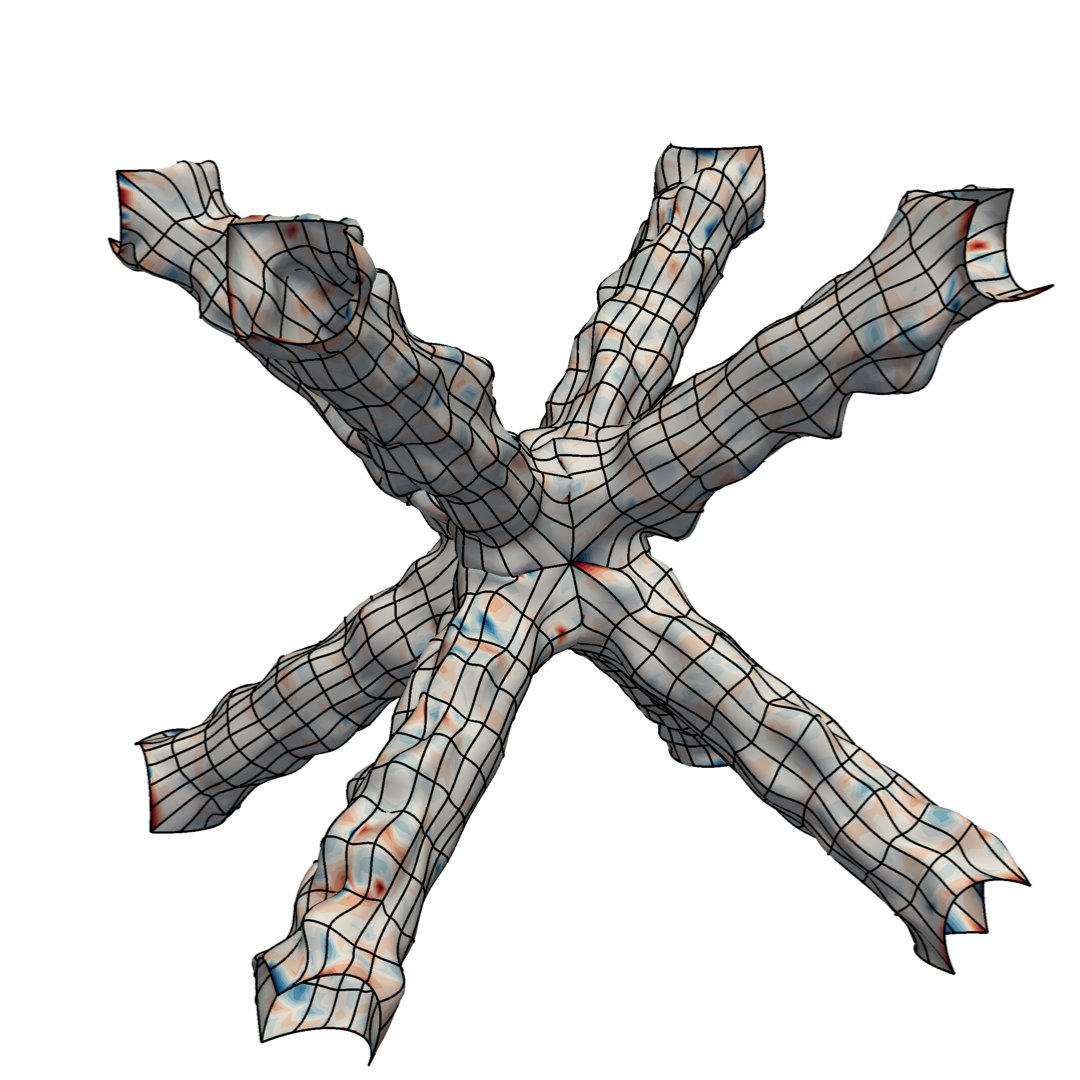
volVIC is a Python library for surface shape measurement from 3D volumetric images (e.g. CT scans) using the Virtual Image Correlation (VIC) method. It fits a parametric B-spline surface mesh to a grayscale volume by minimizing an energy functional that compares a synthetic "virtual image" — built from the surface geometry — to the actual acquired image.
The method is particularly suited to problems in experimental mechanics, where one wants to track the shape or deformation of a material surface from tomographic data.
Table of Contents
Method overview
The VIC approach replaces classical pixel-to-pixel image correlation with a physics-motivated model. Given a B-spline surface mesh and a volumetric image:
- A virtual image is constructed analytically from the surface geometry. It models the gray-level transition (background ↔ foreground) along the surface normal, parameterized by a scalar distance
rho. - The VIC energy measures the discrepancy between the virtual image and the actual acquired image, integrated over a normal neighborhood of the surface.
- A Gauss–Newton solver iteratively minimizes the total energy (VIC + membrane regularization) with respect to the B-spline control point displacements and
rho. - C¹ continuity constraints across patches and Dirichlet boundary conditions are enforced through a constraint matrix.
Installation
1. High-Performance Solvers (Optional but Recommended)
volVIC relies on IGA_for_bsplyne for its linear system solvers. This library can leverage SuiteSparse (via scikit-sparse and sparseqr) for significant speedups on large-scale problems.
-
Recommended (Conda):
conda install -c conda-forge scikit-sparse
pip install sparseqr
Note:
sparseqris not on Conda, but it will successfully link to the SuiteSparse libraries installed byscikit-sparse. -
Alternative (system package manager):
- macOS:
brew install suitesparse && pip install scikit-sparse sparseqr - Ubuntu/Debian:
sudo apt-get install libsuitesparse-dev && pip install scikit-sparse sparseqr
- macOS:
-
Fallback: If SuiteSparse is not available, the library automatically falls back to standard
scipy.sparsesolvers, ensuring full compatibility at the cost of performance.
2. Install volVIC
pip install volVIC
Requirements: Python ≥ 3.9
Key dependencies: numpy, scipy, numba, bsplyne, IGA_for_bsplyne, pyvista, meshio, interpylate, treeIDW, matplotlib, tqdm
Quick start
import numpy as np
from volVIC import Mesh, Problem

# Load your B-spline surface mesh and volumetric image
mesh = Mesh.Mesh.load("my_mesh.pkl")
image = np.load("my_ct_scan.npy")   # dtype: uint16, shape: (Z, Y, X)

# Set up and solve the VIC problem
problem = Problem(
    mesh=mesh,
    image=image,
    ICP_init=True,         # Rigid-body alignment before solving
    C1_mode="auto",        # Automatic C¹ continuity between patches
    membrane_weight=None,  # Automatic regularization weight estimation
)
u_field, rho = problem.solve(max_iter=20)

# Visualize results
problem.plot_results(u_field)

# Export to ParaView
problem.save_paraview(u_field, folder="results/", name="vic_output")
Module overview
volVIC.Problem — High-level solver
The main entry point. The Problem class encapsulates the full VIC pipeline.
Constructor Problem(mesh, image, ...):
- Estimates foreground/background gray levels from the image histogram (Otsu or interpolation-based).
- Optionally performs a rigid-body ICP alignment of the mesh to the image isosurface.
- Builds the virtual image energy elements, membrane stiffness matrix, and C¹ constraint matrix.
- Calibrates the membrane regularization weight automatically.
Key methods:
| Method | Description |
|---|---|
solve(max_iter, ...) |
Run the Gauss–Newton optimization loop. Returns (u_field, rho). |
plot_results(u_field, ...) |
Visualize signed distance fields with PyVista. |
save_paraview(u_field, folder, name) |
Export displacement and distance fields to VTK for ParaView. |
propagate_displacement_to_volume_mesh(u_field, volume_mesh) |
Propagate the surface displacement to a volumetric B-spline mesh. |
volVIC.Mesh — B-spline mesh management
Provides the Mesh class wrapping multi-patch B-spline surfaces.
Key features:
- Load/save mesh from
.pkl(pickle) files (Mesh.load,Mesh.save). - Evaluate the mesh geometry and fields at arbitrary parametric points.
- Convert fields between per-patch and unique-node representations.
- Extract border patches, mesh subsets, and orientation fields.
- Visualize with PyVista (
plot,plot_in_image,plot_orientation). - Export time series to ParaView with
save_paraview. - Register mesh to a target triangle surface with
ICP_rigid_body_transform. - Propagate scalar or vector fields from a submesh to a parent mesh.
volVIC.virtual_image_correlation_energy — VIC energy
The VirtualImageCorrelationEnergyElem class handles the energy computation for a single B-spline patch. It:
- Builds integration grids in both parametric and normal directions.
- Constructs the sparse small rotation displacement operator mapping control points to integration points in the image.
- Evaluates the VIC energy, gradient, and Gauss-Newton Hessian w.r.t. displacements and
rho.
The module also provides utilities:
make_image_energies(mesh, h, ...)— initialize energy elements for a full mesh.compute_image_energy_operators(...)— assemble global gradient and Hessian.compute_distance_field(...)— compute the signed distance field on each patch.
volVIC.virtual_image — Virtual image model
Defines the virtual image function used in the VIC energy:
from volVIC.virtual_image import g_slide

g, dg_drho = g_slide(xi, eta, gamma, rho, bg=0.0, fg=1.0)
g_slide models a smooth transition from background to foreground gray level along the surface normal (gamma), parameterized by the half-width rho. It returns both the image value g and its derivative w.r.t. rho.
volVIC.solve — Gauss–Newton iteration
Low-level function performing one VIC iteration:
from volVIC.solve import iteration

du_field, drho = iteration(u_field, rho, mesh, image_energies, image,
                           membrane_K, membrane_weight, C)
Assembles and solves the linearized system H_tot @ Δu = -grad_tot, with constraint enforcement via the matrix C. The rho increment is computed independently by a Newton step on the scalar energy.
volVIC.membrane_stiffness — Regularization
Assembles the membrane (in-plane) stiffness matrix for B-spline surface patches, used as a regularization term in the VIC energy:
from volVIC.membrane_stiffness import make_membrane_stifness, make_membrane_weight

K = make_membrane_stifness(mesh)
w = make_membrane_weight(mesh, image_energies, K, rho=1.5, image_std=5000)
The make_membrane_weight function calibrates the regularization weight by matching the expected membrane energy to the expected VIC energy under a probabilistic displacement model.
volVIC.C1_triplets — Smoothness constraints
Generates C¹ continuity constraints between neighboring patches:
from volVIC.C1_triplets import make_C1_eqs

C = make_C1_eqs(mesh, C1_inds="auto", threshold=0.1)
Each constraint takes the form A - 2B + C = 0 for a triplet of control nodes (A, B, C). The "auto" mode selects only geometrically consistent triplets.
volVIC.image_utils — Image preprocessing
Utilities for gray-level analysis of CT images:
from volVIC.image_utils import find_fg_bg, find_sigma_hat

fg, bg = find_fg_bg(image, method="otsu")   # or "interp"
sigma  = find_sigma_hat(image, fg, bg)
find_fg_bgestimates foreground and background gray levels from the image histogram.find_sigma_hatestimates the noise standard deviation from single-phase voxels.- Lower-level functions
hist,otsu_threshold, andinterp_fg_bgare also exposed.
volVIC.marching_cubes — Isosurface extraction
Extracts a triangle isosurface from a 3D scalar field:
from volVIC.marching_cubes import marching_cubes

surface = marching_cubes(volume, threshold=0.5)  # returns meshio.Mesh
Uses a Numba-compiled implementation for performance, with vertex deduplication and zero-area triangle prevention.
volVIC.integration_space_image — Parametric integration
Computes integration points and weights in the parametric space of a B-spline surface such that mapped distances between points are approximately uniform:
from volVIC.integration_space_image import linspace_for_VIC_elem

(xi, eta), (dxi, deta) = linspace_for_VIC_elem(spline, ctrl_pts, dist=1.0)
Documentation
The full API documentation is available on the Online Portal.
License
This project is licensed under the CeCILL-2.1 license — see https://cecill.info for details.
Author: Dorian Bichet — dbichet@insa-toulouse.fr
Repository: https://github.com/Dorian210/volVIC
Release history Release notifications | RSS feed


Download files
Download the file for your platform. If you're not sure which to choose, learn more about installing packages.
Source Distribution
Built Distribution
Filter files by name, interpreter, ABI, and platform.
If you're not sure about the file name format, learn more about wheel file names.
Copy a direct link to the current filters
File details
Details for the file volvic-1.0.1.tar.gz.
File metadata
- Download URL: volvic-1.0.1.tar.gz
- Upload date:
- Size: 66.2 kB
- Tags: Source
- Uploaded using Trusted Publishing? No
- Uploaded via: twine/6.2.0 CPython/3.9.23
File hashes
| Algorithm | Hash digest | |
|---|---|---|
| SHA256 |
99798a0485d795f1924a0d17c6cf11a4af6b2c8c6a2c34ac36a83aa6d3194a6d
|
|
| MD5 |
2036c4fd2aa758aea98232449d8bc523
|
|
| BLAKE2b-256 |
f4a4aef0224d30d4155f3575260ab99516baac59b67da3bca76633d82d3afba4
|
File details
Details for the file volvic-1.0.1-py3-none-any.whl.
File metadata
- Download URL: volvic-1.0.1-py3-none-any.whl
- Upload date:
- Size: 67.0 kB
- Tags: Python 3
- Uploaded using Trusted Publishing? No
- Uploaded via: twine/6.2.0 CPython/3.9.23
File hashes
| Algorithm | Hash digest | |
|---|---|---|
| SHA256 |
394b8a72c78a9f2cef56f80d26f8137355fde3e114033b73132d5aef740e33cc
|
|
| MD5 |
2c127995e54a6211cfecb1537e090a82
|
|
| BLAKE2b-256 |
f09c772ed71b986f6981e839ef91bdae53cadfbd9bb1b74f7a553751d707f7b7
|






