
votum
A decision model on a fully open LLM backbone.




Quickstart · Request and response · Images · Server · Speed · Fine-tuning · Documentation
Votum turns 
It does not write text. It reads the prompt once and scores the answers, so a short decision takes under 100 ms, the result is always one of your options, and the probabilities always sum to one.
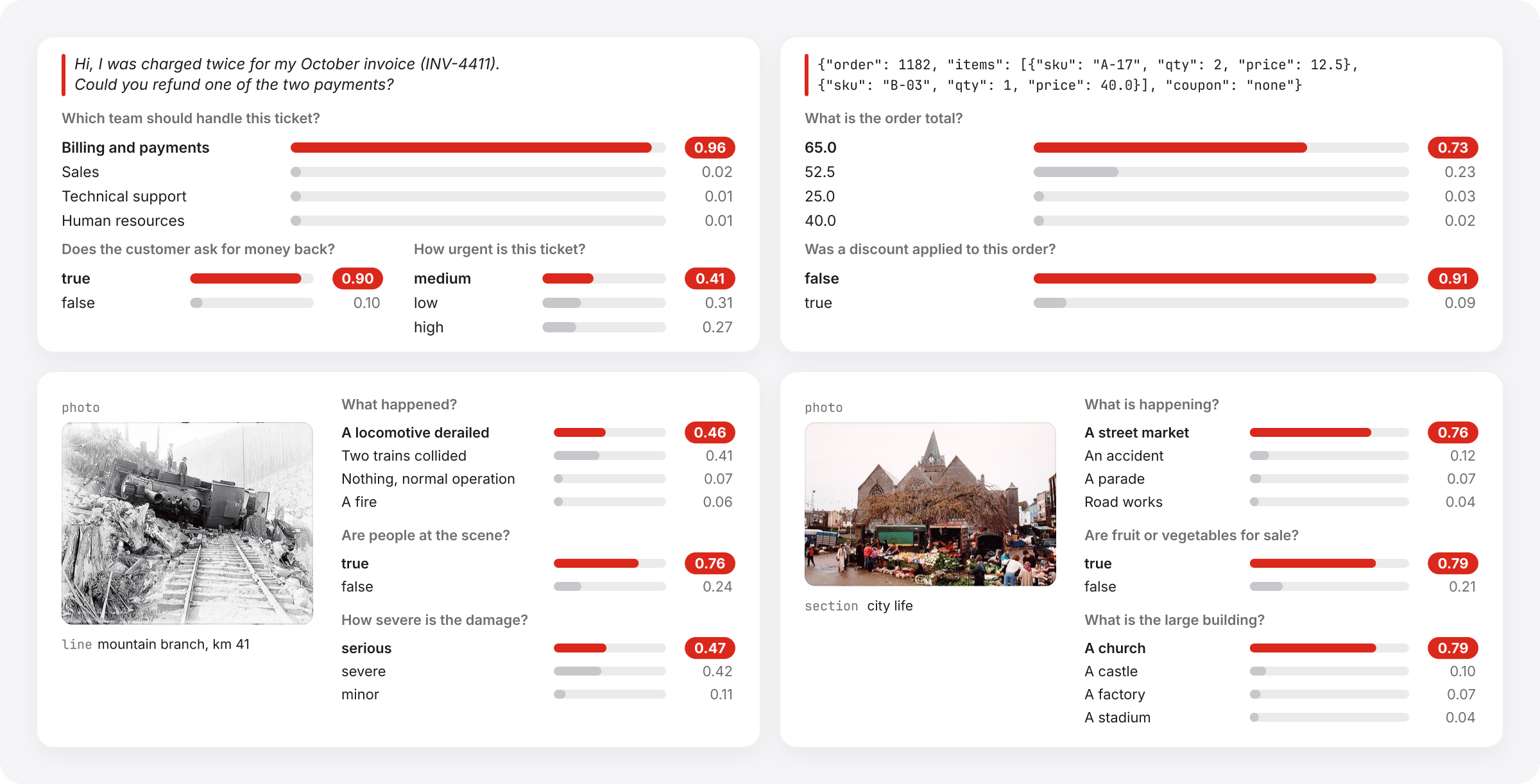
The open weights and the open dataset are on Hugging Face: Votum-8B, Votum-8B-FP8 (smaller) and the training data, Votum-Pool. This repository holds the code.
Quickstart
Requirements: Python 3.11 or newer and an NVIDIA GPU.
| GPU memory | Model | Notes |
|---|---|---|
| 24 GB or more | votum-ai/Votum-8B | the full model, a 16 GB download |
| 16 GB | votum-ai/Votum-8B-FP8 | FP8-quantized weights, a 9 GB download; it gives the same answer as the full model 96 to 99 % of the time |
1. Install the package.
pip install votum
2. Get access to the model. The model is gated: accept the Apertus Acceptable Use Policy on votum-ai/Votum-8B, then log in:
hf auth login
3. Run a request. The email from the figure above, with its three questions:
from votum import Votum

# On a 16 GB GPU, use "votum-ai/Votum-8B-FP8" instead.
vm = Votum.from_pretrained("votum-ai/Votum-8B")

request = {
    "state": "Hi, I was charged twice for my October invoice (INV-4411). Could you refund one of the two payments?",
    "questions": {
        "team": {
            "type": "choice",
            "instructions": "Which team should handle this ticket?",
            "criteria": {
                "billing": "Billing and payments",
                "tech": "Technical support",
                "sales": "Sales",
                "hr": "Human resources",
            },
        },
        "refund": {
            "type": "noul",
            "instructions": "Does the customer ask for money back?",
        },
        "urgency": {
            "type": "score",
            "instructions": "How urgent is this ticket?",
            "criteria": ["low", "medium", "high"],
        },
    },
}

out = vm.decide(request)

print(out["answers"])
{
    "team": {
        "type": "choice",
        "choice": "billing",
        "confidence": 0.9619,
        "probabilities": {
            "billing": 0.9619,
            "tech": 0.0079,
            "sales": 0.0243,
            "hr": 0.0059,
        },
    },
    "refund": {
        "type": "noul",
        "noul": 0.8994,
    },
    "urgency": {
        "type": "score",
        "score": 0.9621,
        "confidence": 0.4133,
        "legend": {
            "0": "low",
            "1": "medium",
            "2": "high",
        },
        "probabilities": {
            "0": 0.3123,
            "1": 0.4133,
            "2": 0.2744,
        },
    },
}
Votum returns probabilities, not just a label, so high-confidence answers can be acted on and the rest escalated.
Request and response
A request has two parts:
state: the context to decide on. A string, or any JSON object.questions: up to 8 questions about that state, keyed by an id. They are answered together.
Every question has instructions (the question text), a type and, depending on the type, criteria:
type |
Use | criteria |
|---|---|---|
choice |
one of several options | the options: {id: description}, or a list of ids |
noul |
a yes/no question | optional: {"true": description, "false": description} |
score |
a rating on a scale | the levels, lowest first |
The answer to a question holds its type and these fields:
| Field | Returned for | Value |
|---|---|---|
choice |
choice |
id of the most likely option |
noul |
noul |
probability that the answer is yes |
score |
score |
expected level, counting from 0 (0.96 is close to level 1, the second one) |
confidence |
choice, score |
probability of the most likely option or level |
probabilities |
choice, score |
probability of every option or level |
legend |
score |
level index to level text |
Notes:
- Option descriptions.
{"billing": "Billing and payments"}works better than a bare"billing". - Languages. Votum was built for English, German, French and Italian; instructions can be in the language of the state or in English.
- Context. The state, one question and its options must fit in 8,192 tokens. A longer request is refused with an error, never truncated.
- Questions. The architecture puts no limit on the number of questions per request: each question is scored in
its own pass over the shared state, so only a single question's prompt has to fit. The server accepts 64 per
request by default (
VOTUM_MAX_QUESTIONS).
The request format (noul, instructions, criteria) is that of Jev and Jeff, so their clients
work unchanged.
Images
A state can hold images. Put one anywhere in it as {"image": ...}:
request = {
    "state": {
        "photo": {
            "image": "wreck.jpg",
        },
        "line": "mountain branch, km 41",
    },
    "questions": {
        "incident": {
            "type": "choice",
            "instructions": "What happened?",
            "criteria": {
                "derailment": "A locomotive derailed",
                "collision": "Two trains collided",
                "fire": "A fire",
                "none": "Nothing, normal operation",
            },
        },
    },
}

out = vm.decide(request)
In Python, the image can be a file path (as here), raw bytes, a PIL image or a base64 string. Over HTTP it must be
base64-encoded, either plain or as a data URL ("data:image/png;base64,..."): the server never opens files or URLs
named in a request.
This needs two more packages: pip install "votum[vision]".
Image support is a preview. Votum-8B was never trained on images: everyday photos work well, text inside scanned documents does not yet. docs/images.md has more examples, the measured accuracy and the settings.
Run it as a server
votum serve starts an HTTP server built on vLLM, which batches concurrent requests:
pip install "votum[vllm]"
votum serve --model votum-ai/Votum-8B --port 8011
curl -s localhost:8011/v1/systemone -H 'content-type: application/json' -d '{
  "state": "The printer on floor 3 is jammed again.",
  "questions": {
    "team": {
      "type": "choice",
      "instructions": "Which team?",
      "criteria": {
        "it": "IT support",
        "fac": "Facilities"
      }
    }
  }
}'
The endpoint takes the same request as vm.decide and returns the same answers. It follows Jev's System One API, so
Jev clients work against it. docs/serving.md covers the API key, memory and the other settings.
Speed
Measured on one NVIDIA RTX 4090 (24 GB) with the full Votum-8B, running as a server:
| Request | Prompt tokens | Latency | Decisions/s, many requests at once |
|---|---|---|---|
| 1 question about a short text | ~450 | ~40 ms | 23.5 |
| 1 question about a long document | ~3,000 | ~320 ms | 3.1 |
| 8 questions about a long document | ~3,300 | ~470 ms | 15.8 |
Asking several questions about the same state at once is cheaper than asking them one by one, because the state is read only once. With eight questions per request, the long document gives 5 times as many decisions per second as with one.
For comparison, Apertus-1.5-8B generating the choice and its probabilities as structured output takes about 1.1 s for the short text, against about 40 ms. docs/benchmarks.md says exactly how each number was measured.
How good are the answers?
Accuracy on public test sets outside the training data:
| Task | Accuracy | Accuracy among the most confident half |
|---|---|---|
| Yes/no questions about a passage (BoolQ) | 88.9 % | 98.2 % |
| Topic of a text, in 12 languages (SIB-200) | 82.4 % | 97.4 % |
| Customer intent among 77 options (BANKING77) | 70.4 % | 85.3 % |
| School and university exam questions (MMLU) | 60.4 % | 82.1 % |
Accuracy is much higher on high-confidence answers, so the confidence can be used to route. The model card has the full evaluation and the limitations.
How it works
Votum is Apertus-1.5-8B with a LoRA adapter (rank 16, all 32 layers), a custom attention mask and a pointer head. The language-model head is not used: nothing is generated.
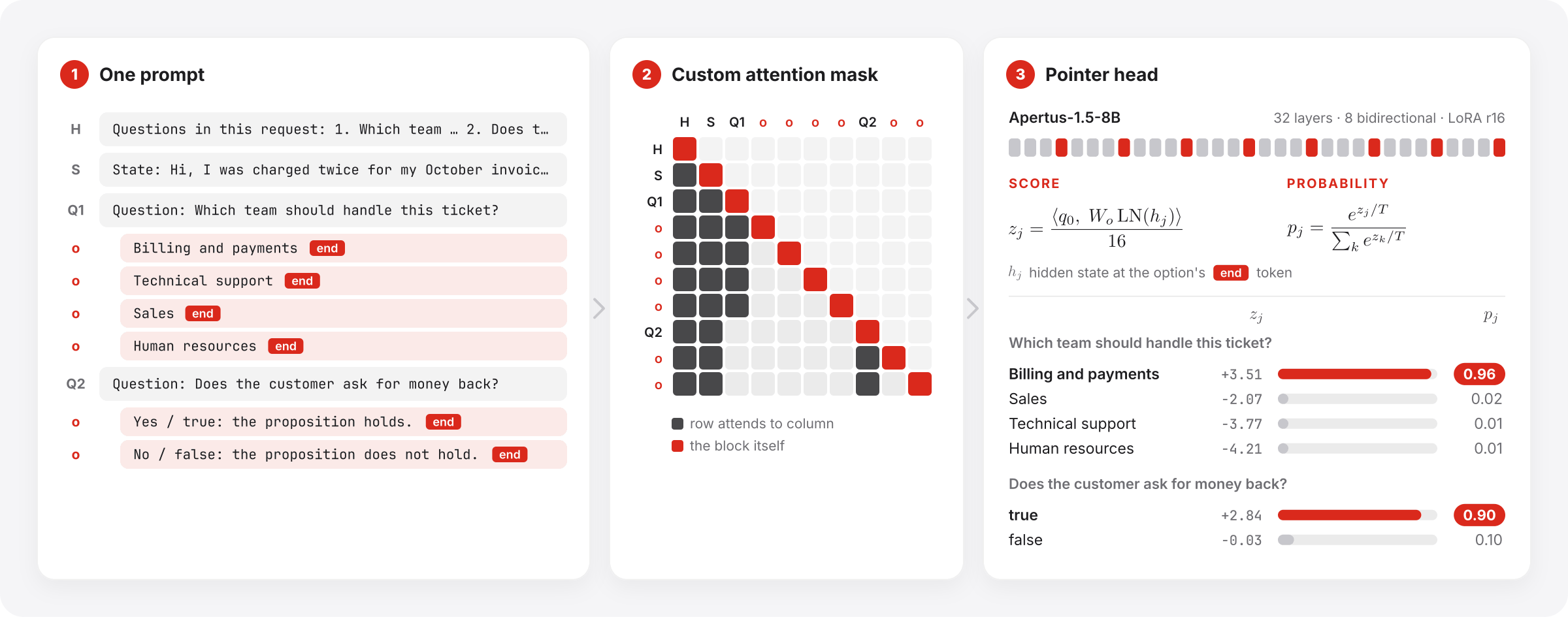
1. One prompt. A request is rendered as a single prompt: a header that lists its questions, then the state, then each question with its options. Every option ends with an end token.
2. Custom attention mask. Eight of the 32 layers (3, 7, …, 31) attend in both directions; the other 24 are causal. On top of that, a block mask isolates the parts of the prompt:
- the header does not attend to the state, and the state does not attend to the questions, so both are the same for every question of a request and are computed once;
- an option attends to the header, the state and its own question, never to another option, and nothing outside an option attends to it;
- all options of a question start at the same position id, so their order carries no signal.
The mask buys two things: answers that do not depend on the order of the options, and a header and state that are
computed once and shared by every question of a request. It costs two: options cannot be
weighed against each other (the model rarely picks "none of the above" when it is right), and the model only works
with the votum loader, not with plain transformers or vLLM.
3. Pointer head. Option j gets a score zj from the final hidden state hj at its end token, and a softmax over the options of a question gives the probabilities pj (formula in the figure). q0 is a learned 256-dimensional query, Wo a 256 × 4096 projection, LN a layer norm, and T a temperature per question type, which can be recalibrated on your own data.
docs/internals.md covers the weights, the two implementations and how to reproduce the release.
Fine-tuning
training/README.md covers fine-tuning on your own data: prepare the rows, train from the released model, export the checkpoint and refit the calibration temperatures. One 24 GB GPU is enough.
Documentation
| Page | What is in it |
|---|---|
| docs/serving.md | the HTTP server: API, API key, memory, settings |
| docs/images.md | images in requests: set-up, examples, accuracy |
| docs/benchmarks.md | speed measurements and how they were made |
| docs/internals.md | how the model works inside, the repository layout, tests, reproducing the release |
| training/README.md | fine-tuning on your own data |
Acknowledgements
Votum builds on other people's work:
- Apertus, by the Swiss AI Initiative (EPFL, ETH Zurich, CSCS): the open model underneath Votum.
- Jev: the original decision models. Votum uses their request format (
choice,noul,score). - Jeff, by Jonathan Geuter, Andrew Cheng and David Alvarez-Melis
(Releasing the Inner Jev): the open recipe for turning a language model into a
decision model. Our evaluation was checked against their published numbers, and the code that reads requests is
derived from theirs (see
NOTICE). - JevPertus (code): an earlier decision model built on the same Apertus-1.5-8B.
- JevBench and the Jev Decision Index: independent public benchmarks for decision models, on which Votum is measured.
License
Apache-2.0 (LICENSE, NOTICE). The Apertus model underneath carries the
Apertus Acceptable Use Policy,
which applies to anyone who uses Votum. Votum is an independent project, not affiliated with or endorsed by the Swiss
AI Initiative.
1 maintainer

Metadata
1 maintainer
Release files for votum 0.1.1
For a detailed explanation of source distributions (sdists) and built distributions (wheels), please see the package formats documentation.
Source distribution (sdist)
| File | Size | Uploaded | Provenance | Actions |
|---|---|---|---|---|
| votum-0.1.1.tar.gz | 86.8 kB | With provenance | Details for votum-0.1.1.tar.gz |
Built distribution (wheel)
| File | Interpreter | ABI | Platform | Actions Reset |
|---|---|---|---|---|
| votum-0.1.1-py3-none-any.whl | Python 3 | none | any | Details for votum-0.1.1-py3-none-any.whl |
Total release size: 151.4 kB
Release files / votum-0.1.1.tar.gz
| Download URL | votum-0.1.1.tar.gz |
|---|---|
| Size | 86.8 kB |
| Tags | Source |
|
SHA-256 checksum How to use checksums |
4d7466213bc61a2ff11b580e6798989b42f12737c32ee3761e95f1501d773a54
|
|
BLAKE2b-256 checksum How to use checksums |
d865614f736fa8ef9bd7e3c1f5b81cd3e159a5eb2b3820d83bde3ab6155901d3
|
| Upload date | |
|
Uploaded using Trusted Publishing? What is trusted publishing? |
Yes |
| Uploaded via |
twine/7.0.0 CPython/3.13.16
|
Provenance
Provenance describes where a file came from. On PyPI, provenance is shared via attestations, which provide a verifiable record of the build or publishing details. View details, limitations and caveats.


PyPI Publish Attestation
PyPI verified that this artifact, at this checksum, originated from the publisher listed below.
Signed by GitHub Actions, verified by PyPI on Nov 17, 2026.
Transparency logRelease files / votum-0.1.1-py3-none-any.whl
| Download URL | votum-0.1.1-py3-none-any.whl |
|---|---|
| Size | 64.6 kB |
| Tags | Python 3 |
|
SHA-256 checksum How to use checksums |
29045fc3d0055969c63399a50b3f98993270d6e4ed9783dda70bca4fe34b97f9
|
|
BLAKE2b-256 checksum How to use checksums |
2da61fedad09e97f4acf443e078c8c333f26af34175b74ac128f6d83f3180780
|
| Upload date | |
|
Uploaded using Trusted Publishing? What is trusted publishing? |
Yes |
| Uploaded via |
twine/7.0.0 CPython/3.13.16
|
Provenance
Provenance describes where a file came from. On PyPI, provenance is shared via attestations, which provide a verifiable record of the build or publishing details. View details, limitations and caveats.
PyPI Publish Attestation
PyPI verified that this artifact, at this checksum, originated from the publisher listed below.
Signed by GitHub Actions, verified by PyPI on Nov 17, 2026.
Transparency logSecurity for votum 0.1.1
Provenance
Provenance describes where a file came from. On PyPI, provenance is shared via attestations, which provide a verifiable record of the build or publishing details. View details, limitations and caveats.
Full provenance
Both files in this release have been uploaded with provenance metadata.
Attestation for votum-0.1.1.tar.gz
PyPI Publish Attestation
PyPI verified that this artifact, at this checksum, originated from the publisher listed below.
Signed by GitHub Actions, verified by PyPI on Nov 17, 2026.
Transparency logA note on package security
PyPI is a repository for distributing packages, not a service for auditing them. While third-party security researchers and our staff do their best to detect and remove malicious packages, PyPI cannot guarantee the quality, security or suitability of any given package.
To learn more about protecting yourself from malicious actors, visit our package security documentation.














