





vowl
vowl (vee-owl 🦉) is a validation engine for Open Data Contract Standard (ODCS) data contracts. Define your validation rules once in a declarative YAML contract and get rich, actionable reports on your data's quality.
🏆 Official ODCS Vendor: vowl is actively maintained and listed on the official ODCS vendors list as a natively compatible tool.
Who it's for
- Data engineers and platform teams that need declarative, standards-based data quality validation
- Teams wanting a deterministic quality gate that guards pipelines against unreliable data, including data produced by increasingly automated or AI-assisted workflows
- Anyone working with ODCS data contracts who wants an automated way to enforce them
Table of Contents
Part 1 · Getting Started
Part 2 · Core Concepts
- Data Contracts
- Auto-Generated Checks
- Library Metrics (
type: library) - Format Checks
- Validation Results
- Architecture
Part 3 · Usage Patterns
- Common sources — Local DataFrame · PySpark · Ibis (20+ backends) · Concurrent Checks
- Filtering & cross-source — Filter Conditions · Multi-Source · Compatibility Mode
- Advanced & extending — Servers in Contract · Custom Adapters · Remote Contracts (Git/S3)
More
Part 1 · Getting Started
Features
- Extensible Check Engine: Ships with a SQL check engine out of the box, with the architecture designed to support custom check types beyond SQL.
- Auto-Generated Rules: Checks are automatically derived from contract metadata (
logicalType,logicalTypeOptions,enum,required,unique,primaryKey) and library metrics (nullValues,missingValues,invalidValues,duplicateValues,rowCount). - Any DataFrame, Any Backend: Load any Narwhals-compatible DataFrame type (pandas, Polars, PySpark, etc.) or connect to 20+ backends via Ibis. SQL dialect translation is handled by SQLGlot.
- Server-Side Execution: SQL checks run server-side through Ibis without materialising tables on the client.
- Multi-Source Validation: Validate across tables in different source systems with cross-database joins.
- Declarative ODCS Contracts: Define validation rules in YAML following the Open Data Contract Standard.
- Flexible Filtering: Filter conditions with wildcard pattern matching, ideal for incremental validation of new data.
- Rich Reporting: Detailed summaries, row-level failure analysis, saveable reports, and a chainable
ValidationResultAPI. - DQ Metrics & OpenTelemetry: Row-level pass rates per table, dimension and check, saved to
dq_metrics.jsonor exported as OTLP metrics, traces and logs. - No Silent Gaps: Unimplemented or unrecognised checks surface as
ERROR, not quietly skipped, so nothing slips through the cracks.
Installation
pip install vowl
Or install from source:
pip install git+https://github.com/govtech-data-practice/vowl.git
Optional extras are available: vowl[spark], vowl[otel], vowl[all]. vowl[otel] adds the OpenTelemetry SDK and OTLP exporter that export_otel() needs. vowl[spark] supports both classic Spark and Spark Connect (pyspark[connect], requires pyspark >= 3.4). On runtimes pinned to pyspark 3.0–3.3, use vowl[spark-classic] for classic Spark only (no Spark Connect).
For local development, testing, and release workflow, see CONTRIBUTING.md.
Validate in 3 lines
import pandas as pd  # or any Narwhals-compatible DataFrame
from vowl import validate_data

df = pd.read_csv("tests/hdb_resale/HDBResaleWithErrors.csv")
result = validate_data("tests/hdb_resale/hdb_resale_simple.yaml", df=df)
result.display_full_report()
Output (click to expand)
=== Data Quality Validation Results ===
   Contract Version:      v3.2.0
   Contract ID:           c11443ee-542f-4442-b28d-2d224342be37
   Schemas:               hdb_resale_prices

 OVERALL DATA QUALITY
   Overall:
     Checks Pass Rate:          7 / 9 (77.7%)

   hdb_resale_prices:
     Overall:
       Checks Pass Rate:          7 / 9 (77.7%)
       ERRORED Checks:            0
       Failed Rows (approximate): 14
     Single Table:
       Checks Pass Rate:          7 / 9 (77.7%)
       ERRORED Checks:            0
     Multi Table:
       Checks Pass Rate:          0 / 0 (N/A)
       ERRORED Checks:            0
       Failed Rows (approximate): N/A


 CHECK RESULTS
+------------------------------------+----------------------------------+-------------------+--------+----------+----------+--------+----------------+
| check_id                           | Target                           | tables_in_query   | status | operator | expected | actual | execution time |
+------------------------------------+----------------------------------+-------------------+--------+----------+----------+--------+----------------+
| Month                              | hdb_resale_prices.month          | hdb_resale_prices | FAILED | mustBe   | 0        | 2      | 18.60 ms       |
| floor_area_must_be_less_than_200   | hdb_resale_prices.floor_area_sqm | hdb_resale_prices | FAILED | mustBe   | 0        | 12     | 15.28 ms       |
+------------------------------------+----------------------------------+-------------------+--------+----------+----------+--------+----------------+
| flat_type_column_exists_check      | hdb_resale_prices.flat_type      | hdb_resale_prices | PASSED | mustBe   | 0        | 0      | 4.44 ms        |
| flat_type_enum_check               | hdb_resale_prices.flat_type      | hdb_resale_prices | PASSED | mustBe   | 0        | 0      | 8.24 ms        |
| floor_area_sqm_column_exists_check | hdb_resale_prices.floor_area_sqm | hdb_resale_prices | PASSED | mustBe   | 0        | 0      | 4.43 ms        |
| month_column_exists_check          | hdb_resale_prices.month          | hdb_resale_prices | PASSED | mustBe   | 0        | 0      | 4.81 ms        |
| month_logical_type_check           | hdb_resale_prices.month          | hdb_resale_prices | PASSED | mustBe   | 0        | 0      | 10.04 ms       |
| resale_price_column_exists_check   | hdb_resale_prices.resale_price   | hdb_resale_prices | PASSED | mustBe   | 0        | 0      | 4.32 ms        |
| resale_price_must_not_exceed_2m    | hdb_resale_prices.resale_price   | hdb_resale_prices | PASSED | mustBe   | 0        | 0      | 14.53 ms       |
+------------------------------------+----------------------------------+-------------------+--------+----------+----------+--------+----------------+
Total Execution:       84.69 ms

=== Failed Checks and Rows (up to 5 row(s) per failed check) ===

  hdb_resale_prices
    Single checks

      [Month]
        Operator:   mustBe
        Expected:   0
        Actual:     2
        Target:   hdb_resale_prices.month
        Details:  Based on ISO 8601 | YYYY-MM
        Rule:     SELECT COUNT(*) FROM "hdb_resale_prices" WHERE NOT REGEXP_MATCHES(TRY_CAST(month AS TEXT), '^[0-9]{4}-(0[1-9]|1[0-2])$')
        Rows shown: 2 of 2
+----------+--------+-----------+-------+--------------+--------------+----------------+---------------+---------------------+--------------------+--------------+
| month    | town   | flat_type | block | street_name  | storey_range | floor_area_sqm | flat_model    | lease_commence_date | remaining_lease    | resale_price |
+----------+--------+-----------+-------+--------------+--------------+----------------+---------------+---------------------+--------------------+--------------+
| 2017-jan | BEDOK  | 5 ROOM    | 21    | CHAI CHEE RD | 07 TO 09     | 130.0          | Adjoined flat | 1972                | 54 years 06 months | 530000.0     |
| 2017-jan | BISHAN | 3 ROOM    | 105   | BISHAN ST 12 | 04 TO 06     | 4.0            | Simplified    | 1985                | 67 years 11 months | 395000.0     |
+----------+--------+-----------+-------+--------------+--------------+----------------+---------------+---------------------+--------------------+--------------+

      [floor_area_must_be_less_than_200]
        Operator:   mustBe
        Expected:   0
        Actual:     12
        Target:   hdb_resale_prices.floor_area_sqm
        Details:  Check failed: expected mustBe 0, got 12
        Rule:     SELECT COUNT(*) FROM "hdb_resale_prices" WHERE TRY_CAST(floor_area_sqm AS BIGINT) >= 200
        Rows shown: 5 of 12
+---------+-----------------+-----------+-------+---------------------+--------------+----------------+--------------------+---------------------+--------------------+--------------+
| month   | town            | flat_type | block | street_name         | storey_range | floor_area_sqm | flat_model         | lease_commence_date | remaining_lease    | resale_price |
+---------+-----------------+-----------+-------+---------------------+--------------+----------------+--------------------+---------------------+--------------------+--------------+
| 2017-06 | KALLANG/WHAMPOA | 3 ROOM    | 38    | JLN BAHAGIA         | 01 TO 03     | 215.0          | Terrace            | 1972                | 54 years 01 month  | 830000.0     |
| 2017-09 | CHOA CHU KANG   | EXECUTIVE | 641   | CHOA CHU KANG ST 64 | 16 TO 18     | 215.0          | Premium Maisonette | 1998                | 79 years 04 months | 888000.0     |
| 2017-12 | KALLANG/WHAMPOA | 3 ROOM    | 65    | JLN MA'MOR          | 01 TO 03     | 249.0          | Terrace            | 1972                | 53 years 07 months | 1053888.0    |
| 2018-01 | CHOA CHU KANG   | EXECUTIVE | 639   | CHOA CHU KANG ST 64 | 10 TO 12     | 215.0          | Premium Maisonette | 1998                | 79 years           | 900000.0     |
| 2018-09 | KALLANG/WHAMPOA | 3 ROOM    | 41    | JLN BAHAGIA         | 01 TO 03     | 237.0          | Terrace            | 1972                | 52 years 10 months | 1185000.0    |
+---------+-----------------+-----------+-------+---------------------+--------------+----------------+--------------------+---------------------+--------------------+--------------+
Next, Part 2 · Core Concepts explains what a contract looks like and what you get back. If you'd rather see runnable code, jump to Part 3 · Usage Patterns for PySpark, Ibis connections, multi-source validation, and more.
Part 2 · Core Concepts
This section walks through the four ideas you need: how you declare rules (Data Contracts), what vowl generates for you (Auto-Generated Checks), the declarative metrics you can add (Library Metrics and Format Checks), and what you get back (Validation Results). It closes with the Architecture.
Data Contracts
Instead of writing validation logic in Python, you declare it in a YAML file following the Open Data Contract Standard (ODCS). This separates your rules from your code, making them easier to manage, version, and share.
Example hdb_resale_simple.yaml:
kind: DataContract
apiVersion: v3.2.0
version: 1.0.0
id: c11443ee-542f-4442-b28d-2d224342be37
name: HDB Resale Flat Prices
schema:
  - name: hdb_resale_prices # This becomes the table name in your SQL queries
    properties:
      # --- SQL Check: regex-based format validation ---
      - name: month
        logicalType: string
        quality:
          - type: sql
            name: Month
            description: Based on ISO 8601 | YYYY-MM
            mustBe: 0
            query: |-
              SELECT COUNT(*)
              FROM "hdb_resale_prices"
              WHERE CAST(month AS TEXT) !~ '^[0-9]{4}-(0[1-9]|1[0-2])$';
            dimension: conformity

      # --- Generated Check: allowed values from enum ---
      - name: flat_type
        enum:
          - value: 1 ROOM
          - value: 2 ROOM
          - value: 3 ROOM
          - value: 4 ROOM
          - value: 5 ROOM
          - value: EXECUTIVE
          - value: MULTI-GENERATION

      # --- SQL Check: business rule ---
      - name: floor_area_sqm
        quality:
          - name: floor_area_must_be_less_than_200
            type: sql
            query: SELECT COUNT(*) FROM "hdb_resale_prices" WHERE floor_area_sqm >= 200
            mustBe: 0
            dimension: consistency

      # --- SQL Check: resale price cap ---
      - name: resale_price
        quality:
          - name: resale_price_must_not_exceed_2m
            type: sql
            query: SELECT COUNT(*) FROM "hdb_resale_prices" WHERE resale_price > 2000000
            mustBe: 0
            dimension: consistency
Auto-Generated Checks
You don't have to write every check by hand. When a contract is loaded, vowl automatically derives checks from your column metadata, so simply declaring logicalType, required: true, unique: true, and similar gives you validation for free. These auto-generated checks run before any explicit quality checks you've authored.
The check types currently generated:
| Generated from | What vowl validates |
|---|---|
name |
Column declared in the contract exists in the source table |
logicalType |
Values can be cast to the declared SQL type for integer, number, boolean, date, timestamp, and time |
logicalTypeOptions.minLength |
String length is at least the configured minimum |
logicalTypeOptions.maxLength |
String length does not exceed the configured maximum |
logicalTypeOptions.pattern |
String values match the configured regex pattern |
logicalTypeOptions.minimum |
Value is greater than or equal to the configured minimum |
logicalTypeOptions.maximum |
Value is less than or equal to the configured maximum |
logicalTypeOptions.exclusiveMinimum |
Value is strictly greater than the configured minimum |
logicalTypeOptions.exclusiveMaximum |
Value is strictly less than the configured maximum |
logicalTypeOptions.multipleOf |
Value is a multiple of the configured number |
logicalTypeOptions.format |
Value satisfies the declared format (see Format Checks) |
logicalTypeOptions.minItems |
Array (logicalType: array) contains at least the configured number of items |
logicalTypeOptions.maxItems |
Array contains at most the configured number of items |
logicalTypeOptions.uniqueItems |
Array (uniqueItems: true) contains no duplicate items |
items.logicalType |
Every element of an array casts to the declared element type |
items.logicalTypeOptions.* |
Every element satisfies the element option (minLength, pattern, minimum, format, …) |
items.enum |
Every element is within the declared allowed set |
enum |
Non-null values are within the declared allowed set (enum value list) |
required: true |
Column contains no NULL values |
unique: true |
Non-null values are unique |
primaryKey: true |
Values are both unique and non-null |
relationships (foreignKey) |
Every non-null key value exists in the referenced target table (referential integrity) |
For example, a property like this:
- name: block
    logicalType: string
    logicalTypeOptions:
        maxLength: 10
    required: true
produces three generated checks: a column-exists check, a maxLength option check, and a required (no-NULL) check. Because string does not currently generate a SQL cast-based type check, the logicalType entry above contributes metadata for option checks rather than a standalone type-validation query. If you use integer, number, boolean, date, timestamp, or time, vowl also generates a logicalType SQL check automatically. You only need to define extra quality entries when you want custom business rules beyond the contract metadata.
Reference: how check references are built (JSONPath internals)
When a contract is loaded, vowl builds CheckReference objects for every executable check via Contract.get_check_references_by_schema(). This includes both user-authored checks in quality blocks and synthetic checks derived from column metadata. The generated references are grouped by schema, and the auto-generated ones run before explicit quality checks.
| Reference type | Trigger in contract | JSONPath stored in the reference |
|---|---|---|
| Table check | Entry under schema-level quality |
$.schema[N].quality[M] |
| Column check | Entry under property-level quality |
$.schema[N].properties[M].quality[K] |
| Library column metric | type: library under property-level quality |
$.schema[N].properties[M].quality[K] |
| Library table metric | type: library under schema-level quality |
$.schema[N].quality[M] |
| Declared column exists check | Property has a name |
$.schema[N].properties[M] |
| Logical type check | logicalType present on a property |
$.schema[N].properties[M].logicalType |
| Logical type options check | Supported key under logicalTypeOptions |
$.schema[N].properties[M].logicalTypeOptions.<optionKey> |
| Array items check | items sub-schema on a logicalType: array |
$.schema[N].properties[M].items.<...> |
| Enum check | enum present on a property |
$.schema[N].properties[M].enum |
| Required check | required: true |
$.schema[N].properties[M].required |
| Unique check | unique: true |
$.schema[N].properties[M].unique |
| Primary key check | primaryKey: true |
$.schema[N].properties[M].primaryKey |
So the block property above produces three generated check references pointing at:
| Check path | Check type |
|---|---|
$.schema[0].properties[...] |
DeclaredColumnExistsCheckReference |
$.schema[0].properties[...].logicalTypeOptions.maxLength |
LogicalTypeOptionsCheckReference |
$.schema[0].properties[...].required |
RequiredCheckReference |
Relationships (foreign keys)
A relationships entry of type foreignKey says every non-NULL value in a column must exist in another table's column. vowl runs this as a real check, so you get referential integrity from metadata without writing the cross-table SQL by hand (compare the employee_id_exists_in_master_list example under Residues below).
Declare the relationship on the property that holds the key. The to target uses shorthand <object>.<property> notation, resolved by property name:
schema:
  - name: demo_employee_list # the master list (referenced side)
    properties:
      - name: employee_id
        logicalType: string
        primaryKey: true
  - name: demo_employee_payroll # references the master list
    properties:
      - name: employee_id
        logicalType: string
        relationships:
          - type: foreignKey
            to: demo_employee_list.employee_id
This generates a check named demo_employee_payroll_employee_id_to_demo_employee_list_employee_id_foreign_key_check. A payroll row whose employee_id is NULL is skipped, so an optional foreign key is allowed. A value fails only when it is present but has no match in the master list. Because failed rows carry only the payroll table's columns, they appear in the demo_employee_payroll annotated table rather than a separate residue.
Need composite keys, cross-file references, or cross-source joins? See Data Contracts: Relationships (Foreign Keys).
Library Metrics (type: library)
Instead of writing SQL by hand, you can declare common data quality metrics using type: library in your quality blocks. vowl auto-generates the appropriate SQL at runtime.
Column-level metrics (under a property's quality):
metric |
What it checks | Arguments |
|---|---|---|
nullValues |
Count of NULL values in the column |
- |
missingValues |
Count of values matching a configurable missing-values list | arguments.missingValues: list of sentinel values (use null for SQL NULL) |
invalidValues |
Count of values that fail valid-value or pattern criteria | arguments.validValues: allowed values list and/or arguments.pattern: regex |
duplicateValues |
Count of duplicate non-NULL values in the column | - |
Table-level metrics (under a schema's quality):
metric |
What it checks | Arguments |
|---|---|---|
rowCount |
Total number of rows in the table | - |
duplicateValues |
Count of duplicate rows across specified columns | arguments.properties: list of column names to check |
All library metrics support unit: "percent" to return the result as a percentage of total rows instead of an absolute count. They also accept any of the standard check operators (mustBe, mustBeGreaterThan, etc.).
Example:
properties:
  - name: town
    quality:
      - type: library
        metric: nullValues
        mustBe: 0
        dimension: completeness

  - name: flat_type
    quality:
      - type: library
        metric: invalidValues
        mustBe: 0
        dimension: conformity
        arguments:
          validValues:
            - 3 ROOM
            - 4 ROOM
            - 5 ROOM
            - EXECUTIVE

quality:
  - type: library
    metric: rowCount
    mustBeGreaterThan: 0
    dimension: completeness

  - type: library
    metric: duplicateValues
    mustBe: 0
    dimension: uniqueness
    arguments:
      properties:
        - month
        - block
        - street_name
Format Checks
The logicalTypeOptions.format key validates that column values conform to a declared format. The check generated depends on the column's logicalType. In short:
- Integer formats (
i8…u64) — range-check a fixed-width integer type. - String formats (
uuid,email,ipv4,ipv6,hostname,uri) — match a built-in regex. - Date/timestamp/time formats — a JDK
DateTimeFormatterpattern (e.g.yyyy-MM-dd) is converted to a regex and matched against string-cast values. - Number formats (
f32,f64) — recognised but metadata-only (no check).
- name: age
  logicalType: integer
  logicalTypeOptions:
    format: u8 # 0 – 255

- name: request_id
  logicalType: string
  logicalTypeOptions:
    format: uuid

- name: created_at
  logicalType: timestamp
  logicalTypeOptions:
    format: "yyyy-MM-dd'T'HH:mm:ss.SSSXXX"
Reference: supported formats and ranges
Integer formats — validates that values fall within the range of a fixed-width integer type:
format |
Min | Max |
|---|---|---|
i8 |
-128 | 127 |
i16 |
-32,768 | 32,767 |
i32 |
-2,147,483,648 | 2,147,483,647 |
i64 |
-9,223,372,036,854,775,808 | 9,223,372,036,854,775,807 |
u8 |
0 | 255 |
u16 |
0 | 65,535 |
u32 |
0 | 4,294,967,295 |
u64 |
0 | 18,446,744,073,709,551,615 |
i128 and u128 are recognised but skipped because their ranges exceed what SQL engines can represent.
String formats — validates values against a built-in regex pattern:
format |
What it checks |
|---|---|
uuid |
UUID v1-v5 hex format (xxxxxxxx-xxxx-xxxx-xxxx-xxxxxxxxxxxx) |
email |
Basic local@domain.tld structure |
ipv4 |
Dotted-decimal IPv4 address (0.0.0.0 - 255.255.255.255) |
ipv6 |
Full-form colon-separated IPv6 address |
hostname |
RFC-952 hostname with TLD |
uri |
URI with a valid scheme prefix (e.g. https:, s3:) |
password, byte, and binary are recognised but skipped because they cannot be validated against data.
Number formats — f32 and f64 are recognised but produce no check (metadata-only).
Date, timestamp and time formats — accepts a JDK DateTimeFormatter pattern (e.g. yyyy-MM-dd). vowl converts the pattern to a regex and validates that string-cast values match. Supported tokens include yyyy, yy, MM, dd, HH, mm, ss, SSS, and timezone offsets (X/XXX/Z). If a pattern contains tokens vowl cannot translate, the check is skipped with a warning.
Validation Results
The validate_data function returns a powerful ValidationResult object that provides multiple ways to interact with your validation results.
Core Methods
| Method/Property | What It Does | Returns |
|---|---|---|
print_summary() |
Prints high-level statistics (pass/fail counts, success rate, performance) | self (chainable) |
show_failed_rows(max_rows=5) |
Displays sample of failed rows in console. Use max_rows=-1 for all rows. |
self (chainable) |
display_full_report(max_rows=5) |
Prints summary + shows failed rows (convenience method) | self (chainable) |
save(output_dir=".", prefix="vowl_results", outputs=None, check_info=None) |
Saves the results to disk. outputs lists the files to write. The default writes everything but "failed_query_outputs", whose files "all_query_outputs" already writes. check_info shapes the check_info column |
self (chainable) |
get_output_dfs(checks=None, scope="failed") |
Returns per-check failed rows as {check_id: DataFrame}. scope="all" returns the rows of every row-level check, with a status column |
Dict[str, DataFrame] |
get_annotated_output(checks=None, check_info=None) |
Returns full in-scope tables with a check_info column (JSON array of objects) annotating failed rows |
Dict[str, Dict[str, DataFrame]] |
get_dq_metrics_df(by="schema") |
Returns how many rows of each table failed at least one check, and the pass rate. by can be "schema", "dimension" or "check" |
DataFrame |
get_check_results_df() |
Returns one row per check with its status, dimension and counts | DataFrame |
get_consolidated_output_dfs(checks=None) |
Returns the failed rows grouped per table set, the frames behind the grouped failed-rows CSVs. Never downloads a table except to copy the tables of a cross-source check, so it suits large tables | Dict[str, DataFrame] |
get_dq_metrics() |
Returns the run's DQ metrics at check, dimension, schema and run level: the content of dq_metrics.json. See Understanding DQ Metrics |
dict |
export_otel(endpoint=None, signals=("metrics", "traces", "logs")) |
Sends the run's DQ metrics, traces and logs over OTLP. Needs vowl[otel]. See Exporting to OpenTelemetry |
str (run id) |
.passed (property) |
Boolean indicating if all checks passed | True/False |
Row Quality
get_dq_metrics_df() returns the row counts. The summary does not show them. It shows Failed Rows (approximate), a sum of the scalar counts of the failed checks. For each table, get_dq_metrics_df() gives how many rows failed at least one row-level check, and the share that passed. A row that fails two checks counts once, and every copy of a duplicated row counts. vowl counts inside your data source where it can, so the numbers do not depend on max_failed_rows, and each one carries an approximate flag for the cases where it could be off. A check whose failed rows vowl can't attribute to the table is left out and counted in checks_not_attributable. See When counting and annotating differ for how the row counts relate to annotated output.
result.get_dq_metrics_df()                  # one row per table
result.get_dq_metrics_df(by="dimension")    # one row per table and dimension
result.get_dq_metrics_df(by="check")        # which checks are row-level, and how they were counted
By default only failed checks add rows. A check that passed within its tolerance (for example 50 rows under mustBeLessThan: 100) adds nothing. Set ValidationConfig(fetch_tolerated_rows=True) to fetch its rows too, so they count in the row counts and appear in every output, marked as tolerated. See Tolerated rows.
Checks that are plain row filters are counted inside your data source wherever it supports it. For other checks, such as ones with DISTINCT or a join, vowl attributes each failed row to the source table, so a row that fails several checks counts once. On DuckDB, SQLite, Spark, Databricks and PostgreSQL the data source does this. Elsewhere vowl downloads the table and holds it in memory, about 1 to 1.5 GiB for 1 million rows at 6 columns. Annotated output reuses the same download. This work runs only when you ask for DQ metrics or annotated output, which includes the default save() and export_otel(). print_summary(), get_check_results_df() and save(outputs=["consolidated_query_outputs"]) use the scalar counts only.
When a count could be off, for example because a check ended in ERROR and may hide failed rows, its approximate flag is set. The same flag is exported as the vowl.<level>.row.approximate gauges, so you can alert on it. See Approximate row counts.
See How Attributed Rows Work for how each failed row is matched to its table, and Counting Mechanisms.
Annotated Output
get_annotated_output() returns the full in-scope table with a check_info column that annotates which rows failed which checks. Passing rows have null in the check_info column. This is useful when you need to see failures in the context of the full dataset rather than just the isolated failed rows.
New to this? Check Results explains failed rows, annotated output and residues in plain language, with a small worked example.
It returns a nested dict with two reserved keys:
"annotated": a{schema: table}dict where each table is your full in-scope data plus acheck_infocolumn. Every original row is present;check_infoisnullfor rows that passed everything and holds a JSON array of objects describing the failing check(s) otherwise."residues": failed rows for checks that cannot be merged onto a single table (checks whose failed rows lack the table's primary key or, when it declares none, don't have exactly its columns, such as column-subset checks). Checks that return one number, such as an average, a sum, a minimum or a maximum, produce none. Most single-table contracts produce none. Residues are per-check (one entry per non-mergeable check, keyed"<schema>.<column>::<check_name>", or"<schema>::<check_name>"for a schema-level check) and carry the samecheck_infocolumn as the annotated tables (a single-element JSON array, shaped by the same preset) plustables_in_query, so everythingget_annotated_output()returns is read the same way. (A cross-table check can merge onto its home schema if you shape its row query to project only that schema's columns: see Annotating the failed rows of a cross-table check.)
The check_info parameter ("names" default, "summary", or "full") shapes each array element. Every preset emits a JSON array of objects so consumers parse uniformly via item["check_name"]; they differ only in how many keys each object carries:
"names"—[{"check_name": ...}, ...](just the failing check name(s))."summary"—[{"check_name", "dimension", "tags", "target"}, ...]."full"—[<full check_definition> + "check_name" + "target", ...].
import json

result = validate_data("contract.yaml", df=df)
output = result.get_annotated_output(check_info="summary")

annotated = output["annotated"]["hdb_resale_prices"].to_pandas()
# columns: <original columns> + check_info
# output["residues"] — cross-table or non-mergeable failures (empty for single-table contracts)

# check_info is a JSON string; parse it to read each failing check's dimension/tags/target.
failing = annotated[annotated["check_info"].notna()].iloc[0]
print(json.loads(failing["check_info"]))
# [{"check_name": "Year", "dimension": "conformity",
#   "tags": ["SG-DRM v5.0"], "target": "hdb_resale_prices.lease_commence_date"}]
Annotated Table
Output — full table, flagged rows floated to the top (click to expand)
# Sort so flagged rows surface first; passing rows (check_info = null) sink to the bottom.
flagged_first = annotated.sort_values("check_info", na_position="last").reset_index(drop=True)

flagged_first[["month", "town", "block", "floor_area_sqm",
               "lease_commence_date", "check_info"]]
| month | town | block | floor_area_sqm | lease_commence_date | check_info | |
|---|---|---|---|---|---|---|
| 0 | 2017-01 | BEDOK | 84.0 | 1986 | [{"check_name": "AddressBlockHouseNumber", "dimension": "conformity", "tags": [...], "target": "hdb_resale_prices.block"}] |
|
| 1 | 2017-jan | BEDOK | 21 | 130.0 | 1972 | [{"check_name": "Month", "dimension": "conformity", "tags": [...], "target": "hdb_resale_prices.month"}] |
| 2 | 2017-jan | BISHAN | 105 | 4.0 | 1985 | [{"check_name": "Month", "dimension": "conformity", "tags": [...], "target": "hdb_resale_prices.month"}] |
| 3 | 2017-01 | ANG MO KIO | 219 | 67.0 | 1977.0 | [{"check_name": "Year", "dimension": "conformity", "tags": [...], "target": "hdb_resale_prices.lease_commence_date"}] |
| 4 | 2017-01 | ANG MO KIO | 211 | 67.0 | abc | [{"check_name": "Year", "dimension": "conformity", "tags": [...], "target": "hdb_resale_prices.lease_commence_date"}] |
| 5 | 2017-06 | KALLANG/WHAMPOA | 38 | 215.0 | 1972 | [{"check_name": "floor_area_must_be_less_than_200", "dimension": "accuracy", "tags": [...], "target": "hdb_resale_prices.floor_area_sqm"}] |
| ... | ... | ... | ... | ... | ... | ... |
| 8 | 2017-01 | ANG MO KIO | 406 | 73.0 | 1979 | |
| 9 | 2017-01 | ANG MO KIO | 108 | 67.0 | 1978 | |
| 10 | 2017-01 | ANG MO KIO | 602 | 67.0 | 1984 | |
| ... | ... | ... | ... | ... | ... | ... |
201,879 rows — failed rows floated to the top, passing rows (empty check_info) below. Shown with check_info="summary".
Because the annotation lives on the full table, separating the good rows from the bad is a one-liner — filter to where check_info is null and drop the annotation column:
clean = annotated[annotated["check_info"].isna()].drop(columns=["check_info"])
# 201,861 clean rows of 201,879, ready for downstream use — no join back to the source needed
A check whose failed rows can't be matched to rows of one table becomes a residue: its rows lack the table's declared primary key or, when the table declares none, don't have exactly the table's columns. Column-subset checks, such as one that returns only distinct values, are the usual case. A cross-table check merges when its failed rows carry the table's primary key, or when its row query projects only its home schema's columns. See Annotating the failed rows of a cross-table check. Checks that return one number, such as an average, a sum, a minimum or a maximum, have no failed rows and appear only in the summary. Residues are per-check, one entry per non-mergeable check, keyed "<schema>.<column>::<check_name>" ("<schema>::<check_name>" for a schema-level check). Each carries its own failed rows plus the same check_info column the annotated tables use (a single-element JSON array) and tables_in_query:
Residues
Output — a residue from a cross-table (multi-source) contract (click to expand)
The payroll table declares a primary key, so its bare-JOIN referential checks merge onto it. This check returns only the distinct phone numbers missing from the master list, which hold no key:
- name: phone_numbers_missing_from_master_list
  type: sql
  query: >-
    SELECT COUNT(*) FROM (
      SELECT DISTINCT payroll.phone_number
      FROM demo_employee_payroll payroll
      LEFT JOIN demo_employee_list ref ON payroll.phone_number = ref.phone_number
      WHERE payroll.phone_number IS NOT NULL AND ref.phone_number IS NULL
    ) AS missing_numbers
  mustBe: 0
output = result.get_annotated_output()

print("Residue keys:", list(output["residues"].keys()))
for key, residue in output["residues"].items():
    df = residue.to_pandas()
    print(f"\nResidue '{key}': {len(df)} failed row(s)")
    print(df)
Residue keys: ['demo_employee_payroll::phone_numbers_missing_from_master_list']
Each non-mergeable check gets its own entry. They are never grouped together, so a row that failed two such checks appears once under each check's residue:
Residue 'demo_employee_payroll::phone_numbers_missing_from_master_list': 2 failed row(s)
| phone_number | check_info | tables_in_query | |
|---|---|---|---|
| 0 | 6581234567 | [{"check_name": "phone_numbers_missing_from_master_list"}] |
demo_employee_list, demo_employee_payroll |
| 1 | 6594327654 | [{"check_name": "phone_numbers_missing_from_master_list"}] |
demo_employee_list, demo_employee_payroll |
For the full eligibility rules and worked examples of each non-mergeable category, see Where each failed check ends up. The Basic Tutorial notebook walks through these examples end-to-end.
save() always writes <prefix>_check_results.csv and <prefix>_summary.json. The outputs argument lists the other files to write:
| Output | Files |
|---|---|
"failed_query_outputs" |
<prefix>_checks/<schema>__<column>__<check>.csv, one per failed check |
"all_query_outputs" |
The same folder, one per row-level check whatever its status |
"consolidated_query_outputs" |
<prefix>_<tables>.csv, the failed rows grouped per table set |
"annotated_table" |
<prefix>_<schema>_annotated.csv and the residue files |
"dq_metrics" |
<prefix>_dq_metrics.json |
# Every output but "failed_query_outputs". This is the default.
result.save()

# Shape the check_info column: "names" (default), "summary", or "full"
result.save(outputs=["annotated_table"], check_info="summary")

# Only the grouped failed-rows CSVs
result.save(outputs=["consolidated_query_outputs"])
Cost:
"annotated_table"and"dq_metrics"attribute failed rows to each table and may download it, which can be slow on a large table. They share that work, so writing both costs no more than writing one. The other outputs do nothing to the rows."all_query_outputs"runs the row query of each check that passed.
output_mode is deprecated. It still works with a FutureWarning and will be removed in a future release. See Deprecated output_mode.
You can also set the outputs globally via ValidationConfig (see Run Settings):
from vowl import ValidationConfig, validate_data

config = ValidationConfig(outputs=["annotated_table", "dq_metrics"], annotated_check_info="summary")
result = validate_data("contract.yaml", df=df, config=config)
result.save()  # uses the configured outputs and check_info
save() can also write straight to cloud storage. Pass a URI instead of a folder:
result.save("s3://my-bucket/dq-results/run-1/")
It works for s3://, gs://, abfs:// and hdfs:// using the filesystems built into pyarrow, so there's nothing extra to install. Credentials come from the usual place for each cloud, such as environment variables, ~/.aws, or an IAM role. To use a custom endpoint or explicit credentials, pass filesystem=. See Saving Results to Cloud Storage.
OpenTelemetry Export
export_otel() sends a run's results to an OpenTelemetry Collector or any monitoring tool that accepts OTLP. Install the extra first with pip install 'vowl[otel]'.
result = validate_data("contract.yaml", df=df)

run_id = result.export_otel(
    endpoint="http://localhost:4317",
    service_name="orders-dq",
    custom_attributes={"deployment.environment": "prod"},
)
vowl sends three signals by default:
- Metrics: the DQ metrics at check, dimension, schema and run level, for dashboards and alerts.
- Traces: one
vowl.validatespan per run, with avowl.checkspan per check and avowl.savespan for eachsave()made before the export. - Logs: one record per check that failed or ended in
ERROR.
Nothing is re-run against the data. The returned run_id matches the one in dq_metrics.json, so you can link a saved run to its telemetry. In a deployed pipeline, leave out endpoint and set the standard OTEL_EXPORTER_OTLP_* environment variables instead.
To try it locally, the repo ships a Collector, Prometheus, Tempo, Loki and Grafana stack with a ready-made DQ dashboard. Run make otel-up, then make otel-add-vowl-runs to send sample runs (needs Docker). See the local stack guide.
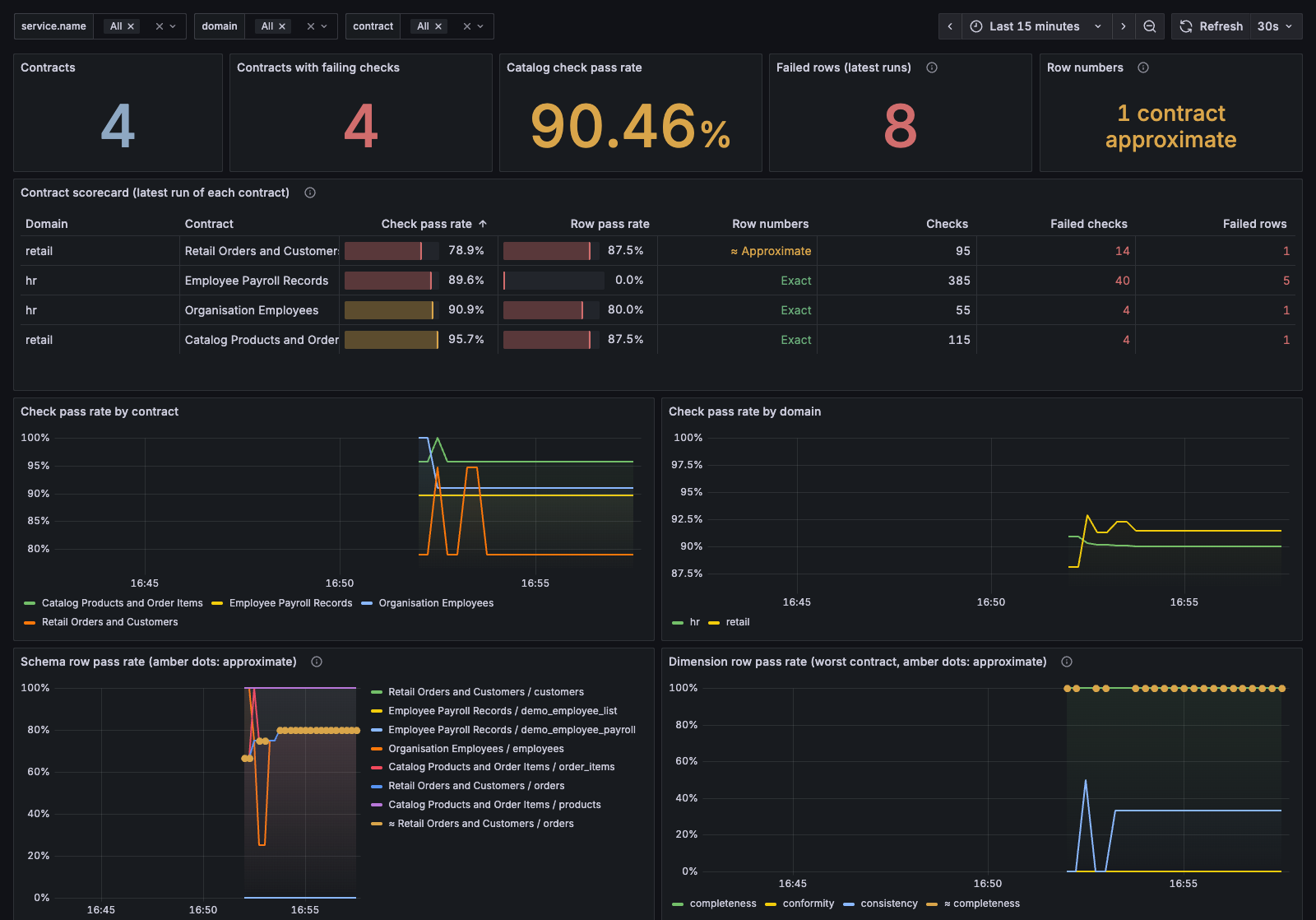
See Exporting to OpenTelemetry for every parameter, the span and log attributes, and how to use your own OTel providers.
Architecture
vowl has a modular architecture built around Ibis as the universal query layer.
┌─────────────────────────────────────────────────────────────────────────────┐
│                              validate_data()                                │
│                           (Main Entry Point)                                │
└─────────────────────────────────────────────────────────────────────────────┘
                                     │
                                     ▼
┌─────────────────────────────────────────────────────────────────────────────┐
│                           DataSourceMapper                                  │
│              (Auto-detects input type → creates adapter)                    │
└─────────────────────────────────────────────────────────────────────────────┘
                                     │
          ┌──────────────────────────┼──────────────────────────┐
          ▼                          ▼                          ▼
┌──────────────────┐      ┌──────────────────┐      ┌──────────────────┐
│   IbisAdapter    │      │ MultiSourceAdapter│      │  Custom Adapter  │
│                  │      │                  │      │                  │
│ • pandas/Polars  │      │ • Cross-database │      │ • Extend         │
│ • PySpark        │      │   validation     │      │   BaseAdapter    │
│ • PostgreSQL     │      │ • Data federation│      │                  │
│ • Snowflake      │      │                  │      │                  │
│ • BigQuery       │      │                  │      │                  │
│ • 20+ backends   │      │                  │      │                  │
└──────────────────┘      └──────────────────┘      └──────────────────┘
          │                          │                          │
          └──────────────────────────┼──────────────────────────┘
                                     ▼
┌─────────────────────────────────────────────────────────────────────────────┐
│                              Executors                                      │
│                                                                             │
│  ┌─────────────────┐  ┌─────────────────────┐  ┌─────────────────────┐     │
│  │  IbisSQLExecutor│  │MultiSourceSQLExecutor│  │  Custom Executor   │     │
│  │                 │  │                     │  │                     │     │
│  │ Runs SQL checks │  │ Mode 1: delegate to │  │ Extend BaseExecutor │     │
│  │ via Ibis        │  │ backend (same conn) │  │ or SQLExecutor      │     │
│  │ (server-side)   │  │ Mode 2: materialise │  │                     │     │
│  │                 │  │ to DuckDB via Arrow │  │                     │     │
│  └─────────────────┘  └─────────────────────┘  └─────────────────────┘     │
└─────────────────────────────────────────────────────────────────────────────┘
                                     │
                                     ▼
┌─────────────────────────────────────────────────────────────────────────────┐
│                           ValidationResult                                  │
│                                                                             │
│  • Per-check failed rows with check_id & tables_in_query columns            │
│  • Detailed check results and metrics                                       │
│  • Export to CSV/JSON                                                       │
└─────────────────────────────────────────────────────────────────────────────┘
Key Components
| Component | Description |
|---|---|
| DataSourceMapper | Auto-detects a single input source (DataFrame, Spark object, Ibis backend, or connection string) and creates the appropriate adapter |
| IbisAdapter | Universal adapter supporting 20+ backends via Ibis (pandas, Polars, PySpark, PostgreSQL, Snowflake, BigQuery, etc.) |
| MultiSourceAdapter | Routes checks across multiple data sources, separating single-table checks (delegated to per-schema adapters) from multi-table checks (sent to MultiSourceSQLExecutor) |
| IbisSQLExecutor | Executes SQL-based quality checks through the Ibis query layer (server-side) |
| MultiSourceSQLExecutor | Executes cross-source SQL with two modes: direct delegation when all tables share the same compatible backend, or DuckDB materialisation when backends differ. Tables are exported as Arrow and loaded into a local DuckDB for cross-database joins |
| Contract | Parses ODCS YAML contracts into executable validation rules |
| ValidationResult | Rich result object with enhanced DataFrames, metrics, and export capabilities |
Part 3 · Usage Patterns
Interactive demo: Try the example notebooks for a hands-on walkthrough of the examples below — start with the Basic Tutorial.
The patterns are grouped from most common to most advanced:
- Common sources — point vowl at the data you already have: a local DataFrame, PySpark, or any of 20+ Ibis backends.
- Filtering & cross-source — validate a subset of rows, or join across multiple source systems — optionally through DuckDB ATTACH.
- Advanced & extending — drive connections from servers in the contract, build custom adapters/executors, or load contracts from Git and S3.
Common sources
Local DataFrame (Pandas/Polars)
import pandas as pd
from vowl import validate_data

df = pd.read_csv("data.csv")
result = validate_data("contract.yaml", df=df)
result.display_full_report()
PySpark
from pyspark.sql import SparkSession
from vowl import validate_data

# Create SparkSession (user-managed)
spark = SparkSession.builder.appName("vowl").getOrCreate()

try:
    spark_df = spark.read.table("my_table")
    result = validate_data("contract.yaml", df=spark_df)
    result.display_full_report()
finally:
    # User is responsible for stopping the SparkSession
    spark.stop()
Note: The library does not manage the SparkSession lifecycle. You must create and stop it yourself. This is by design - SparkSession is a heavy, application-owned resource with specific configuration requirements.
Ibis Connections (20+ Backends)
# Ibis supports: Amazon Athena, BigQuery, ClickHouse, Dask, Databricks, DataFusion,
# Druid, DuckDB, Exasol, Flink, Impala, MSSQL, MySQL, Oracle, pandas, Polars,
# PostgreSQL, PySpark, RisingWave, SingleStoreDB, Snowflake, SQLite, Trino, ...
# Find out more at https://github.com/ibis-project/ibis

import ibis
from vowl import validate_data
from vowl.adapters import IbisAdapter

con = ibis.postgres.connect(...)  # Redshift can be supported via Postgres connections too

result = validate_data("contract.yaml", adapter=IbisAdapter(con))
result.display_full_report()
For MySQL, select the database when you create the connection, for example via
ibis.mysql.connect(..., database="my_db") or a connection URI that already
includes the database name. vowl does not issue USE database during
validation; it runs read-only SELECT queries against the active database on
the existing connection. If you need to avoid relying on the connection's
default database, use qualified table names such as my_db.my_table in your
contract queries.
Concurrent Checks (PooledAdapter)
When a contract has many independent checks and the backend can serve several
queries at once, run them concurrently by wrapping a connection factory in a
PooledAdapter. It keeps a thread-safe pool of connections (one per worker) and
dispatches checks across them; the verdicts are identical to a sequential run.
import ibis
from vowl import validate_data
from vowl.adapters import IbisAdapter, PooledAdapter

# factory: returns a fresh adapter (new connection) on each call. Called once
# per pooled connection, so the table must be available on every connection.
def make_adapter():
    con = ibis.duckdb.connect("my_db.duckdb")
    return IbisAdapter(con)

pooled = PooledAdapter(factory=make_adapter, max_concurrency=4)

# Pass the pool like any other adapter: adapter=pooled for every schema,
# or adapters={"my_table": pooled, ...} to give each schema its own.
result = validate_data("contract.yaml", adapter=pooled)
result.display_full_report()
max_concurrency caps the checks in flight, and so the connections open, for
the whole run. Schemas given the same pool share that cap and run side by side.
A join between tables on one pool runs in the database on one of the pool's
connections. A join across two pools, or between a pool and another adapter,
is copied to a local DuckDB. See PooledAdapter.
The pool keeps its adapters after the run, so you can pass it to another
validate_data call. Call pooled.cleanup() when you are done with it. This
drops the pooled adapters and calls cleanup() on each one that defines it. It
does not close Ibis connections, so close those yourself if your factory opens
ones that need closing.
Filtering & cross-source
Explicit Adapter with Filter Conditions
from vowl import validate_data
from vowl.adapters import IbisAdapter
from datetime import datetime, timedelta
import ibis

date_limit = (datetime.today() - timedelta(days=7)).strftime("%Y-%m-%d")
con = ibis.postgres.connect(...)

# Using dict for filter conditions with wildcard patterns
# Wildcards use glob-style matching: * (any chars), ? (single char), [seq] (char in seq)
adapter = IbisAdapter(
    con,
    filter_conditions={
        # Exact match
        "TableA": {
            "field": "date_dt",
            "operator": ">=",
            "value": date_limit
        },
        # Wildcard: matches employees, emp_history, emp_details, etc.
        "emp*": {
            "field": "date_dt",
            "operator": ">=",
            "value": date_limit
        },
        # Wildcard: matches orders_archive, customers_archive, etc.
        "*_archive": {
            "field": "is_deleted",
            "operator": "=",
            "value": False
        },
        # Apply to ALL tables
        "*": {
            "field": "tenant_id",
            "operator": "=",
            "value": 123
        },
    }
)
# Note: If multiple patterns match a table, conditions are combined with AND

# Multiple filter conditions on same table (combined with AND)
adapter = IbisAdapter(
    con,
    filter_conditions={
        "TableA": [
            {"field": "date_dt", "operator": ">=", "value": date_limit},
            {"field": "status", "operator": "=", "value": "active"},
        ]
    }
)

result = validate_data("contract.yaml", adapter=adapter)
result.display_full_report()
Multi-Source Validation
There are two ways to validate across tables in different databases.
Option A: DuckDB ATTACH (streams rows per check, no up-front download)
import ibis
from vowl import validate_data
from vowl.adapters import IbisAdapter

con = ibis.duckdb.connect()

# Attach multiple remote databases
con.raw_sql("ATTACH 'postgresql://user:pass@host:5432/salesdb' AS pg_sales (TYPE postgres, READ_ONLY)")  # trufflehog:ignore
con.raw_sql("ATTACH 'sqlite:///path/to/users.db' AS sqlite_users (TYPE sqlite, READ_ONLY)")

# Switch back to local DuckDB so views live in memory
con.raw_sql("USE memory")

# Create views as prefix-free shortcuts to the attached tables
con.raw_sql("CREATE VIEW transactions AS SELECT * FROM pg_sales.transactions")
con.raw_sql("CREATE VIEW users AS SELECT * FROM sqlite_users.users")

# Now vowl (and your contract queries) can reference tables without alias prefixes
result = validate_data("contract.yaml", adapter=IbisAdapter(con))
result.display_full_report()
Note: A view is a saved query, not a copy, and it gives your contracts clean, prefix-free table names. DuckDB still runs on your machine, so each check streams the rows it reads from the attached databases, then discards them. For PostgreSQL and MySQL, simple filters are sent to the source. Joins and aggregates such as
COUNT(*)run inside DuckDB, so the rows they read cross the network, and a table used by several checks is read once per check. DuckDB ATTACH supports PostgreSQL, MySQL, and SQLite.
Option B: Multi-Source Adapters (downloads tables for cross-table checks)
from vowl import validate_data
from vowl.adapters import IbisAdapter
import ibis

con_a = ibis.postgres.connect(...)
con_b = ibis.sqlite.connect(...)

adapters = {
    "table_a": IbisAdapter(con_a),
    "table_b": IbisAdapter(con_b)
}

result = validate_data("contract.yaml", adapters=adapters)
result.display_full_report()
Why this exists: A fallback for backends that DuckDB ATTACH does not support (e.g. Snowflake, BigQuery, Databricks, Oracle, MSSQL). Single-table checks run inside each table's own database. For a cross-table check across different connections, the
MultiSourceAdapterdownloads each table it reads in full (after filter conditions) via Arrow into a local DuckDB instance, so prefer ATTACH for large tables when your sources support it. DuckDB ATTACH only supports PostgreSQL, MySQL, and SQLite. It cannot be used as a general-purpose multi-source strategy because of namespace, credential, and filter limitations. Both options share a known dark pattern: SQL checks can reference tables not declared in the contract'sschemablock. vowl reads an undeclared table through the connection of the schema the check sits under, whether the check reads it alone or joins it to other tables, and the check runs whenever that connection can see the table.
Compatibility Mode (DuckDB ATTACH)
import ibis
from vowl import validate_data
from vowl.adapters import IbisAdapter

# ATTACH lets DuckDB query your remote database directly.
# Data is streamed on demand, not materialised locally.
# All SQL is evaluated by DuckDB, so dialect differences are eliminated.
con = ibis.duckdb.connect()
con.raw_sql("ATTACH 'postgresql://user:pass@host:5432/mydb' AS pg (TYPE postgres, READ_ONLY)")  # trufflehog:ignore
con.raw_sql("USE pg")  # Allows querying tables without the pg. alias

result = validate_data("contract.yaml", adapter=IbisAdapter(con))
result.display_full_report()
When to use this: Your remote backend doesn't support a SQL feature that a check needs, or you want a single local engine for reproducible results regardless of the source database. DuckDB ATTACH supports PostgreSQL, MySQL, and SQLite.
Advanced & extending
Using Servers Defined in Data Contract
from vowl import validate_data
from vowl.contracts import Contract
from vowl.adapters import IbisAdapter
import ibis

# Load the contract and get server configuration
contract = Contract.load("contract.yaml")
server = contract.get_server("my-postgres-server")  # Match by server name
# Or: contract.get_server("uat")        # falls back to matching by environment
# Or: contract.get_server()             # returns the first server

# Create connection based on server config
con = ibis.postgres.connect(
    host=server["server"],
    port=server.get("port", 5432),
    database=server.get("database", ""),
)

# Create adapter and validate
adapter = IbisAdapter(con)
result = validate_data("contract.yaml", adapter=adapter)
result.display_full_report()
Custom Adapters and Executors
BaseAdapter, BaseExecutor, and SQLExecutor are intended as boilerplate extension points for teams building custom integrations. The typical pattern is to wrap an existing adapter, register custom executors, and then add backend-specific behavior incrementally.
from typing import Optional

import ibis

from vowl.adapters import BaseAdapter, IbisAdapter
from vowl.executors import BaseExecutor, SQLExecutor


class CustomAdapter(BaseAdapter):
    def __init__(self, con, **kwargs):
        super().__init__(executors={
            "sql": CustomSQLExecutor,
            "xxx": CustomEngineExecutor,
        })
        self._wrapped = IbisAdapter(con, **kwargs)

    def get_connection(self):
        return self._wrapped.get_connection()

    @property
    def filter_conditions(self):
        return self._wrapped.filter_conditions

    def test_connection(self, table_name: str) -> Optional[str]:
        return self._wrapped.test_connection(table_name)


class CustomEngineExecutor(BaseExecutor):
    ...


class CustomSQLExecutor(SQLExecutor):
    ...


con = ibis.duckdb.connect()
adapter = CustomAdapter(con)

executors = adapter.get_executors()
assert "sql" in executors
validate_data accepts any BaseAdapter through adapter= or adapters=, including IbisAdapter, PooledAdapter and your own subclasses. A custom adapter runs its checks through the executors it registers. A cross-table check runs in the database only if is_compatible_with says the adapters can share a query. The default returns False, so vowl copies the tables to a local DuckDB, which needs export_table_as_arrow. When the tables in such a join have different filter conditions, the adapter also needs with_filter_conditions, or vowl copies the tables.
Loading Contracts from Remote Sources (Git/S3)
Contracts don't have to live on local disk — validate_data accepts GitHub/GitLab URLs and S3 URIs directly.
Git (GitHub/GitLab):
from vowl import validate_data

# GitHub - blob URL (auto-converted to raw)
result = validate_data(
    "https://github.com/org/repo/blob/main/contracts/my_contract.yaml",
    df=df
)
result.display_full_report()

# GitHub - raw URL
result = validate_data(
    "https://raw.githubusercontent.com/org/repo/main/contracts/my_contract.yaml",
    df=df
)
result.display_full_report()

# GitLab - blob URL (auto-converted to raw)
result = validate_data(
    "https://gitlab.com/org/repo/-/blob/main/contracts/my_contract.yaml",
    df=df
)
result.display_full_report()

# Note: `requests` is included in base install.
S3:
from vowl import validate_data

# S3 URI format
result = validate_data("s3://my-bucket/contracts/my_contract.yaml", df=df)
result.display_full_report()

# Note: `boto3` is not included in the base install.
# Install it with: pip install vowl[all]  or  pip install boto3
# Uses default AWS credentials (environment variables, ~/.aws/credentials, IAM role, etc.)
Roadmap
Completed
| Capability | Description |
|---|---|
| ✅ Ibis Connectors | Interoperability with 20+ data sources via Ibis (PostgreSQL, Snowflake, BigQuery, Databricks, etc.) |
| ✅ Remote Contract Loading | Load contracts from S3 (s3://) and Git (GitHub/GitLab URLs) |
| ✅ Remote Result Saving | Save results straight to S3, Google Cloud, Azure, or HDFS with result.save("s3://...") |
| ✅ JSONPath Navigation | Navigate contract elements using JSONPath expressions (contract.resolve("$.schema[0].name")) |
| ✅ Static Checks | Auto-generated checks from contract elements: logicalType, logicalTypeOptions, required, unique, primaryKey |
| ✅ Library Metrics | Declare common data quality metrics (nullValues, missingValues, invalidValues, duplicateValues, rowCount) with type: library. SQL auto-generated at runtime |
| ✅ ODCS Schema Validation | Contracts validated against ODCS JSON Schema before execution |
| ✅ Filter Conditions | Incremental quality testing with wildcard pattern matching - optimised for append-only data sources |
| ✅ Multi-Schema Checks | Cross-table referential checks within a single contract |
| ✅ Multi-Connection Checks | Cross-table referential checks between different servers/databases via MultiSourceAdapter |
| ✅ Foreign Key Checks | Checks built from ODCS relationships (foreignKey), including composite, self-referencing and external-file targets |
| ✅ Optional Extras | Add optional Spark support with .[spark], OpenTelemetry export with .[otel], or install .[all] |
| ✅ Custom Adapters & Executors | Extensible architecture - create custom adapters and executors by extending BaseAdapter, BaseExecutor, or SQLExecutor |
| ✅ Parallel Check Execution | Run checks in parallel for faster validation across large contracts via the pooled adapter |
| ✅ Annotated Output | Failed rows marked on a copy of the source table, with residues for checks that can't be merged |
| ✅ OpenTelemetry Export | Export DQ metrics, traces, and logs via OpenTelemetry (OTLP), behind the optional [otel] extra. Try it locally with the Grafana DQ dashboard stack |
| ✅ DQ Metrics Export | Row-level pass and fail counts per table, dimension and check, saved to dq_metrics.json |
Planned
| Capability | Description | Status |
|---|---|---|
| 🔬 Alternative Check Engines | Support for dqx, Soda, Great Expectations (subject to licensing review) | Planned |
| 📅 CLI Interface | Command-line interface for running validations directly from the terminal | Planned |
| 📅 vowl-ui | Web-based validation interface for vowl | Planned |
Status
Active. Under ongoing development, with issues and PRs monitored.
Contributing
We welcome contributions! Please see CONTRIBUTING.md for guidelines on how to get started.
Owner
Maintained by GovTech's Data Practice (govtech-data-practice).
Security
See SECURITY.md for how to report a vulnerability and which versions are supported.
License
This project is licensed under the MIT License.
1 maintainer

Metadata
1 maintainer
Release files for vowl 0.0.7
For a detailed explanation of source distributions (sdists) and built distributions (wheels), please see the package formats documentation.
Source distribution (sdist)
| File | Size | Uploaded | |
|---|---|---|---|
| vowl-0.0.7.tar.gz | 331.5 kB | Details |
Built distribution (wheel)
| File | Interpreter | ABI | Platform | Reset |
|---|---|---|---|---|
| vowl-0.0.7-py3-none-any.whl | Python 3 | none | any | Details |
Total release size: 627.6 kB
Release files / vowl-0.0.7.tar.gz
| Download URL | vowl-0.0.7.tar.gz |
|---|---|
| Size | 331.5 kB |
| Tags | Source |
|
SHA-256 checksum How to use checksums |
1038add19e42ce4729c261eb3601ebc658e3573a8ee9be347aec8aabc498629a
|
|
BLAKE2b-256 checksum How to use checksums |
c41c5213479e2b7ce4f2468d8a628f7b2ff787194065af3c9ae125ce71dd29ae
|
| Upload date | |
|
Uploaded using Trusted Publishing? What is trusted publishing? |
Yes |
| Uploaded via |
twine/7.0.0 CPython/3.13.14
|
Provenance
Provenance describes where a file came from. On PyPI, provenance is shared via attestations, which provide a verifiable record of the build or publishing details. View details, limitations and caveats.


PyPI Publish Attestation
PyPI verified that this artifact, at this checksum, originated from the publisher listed below.
Signed by GitHub Actions, verified by PyPI on Oct 14, 2026.
Transparency logRelease files / vowl-0.0.7-py3-none-any.whl
| Download URL | vowl-0.0.7-py3-none-any.whl |
|---|---|
| Size | 296.1 kB |
| Tags | Python 3 |
|
SHA-256 checksum How to use checksums |
8c311df8d4bcd6df93f200e312b0796a0c87e04d5f6657aac2881e178bffa913
|
|
BLAKE2b-256 checksum How to use checksums |
c82f7eae5286777a040c9c8b7ef79db06802949ad75f5b914ad370e061456c92
|
| Upload date | |
|
Uploaded using Trusted Publishing? What is trusted publishing? |
Yes |
| Uploaded via |
twine/7.0.0 CPython/3.13.14
|
Provenance
Provenance describes where a file came from. On PyPI, provenance is shared via attestations, which provide a verifiable record of the build or publishing details. View details, limitations and caveats.
PyPI Publish Attestation
PyPI verified that this artifact, at this checksum, originated from the publisher listed below.
Signed by GitHub Actions, verified by PyPI on Oct 14, 2026.
Transparency log













