
VoxLock
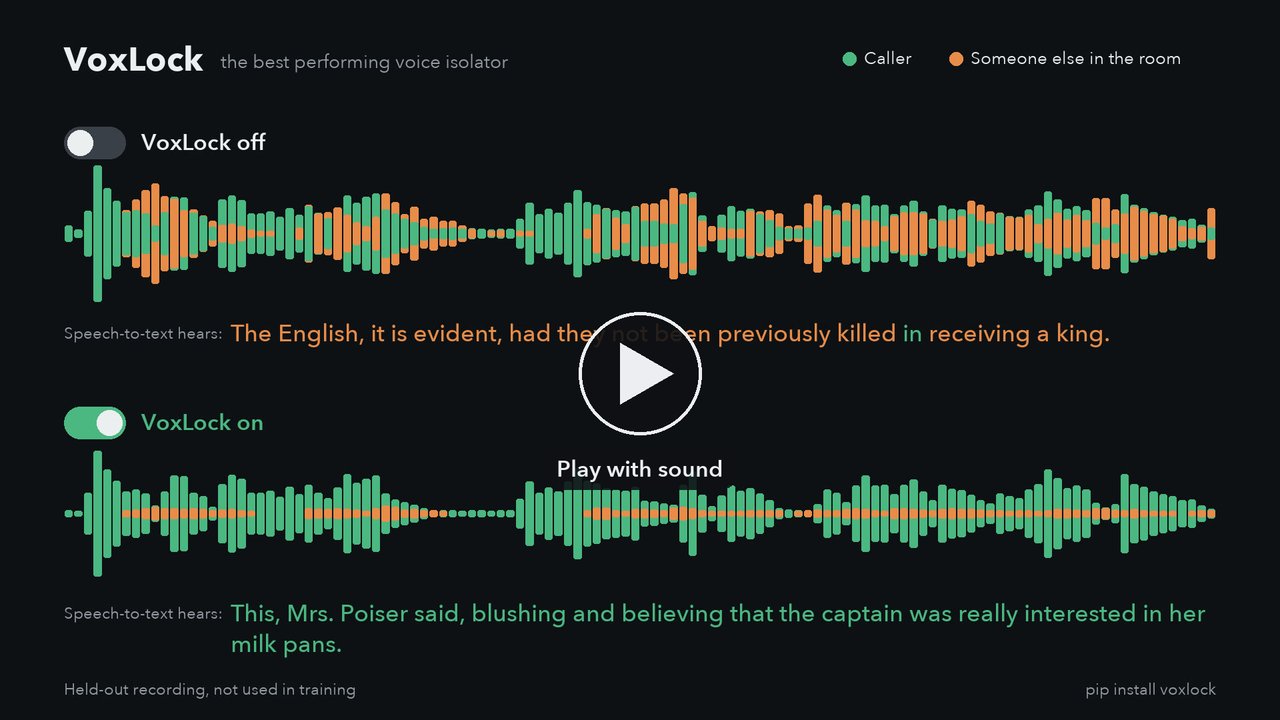
The best performing voice isolator there is. VoxLock is an open-source voice isolation model: it keeps the caller's voice and removes the other voices in the room before speech-to-text hears them. Made for voice agents and phone calls: one input, the call audio, and it picks out the caller by itself. It streams on a CPU with 24 ms of algorithmic latency.
Live demo · Model on Hugging Face




Results
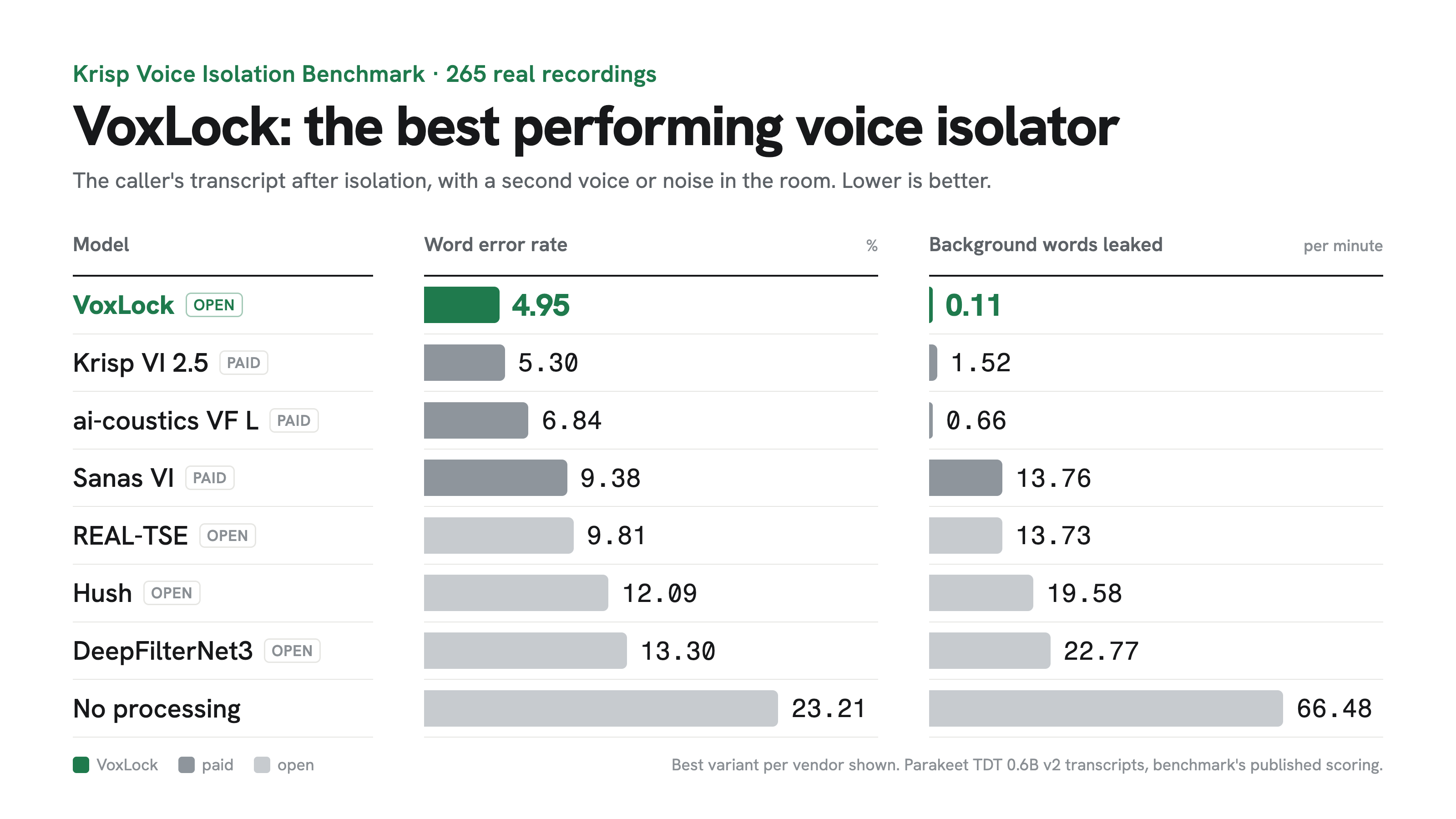
| Model | Access | Word error rate % | Background words leaked / min |
|---|---|---|---|
| VoxLock | open | 4.95 | 0.11 |
| Krisp VI 2.5 Default | paid | 5.30 | 1.52 |
| Krisp VI 2.5 Balanced | paid | 5.32 | 2.02 |
| Krisp VI 2.5 HD | paid | 5.79 | 2.74 |
| Krisp VI 2.5 Lite | paid | 6.21 | 4.52 |
| ai-coustics Voice Focus 2.2 L | paid | 6.84 | 0.66 |
| ai-coustics Voice Focus 2.2 S | paid | 6.91 | 1.00 |
| Sanas Voice Isolation SE 1.0 | paid | 9.38 | 13.76 |
| REAL-TSE causal (VoxLock's starting checkpoint) | open | 9.81 | 13.73 |
| Hush | open | 12.09 | 19.58 |
| DeepFilterNet3 | open | 13.30 | 22.77 |
| TIGER | open | 14.72 | 37.24 |
| No processing | 23.21 | 66.48 | |
| SAM-Audio small (Meta) | open | 33.77 | 21.15 |
| ElevenLabs Voice Isolator** | paid | 43.79** | 144.6** |
265 real recordings from the Krisp Voice Isolation Benchmark, transcribed with Parakeet TDT 0.6B v2 and scored with the benchmark's published method. Background words leaked counts words transcribed while only the background was talking, per minute of that audio.
** ElevenLabs Voice Isolator, run on the 7 of these recordings with the most background speech, not all 265. On the same 7, no processing scores 45.82% and 154.3 leaked words per minute, and VoxLock 2.98% and 0.0.
On real AMI meetings not used in training, with the headset wearer as the caller:
| Model | Access | Word error rate % | Background words leaked / min |
|---|---|---|---|
| VoxLock | open | 10.12 | 2.12 |
| ai-coustics Voice Focus 2.2 S | paid | 11.85 | 1.06 |
| ai-coustics Voice Focus 2.2 L | paid | 12.13 | 1.72 |
| Sanas Voice Isolation SE 1.0 | paid | 13.30 | 5.30 |
| TIGER | open | 22.84 | 36.85 |
| DeepFilterNet3 | open | 26.78 | 38.84 |
| Hush | open | 33.00 | 68.93 |
| No processing | 33.03 | 78.34 |
Caller words missed, deletions, insertions and 95% intervals: bench/results.
Use
pip install voxlock
voxlock call.wav -o caller.wav
Any sample rate, mono or stereo. The model downloads from Hugging Face on first use: 75 MB, the 8-bit version (see Quantized models).
import voxlock

vl = voxlock.VoxLock()                     # precision="fp32" for the benchmarked model
call = voxlock.load_audio("call.wav")      # 16 kHz mono float32
caller = vl.isolate(call)                  # same length as the input
VoxLock keeps the voice in a 3-second sample of the caller. isolate takes the loudest 3 seconds in the first 15 seconds of the call, which is how it was benchmarked. Pass sample= to choose it yourself.
Streaming
Push the call in as it arrives, as 16 kHz float32 chunks of any size. Each push returns the isolated audio that is ready, about 24 ms behind the input.
vl = voxlock.VoxLock(threads=4)
stream = vl.live()                         # finds the caller by itself
for chunk in call_audio:                   # e.g. 40 ms = 640 samples
    send(stream.push(chunk))
send(stream.flush())                       # at the end of the call
live() passes the audio through unchanged until it has heard 3 seconds of speech, takes that speech as the voice sample and isolates from then on. On our test calls it switched over a median of 3.6 seconds in.
If you already have a sample, from earlier in the call or from a previous call, isolation starts with the first chunk:
stream = vl.stream(sample) # about 3 s of the caller, 16 kHz mono
Streaming gives the same output as isolate with the same sample. To keep up with a live call, push chunks of 40 ms or more: 40 ms chunks on 4 threads run at 0.69x real time on an Apple M2 Pro and 0.89x on an 8-vCPU Xeon server, and 80 ms chunks on 2 threads at 0.67x on the Xeon. Larger chunks use less CPU and add their length to the delay.
Pipecat
pip install "voxlock[pipecat]"
from pipecat.transports.base_transport import TransportParams
from voxlock.pipecat import VoxLockFilter

params = TransportParams(audio_in_enabled=True, audio_in_filter=VoxLockFilter())
The filter cleans the caller's audio before VAD and speech-to-text, at any transport sample rate (Twilio's 8 kHz included). Like live(), it passes audio through until it has heard 3 seconds of the caller; pass voice_sample= to isolate from the start. It runs the int8 model in 80 ms chunks on 2 threads by default (chunk_ms=, threads=, precision=). With a single vCPU, such as Pipecat Cloud's agent-2x, use VoxLockFilter(chunk_ms=160, threads=1): 0.73x real time on the Xeon server. Half a vCPU (agent-1x) is too little. A full voice agent: examples/pipecat_bot.py. Tested with Pipecat 1.12.0.
PyTorch
git clone https://github.com/arbazsiddiqui/voxlock && cd voxlock
pip install -r requirements.txt
huggingface-cli download arbazsiddiqui/voxlock model.safetensors config.yaml --local-dir ckpt
python isolate.py --ckpt ckpt --in call.wav --out caller.wav
Quantized models
The ONNX model comes in four precisions, all in the Hugging Face repository. Choose with VoxLock(precision=...), voxlock --precision ... or VoxLockFilter(precision=...).
| Precision | Files | Download | Word error rate % | Background words leaked / min | Real-time factor, 40 ms chunks, 2 / 4 threads |
|---|---|---|---|---|---|
int8 (default) |
enroll.onnx, chunk_int8.onnx |
75 MB | 5.11 | 0.12 | 0.89 / 0.69 |
int8-full |
enroll.onnx, chunk_int8_full.onnx |
67 MB | 5.85 | 0.04 | 0.67 / 0.54 |
fp16 |
enroll_fp16.onnx, chunk_fp16.onnx |
48 MB | 4.95* | 0.11* | 1.31 / 1.00 |
fp32 |
enroll.onnx, chunk.onnx |
95 MB | 4.95 | 0.11 | 1.33 / 0.97 |
Scores are on all 265 recordings of the Krisp benchmark above, so even the int8 model is ahead of every other model in the table. The real-time factor is streaming on an Apple M2 Pro; below 1 keeps up with a live call. The 8-bit files are post-training dynamic quantization of the same weights: int8 stores the LSTM weights in 8 bits, int8-full the LSTMs and the matrix multiplies. int8-full is the fastest: on one thread it keeps up with 80 ms chunks (0.80x real time on the Xeon server), where int8 needs 160 ms chunks (0.73x).
* fp16 is the float32 model with its weights rounded to float16. Its output matches float32 to 45 dB, so it carries the float32 scores. The browser demo uses it.
enroll runs once on the voice sample, chunk runs on each chunk of the call and carries the LSTM state.
Training
A 27M causal band-split RNN target-speaker extractor, fine-tuned from the REAL-TSE challenge baseline on a single NVIDIA L4:
REAL-TSE tfmap_context_causal_100
  -> simulated calls        4,000 steps   LibriSpeech callers + background talkers in simulated rooms
  -> real AMI crosstalk     4,000 steps   headset recordings from 40 meetings
  -> long calls (30 s)        800 steps   callers who talk throughout
  -> rooms and distances     400 steps   callers near or far from the mic, background voices dry or in the room, room noise
Repository
| Path | |
|---|---|
voxlock/ |
the pip install voxlock package: whole files, streaming, command line, Pipecat filter |
examples/ |
a Pipecat voice agent with VoxLock |
tests/ |
the Pipecat filter test |
isolate.py |
PyTorch inference |
export_onnx.py |
ONNX export |
demo/ |
the browser demo (python demo/serve.py) |
bench/ |
benchmark harness, vendor runners, per-file results |
train/ |
training scripts and data preparation |
Acknowledgements
Built on the REAL-TSE challenge baseline and WeSep by Shuai Wang, Ke Zhang and co-authors, with WeSpeaker's ECAPA model. Trained on LibriSpeech and the AMI Meeting Corpus.
License
Apache-2.0.
1 maintainer

Metadata
1 maintainer
Release files for voxlock 1.1.0
For a detailed explanation of source distributions (sdists) and built distributions (wheels), please see the package formats documentation.
Source distribution (sdist)
| File | Size | Uploaded | |
|---|---|---|---|
| voxlock-1.1.0.tar.gz | 21.1 kB | Details |
Built distribution (wheel)
| File | Interpreter | ABI | Platform | Reset |
|---|---|---|---|---|
| voxlock-1.1.0-py3-none-any.whl | Python 3 | none | any | Details |
Total release size: 38.0 kB
Release files / voxlock-1.1.0.tar.gz
| Download URL | voxlock-1.1.0.tar.gz |
|---|---|
| Size | 21.1 kB |
| Tags | Source |
|
SHA-256 checksum How to use checksums |
0d037048ce33171d5c08fd01fc6686159faa40c33eb9bdd2b4d45720ed24d861
|
|
BLAKE2b-256 checksum How to use checksums |
e83b2329e2aeee0a80ed0658e73452052de2753d7176dd4d582d7d42329513bf
|
| Upload date | |
|
Uploaded using Trusted Publishing? What is trusted publishing? |
No |
| Uploaded via |
twine/7.0.0 CPython/3.12.6
|
Release files / voxlock-1.1.0-py3-none-any.whl
| Download URL | voxlock-1.1.0-py3-none-any.whl |
|---|---|
| Size | 16.9 kB |
| Tags | Python 3 |
|
SHA-256 checksum How to use checksums |
d69c073ece1114704a4f24ff0088b8900fdb9c4dafb52c1b0693d1d2237757e7
|
|
BLAKE2b-256 checksum How to use checksums |
42196f4acb8254c6909d3a446228fe65c46d4bf89a5bf7a62b1a5823faf3766e
|
| Upload date | |
|
Uploaded using Trusted Publishing? What is trusted publishing? |
No |
| Uploaded via |
twine/7.0.0 CPython/3.12.6
|














