

Fast, deterministic speech-to-text for Python — a Rust runtime for Parakeet Redux.






voxrt runs moondream/parakeet-redux, the 1.58-bit ternary
distillation of NVIDIA's Parakeet-TDT 0.6B (25 European languages, 178 MB), with native ternary kernels written in
Rust. No PyTorch, ONNX or ML framework: one small wheel and huggingface_hub.
- Fast — 197× real time on LibriSpeech test-clean on an M4 Max GPU, 105× on an 8-core AMD server CPU
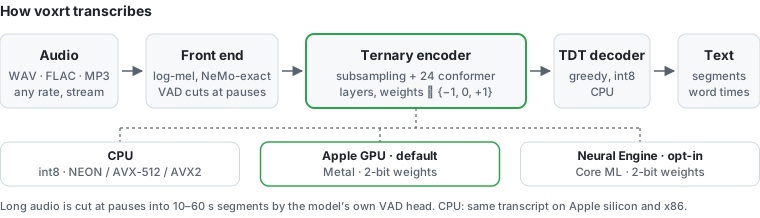
- Apple GPU by default on Apple silicon (Metal); the Neural Engine on request; CPU everywhere else
- Same bits everywhere — the CPU path gives byte-identical transcripts on Apple silicon and x86
- Long audio built in — the model's own VAD head cuts talks and meetings at pauses; segment and word timestamps
- Streaming — push audio as it arrives; the streamed transcript equals the offline one
- Accurate — WER 1.95 on LibriSpeech test-clean (the model card reports 1.96)
Install
pip install voxrt            # WAV input
pip install "voxrt[audio]"   # plus FLAC / OGG / MP3 and numpy arrays
Wheels for Apple silicon and Intel Macs (macOS 10.12+) and Linux x86-64, Python 3.9 and later. The model (≈ 180 MB) downloads into the Hugging Face cache on first use.
Quick start
import voxrt

t = voxrt.Transcriber()                       # or voxrt.Transcriber("/path/to/parakeet-redux")
r = t.transcribe("talk.mp3")
print(r.text)

for s in r.segments:                          # Segment(start, end, text, words=[Word(word, start, end)])
    print(f"[{s.start:6.2f} → {s.end:6.2f}] {s.text}")
Audio: WAV is decoded natively, FLAC / OGG / MP3 with voxrt[audio], anything else (M4A, AAC, video) when ffmpeg is
on PATH. Arrays work too: t.transcribe(samples, sample_rate=48000) takes mono or [n, channels].
Streaming
st = t.stream()
for chunk in microphone_chunks_16k():         # float32, 16 kHz mono
    for seg in st.push(chunk):                # segments are emitted as soon as their end is certain
        print(seg.text)
for seg in st.flush():
    print(seg.text)
Devices
voxrt.Transcriber(device="auto")   # default: the Apple GPU on Apple silicon, the CPU elsewhere
voxrt.Transcriber(device="cpu")    # byte-identical across machines
voxrt.Transcriber(device="ane")    # Apple Neural Engine (macOS 15+): downloads a Core ML bundle, ≈ 300 MB
t.device reports where the encoder runs. The Neural Engine bundle,
MaksL/voxrt-parakeet-redux-coreml, keeps the ternary
weights exact in 2 bits; macOS compiles it on the first load (≈ 5 min, once).
Results are frozen dataclasses (Transcript, Segment, Word) with type hints. The GIL is released while
transcribing, so one Transcriber can serve several threads.
How it works
Benchmarks
Apple M4 Max, the same method for every runtime (processing time, model load excluded):
| Workload | voxrt GPU (default) | voxrt CPU | Photon CPU (Moondream) |
|---|---|---|---|
| LibriSpeech test-clean, 2,620 utterances | 197× · WER 1.96 | 79× · WER 1.95 | 51× · WER 1.96 |
| TED-LIUM 3 long-form, 148 min | 174× · WER 2.54 | 92× · WER 2.55 | 65× · WER 2.52 |
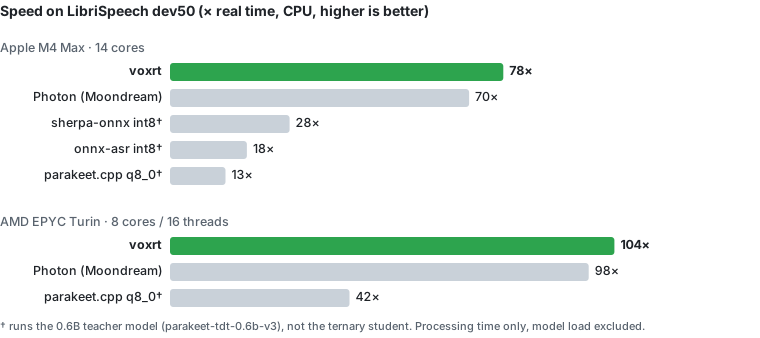
More machines, the method and the comparison with other runtimes: benchmarks in the repository.
Links
- Source, CLI, Swift and C bindings: github.com/lmaksym/voxrt
- Model: moondream/parakeet-redux · Neural Engine bundle: MaksL/voxrt-parakeet-redux-coreml
- Changes: CHANGELOG
Development
Build from source with maturin develop --release in bindings/python. Tests: pip install "voxrt[test]", then
VOXRT_TEST_DOWNLOAD=1 pytest bindings/python/tests (or point VOXRT_MODEL_DIR at a local copy). The test clip is
LibriSpeech test-clean 1089-134686-0001 (CC BY 4.0, see tests/audio/ATTRIBUTION.md).
License
voxrt is Apache-2.0. The model weights are © NVIDIA and M87 Labs (Moondream), CC-BY-4.0.
1 maintainer

Metadata
1 maintainer
Release files for voxrt 0.2.1
For a detailed explanation of source distributions (sdists) and built distributions (wheels), please see the package formats documentation.
Built distributions (wheels)
| File | Interpreter | ABI | Platform | Reset |
|---|---|---|---|---|
| voxrt-0.2.1-cp39-abi3-manylinux_2_17_x86_64.manylinux2014_x86_64.whl | CPython 3.9 | abi3 | Linux glibc 2.17+ x86-64 | Details |
| voxrt-0.2.1-cp39-abi3-macosx_10_12_x86_64.macosx_11_0_arm64.macosx_10_12_universal2.whl | CPython 3.9 | abi3 | macOS 10.12+ x86-64, macOS 10.12+ universal2 (ARM64, x86-64), macOS 11.0+ ARM64 | Details |
Total release size: 4.3 MB
Release files / voxrt-0.2.1-cp39-abi3-manylinux_2_17_x86_64.manylinux2014_x86_64.whl
| Download URL | voxrt-0.2.1-cp39-abi3-manylinux_2_17_x86_64.manylinux2014_x86_64.whl |
|---|---|
| Size | 2.7 MB |
| Tags | CPython 3.9 Linux glibc 2.17+ x86-64 abi3 |
|
SHA-256 checksum How to use checksums |
42bfb12da194402213ab5a3c8cdfdad466be321bb7afae627f7040de7b21c4d4
|
|
BLAKE2b-256 checksum How to use checksums |
9af6dd653777b11f61ec6ed06bc2781f10a0f694c07bece92f8220954b169eb2
|
| Upload date | |
|
Uploaded using Trusted Publishing? What is trusted publishing? |
Yes |
| Uploaded via |
twine/7.0.0 CPython/3.13.14
|
Provenance
Provenance describes where a file came from. On PyPI, provenance is shared via attestations, which provide a verifiable record of the build or publishing details. View details, limitations and caveats.


PyPI Publish Attestation
PyPI verified that this artifact, at this checksum, originated from the publisher listed below.
Signed by GitHub Actions, verified by PyPI on Oct 12, 2026.
Transparency logRelease files / voxrt-0.2.1-cp39-abi3-macosx_10_12_x86_64.macosx_11_0_arm64.macosx_10_12_universal2.whl
| Download URL | voxrt-0.2.1-cp39-abi3-macosx_10_12_x86_64.macosx_11_0_arm64.macosx_10_12_universal2.whl |
|---|---|
| Size | 1.6 MB |
| Tags | CPython 3.9 abi3 macOS 10.12+ universal2 (ARM64, x86-64) macOS 10.12+ x86-64 macOS 11.0+ ARM64 |
|
SHA-256 checksum How to use checksums |
98cf126abeb1778a912bc6945ebd6b5eeb5334485368c598cb1c4b2edc59d662
|
|
BLAKE2b-256 checksum How to use checksums |
3ae2ae563dcaecfc2782152f1ccbc15cdf460dd7632ba584f5ae0fe4649666b6
|
| Upload date | |
|
Uploaded using Trusted Publishing? What is trusted publishing? |
Yes |
| Uploaded via |
twine/7.0.0 CPython/3.13.14
|
Provenance
Provenance describes where a file came from. On PyPI, provenance is shared via attestations, which provide a verifiable record of the build or publishing details. View details, limitations and caveats.
PyPI Publish Attestation
PyPI verified that this artifact, at this checksum, originated from the publisher listed below.
Signed by GitHub Actions, verified by PyPI on Oct 12, 2026.
Transparency logSecurity for voxrt 0.2.1
Provenance
Provenance describes where a file came from. On PyPI, provenance is shared via attestations, which provide a verifiable record of the build or publishing details. View details, limitations and caveats.
Full provenance
All 2 files in this release have been uploaded with provenance metadata.
Attestation for voxrt-0.2.1-cp39-abi3-manylinux_2_17_x86_64.manylinux2014_x86_64.whl
PyPI Publish Attestation
PyPI verified that this artifact, at this checksum, originated from the publisher listed below.
Signed by GitHub Actions, verified by PyPI on Oct 12, 2026.
Transparency logA note on package security
PyPI is a repository for distributing packages, not a service for auditing them. While third-party security researchers and our staff do their best to detect and remove malicious packages, PyPI cannot guarantee the quality, security or suitability of any given package.
To learn more about protecting yourself from malicious actors, visit our package security documentation.














