
vqu
vqu is a command-line tool for querying and updating version numbers across multiple configuration
files in your projects. It allows you to:
- Query version information from .env, JSON, TOML, XML, and YAML configuration files
- Compare versions across different files to ensure consistency
- Update version numbers simultaneously in all configured files with a single command
vqu uses yq syntax to locate and extract version values from
your configuration files. This means you can use powerful query expressions like .version,
.project.version, or .metadata[0].version to precisely target version fields regardless of file
format or nesting depth.
This is particularly useful for monorepos and projects that maintain version information across
multiple configuration formats. Instead of manually updating each file, vqu automates the process
and validates that all versions are consistent.
Requirements
System
- yq must be installed on your system.
Python
vqurequires Python 3.10 or later.- Runs on macOS, Windows, and all Linux distributions.
Installation
vqu can be installed using pip:
pip install vqu
YAML File Structure
By default, vqu looks for a .vqu.yaml configuration file in the current directory. Here's an
example of the configuration structure:
projects:
  Project_1:
    version: 0.1.1
    config_files:
      - path: proj1/.env
        format: dotenv
        filters:
          - expression: .VERSION
      - path: proj1/conf.json
        format: json
        filters:
          - expression: .project.version
  Project_2:
    version: 0.1.3
    config_files:
      - path: proj2/conf.yaml
        format: yaml
        filters:
          - expression: .project.version
  Nginx_Service:
    version: stable-alpine3.21
    config_files:
      - path: compose.yaml
        format: yaml
        filters:
          - expression: .services.service2.image | split(":")[1]
            validate_docker_tag: true
      - path: proj2/conf.xml
        format: xml
        filters:
          - expression: .Project.ImageTag
            validate_regex: "[\\w.-]{1,50}"
Schema
Root level:
projects(required) - Object containing one or more project definitions. Keys are arbitrary project names.
Project object:
version(required) - The expected version number for this project (e.g.,"0.1.1").config_files(required) - Array of configuration files to manage for this project.
Configuration file object:
path(required) - Path to the configuration file, relative to the.vqu.yamlfile.format(required) - File format. Supported formats:dotenv,json,toml,xml,yaml.filters(required) - Array of filter objects that extract version values from this file.
Filter object:
expression(required) - A yq query expression that targets a version value in the configuration file (e.g.,.version,.project.version,.[0].version).validate_docker_tag(optional) - Boolean flag to validate extracted value as valid Docker tag format. When set totrue, value must match Docker tag naming rules (e.g.,"stable-alpine3.21","11-noble").validate_regex(optional) - A regex pattern to validate extracted value against. Entire value must match the provided pattern (e.g.,"v\\d+\\.\\d+\\.\\d+"for semantic versioning with 'v' prefix).
Example
If you've downloaded or cloned the repository from GitHub, you can try the example configuration:
vqu -c ./examples/.vqu.yaml
This will output version information for all configured projects with color-coded status:
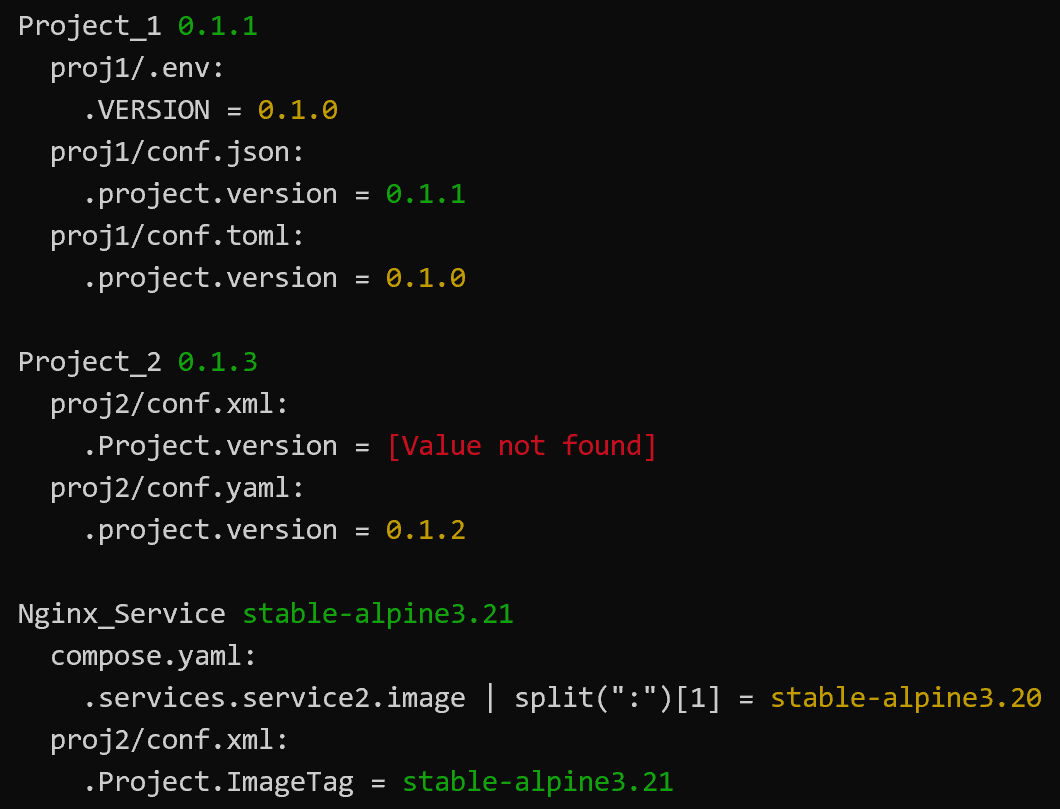
Color legend:
- 🟢 Version matches the expected project version
- 🟡 Version differs from the expected project version
- 🔴 Value not found or invalid version format
Command line usage
usage: vqu [project] [options]

Query and update version numbers across multiple configuration files.

positional arguments:
  project               The name of the project to display versions for.

options:
  -c PATH, --config PATH
                        Path to the configuration file (default: .vqu.yaml).
  -u, --update          Write the version numbers in the configuration files.
  -h, --help            Show this help message and exit.
  -v, --version         Show the version and exit.
License
This project is licensed under the terms of the MIT license.
1 maintainer

Metadata
1 maintainer
Release files for vqu 0.1.3
For a detailed explanation of source distributions (sdists) and built distributions (wheels), please see the package formats documentation.
Source distribution (sdist)
| File | Size | Uploaded | |
|---|---|---|---|
| vqu-0.1.3.tar.gz | 8.5 kB | Details |
Built distribution (wheel)
| File | Interpreter | ABI | Platform | Reset |
|---|---|---|---|---|
| vqu-0.1.3-py3-none-any.whl | Python 3 | none | any | Details |
Total release size: 18.8 kB
Release files / vqu-0.1.3.tar.gz
| Download URL | vqu-0.1.3.tar.gz |
|---|---|
| Size | 8.5 kB |
| Tags | Source |
|
SHA-256 checksum How to use checksums |
58a3a27a3d2e68f54a0e1a8071f7f9bb57c956c33e0c6b158acaa04916503676
|
|
BLAKE2b-256 checksum How to use checksums |
3a580c797a3d2a55708ad14a5ebabdcd5cb612227cd9b3d5dfe95bc0fc0418fa
|
| Upload date | |
|
Uploaded using Trusted Publishing? What is trusted publishing? |
Yes |
| Uploaded via |
twine/6.1.0 CPython/3.13.7
|
Provenance
Provenance describes where a file came from. On PyPI, provenance is shared via attestations, which provide a verifiable record of the build or publishing details. View details, limitations and caveats.


PyPI Publish Attestation
PyPI verified that this artifact, at this checksum, originated from the publisher listed below.
Signed by GitHub Actions, verified by PyPI on Dec 28, 2025.
Transparency logRelease files / vqu-0.1.3-py3-none-any.whl
| Download URL | vqu-0.1.3-py3-none-any.whl |
|---|---|
| Size | 10.3 kB |
| Tags | Python 3 |
|
SHA-256 checksum How to use checksums |
8fc5f4dee1a0445b4d4eff1906e9d8f5f8fe4dc2a9f99b5ae90ee48ec50075eb
|
|
BLAKE2b-256 checksum How to use checksums |
5dff35cd049f5aa65e0228416a2a0fb19a2ac39d8bc4b37854fcdd84367ed986
|
| Upload date | |
|
Uploaded using Trusted Publishing? What is trusted publishing? |
Yes |
| Uploaded via |
twine/6.1.0 CPython/3.13.7
|
Provenance
Provenance describes where a file came from. On PyPI, provenance is shared via attestations, which provide a verifiable record of the build or publishing details. View details, limitations and caveats.
PyPI Publish Attestation
PyPI verified that this artifact, at this checksum, originated from the publisher listed below.
Signed by GitHub Actions, verified by PyPI on Dec 28, 2025.
Transparency log













