
Source-traceable structured IR for Huawei VRP configurations (parse-time SourceRef).
Verified details
These details have been verified by PyPIProject links
GitHub Statistics
Maintainers

Project description
vrp-ir




Source-traceable structured IR for Huawei VRP configurations.
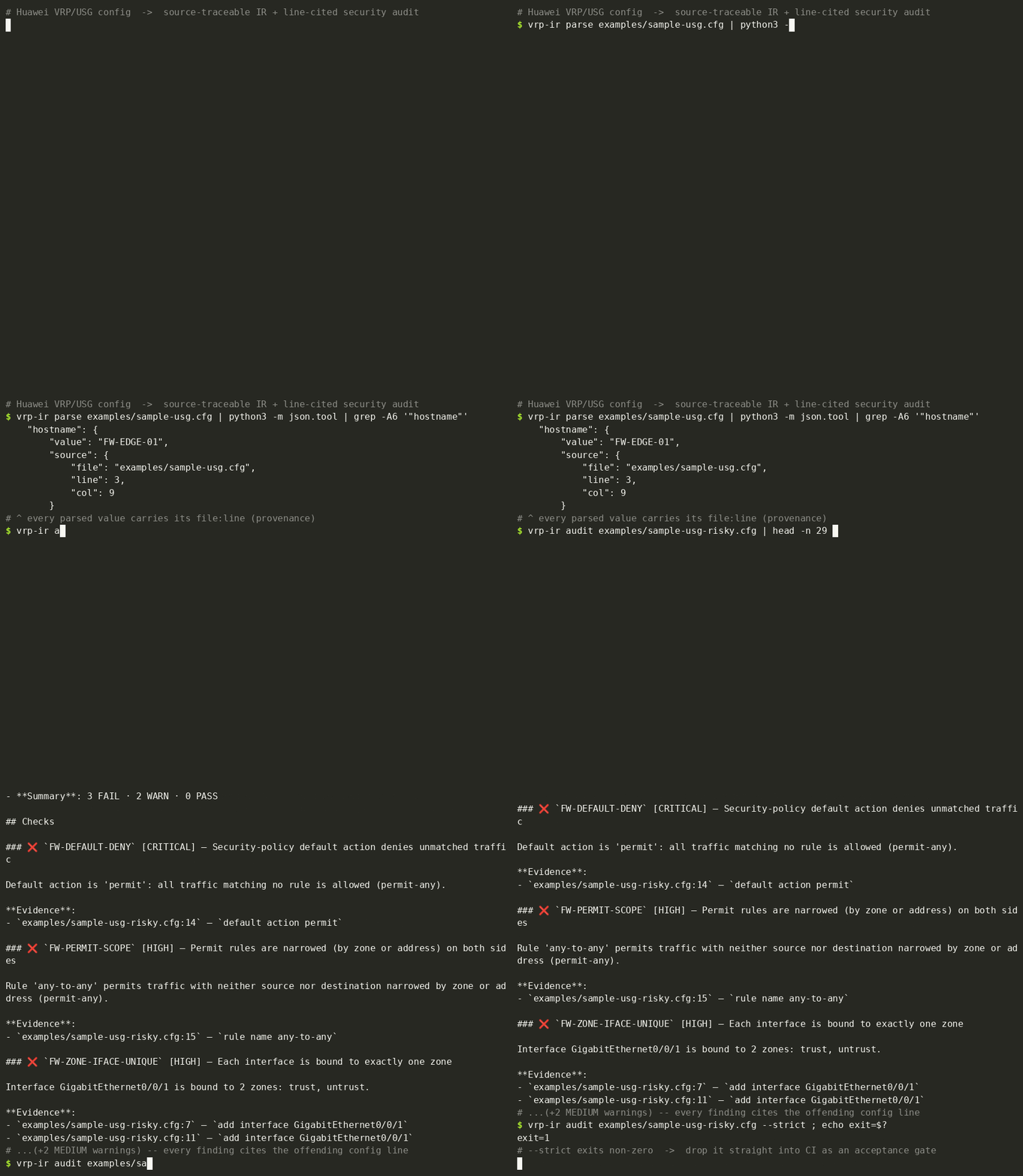
vrp-ir parses an offline Huawei VRP configuration file (display current-configuration output / saved .cfg) into a structured, typed model
where every parsed value carries a SourceRef back to the exact file + line
it came from.
Huawei VRP .cfg ──► structured IR ──► every field knows its source line
Status: v0.6 / alpha. Routing/switching (VLAN, VRF RD/RT, interfaces, ACL, static routes) and USG firewall (
firewall zone,security-policy,nat-policy,nat server,ip address-set/ip service-setobjects,hrp, and the management plane —user-interfacecon/vty,ssh server cipher,aaalocal-users, telnet/http switches) parsed with full source provenance, plus a security acceptance audit (vrp-ir audit, 13 checks) whose findings cite the exact config line. Roadmap below.
💼 Commercial —
vrp-iris the open core of AegisTwin, a Huawei security-integration acceptance workbench. Need customer-grade acceptance reports, a readiness review, or multi-vendor coverage? See Commercial / support.
Why this exists (the gap)
The network-automation ecosystem is rich, but a specific combination is missing:
- Batfish is excellent, but its source explicitly marks Huawei VRP as
UNSUPPORTED. - ntc-templates has ~35 Huawei
displayshow-command templates, but nodisplay current-configuration(config-file) parser. - ciscoconfparse2 is Cisco-centric and only exposes an integer
.linenumper line — not field-level provenance. - No open-source tool exposes field →
file:lineprovenance for parsed config facts.
vrp-ir fills exactly that gap: Huawei VRP config file → semantic model with
per-field source traceability. This is what acceptance/audit work needs — when
a value looks wrong, jump straight to the line, don't grep the raw config.
Install
pip install vrp-ir
# or, from source:
pip install -e .
Quick start (CLI)
vrp-ir parse examples/sample-vrp.cfg     # routing / switching
vrp-ir parse examples/sample-usg.cfg     # USG firewall (zones / policy / nat-policy / objects / hrp)
{
  "hostname": { "value": "CORE-FW-01", "source": { "file": "...", "line": 2, "col": 8 } },
  "interfaces": [
    {
      "name": { "value": "GigabitEthernet0/0/1", "source": { "line": 9 } },
      "ipv4": [
        { "address": { "value": "10.10.10.1", "source": { "line": 11 } },
          "prefix_length": { "value": 24, "source": { "line": 11 } } }
      ]
    }
  ]
}
Quick start (Python)
from vrp_ir import parse_file

cfg = parse_file("examples/sample-vrp.cfg")
print(cfg.hostname.value)                       # CORE-FW-01
ip = cfg.interfaces[0].ipv4[0]
print(ip.address.value, ip.prefix_length.value) # 10.10.10.1 24
print(ip.address.source)                        # examples/sample-vrp.cfg:11  ← provenance
Security acceptance audit (v0.6)
Turn the source-traceable IR into a security acceptance report: each check is a small test case (intent), and every finding cites the exact config line it is based on — so a reviewer jumps straight to the offending line.
vrp-ir audit examples/sample-usg-risky.cfg            # Markdown acceptance report
vrp-ir audit examples/sample-usg.cfg --format json    # machine-readable JSON
vrp-ir audit examples/sample-usg-risky.cfg --strict   # exit 1 if any check fails (CI gate)
### ❌ `FW-DEFAULT-DENY` [CRITICAL] — Security-policy default action denies unmatched traffic
Default action is 'permit': all traffic matching no rule is allowed (permit-any).
**Evidence**:
- `examples/sample-usg-risky.cfg:14` — `default action permit`
Checks (13): policy default-deny (permit-any); permit-scope (rules not narrowed by
zone/address, dereferencing address-set references so an object that resolves
to 0.0.0.0/0 is still flagged); permit rules without session logging;
one-interface-per-zone; address-set equal to any; HRP enabled; HRP enabled but
heartbeat interface/peer incomplete; management plane — Telnet/HTTP enabled
(cleartext), VTY accepting Telnet, VTY without an inbound source ACL, weak SSH
ciphers (CBC/3DES/DES), and local AAA users granted the Telnet service. See a full
rendered report at
docs/acceptance-report-example.md.
Design principles
- Zero runtime dependencies in the core — easy to embed.
- Reuse, don't reinvent.
vrp-iris a thin VRP-config + provenance layer. It complements (does not replace)ntc-templates(show-command parsing),hier_config(VRP diff/remediation),napalm(live-device collection) andBatfish(multi-vendor analysis). Topology/analysis layers will integrate these rather than rebuild them. - Provenance first. If we can't say where a value came from, we don't surface it.
Roadmap
- v0.1: hostname + interface basics with SourceRef. ✅
- v0.2: VLANs (batch ranges), VRF (RD/RT), interface enhancements (link-type, trunk allow-pass ranges, Eth-Trunk, dot1q subinterfaces, secondary IPv4, VRF binding), ACLs, static routes. ✅
- v0.3: Huawei USG firewall objects —
firewall zone,security-policy(rule namewith zones / addresses / services / profiles / action / logging),nat server,hrp(the global OSS gap; Batfish drops VRP entirely). ✅ - v0.4: security acceptance audit — test-case schema
(
testCase ↔ intent ↔ evidenceRef) + a Markdown/JSON report generator;vrp-ir auditwith seed firewall checks, each citing its source line. ✅ - v0.5:
nat-policyblocks,ip address-set/ip service-setobjects, telnet/http management switches; audit at 9 checks —address-setdereference in permit-scope,address-set-equals-any, HRP consistency, cleartext management (Telnet / HTTP). ✅ - v0.6: management-plane access baseline (driven by real-world
config corpus) —
user-interfacecon/vty (protocol inbound / inbound ACL / auth mode),ssh server cipher,aaalocal-users; audit grows to 13 checks (VTY-accepts-Telnet, VTY-no-ACL, weak-SSH-cipher, AAA-user-Telnet). ✅ - v0.7: GB18030/GBK config support; parser coverage transparency
(unparsed lines surfaced in the audit);
info-center loghost; audit status semanticsPASS / WARN / FAIL / NA / UNCHECKED; checks for weak SNMP community and missing NTP. ✅
What's next
The forward-looking roadmap is maintained as Now / Next / Later (no fixed dates) in ROADMAP.md. In short: Now — trust foundation (evidence policy, real de-identified corpus, richer reports, SARIF/JUnit, advisory standards anchoring incl. 等保 Level 3/4 advisory references); Next — check registry, corpus-driven parser hardening, coverage breadth; Later — a stable IR/check-id contract that defines 1.0.
See GOVERNANCE.md for how the project is run and the open-core boundary with AegisTwin.
Commercial / support
vrp-ir is free and open source (Apache-2.0), and it stays that way.
It is the open core of AegisTwin — an acceptance workbench for carrier and
data-center security integration (HLD/LLD → traceable topology → acceptance
advisor → evidence chain → sign-off report). If you liked vrp-ir, AegisTwin
builds on top of it for teams that deliver acceptance at scale: Huawei
security-device coverage (USG / WAF / AntiDDoS / 4A), HLD/LLD → traceable
acceptance test cases, and customer-grade, auditable reports (incl. MLPS /
carrier formats).
See the open-source vs. commercial comparison.
Talk to us about a paid workflow review or a design-partner pilot → support@zynovexllc.com.
Contributing
See CONTRIBUTING.md. Real (de-identified) VRP config snippets that we parse incorrectly make the best issues; follow the de-identification guide before sharing any snippet publicly.
License
Project details
Verified details
These details have been verified by PyPIProject links
GitHub Statistics
Maintainers


Download files
Download the file for your platform. If you're not sure which to choose, learn more about installing packages.
Source Distribution
Built Distribution
Filter files by name, interpreter, ABI, and platform.
If you're not sure about the file name format, learn more about wheel file names.
Copy a direct link to the current filters
File details
Details for the file vrp_ir-0.8.0.tar.gz.
File metadata
- Download URL: vrp_ir-0.8.0.tar.gz
- Upload date:
- Size: 49.6 kB
- Tags: Source
- Uploaded using Trusted Publishing? Yes
- Uploaded via: twine/6.1.0 CPython/3.13.13
File hashes
| Algorithm | Hash digest | |
|---|---|---|
| SHA256 |
879f742e0839dac059eb57a8dde79bee540ea64379e64caa3c72492d57343d1c
|
|
| MD5 |
9cbfbe300aaa1943181edb54a6db4990
|
|
| BLAKE2b-256 |
2b7d279db65477683b99a070045c6aa5afe43e6437038bffcb59615f3edc1439
|
Provenance
The following attestation bundles were made for vrp_ir-0.8.0.tar.gz:
Publisher:
publish.yml on zynovexllc/vrp-ir
-
Statement:
-
Statement type:
https://in-toto.io/Statement/v1 -
Predicate type:
https://docs.pypi.org/attestations/publish/v1 -
Subject name:
vrp_ir-0.8.0.tar.gz -
Subject digest:
879f742e0839dac059eb57a8dde79bee540ea64379e64caa3c72492d57343d1c - Sigstore transparency entry: 1953763234
- Sigstore integration time:
-
Permalink:
zynovexllc/vrp-ir@c8b0f9f5df638cd32a405ff44f4f2dd3807ccd2b -
Branch / Tag:
refs/tags/v0.8.0 - Owner: https://github.com/zynovexllc
-
Access:
public
-
Token Issuer:
https://token.actions.githubusercontent.com -
Runner Environment:
github-hosted -
Publication workflow:
publish.yml@c8b0f9f5df638cd32a405ff44f4f2dd3807ccd2b -
Trigger Event:
push
-
Statement type:
File details
Details for the file vrp_ir-0.8.0-py3-none-any.whl.
File metadata
- Download URL: vrp_ir-0.8.0-py3-none-any.whl
- Upload date:
- Size: 31.1 kB
- Tags: Python 3
- Uploaded using Trusted Publishing? Yes
- Uploaded via: twine/6.1.0 CPython/3.13.13
File hashes
| Algorithm | Hash digest | |
|---|---|---|
| SHA256 |
6ea4b17a4094473fe1707bc8500e6770a7bcd7b475572e5107b1b04d175c3dff
|
|
| MD5 |
5101c17b4eafcb7f0973735831265b17
|
|
| BLAKE2b-256 |
3f4e0d23711e4297a19893bd4bc016d3e2da8ccebd746f67de3f5c2d300a4322
|
Provenance
The following attestation bundles were made for vrp_ir-0.8.0-py3-none-any.whl:
Publisher:
publish.yml on zynovexllc/vrp-ir
-
Statement:
-
Statement type:
https://in-toto.io/Statement/v1 -
Predicate type:
https://docs.pypi.org/attestations/publish/v1 -
Subject name:
vrp_ir-0.8.0-py3-none-any.whl -
Subject digest:
6ea4b17a4094473fe1707bc8500e6770a7bcd7b475572e5107b1b04d175c3dff - Sigstore transparency entry: 1953763503
- Sigstore integration time:
-
Permalink:
zynovexllc/vrp-ir@c8b0f9f5df638cd32a405ff44f4f2dd3807ccd2b -
Branch / Tag:
refs/tags/v0.8.0 - Owner: https://github.com/zynovexllc
-
Access:
public
-
Token Issuer:
https://token.actions.githubusercontent.com -
Runner Environment:
github-hosted -
Publication workflow:
publish.yml@c8b0f9f5df638cd32a405ff44f4f2dd3807ccd2b -
Trigger Event:
push
-
Statement type:






