






vusvna (Vulkan Self-Validated Numerical Analysis) is a Slang module providing computations with guaranteed error bounds in Vulkan shaders. It implements affine arithmetic (AA), a model that keeps track of the correlations between quantities and therefore yields much tighter bounds than interval arithmetic on long computations. It is the partial Vulkan port of the CUDA library cusvna.
- Rigorous: the exact real result of a computation always lies within the computed bounds, including floating point rounding errors, under the weak guarantees of the Vulkan specification (no directed rounding, no infinities nor NaNs, denormals flushed, possible fused multiply-adds).
- GPU friendly: no dynamic allocation, affine forms are small fixed-size structs living in registers. Works in any shader stage: compute, ray tracing (intersection shaders), fragment...
- Generic: functions written once for a type
T : IRealare evaluated on affine forms to bound them and on floats to compute their values.
Unlike cusvna, vusvna:
- works in single precision (
float) only, there is nodoubleversion, - only implements reduced affine arithmetic (AF1, also available in cusvna as
cusvna::AF1): the errors of nonlinear operations are accumulated in a single error term instead of creating new noise symbols, which makes forms small and fast but gives slightly wider bounds on long computations; cusvna also provides standard affine arithmetic (cusvna::AA), - does not provide
asin,acos, the hyperbolic functions and their inverses,expm1,log1p,erf,erfc,normcdf,tgammaandlgamma: SPIR-V either does not have them or does not give usable error bounds for them, so they would have to be reimplemented with validated polynomials.
See Differences with cusvna for details.
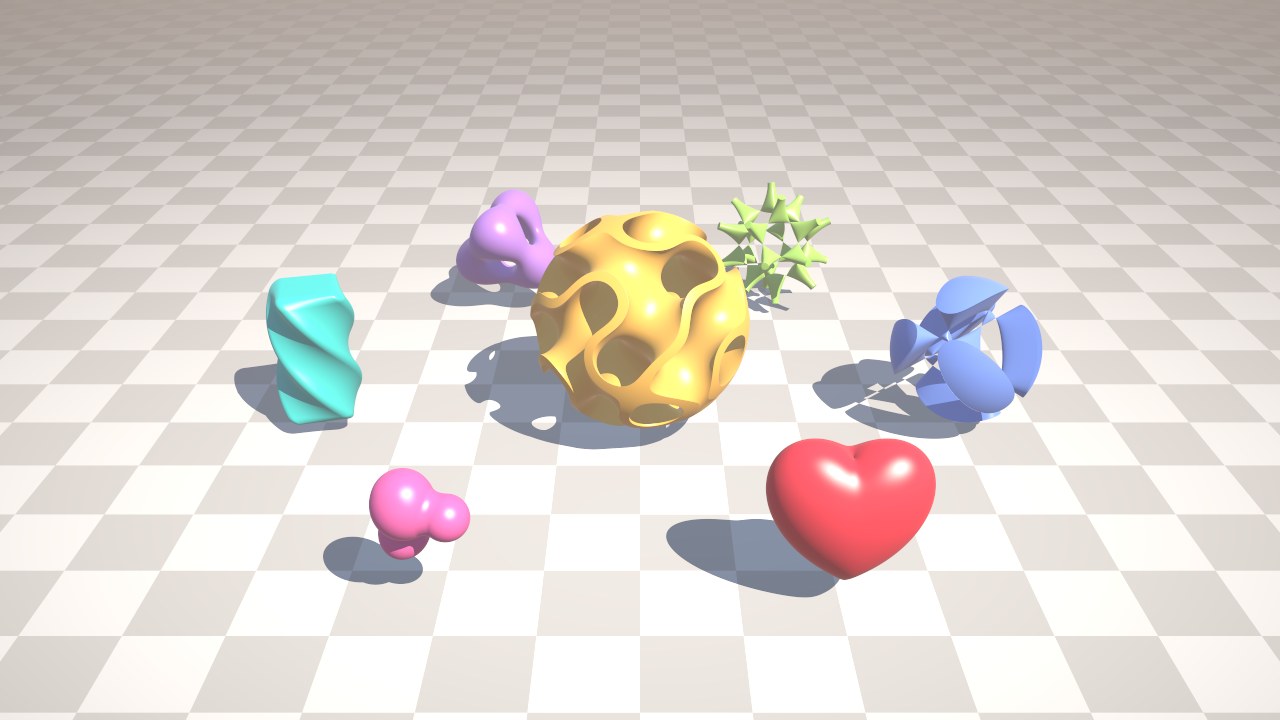
Typical applications are robust root isolation and subdivision schemes (quadtrees, octrees), ray tracing of implicit surfaces and level sets, and any numerical method that must not miss a solution.
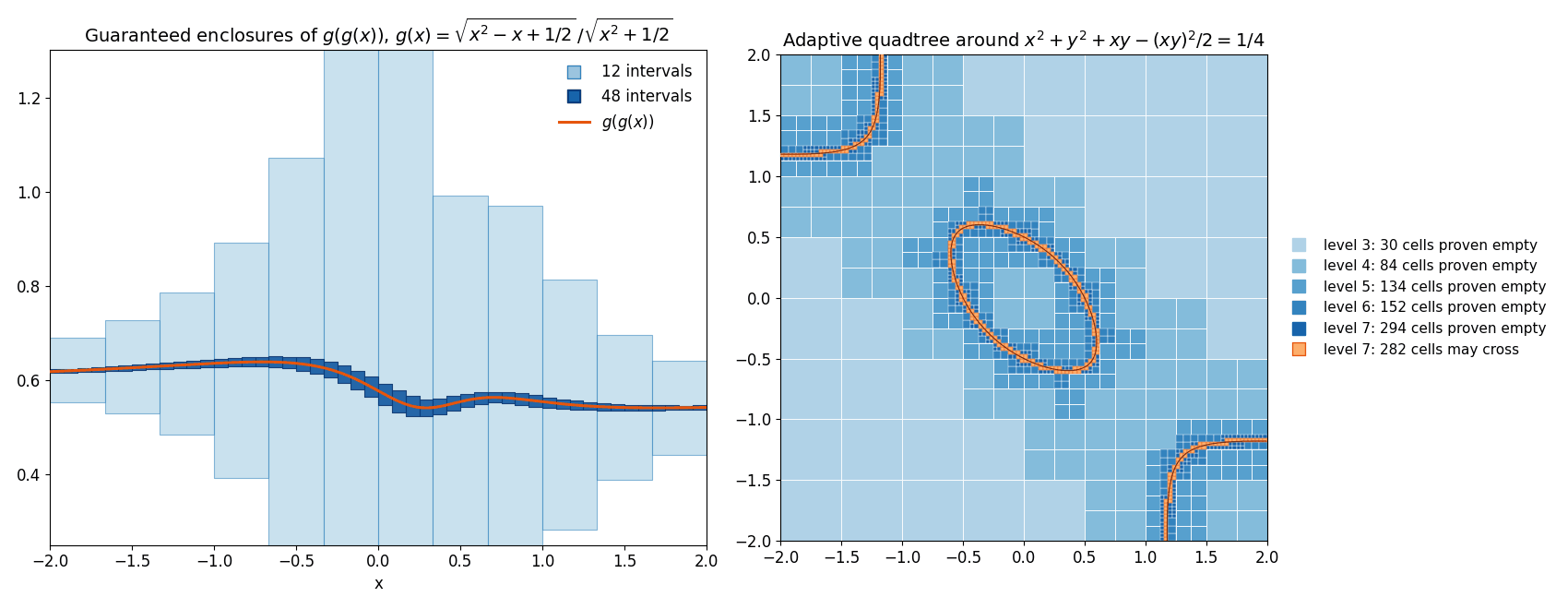
Left: guaranteed enclosures of a function on 12 and 48 intervals. Right: adaptive quadtree around an implicit curve, cells proven empty are discarded at each level. Computed on the GPU with AA<1> (1D) and AA<2> (2D) in a Slang compute shader.
Getting started
The examples and the tests only need a Vulkan GPU and Python: they compile the Slang shaders at runtime with slangpy.
git clone https://github.com/keckj/vusvna.git
cd vusvna
python3 -m venv .venv
source .venv/bin/activate         # on Windows: .venv\Scripts\activate
python3 -m pip install -r examples/requirements.txt
python3 examples/02_quadtree.py   # adaptive quadtree around a 2D curve
python3 examples/05_levelset.py   # interactive ray tracing of animated level sets (needs ray tracing)
python3 tests/test_vusvna.py      # check the enclosures on your GPU
See Examples for the other scripts and Installation to use vusvna in your own shaders.
Example
import vusvna;

typealias AA2 = AA<2>;

/* the unit circle, generic over the number type */
T circle<T : IReal>(T x, T y) { return sqr(x) + sqr(y) - 1.0; }

/* returns false only if the unit circle certainly does not cross the box X x Y */
bool may_contain_root(Interval X, Interval Y) {
    const AA2 x = AA2::variable(0, X);   /* input k gets noise symbol k */
    const AA2 y = AA2::variable(1, Y);
    return possibly_zero(circle(x, y));  /* circle(x, y) is guaranteed to lie in its interval() */
}

/* the same function evaluated on floats */
float circle_value(float x, float y) { return circle(Real(x), Real(y)).v; }
The generic operators and functions are not defined for float, so that they never shadow the builtin
functions: floats are wrapped into Real (field v) to call generic code.
Installation
vusvna is distributed as Slang source: add the vusvna directory of this repository (the directory that
contains vusvna.slang) to the include paths of the Slang compiler and write import vusvna;.
With slangpy:
import slangpy as spy

device = spy.Device(type=spy.DeviceType.vulkan,
                    compiler_options=spy.SlangCompilerOptions({"include_paths": ["path/to/vusvna/vusvna"]}))
The Slang module is also available as a Python package:
python3 -m pip install vusvna
python3 -m vusvna --include   # directory to add to the include paths of the Slang compiler
import slangpy as spy
import vusvna

device = spy.Device(type=spy.DeviceType.vulkan,
                    compiler_options=spy.SlangCompilerOptions({"include_paths": [vusvna.get_include()]}))
Requirements:
- a Vulkan device, with hardware ray tracing for examples 04 and 05,
- Slang (tested with the compiler shipped with slangpy 0.43),
- single precision only: all computations are done in
float, there is nodoubleversion, - no fast math options, see Guarantees.
Affine arithmetic in vusvna
An affine form represents an unknown real quantity as
x = b + x_1 e_1 + ... + x_N e_N + e, e_i unknown in [-1, 1], |e| <= err
The noise symbols e_i are shared between forms and carry correlations: x - x is exactly zero, while
interval arithmetic would return [-2r, 2r].
vusvna uses reduced affine arithmetic (AF1): AA<N> stores exactly N coefficients, one per input
variable created with AA<N>::variable(k, interval). Nonlinear operations approximate their result by an
affine function of their input, and their approximation errors, as well as all rounding errors, are
accumulated in the independent term err. Forms therefore never grow and cost N + 2 floats, but the
correlations of these errors are lost: sqr(x) - sqr(x) is not zero but an interval whose radius is twice
the error term of sqr(x). AF1 is the only mode of vusvna. cusvna provides the same reduced forms
(AF1<T, N>) and standard affine forms (AA<T, N>).
AA<N>::variable(k, I): the input variable of symbolk(0 <= k < N), taking all values ofI.AA<N>::from_interval(I): a quantity taking any value ofI, uncorrelated with everything else.AA<N>(c),AA<N>::entire(): constants and the form representing any real number.x.interval(),x.sign(),x.affine_range(),x.radius()(sum of the|x_i|, withouterr),x.magnitude(k),x.is_entire(): conversions back to intervals.
Differences with cusvna
vusvna follows the design of cusvna and its examples, but it is not exactly equivalent to it and the bounds computed by the two libraries differ:
- Model: cusvna provides reduced affine arithmetic (
cusvna::AF1, the model of vusvna) and standard affine arithmetic (cusvna::AA), where each nonlinear operation creates a new noise symbol, identified at compile time by the types of its operands and at runtime by a tag. AA forms grow with the computation and keep the correlations of all the approximation errors. This relies on C++ template metaprogramming (the symbols of a form are part of its type) that Slang generics cannot express, so vusvna only provides the reduced model, whose forms are much smaller and cheaper but whose bounds are a bit wider on long computations or wide inputs. - Rounding: on the GPU, cusvna uses the directed rounding instructions of the hardware (
__fadd_ru,__dmul_rd, ...) and computes the rounding errors of affine operations exactly; in host code it emulates outward rounding with error-free transformations (TwoSum, TwoProd). Vulkan has neither directed rounding nor reliable error-free transformations (the driver may fuse operations), so vusvna bounds rounding errors with the standard model of floating point arithmetic, which is more pessimistic (see Guarantees). - Ignoring rounding errors: both libraries can ignore rounding errors for speed (
CUSVNA_IGNORE_ROUNDINGandVUSVNA_IGNORE_ROUNDING,--fastoption of the examples), the results are then no longer rigorous. - Precision: vusvna only supports single precision (
float), cusvna supportsfloatanddouble. Vulkan has optional 64-bit floats (shaderFloat64), but the transcendental functions of SPIR-V (GLSL.std.450) are only defined for 16 and 32-bit floats, so a double precision vusvna would have to implement all of them itself. - Functions: vusvna implements a subset of the functions of cusvna (see below).
Supported operations
| Operations | Notes |
|---|---|
+, -, *, / between forms and with floats |
|
sqr(x), pown(x, int n) |
sqr(x) is tighter than x*x |
reciprocal(x) |
min-range approximation, entire if 0 belongs to x |
sqrt(x), rsqrt(x), cbrt(x) |
sqrt is evaluated on the part of its input where x >= 0 |
pow(x, float y) |
for x >= 0 (x > 0 if y < 0) |
pow(x, y) with an affine exponent |
exp(y*log(x)), for x > 0 |
rcbrt(x) |
1/cbrt(x), entire if 0 belongs to x |
exp(x), exp2(x), exp10(x), log(x), log2(x), log10(x) |
|
sin(x), cos(x), tan(x), cot(x), atan(x) |
tan and cot are entire if a pole belongs to x |
sinpi(x), cospi(x) |
sin(pi x) and cos(pi x), with an exact argument reduction |
atan2(y, x) |
atan(y/x) for x > 0, +-pi/2 - atan(x/y) for y > 0 or y < 0, else [-pi, pi] |
abs(x), positive_part(x) |
positive_part(x) = max(x, 0) |
floor(x), ceil(x), trunc(x), round(x), rint(x) |
round rounds ties away from zero, rint to even |
fract(x), modf(x, out ip) |
x - floor(x), and x - trunc(x) with ip = trunc(x) |
fmod(x, y), remainder(x, y), remquo(x, y, out lo, out hi) |
y float or affine, entire if 0 belongs to y |
min(x, y), max(x, y), clamp(x, lo, hi) |
(x + y -+ abs(x - y))/2 |
hypot(x, y), hypot(x, y, z), rhypot |
|
lerp(a, b, t), smoothstep(e0, e1, x) |
|
smooth_min(a, b, k), smooth_max(a, b, k) |
polynomial smooth minimum of distances |
certainly_lt, certainly_le, certainly_gt, certainly_ge, possibly_zero |
rigorous predicates |
join, intersect, contains, subset, is_empty, +, -, *, /, sqr, sqrt, abs |
on Interval |
All of them are generic over T : IReal and also work on Real.
The discontinuous functions (floor to remquo) are evaluated on the whole range of their input. When the
range does not cross a discontinuity, the result is exact and stays correlated with the input (fract(x) is
then x - n), otherwise it is the range of the function, uncorrelated with the input. fmod(x, y) is
x - trunc(x/y) y and remainder(x, y) is x - rint(x/y) y; remquo also returns the range [lo, hi] of
the integer quotient rint(x/y) (the full quotient, not only its low bits as in C), saturated to the int
range. lo == hi means that the quotient is known.
The following functions of cusvna are not available, because SPIR-V either does not provide them or gives no
usable error bounds for them, so vusvna would have to implement them with validated polynomials as it does
for sin and cos:
asin,acos,sinh,cosh,tanh,asinh,acosh,atanh: the precision of the SPIR-V functions is only inherited from their defining formulas (for instanceasin(x)fromatan2(x, sqrt(1 - x*x))), which gives very loose bounds near0or near the ends of their domains,expm1,log1p,erf,erfc,normcdf,tgamma,lgamma: these functions do not exist in SPIR-V.
Guarantees
For any operation, the exact real result of the computation belongs to the range of the computed form,
including rounding errors. In particular x.interval(), x.sign() and the predicates are rigorous.
Vulkan gives few guarantees on floating point arithmetic, and vusvna only relies on the following ones:
- additions, subtractions and multiplications are correctly rounded to nearest, divisions, square roots and transcendental functions are within the error bounds of the Vulkan specification ("Precision and Operation of SPIR-V Instructions"),
- denormals may be flushed to zero on input and output of any instruction,
- the compiler may contract
a*b + cinto a fused multiply-add, - the implementation may assume that no infinity nor NaN is ever produced. Drivers do exploit it: on
NVIDIA
isinf(+inf)is false andNaN == NaNis true.
As a consequence:
- No infinities nor NaNs: all magnitudes are kept below
2^60, so that products and sums of products cannot overflow, and larger quantities mean "any real number" (entire forms). Entire forms propagate through all operations, except through bounded functions such assin. - Rounding: error-free transformations (TwoSum, TwoProd) cannot be trusted when the driver may fuse
operations. Rounding errors are bounded with the standard model
|r - x| <= k ulp(x) + 2^-126, wherek = 1/2for correctly rounded operations,kis the documented bound otherwise, and2^-126accounts for flushed denormals. A fused multiply-add only removes a rounding, the bounds remain valid. - Nonlinear functions: the residual
f(x) - alpha*xis bounded with outward rounding by splitting the input range into pieces wherefis convex or concave, from rigorous enclosures offandf'at points. These enclosures use the bounds of the specification forexp,exp2,log,log2andatan.sinandcos(only guaranteed to2^-11by the specification) are computed by vusvna with a Cody-Waite reduction and Taylor polynomials,cbrt(not in SPIR-V) with a Newton step validated by cubing its bounds. The functions missing from SPIR-V are built from these enclosures:exp10andlog10fromexp2andlog2with rigorous bounds oflog2(10)andlog10(2),sinpiandcospifromsinandcosafter an exact reduction to[0, 1/4]. - Integer valued functions:
floor,ceilandtruncare exact in SPIR-V. The tie breaking rule of the builtinroundis implementation defined, soroundandrintare computed fromfloorandtrunc. Denormal bounds are moved outward to-+2^-126before evaluating these functions, since the driver may flush them to zero. - Domains: if an input range is not entirely inside the domain of a function, the result is entire,
except for
sqrtandpow(x, float y)which are evaluated on the part of their input inside their domain when it is not empty.
Do not compile vusvna code with the fast floating point mode of the Slang compiler (-fp-mode fast).
Rounding modes
vusvna has two rounding modes, selected at compile time:
| Mode | Selected by | Rigorous | Speed | Use |
|---|---|---|---|---|
| rigorous | default | yes | reference | everything |
| ignore | VUSVNA_IGNORE_ROUNDING |
no | up to 1.5 times faster | visualization |
In the default mode, rounding errors are bounded with the standard model as described above. cusvna has a
third mode: on CUDA devices it uses the directed rounding instructions of the hardware and computes exact
rounding errors, and it emulates them with error-free transformations in host code (or with
CUSVNA_EMULATED_ROUNDING); neither is possible in Vulkan.
Ignoring rounding errors
Defining the preprocessor macro VUSVNA_IGNORE_ROUNDING drops all the bounds of rounding errors: directed
operations become plain round to nearest operations, the error bounds of the builtin functions and the safety
margins are ignored, and the error term err only accumulates the approximation errors of the nonlinear
operations. The same option exists in cusvna (CUSVNA_IGNORE_ROUNDING).
compiler_options = spy.SlangCompilerOptions({
    "include_paths": ["path/to/vusvna/vusvna"],
    "defines": {"VUSVNA_IGNORE_ROUNDING": "1"},
})
The results are then estimates, not guaranteed bounds: the values may lie slightly outside of them, by
rounding errors that are amplified by cancellations and near poles, and a sign test may miss a root. Large
arguments of fmod and remainder (quotients beyond 2^24) give meaningless results. This mode is meant for
applications where speed matters more than rigor, such as visualization: the examples run up to 1.5 times
faster and produce almost the same images, but deep quadtree levels keep fewer cells, because in single
precision the rounding errors become larger than the cells. Fast math is not needed and not recommended.
The tests check that the estimates stay within 1e-2 of the sampled values, relative to the magnitude of
the inputs and of the values.
Examples
The examples directory contains Python scripts that compile the Slang shaders of examples/shaders at
runtime and run them with slangpy:
| Script | Description |
|---|---|
00_1d.py |
enclosures of a 1D function on refined subdivisions |
01_2d.py |
sign classification of a 2D function on refined grids |
02_quadtree.py |
adaptive quadtree refinement around the zero level set of a 2D function |
03_octree.py |
adaptive octree refinement around an implicit surface, meshed with marching cubes |
04_raytracing.py |
ray tracing of implicit surfaces with Vulkan ray tracing (procedural primitives) |
05_levelset.py |
interactive viewer of animated level sets |
With the virtual environment of Getting started activated:
python3 examples/02_quadtree.py
02_quadtree.py to 05_levelset.py take a --fast option that ignores rounding errors (see
Ignoring rounding errors), for instance python3 examples/03_octree.py --fast.
05_levelset.py --benchmark times the rendering offscreen at 1 spp over the animation, with the same
protocol as the level set example of cusvna.
04_raytracing.py [output.png] saves the image when a file name is given. 05_levelset.py opens a window,
or renders offscreen with --output image.png (see --help for the time, mode, method, samples and size).
The level sets are found by marching along the rays with affine forms of the ray parameter, either by a
sign test on the interval of the function or with a root window that skips the parts of the ray where the
affine form proves that there is no root. The shapes cast shadows and are antialiased by accumulating
jittered samples while the scene is paused.
| Key | Action |
|---|---|
ENTER |
rendering mode: shaded, normals, marching steps |
M |
marching method: sign test, root window |
A |
samples per pixel |
SPACE |
pause the animation (images accumulate while paused) |
+/-, UP/DOWN |
animation speed |
| left / right mouse button, wheel | orbit, look around, zoom |
Q, ESC |
quit |
Comparison with cusvna
On an RTX 5090, with the same scenes and settings as the cusvna examples, for the reduced (AF1) and standard
(AA) affine forms of cusvna, with rounding errors bounded (rigorous) and ignored (--fast). 05_levelset.py
is timed with --benchmark in both libraries (1024x768, 1 spp, root window marching, median over the
animation):
| Example | vusvna | cusvna AF1 | cusvna AA | vusvna --fast |
cusvna AF1 --fast |
cusvna AA --fast |
|---|---|---|---|---|---|---|
03_octree.py, level 11 (20M active cells) |
1.0 ms | 1.7 ms | 4.2 ms | 0.69 ms | 0.70 ms | 3.2 ms |
03_octree.py, level 12 (81M active cells) |
4.2 ms | 7.0 ms | 17 ms | 3.0 ms | 2.8 ms | 13 ms |
05_levelset.py, shaded |
2.2 ms | 7.2 ms | 8.3 ms | 1.6 ms | 6.3 ms | 6.9 ms |
05_levelset.py, marching steps |
1.5 ms | 4.4 ms | 5.1 ms | 1.1 ms | 3.7 ms | 4.2 ms |
The images of 04_raytracing.py match those of cusvna (no pixel differs by more than 8/255). In
05_levelset.py, 0.001% of the pixels of the shaded image and 0.6% of the pixels of the marching steps
image differ by more than 16/255: both libraries need the same number of marching steps. The quadtree has the
same active cells as cusvna up to level 12 (deeper levels keep more cells because the coordinates of the
cells are single precision floats), the octree keeps 0.05% more cells at level 12. With rounding errors
ignored, the octree runs at the same speed in both libraries: the rigorous gap comes from the rounding
errors, which cusvna computes exactly with more instructions per operation. The level set example is 3 to 4
times faster in vusvna in both modes.
Tests
The tests check on the GPU that the enclosures of all operations contain the values of the functions, computed in double precision on many sample points of random input intervals (narrow, wide and degenerate), and report the median ratio between the computed and sampled widths (between 1.0 and 1.2 for most operations).
python3 -m pytest tests # or: python3 tests/test_vusvna.py for a report
License
vusvna is released under the MIT License.
1 maintainer

Metadata
1 maintainer
Release files for vusvna 1.0.2
For a detailed explanation of source distributions (sdists) and built distributions (wheels), please see the package formats documentation.
Source distribution (sdist)
| File | Size | Uploaded | |
|---|---|---|---|
| vusvna-1.0.2.tar.gz | 46.2 kB | Details |
Built distribution (wheel)
| File | Interpreter | ABI | Platform | Reset |
|---|---|---|---|---|
| vusvna-1.0.2-py3-none-any.whl | Python 3 | none | any | Details |
Total release size: 80.0 kB
Release files / vusvna-1.0.2.tar.gz
| Download URL | vusvna-1.0.2.tar.gz |
|---|---|
| Size | 46.2 kB |
| Tags | Source |
|
SHA-256 checksum How to use checksums |
a844514ac84fd3691bf22445f205c3b4de3fb6ee8e6dbf54de8ce78c90bc4c03
|
|
BLAKE2b-256 checksum How to use checksums |
3882212bda3bbb6194ac2de97c576eecad8e904a63ea2db8e3b94fd758de6d53
|
| Upload date | |
|
Uploaded using Trusted Publishing? What is trusted publishing? |
No |
| Uploaded via |
twine/7.0.0 CPython/3.10.12
|
Release files / vusvna-1.0.2-py3-none-any.whl
| Download URL | vusvna-1.0.2-py3-none-any.whl |
|---|---|
| Size | 33.8 kB |
| Tags | Python 3 |
|
SHA-256 checksum How to use checksums |
ad55f3add33cb5ffed845e46542735dafcd12e1307ff784f42395bda0c24418c
|
|
BLAKE2b-256 checksum How to use checksums |
e4ac3ca031729fd485c45f5a295a23e9bb4d650ba888cdb3bc050f199d9a9739
|
| Upload date | |
|
Uploaded using Trusted Publishing? What is trusted publishing? |
No |
| Uploaded via |
twine/7.0.0 CPython/3.10.12
|














