
wakit




Move your WhatsApp chat history between chat exports, Android and iPhone. Free, local, open source.
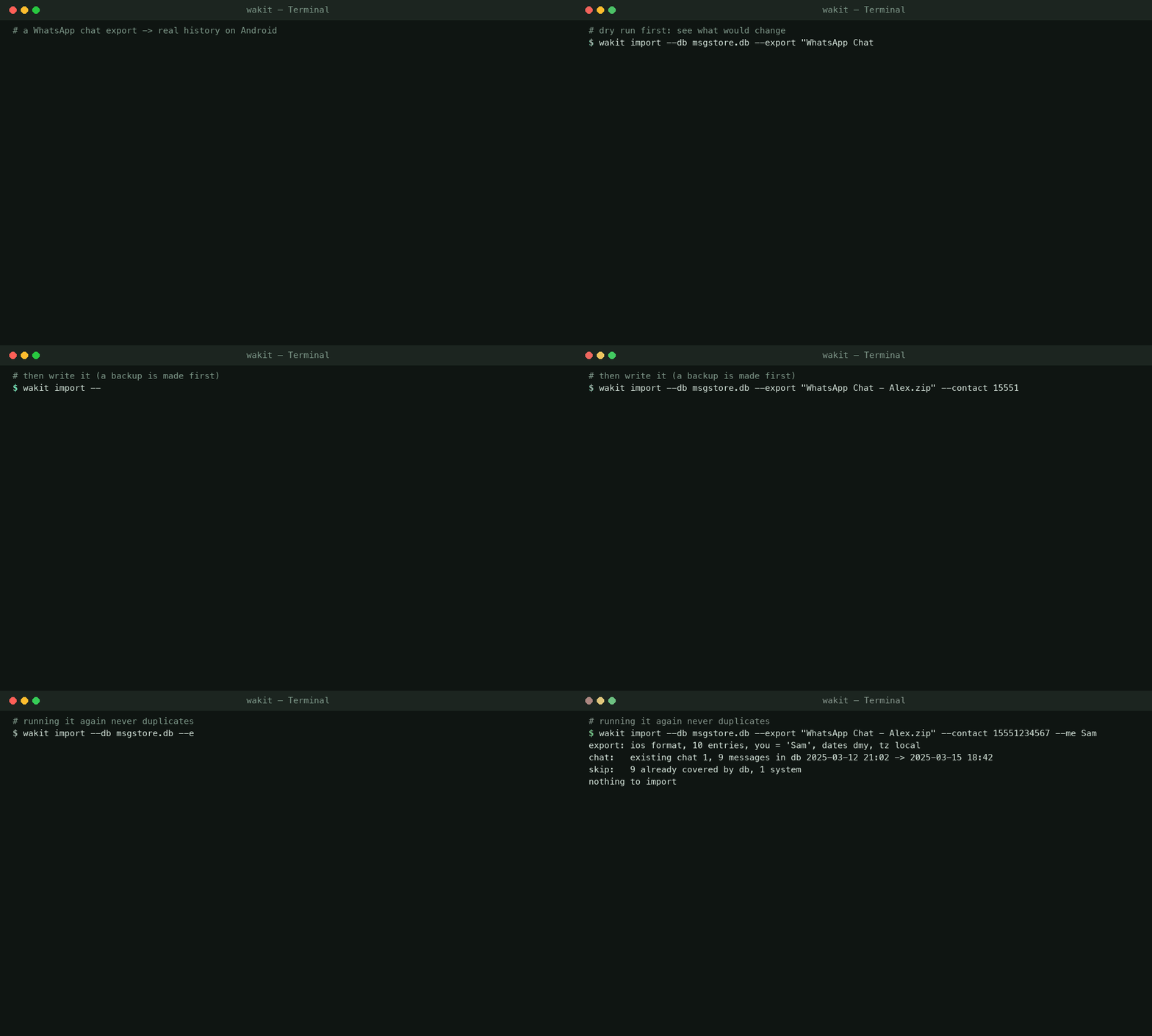
wakit is a command-line tool with a local web GUI. It can:
- turn "Export chat" files (
.zip/_chat.txtwith media) back into real chat history on Android - merge an old Android database (old phone, WhatsApp mod, adb backup) into the current one
- bring an iPhone's chats to Android, and an Android phone's chats to an iPhone, with no paid tool and no factory reset of the Android side
- copy your favourite stickers across
- handle the fiddly device parts: pulling and installing databases on a rooted phone, and checking, repairing and restoring iPhone backups
Everything runs on your own computer. Nothing is uploaded anywhere.
Website: https://wakit-site.vercel.app
wakit is not affiliated with WhatsApp or Meta. It edits your own WhatsApp databases, so keep backups. Every tool is a dry run until you pass
--apply, and each write makes a backup first.
Download
You don't need Python. Download the app for your computer from the latest release, then double-click it to open the GUI, or run it in a terminal with a command (wakit import …).
| System | File |
|---|---|
| macOS (Apple silicon) | wakit-macos-arm64 |
| Windows | wakit-windows-x86_64.exe |
| Linux (x86_64) | wakit-linux-x86_64 |
The apps aren't signed, so the first launch needs one extra step:
- macOS: run
chmod +x wakit-macos-arm64 && xattr -d com.apple.quarantine wakit-macos-arm64once, or right-click it and choose Open. - Windows: choose More info → Run anyway.
- Linux: run
chmod +x wakit-linux-x86_64.
Intel Macs and other systems: install with pip as shown below.
Install with pip
Needs Python 3.9+. There are no Python dependencies.
pipx install wakit          # or: pip install wakit
wakit                       # list the commands
wakit gui                   # open the GUI in your browser
For Android's encrypted backups (wakit crypt), add the one optional dependency: pipx install "wakit[crypt]".
Device tools, only for the steps that touch a phone:
| For | macOS | Linux |
|---|---|---|
Android (device, --push) |
brew install android-platform-tools |
apt install adb |
iPhone (ios-backup backup/restore) |
brew install libimobiledevice |
apt install libimobiledevice-utils |
Most Android steps work on a rooted phone, because WhatsApp's database lives in /data/data/com.whatsapp, where only root can read and write. No root? Use the phone's encrypted backup instead. See workflow 5. That needs one extra package: pip install "wakit[crypt]". The iPhone side needs no jailbreak. It works through an ordinary unencrypted backup.
The GUI
wakit gui
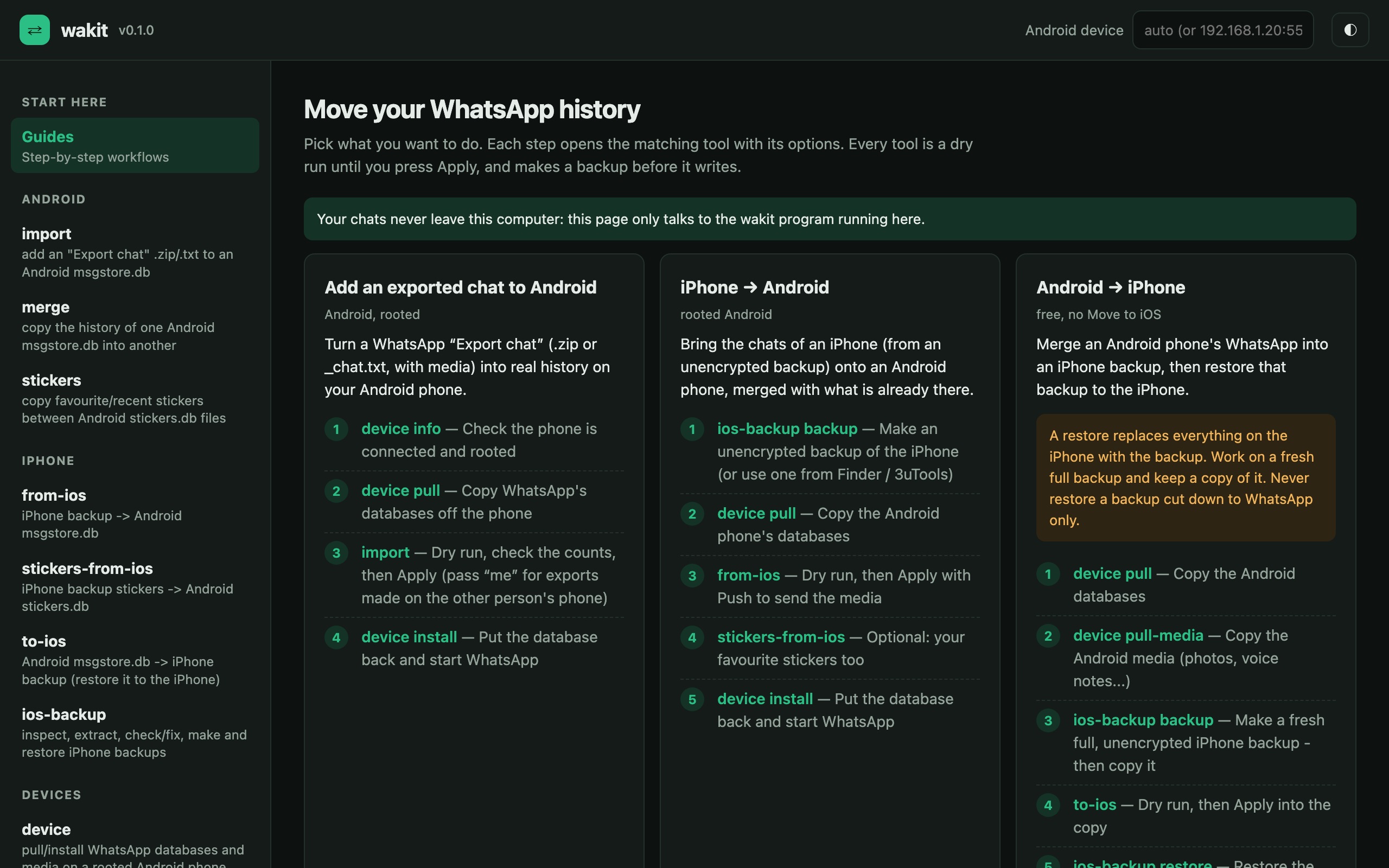
This opens a page served by your computer only (127.0.0.1, with a one-time access token in the link). It has:
- Guides: the workflows below, step by step. Each step opens the matching tool.
- A form for every command, with file pickers, so you never type a path.
- Dry run / Apply buttons and a live log of each run.
Workflows
1. Add an exported chat to Android
wakit device pull --out phone/                    # WhatsApp is disabled while copying
wakit import --db phone/msgstore.db --export "WhatsApp Chat - Alex.zip" --contact 15551234567
#   ... check the counts, then:
wakit import --db phone/msgstore.db --export "WhatsApp Chat - Alex.zip" --contact 15551234567 \
             --apply --push --phone-root /sdcard/WhatsApp
wakit device install --db phone/msgstore.db       # owner + SELinux label copied, then WhatsApp starts
- Reads iPhone exports (
[dd/mm/yyyy, h:mm:ss AM] Name: …) and Android exports (dd/mm/yyyy, hh:mm - Name: …) in either date order. - Brings back text, photos, videos, voice notes, stickers, documents, contact cards, captions and deleted-message markers.
- Messages already in the chat are skipped, so re-running never duplicates anything.
- Exported from the other person's phone? Then the "You …" lines are theirs. Pass
--me "Your Name"with your name as it appears in the export.
2. iPhone → Android
wakit ios-backup backup --out ~/Backups           # or use a Finder / 3uTools backup (unencrypted)
wakit device pull --out phone/
wakit from-ios --db phone/msgstore.db --backup ~/Backups/<device-id>          # dry run
wakit from-ios --db phone/msgstore.db --backup ~/Backups/<device-id> --apply --push --phone-root /sdcard/WhatsApp
wakit stickers-from-ios --db phone/stickers.db --backup ~/Backups/<device-id> --files-out Stickers --apply
wakit device install --db phone/msgstore.db
Chats are matched by WhatsApp id (including the newer @lid ids), so the iPhone history and the Android history of the same person end up in one chat.
3. Android → iPhone
wakit device pull --out phone/
wakit device pull-media --out phone-media/        # one tar stream, much faster than adb pull
wakit ios-backup backup --out ~/Backups           # a FRESH, FULL, unencrypted backup
cp -cR ~/Backups/<device-id> ~/Backups/edit/      # work on a copy (cp -c clones on APFS, using no extra space)
wakit to-ios --db phone/msgstore.db --backup ~/Backups/edit/<device-id> --media phone-media/          # dry run
wakit to-ios --db phone/msgstore.db --backup ~/Backups/edit/<device-id> --media phone-media/ --apply
wakit ios-backup restore --backup ~/Backups/edit/<device-id> --yes
to-ios keeps the iPhone's own WhatsApp history and adds what it is missing: chats, groups, photos, voice notes, stickers, documents, replies and stars. It also makes thumbnails (on macOS) and repairs the backup's file records.
⚠️ A restore replaces everything on the iPhone with the backup's contents.
- Use a backup made just before. Anything added to the iPhone after the backup is lost.
- Never restore a backup cut down to WhatsApp only. The phone comes back with nothing but WhatsApp.
ios-backup restorerefuses such backups.- Turn Find My off, and keep the iPhone unlocked (Auto-Lock: Never) until it reboots.
- When WhatsApp opens, verify your number and skip any iCloud restore it offers. The Android phone gets logged out.
4. Merge two Android databases
wakit merge --old old/msgstore.db --new phone/msgstore.db --fuzzy            # dry run
wakit merge --old old/msgstore.db --new phone/msgstore.db --fuzzy --apply
wakit stickers --db phone/stickers.db --from old/stickers.db --from-files old/files/Stickers --files-out Stickers --apply
5. No root: edit Android's encrypted backup (experimental)
WhatsApp's own local backup (msgstore.db.crypt15) can be decrypted and re-encrypted with your backup key. Every tool above can then work on it with no root.
- Make the key. In WhatsApp, go to Settings → Chats → Chat backup → End-to-end encrypted backup, choose Use 64-digit encryption key instead, write the key down, and back up.
- Copy the backup off the phone. It's in
Android/media/com.whatsapp/WhatsApp/Databases/(on older phones,WhatsApp/Databases/). A file manager or plainadb pullcan read it without root.
wakit crypt decrypt --in msgstore.db.crypt15 --key "<your 64-digit key>" --out msgstore.db
wakit import --db msgstore.db --export "WhatsApp Chat - Alex.zip" --contact 15551234567 --apply   # or from-ios, merge...
wakit crypt encrypt --in msgstore.db --like msgstore.db.crypt15 --key "<your 64-digit key>" --out new/msgstore.db.crypt15
- Put the file back. Copy
new/msgstore.db.crypt15into the sameDatabases/folder on the phone, replacing the old file (keep a copy of it). Copy any media intoWhatsApp/Media/. - Reinstall WhatsApp, or clear its data. Verify your number and tap Restore when it finds the local backup.
crypt also opens .crypt14 backups using the 158-byte key file from /data/data/com.whatsapp/files/key. Copying that file needs root once. Decrypting and re-encrypting is verified on real crypt14 backups, and encrypt checks its own output by decrypting it again. WhatsApp actually restoring an edited backup hasn't been tested on a phone yet, so keep the original file.
Commands
| Command | What it does |
|---|---|
doctor |
check any database, iPhone backup, .crypt file or export: what it is, what's in it, and whether wakit knows its layout. Run it first. |
import |
"Export chat" .zip/.txt → Android msgstore.db |
crypt info | decrypt | encrypt |
open and re-seal .crypt14/.crypt15 backups (no root) |
merge |
one Android msgstore.db → another (messages, media, replies, reactions, calls) |
stickers |
favourite/recent stickers between Android stickers.db files |
from-ios |
iPhone backup → Android msgstore.db |
stickers-from-ios |
iPhone stickers → Android stickers.db |
to-ios |
Android msgstore.db + media → iPhone backup |
ios-backup info | extract | check [--fix] | backup | restore |
iPhone backup tools |
device info | pull | install | enable | pull-media | push-media |
rooted Android over adb |
gui |
the local web GUI |
Run wakit <command> -h for every option. Use wakit --serial <device> to pick an adb device, for example Wi-Fi adb at 192.168.1.20:5555.
Good to know
- "Something went wrong with chat history" after installing a database means the file has the wrong owner or SELinux label.
wakit device installcopies both from the original file. - "Restore chat history" prompt: WhatsApp opened a half-copied file. It restarts itself seconds after a force-stop, which is why
device pull/installdisable the app during the copy. - iPhone restore fails with error 205: the backup has records whose size or checksum doesn't match the file. This is common in backups from third-party tools. Run
wakit ios-backup check --fix. - Encrypted iPhone backups aren't supported. Turn encryption off before backing up. Android
.crypt14/.crypt15backups are supported throughwakit crypt. - Not carried over:
- Android → iPhone: reactions, polls and system notices.
- iPhone → Android: polls, reactions and calls.
- A new WhatsApp version? Every command that writes checks the database layout first and refuses to touch one it doesn't know, naming exactly what's missing.
wakit doctor --path <file>shows the same check. Its output lists only table and column names, so it's safe to paste into an issue. - Tested with WhatsApp 2.26 on a rooted Android 7.1 tablet and on iOS 27. Other versions should work but haven't been tried. WhatsApp changes its database layout from time to time. If something looks off, open an issue with the dry-run output, but never share your databases.
How it works inside (schemas, sort order, the protobuf blobs, the backup format): docs/how-it-works.md.
Development
git clone https://github.com/menaxmaged/wakit && cd wakit
python -m venv .venv && . .venv/bin/activate
pip install -e ".[crypt]"                  # editable: changes in src/ take effect right away
python -m unittest discover -s tests -v
wakit gui
The code is in src/wakit/: one module per command (cli.py dispatches to them), and web/index.html is the GUI page. The standalone apps are built with PyInstaller from packaging/wakit.spec (pip install pyinstaller && pyinstaller packaging/wakit.spec). See CONTRIBUTING.md.
Releases: bump version in pyproject.toml, add a line to CHANGELOG.md, then git tag -a vX.Y.Z -m "wakit X.Y.Z" && git push origin vX.Y.Z. GitHub Actions tests it, publishes it to PyPI, and attaches the apps to the release.
The tests use synthetic data only. Never commit real databases or exports: .gitignore blocks *.db, *.sqlite and media folders.
License
MIT. See LICENSE.
1 maintainer

Metadata
1 maintainer
Release files for wakit 0.3.0
For a detailed explanation of source distributions (sdists) and built distributions (wheels), please see the package formats documentation.
Source distribution (sdist)
| File | Size | Uploaded | Provenance | Actions |
|---|---|---|---|---|
| wakit-0.3.0.tar.gz | 79.2 kB | With provenance | Details for wakit-0.3.0.tar.gz |
Built distribution (wheel)
| File | Interpreter | ABI | Platform | Actions Reset |
|---|---|---|---|---|
| wakit-0.3.0-py3-none-any.whl | Python 3 | none | any | Details for wakit-0.3.0-py3-none-any.whl |
Total release size: 158.9 kB
Release files / wakit-0.3.0.tar.gz
| Download URL | wakit-0.3.0.tar.gz |
|---|---|
| Size | 79.2 kB |
| Tags | Source |
|
SHA-256 checksum How to use checksums |
71998e60f2ba679be075584c3be267754cb61cbef5a79d1defa8b6386c73d347
|
|
BLAKE2b-256 checksum How to use checksums |
ecf7edbc6b74837a9d0c8fbd7a3eae8a3509187596495c19a1e2790cb4beec23
|
| Upload date | |
|
Uploaded using Trusted Publishing? What is trusted publishing? |
Yes |
| Uploaded via |
twine/7.0.0 CPython/3.13.16
|
Provenance
Provenance describes where a file came from. On PyPI, provenance is shared via attestations, which provide a verifiable record of the build or publishing details. View details, limitations and caveats.


PyPI Publish Attestation
PyPI verified that this artifact, at this checksum, originated from the publisher listed below.
Signed by GitHub Actions, verified by PyPI on Oct 26, 2026.
Transparency logRelease files / wakit-0.3.0-py3-none-any.whl
| Download URL | wakit-0.3.0-py3-none-any.whl |
|---|---|
| Size | 79.7 kB |
| Tags | Python 3 |
|
SHA-256 checksum How to use checksums |
73970aecedb795a7d2dfe7b5f7efa2391366900a71701c05370d0ff495b2b1dd
|
|
BLAKE2b-256 checksum How to use checksums |
bf406d6e5124c3e83d2349928469a5181d0ddb65db433eafc5191c30330ccf26
|
| Upload date | |
|
Uploaded using Trusted Publishing? What is trusted publishing? |
Yes |
| Uploaded via |
twine/7.0.0 CPython/3.13.16
|
Provenance
Provenance describes where a file came from. On PyPI, provenance is shared via attestations, which provide a verifiable record of the build or publishing details. View details, limitations and caveats.
PyPI Publish Attestation
PyPI verified that this artifact, at this checksum, originated from the publisher listed below.
Signed by GitHub Actions, verified by PyPI on Oct 26, 2026.
Transparency logSecurity for wakit 0.3.0
Provenance
Provenance describes where a file came from. On PyPI, provenance is shared via attestations, which provide a verifiable record of the build or publishing details. View details, limitations and caveats.
Full provenance
Both files in this release have been uploaded with provenance metadata.
Attestation for wakit-0.3.0.tar.gz
PyPI Publish Attestation
PyPI verified that this artifact, at this checksum, originated from the publisher listed below.
Signed by GitHub Actions, verified by PyPI on Oct 26, 2026.
Transparency logA note on package security
PyPI is a repository for distributing packages, not a service for auditing them. While third-party security researchers and our staff do their best to detect and remove malicious packages, PyPI cannot guarantee the quality, security or suitability of any given package.
To learn more about protecting yourself from malicious actors, visit our package security documentation.














