
WannaDo Series: Automatic AI focus wireless communication environment setup (wannado-wce)
Wanna do a wireless communication simulation?
This library enables you to set up your fundamental wireless communication environment while chatting with your IDE, preventing hallucinations and strictly adhering to 3GPP and ITU standards
Standards-Anchored, Just-in-Time (JIT) Wireless Communication Environment Quick Provisioning for 5G-Advanced, 6G / IMT-2030, ISAC, RIS, Near-Field XL-MIMO, NTN, UAV, V2X, and AI-Native Networks





Stop guessing wireless simulation setups or hand-stitching incompatible channel scripts. Tell your AI Coding Assistant (Antigravity, Claude Code, Codex CLI, or Cursor) what communication research you want to do, and wannado-wce follows a strict 5-Stage Standards-Anchored Provisioning Protocol inside an isolated ./wce_lab/ boundary:
- Traverses & Diagnoses First: Reads your workspace (
torch,gymnasium, ray-tracing configs, sibling./drl_lab/or./adv_eval/) and infers a Stage 0WCESpec. - Anchors Every Knob to Authority: Maps every physical setting (pathloss, LoS probability, NR numerology, O2I loss, antenna spacing, Doppler, traffic queue, clutter/RCS) to 21 codified ITU-R / 3GPP / ETSI / IEEE standards and canonical papers.
- Executes Just-in-Time (JIT) Assembly: Uses fast built-in PyTorch/NumPy Tier 0 kernels immediately, while recommending and scripting exact pull commands for 18 external simulators/libraries (Sionna RT, DeepMIMO, QuaDRiGa, ns-3/5G-LENA, OpenAirInterface, srsRAN, FlexRIC, pyAerial, HermesPy, TorchSig) only after checking your OS/GPU/disk compatibility and confirming with you.
- Audits 10 Physical, Statistical & Provenance Traps (
RigorAuditor 2.0+wannado-wce verify): Automatically flags channel power drift, dB/linear noise bugs, future CSI leakage, Doppler coherence violations, passive RIS|phi_m| > 1, far-field misuse inside the Rayleigh distanceZ_R = 2D^2/lambda, missing classical baselines, zero-variance deterministic stubs, coarse RIS quantization / aperture mismatches, and incompleteTable Iprovenance. - Link-Level Coded OFDM-MIMO PHY (
evaluate_link_level_phy): Includes lightweight systematic Rate-1/2 (K=64, N=128) dual-diagonal LDPC + Normalized Min-Sum BP decoding (fast pure-PyTorch smoke/waterfall engine distinct from full 3GPP TS 38.212 BG1/BG2 codes), Gray QPSK/16QAM/64QAM, comb-pilotLS/LMMSE/Geniechannel estimation, and unprecodedmin(Nr, Nt)-streamMMSE/ZF/MRCequalization over WCE channels. - Exports Camera-Ready Provenance (
Table I): Generatesenvironment_provenance.md(with complete per-parameterTable Irationale),paper_params_table.tex(booktabsLaTeX),paper_results_table.tex, verified zero-hallucinationreferences.bib,wce_report.json, and multi-seed CDF/IQM plots.
Quick Start
pip install wannado-wce
# Or from source checkout: pip install -e ".[dev]" --no-build-isolation
wannado-wce init-agent --dir /path/to/your/project --ide all
wannado-wce inspect /path/to/your/project --query "28 GHz ISAC monostatic radar and RIS MIMO"
Or run the 4-Slot Compositional Assembler (v1.1) and forward-coupled ComposedWirelessEnv inside an isolated ./wce_lab/ workspace:
wannado-wce compose "UAV carrying STAR-RIS at 28 GHz near-field ISAC with 60 fps XR traffic and LMMSE pilot errors"
wannado-wce scaffold --dir ./wce_lab --query "UAV + STAR-RIS + 28 GHz ISAC + XR"
python3 ./wce_lab/run_provision.py --seeds 0 1 2

# Live parameter tuning with automatic Rayleigh near-field / >100 GHz boundary alerts & Table I diff:
wannado-wce diff-spec --spec ./wce_lab/wce_spec.json --request "Switch carrier frequency to 140 GHz" --save

# Run the 10-check automated verification gate (Physics, RigorAuditor 2.0, multi-seed + link-level PHY):
wannado-wce verify --query "64-element passive RIS MIMO at 28 GHz" --seeds 0 1 2

# Check OS/Docker/disk & run contract smoke (`--require-live` when simulator deps are installed):
wannado-wce jit-recipe sionna_rt --write-dir ./wce_lab/adapters --verify
1. Authoritative Standards & Scenario Matrix (21 Standards + 6 IMT-2030 Scenarios)
Every physical assumption in wannado-wce links to a verifiable clause in our built-in registry (STANDARDS_PROVENANCE):
| Organization | Standards Included | Covered Physical / Protocol Scope |
|---|---|---|
| ITU-R | M.2160-0, P.676-13 |
All 6 IMT-2030 6G usage scenarios (IC, HRLLC, MC, UC, AIAC, ISAC) + sub-THz O2/H2O molecular gas attenuation |
| 3GPP Terrestrial | TR 38.901 (Rel-15–18 & Rel-19 ISAC), TS 38.211, TR 38.913, TR 38.914 (Rel-20) |
UMa, UMi, RMa, InH, InF (SL/DL/SH/DH/HH), O2I penetration, CDL-A..E/TDL-A..E, numerologies mu=0..4, 6G Rel-20 FR3 |
| 3GPP Non-Terrestrial & Mobility | TR 38.811, TR 38.821, TR 36.777, TR 37.885 |
LEO/GEO NTN elevation brackets (S/Ka), UAV UMa-AV/UMi-AV/RMa-AV, V2X Urban Grid & 6-lane Highway (NLOSv) |
| 3GPP Traffic, XR, AI & IoT | TR 36.814, TR 38.824, TR 38.838, TR 38.843, TR 38.848, TR 38.855, TR 22.837 |
FTP Models 1–3, VoIP On-Off, URLLC mini-slot, 60/120 fps XR (99% PDB), AI/ML CSI feedback, Ambient IoT backscatter, ISAC KPIs |
| ETSI & IEEE | ETSI GR RIS 003, IEEE 802.11bf, IEEE 802.11bn |
RIS cascaded/near-field unit-cell modeling, WLAN sensing CSI streams, Wi-Fi 8 Multi-AP Coordinated Spatial Reuse |
2. The 33-Block Single-File Arsenal (Classic → 2025 Frontier)
Inspired by CleanRL, each physics/traffic/baseline module is a standalone self-contained file under src/wannado/wce/blocks/ that can be run via provision_*(), mounted through ChannelModuleAdapter / WirelessGymEnvAdapter, or ejected (wannado-wce eject <block_id>) into ./wce_lab/blocks/.
- Classic Statistical & Stochastic Geometry (
channel_classic/, 6 blocks):awgn_link(Shannon 1948),rayleigh_clarke(Clarke/Jakes 1968),rician_los(Rice 1945),nakagami_m(1960),saleh_valenzuela(1987 sparse mmWave),ppp_stochastic_geo(Andrews et al., 2011 exact coverage bound).
- 3GPP NR / NTN / UAV / V2X Channels (
channel_3gpp/, 6 blocks):tr38901_uma_umi_rma,tr38901_inf,tr38901_cdl_tdl,ntn_leo_satellite,uav_air_to_ground(TR 36.777 + Al-Hourani 2014),v2x_vehicular_sl.
- Arrays, Near-Field XL-MIMO, RIS & Flexible Antennas (
arrays_and_ris/, 5 blocks):farfield_upa,nearfield_xlmimo_thz(Cui & Dai 2022 spherical steering + ITU-R P.676),passive_ris_cascade(Wu & Zhang 2019),star_ris(Xu et al. 2021),active_ris_flexible(Active RIS amplified noise Zhang et al. 2023 + Fluid Antenna Wong et al. 2021 + Pinching Antenna Ding et al. 2025).
- 3GPP Traffic Generators & Multi-Cell MAC Queues (
traffic_and_mac/, 4 blocks):traffic_ftp_models(Model 1/2/3),traffic_poisson_pareto_voip,traffic_xr_immersive(TR 38.838 PDB satisfaction),multicell_interference_mac(4-cell wrap-around Gym queue env).
- IMT-2030 / 6G Frontier (
domain_6g/, 7 blocks):isac_jsac_channel(Liu et al. 2022 + TR 38.901 Rel-19),wifi_sensing_80211bf,otfs_delay_doppler(Hadani et al. 2017),hrllc_fbl_urllc(Polyanskiy-Poor-Verdú 2010),ambient_iot_backscatter(TR 38.848),semantic_aircomp_channel(differentiable DeepSC + AirComp),pls_covert_antijamming(Wyner secrecy, Bash covert KL, Sadeghijsr_db).
- Analytical Baselines & CKM RadioMap Bridge (
baselines/, 5 blocks):water_filling(exact KKT),wmmse_precoder(Shi et al. 2011 vs ZF/MRT),ls_lmmse_csi(pilot LS vs spatial LMMSE),proportional_fair(Jalali 2000 PF vs Max-SNR vs RR + Jain's fairness),ckm_radiomap_bridge(CKM / Radio Map reconstruction).
3. Just-in-Time (JIT) Open-Source Ecosystem Registry (18 Tools)
Instead of bloating core installation with multi-gigabyte C++ or CUDA toolchains, wannado-wce pairs instant built-in PyTorch/NumPy execution (Tier 0) with curated pull blueprints across Tier 1 (PyPI), Tier 2 (C++/Docker Network & SDR), and Tier 3 (MATLAB):
- Ray Tracing & Differentiable PHY: NVIDIA
Sionna RT/Sionna,DeepMIMOv3/v4,QuaDRiGa,pyAerial - System / Protocol & Real-Time SDR / O-RAN:
ns-3(5G-LENA/ns3-gym),OMNeT++(Simu5G),OpenAirInterface(OAI 5G),srsRAN Project,FlexRIC/OSC Near-RT RIC,GNU Radio,Colosseum - RF / Waveform / Link Primitives:
TorchSig,HermesPy,Scikit-commpy,Python-FSPL / ITU-Rpy,Vienna 5G Simulators
Run wannado-wce ecosystem --probe to inspect local OS, GPU, CUDA/MPS, installed Python libraries, and system binaries before pulling anything.
4. Empirical Validation & Reproducible Benchmarks
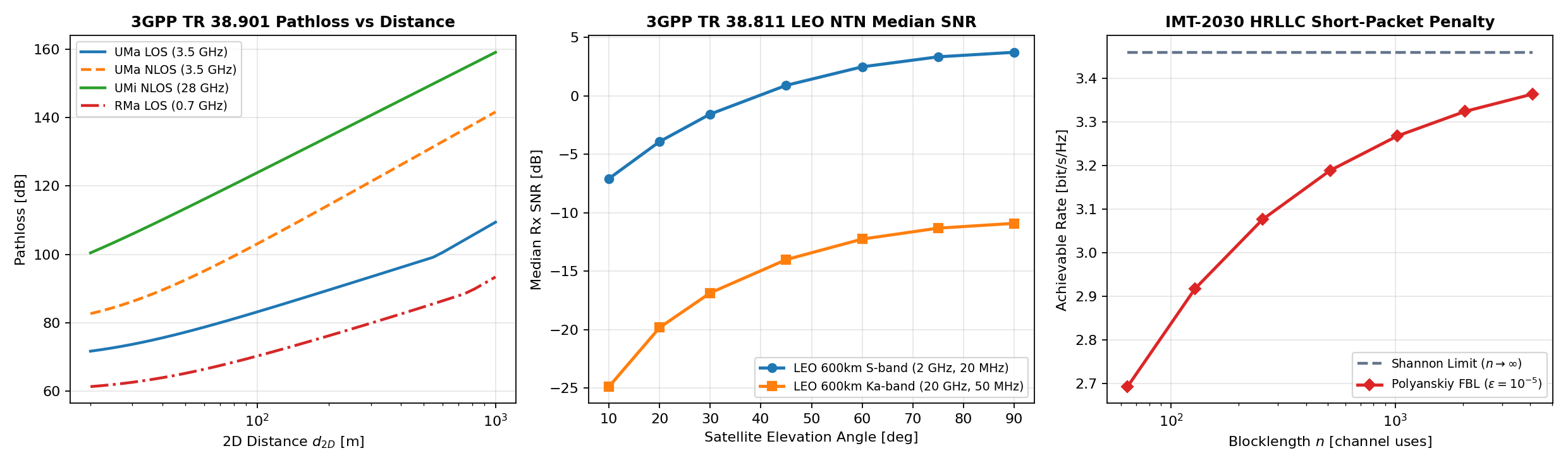
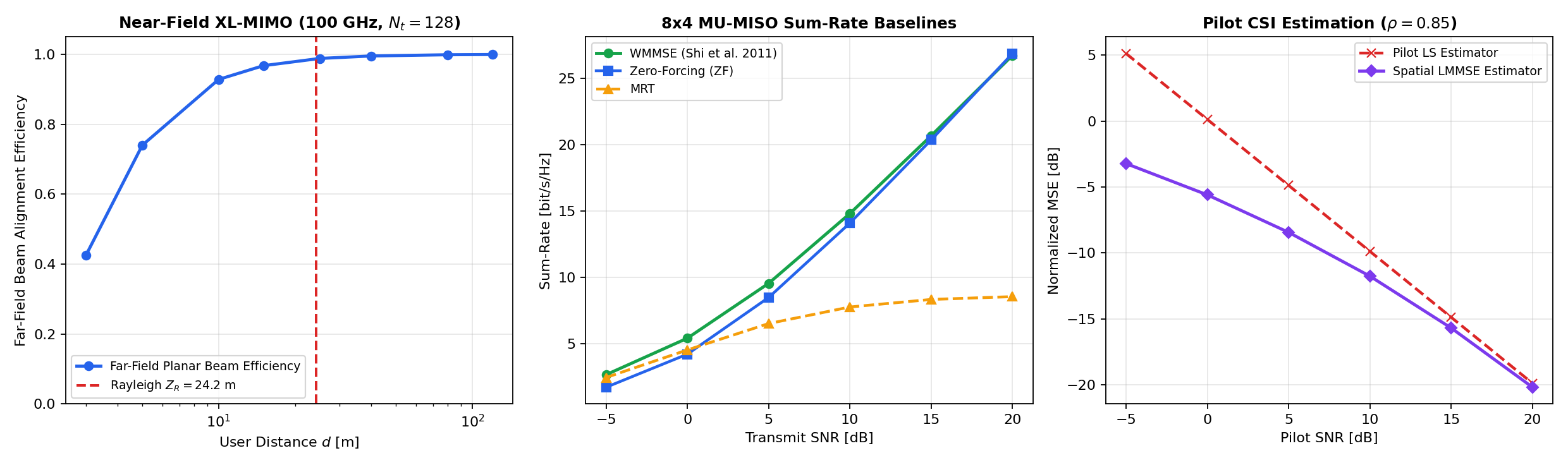
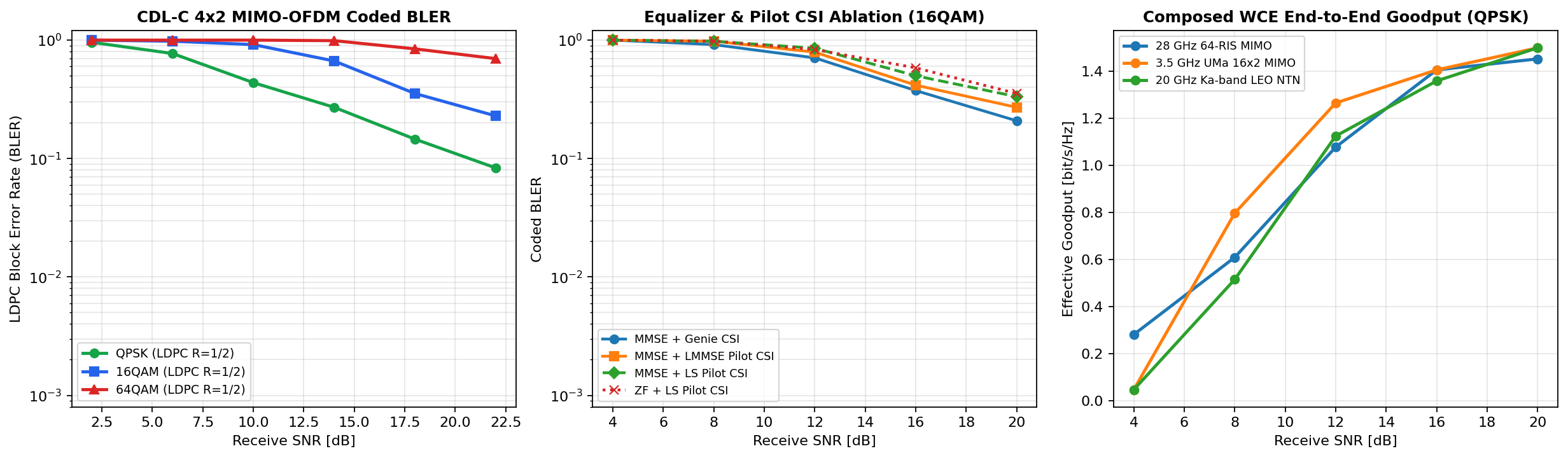
Running benchmarks/bench_3gpp_and_imt2030.py and benchmarks/bench_ris_isac_nearfield_and_audit.py produces standard-aligned validation curves:
Link-Level Coded OFDM-MIMO PHY (evaluate_link_level_phy)
- TR 38.901 & TR 38.811 Fidelity: Verified dual-slope pathloss transitions across
UMa/UMi/RMa/InFand LEO600 kmelevation SNR monotonicity (10°→90°:-6.92 dB→+3.77 dBin S-band). - Polyanskiy FBL URLLC Penalty: At
SNR = 10 dB, finite blocklengthn = 64achieves2.69 bps/Hz(BLER = 1e-5) vs the infinite-blocklength Shannon ceiling (3.46 bps/Hz), exposing short-packet capacity overestimation. - Near-Field Beamfocusing Breakdown: At
100 GHzwithN_t = 128(Z_R = 24.2 m), planar far-field steering alignment collapses to0.42at3 mbefore smoothly recovering toward1.00pastZ_R. - Unit Tests: Verified across all 33 blocks, standards calibration (TR 38.901 / TR 36.777 UAV / TR 38.811 NTN / ITU-R P.676), link-level LDPC/OFDM-MIMO PHY, 4-slot compositional assembly, multi-user
ComposedWirelessEnv,LiveProvenance Diff, honest JIT adapter self-tests (synthetic_contract_smokevs--require-live), 10-checkRigorAuditor 2.0+wannado-wce verify, CLI subcommands, and 3-waywannado.*namespace coexistence viapytest.
5. Multi-Package WannaDo Series Coexistence (wce + drl + adv)
All packages in the WannaDo Series share the strict PEP 420 namespace wannado.* with zero cross-package install coupling and marker-isolated agent rules (<!-- wannado-wce:start --> ... <!-- wannado-wce:end -->):
wannado-wce(Wireless Environment Provisioner): Constructs standards-anchored wireless channels, arrays, traffic, and baselines inside./wce_lab/interface.py(ChannelModuleAdapter,WirelessGymEnvAdapter,export_dataset_pt).wannado-drl(Deep RL Research Kit): Mounts./wce_lab/directly into./drl_lab/(DRLEnvInterface) for PPO/SAC/TD3/QMIX scheduling, trajectory, and RIS control.wannado-adv(Adversarial ML Auditing Kit): Audits RF/semantic classifiers & beamforming policies mounted from./wce_lab/undernorm="jsr_db"jamming budgets inside./adv_eval/.
CLI Reference
wannado-wce inspect . --query "..."          # Traverse codebase & surface clues + dialog + JIT brief
wannado-wce compose "28 GHz UAV STAR-RIS ISAC" # 4-slot compositional assembler -> coupled WCESpec + Table I
wannado-wce diff-spec --spec ./wce_lab/wce_spec.json --request "Switch carrier frequency to 140 GHz" --save
wannado-wce verify --dir ./wce_lab --seeds 0 1 2       # 10-check RigorAuditor 2.0 + link-level PHY gate
wannado-wce jit-recipe sionna_rt --verify            # Platform/disk check + contract smoke (`--require-live` for runtime probe)
wannado-wce arsenal                          # View 33 blocks across 6 families (classic -> frontier)
wannado-wce standards --org 3GPP             # Filter 21 codified ITU-R / 3GPP / ETSI / IEEE specs
wannado-wce ecosystem --probe                # Check OS/GPU/Python/CLI readiness for 18 external tools
wannado-wce recommend "RIS UAV 28 GHz"       # Map research prompt -> WCESpec + JIT plan
wannado-wce intake --archetype imt2030_immersive_xr --out ./wce_lab/wce_spec.json
wannado-wce eject passive_ris_cascade        # Eject 1 standalone file to ./wce_lab/blocks/
wannado-wce scaffold --dir ./wce_lab         # Generate isolated ./wce_lab/ + ComposedWirelessEnv + adapters
wannado-wce cite isac_jsac_channel --format bibtex
wannado-wce init-agent --dir . --ide all     # Install AGENTS.md / CLAUDE.md / .cursor / .agent skills
Feedback & Suggestions
Found a bug, missing 3GPP/ITU standard clause, new 6G channel or simulator adapter request, or ideas to improve the AI IDE Co-Pilot experience? Send feedback or suggestions without leaving GitHub:
- Open Feedback Portal: https://jietaozhao.github.io/wannado-wce/
- Or scan the QR code below from your phone:

1 maintainer

Metadata
1 maintainer
Release files for wannado-wce 1.2.0
For a detailed explanation of source distributions (sdists) and built distributions (wheels), please see the package formats documentation.
Source distribution (sdist)
| File | Size | Uploaded | Provenance | Actions |
|---|---|---|---|---|
| wannado_wce-1.2.0.tar.gz | 282.7 kB | Without provenance | Details for wannado_wce-1.2.0.tar.gz |
Built distribution (wheel)
| File | Interpreter | ABI | Platform | Actions Reset |
|---|---|---|---|---|
| wannado_wce-1.2.0-py3-none-any.whl | Python 3 | none | any | Details for wannado_wce-1.2.0-py3-none-any.whl |
Total release size: 599.7 kB
Release files / wannado_wce-1.2.0.tar.gz
| Download URL | wannado_wce-1.2.0.tar.gz |
|---|---|
| Size | 282.7 kB |
| Tags | Source |
|
SHA-256 checksum How to use checksums |
98023f4d7d3c312a6ccbfafd7c3e2f80a56ade6587c988b05ed1c0108cb0244f
|
|
BLAKE2b-256 checksum How to use checksums |
9125db1f0e29a3a8e9cdea48665d8c7725effc77a18272b42c166d822cf7eaa8
|
| Upload date | |
|
Uploaded using Trusted Publishing? What is trusted publishing? |
No |
| Uploaded via |
twine/7.0.0 CPython/3.13.9
|
Release files / wannado_wce-1.2.0-py3-none-any.whl
| Download URL | wannado_wce-1.2.0-py3-none-any.whl |
|---|---|
| Size | 317.0 kB |
| Tags | Python 3 |
|
SHA-256 checksum How to use checksums |
14100d3ed7e431a723bcdecc1821cb11cd945ab9dd7adc93aaf18eab7025a239
|
|
BLAKE2b-256 checksum How to use checksums |
4033d47e5746625c892b8370e3303658842c7f6fb6762b9885e39fe2cf2952e4
|
| Upload date | |
|
Uploaded using Trusted Publishing? What is trusted publishing? |
No |
| Uploaded via |
twine/7.0.0 CPython/3.13.9
|
Security for wannado-wce 1.2.0
Provenance
Provenance describes where a file came from. On PyPI, provenance is shared via attestations, which provide a verifiable record of the build or publishing details. View details, limitations and caveats.
No provenance found
None of the files in this release were uploaded with provenance metadata.
A note on package security
PyPI is a repository for distributing packages, not a service for auditing them. While third-party security researchers and our staff do their best to detect and remove malicious packages, PyPI cannot guarantee the quality, security or suitability of any given package.
To learn more about protecting yourself from malicious actors, visit our package security documentation.














