
warpax



Observer-robust energy condition verification for warp drive spacetimes.
warpax decides the energy-condition structure of warp-drive spacetimes for
every observer at once, from the eigenstructure of the mixed stress-energy tensor
$T^a{}_b$, with exact curvature from JAX forward-mode autodiff. The decision uses
only the boost-invariant eigenvalues of $T^a{}_b$ and never requires the
coordinate-stationary observer $\partial_t$ to be timelike, so it stays well-defined
at all warp speeds, including superluminal $v_s \ge 1$ where $\partial_t$ turns
spacelike and single-frame tools such as WarpFactory break down. Each Hawking-Ellis
type is decided the same way: a $4\times4$ linear matrix inequality
$\hat T + \sigma\eta \succeq 0$ over every timelike and null observer, with no
rapidity cap and no classification tolerance, and each verdict backed by an exact
rational certificate.
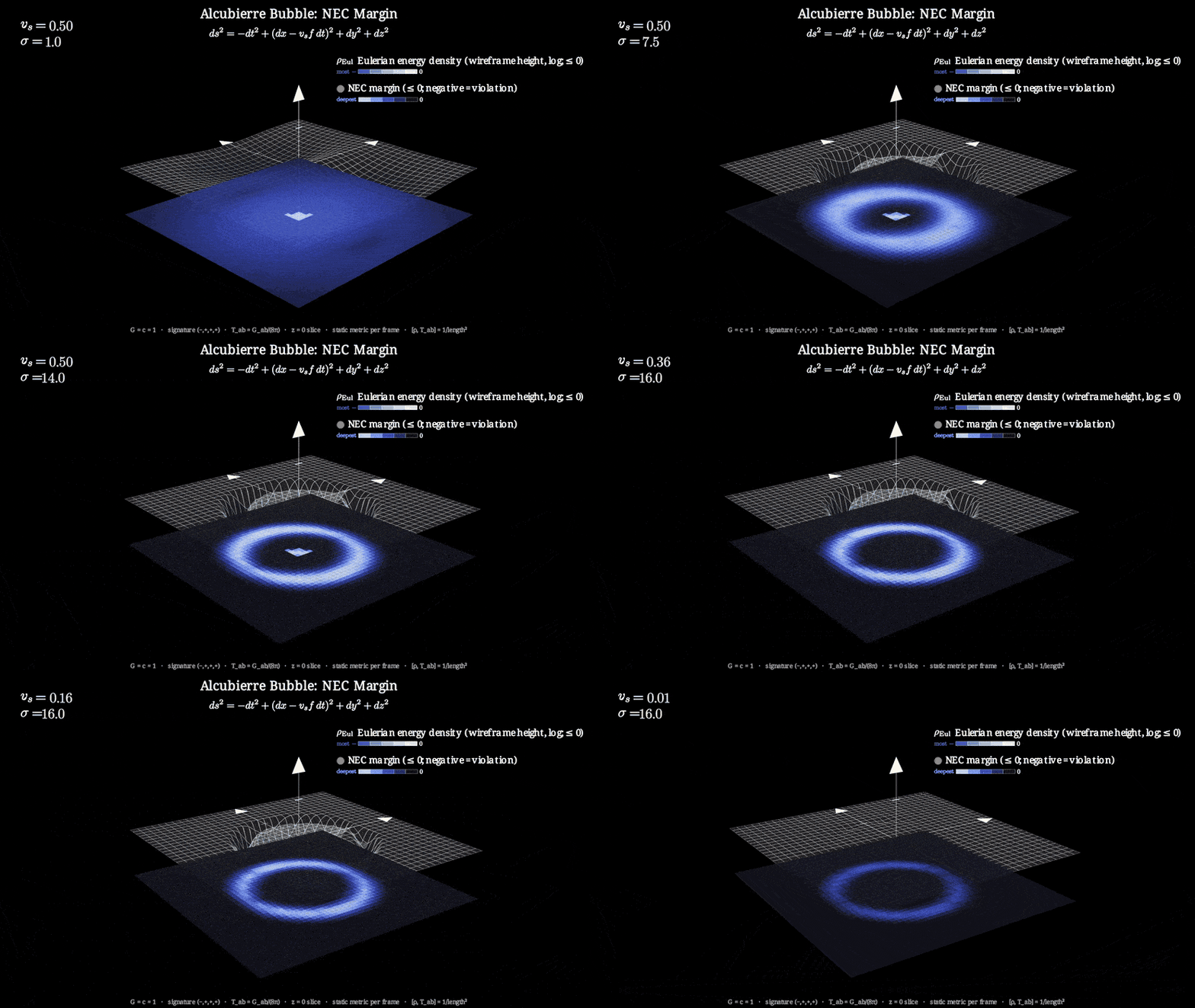
An Alcubierre warp bubble. The wireframe is the Eulerian energy density, negative everywhere across the wall (ρEul ≤ 0); the slab beneath is the NEC margin minimized over the whole null sphere, which never rises above zero. The sweep sharpens the wall (σ: 1 → 16), then eases the velocity toward flat space. Both fields span about three decades over the sweep, so height and colour are on a signed log scale: monotone and sign-preserving, but not proportional.
Features
- Frame-independent, all-observer energy-condition certification at every warp speed (including superluminal $v_s \ge 1$), from the eigenstructure of $T^a{}_b$, exact and cap-free for every Hawking-Ellis type.
- Hawking-Ellis classification (Type I-IV) with explicit Type-IV detection,
cross-checked by two eigensolver backends against a 50-digit
mpmathreference. - Exact decision at Type-III/IV points from the absence of a causal eigenvector, with a closed-form Eulerian null witness for the momentum-sourced case; a closed-form Type-I worst observer and a multistart BFGS optimizer serve only to display violation severity.
- Momentum-density control of the wall type through the discriminant $\Delta=(\rho+S_\parallel)^2-4|j|^2$: a negative discriminant sends a point to Type IV, and the same momentum density sets the wall NEC deficit and curvature scaling.
- Rigorous geodesic-integrated ANEC via a symplectic null integrator (with an on-cone witness), plus a Ford-Roman quantum-inequality diagnostic.
- Bondi four-momentum radiated-flux and Newman-Penrose peeling at null infinity
(
warpax.bondi). - Exact curvature via forward-mode JAX autodiff, no finite-difference stencils.
- Ten warp/shell metrics, constraint residuals, anisotropic TOV, ADM mass with falloff, Israel junctions, transport diagnostics, and source-first S-/T-shell construction with a five-criterion admissibility standard.
Two papers, one toolkit
warpax backs two separate papers with disjoint claims. If you cite a result, cite the paper it belongs to:
| Certification paper (arXiv:2602.18023) | Companion note (arXiv:2605.25417) | |
|---|---|---|
| Question | Which observers see energy-condition violations, at which warp speeds? | Can source-first shells satisfy the energy conditions at all? |
| Results | Frame-free all-velocity certifier; velocity-resolved type map; momentum-density discriminant controlling the wall type; closed-form worst observer; exoticity ranking + two-term $v_s$ deficit law | S-/T-shell constructions from the Einstein constraints; five-criterion admissibility standard; boundary-cost analysis |
| Modules | energy_conditions, geometry, averaged, quantum, analysis, geodesics, transport; metrics Alcubierre / Natário / Van den Broeck / Rodal / Lentz / WarpShell / Garattini |
constraints (S-/T-shell solvers), tov, adm, junction, design, optimization; metrics/sshell.py, metrics/tshell.py |
| Examples | 01-07 | 08-10 |
The S-/T-shells are constructed and certified in the companion note, not in the certification paper; neither paper's results depend on the other's.
Quick start
# Create environment and install
conda create -n warpax python=3.12 -y && conda activate warpax
pip install -e ".[dev,viz,design,solver]"

# Run a quick example
python examples/01_minkowski_sanity.py
See examples/README.md for a numbered learning path (01-10)
and which optional extras each script needs.
For a 5-10 minute walkthrough from install to seeing an energy condition violation, see the Quickstart tutorial.
Key results
Frame-independent type map across the luminal transition
On matched, wall-resolved grids, the Rodal irrotational geometry is globally Hawking-Ellis Type I at every speed from $v_s = 0.1$ to $2.5$, while the Alcubierre/Natário/Van den Broeck bubble walls are Type-IV dominated (no rest frame, no invariant energy density) at every speed. The split is controlled by the Eulerian momentum density through the discriminant $\Delta=(\rho+S_\parallel)^2-4|j|^2$: an irrotational shift carries no wall momentum and stays globally Type I, while a vortical shift drives $\Delta<0$ and the wall to Type IV. For Rodal's globally Type-I drive the Eulerian frame does not register ~73% of the wall weak-energy and ~74% of the wall dominant-energy violations seen by boosted observers, an exact eigenvalue statement rather than an optimizer artifact. A rigorous geodesic-integrated ANEC (symplectic integrator with an on-cone witness) and a Ford-Roman comparison preserve the ordering: every drive violates, and the irrotational Rodal geometry is the mildest by one to two orders of magnitude.
Composite exoticity ranking and scaling laws
A composite exoticity ranking on the benchmark slice, from observer-independent inputs (NEC severity, Type-IV fraction, rigorous ANEC minimum), places the irrotational Rodal drive nearly two orders of magnitude below the bubble-wall drives (index 0.010 against 0.70 to 1.00), driven by its vanishing Type-IV fraction and tiny averaged-null energy, not by a milder pointwise NEC. The wall NEC deficit follows the two-term law $\min(\rho+p_i) = -C,v_s^2 - D,v_s$, single-term for the irrotational Rodal drive ($D=0$) and with a vorticity-set linear correction for the vortical walls, in line with the Santiago-Schuster-Visser no-go. The wall curvature splits by the same vorticity: vortical walls grow as $v_s^2$, the irrotational Rodal wall as $v_s^4$ ($R^2 \ge 0.99$).
Observer-robust vs Eulerian
Conditional on a violation existing, the Eulerian frame misses up to 29% of the
DEC-violating points and 76% of the SEC-violating points across the tested
drives (results/comparison_table.json).
Custom metrics
Subclass ADMMetric and run the full pipeline. The figure below validates a
Gaussian warp bubble on a 24x24x4 grid: SEC margins from the Eulerian observer
(left), from the worst-case boosted observer found by BFGS (center), and the 1496
grid points the Eulerian frame reports as SEC-satisfied while the boosted observer
sees them violated (right). Regenerate it with
python examples/07_custom_warp_metric.py --readme-figure.
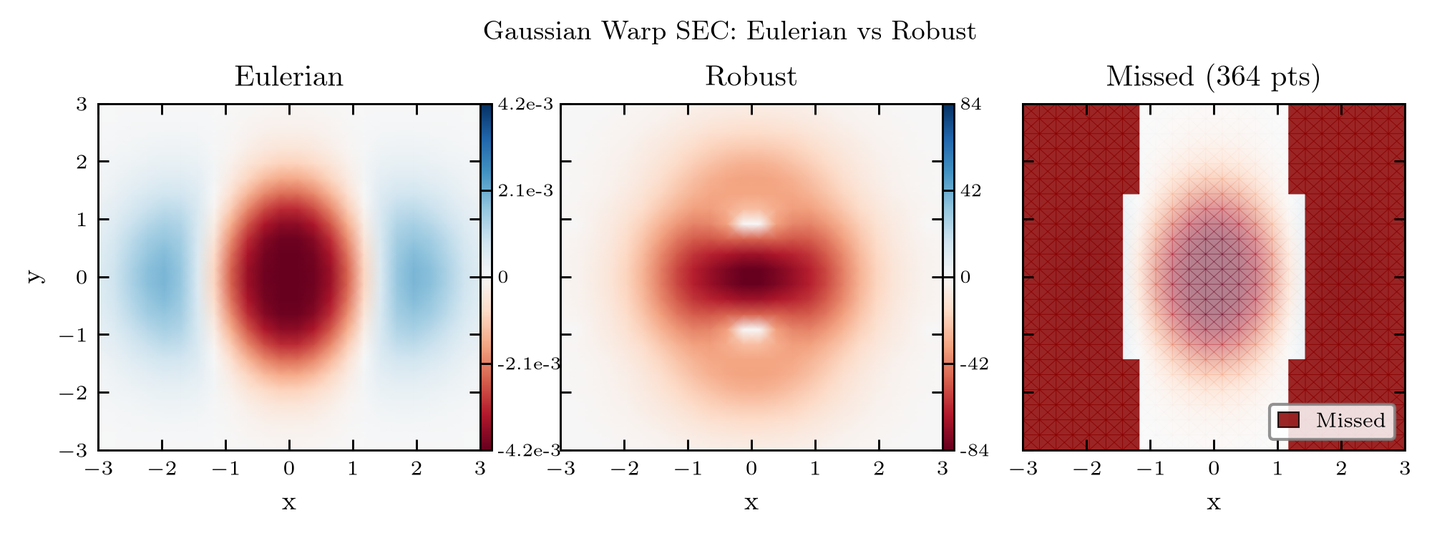
SEC comparison for a custom Gaussian warp bubble (vs = 0.5). Red marks violations the Eulerian frame misses.
See examples/07_custom_warp_metric.py.
Shell admissibility
warpax ships a five-criterion admissibility standard for warp shells:
| Criterion | Checks |
|---|---|
| A. Regularity | $C^2$ metric continuity (thick) or Israel conditions (thin) |
| B. Constraints | Hamiltonian + momentum residuals $\epsilon_{\mathcal{H}}$, $\epsilon_{\mathcal{M}}$ |
| C. Matter model | Identifiable source (anisotropic fluid, elastic shell) |
| D. EC margins | Frame-free NEC/WEC/DEC from Hawking-Ellis eigenvalue slacks (exact, cap-free at Type-I; valid at all $v_s$) |
| E. Global | Positive ADM mass, asymptotic falloff, tidal forces, invariant transport |
Fuchs constant-velocity shell: source-aware $\epsilon_{\mathcal{H}} \approx 3\times10^{-8}$; the bulk shell interior is Type-I and EC-compliant (0 of 13 probes violate), while the smoothing tail turns Type-IV. The source-first S-/ T-shells likewise pass criteria A-C and E with positive interior margins; the binding cost is a cap-free Type-I dominant-energy deficit at the inner shell edge ($\approx -4.4\times10^{-4}$), localized at the smooth source-vacuum transition, and the tilted T-shell's shift vorticity drives a Type-IV onset at its low-density edge. These shell results belong to the companion note; see The boundary cost of source consistency.
Examples
See examples/README.md for runtime estimates, install extras,
and a suggested order for new users.
| Script | Description |
|---|---|
01_minkowski_sanity.py |
Flat-space sanity check (all ECs satisfied) |
02_schwarzschild_verification.py |
Schwarzschild ground-truth validation |
03_alcubierre_analysis.py |
Alcubierre warp drive EC analysis (quickstart entry) |
04_warp_drive_comparison.py |
Multi-metric comparison (six warp drives) |
05_grid_analysis.py |
Grid-based EC verification + comparison figure |
06_geodesic_through_warp_bubble.py |
Geodesic integration with tidal forces |
07_custom_warp_metric.py |
Custom warp manifold + robust EC validation |
08_metric_design.py |
Shape-function metric design (B-spline reproduction) |
09_admissibility_diagnostics.py |
Admissibility diagnostics on the Fuchs warp shell |
10_phase_diagram.py |
Parameter-space sweep and EC-admissible transport phase diagram |
python examples/01_minkowski_sanity.py
python examples/10_phase_diagram.py          # 8x6 demo (~2 min)
python examples/10_phase_diagram.py --full   # 20x15 sweep (~30 min GPU)
Architecture
metrics -> geometry -> energy_conditions -> analysis
              |              |
          geodesics    classification (Hawking-Ellis)
              |
         transport / tidal / blueshift
| Package | Description |
|---|---|
geometry |
JAX autodiff pipeline: metric $\to$ Christoffel $\to$ Riemann $\to$ Ricci $\to$ Einstein $\to$ $T_{\mu\nu}$; ADM 3+1 split; $C^2$ regularity diagnostics |
energy_conditions |
NEC/WEC/SEC/DEC via Hawking-Ellis classification, eigenvalue algebra, multi-start BFGS observer optimization |
grids |
Non-uniform grid generators; wall-clustered sampling that resolves a bubble wall without a uniform refinement everywhere |
metrics |
Nine warp/shell metrics: Natário, Lentz, Rodal, Van den Broeck, WarpShell, Fuchs, S-shell, T-shell, Garattini-Zatrimaylov (Alcubierre, Minkowski, and Schwarzschild ship in benchmarks, making ten warp metrics total) |
constraints |
Hamiltonian + momentum constraint residuals; S-shell and T-shell constraint solvers (pure JAX) |
tov |
Anisotropic TOV equilibrium checker |
adm |
ADM mass with surface integral and asymptotic falloff verification |
junction |
Israel/Darmois junction conditions and surface stress-energy |
transport |
Invariant diagnostics: geodesic deviation, null coordinate-time asymmetry, blueshift hazard |
optimization |
Bernstein basis, multi-objective loss, EC soft/hard constraints, parameter sweep |
geodesics |
Timelike/null geodesic integration via Diffrax, tidal deviation, blueshift extraction |
design |
Differentiable shape-function parametrization with constrained BFGS optimizer |
analysis |
Eulerian vs. robust comparison, convergence tools (stability spreads + continuum polishing of wall extrema, analysis.extrema), kinematic scalars |
io |
External metric loaders: WarpFactory (.mat), EinFields (checkpoint), Cactus (HDF5) |
visualization |
Matplotlib publication figures, Manim animations, phase diagram plots |
classify |
Bobrick-Martire subluminal/superluminal taxonomy |
averaged |
ANEC/AWEC null-ray and geodesic line integrals |
quantum |
Ford-Roman quantum inequality evaluator |
bondi |
Bondi four-momentum, radiated flux, and Newman-Penrose peeling at null infinity |
benchmarks |
Reference spacetimes (Alcubierre, Minkowski, Schwarzschild). Distinct from the top-level benchmarks/ asv harness |
numerics |
Shared numerical utilities: constants, regularity floors, autodiff-safe helpers |
All metrics implement a common MetricFunction interface: a callable (4,) -> (4,4) mapping
coordinates $x^\mu$ to the covariant metric tensor $g_{\mu\nu}$.
Running tests
pytest                      # Whole suite, ~3 min (1090 tests, parallel by default)
pytest -m smoke             # Visualization import / render smoke tests
pytest tests/test_slemma.py # One module
One tier only: -n auto comes from pyproject.toml, and no test is excluded by
default.
Reproducing results
To pin the exact Python environment used to produce the published results:
export PYTHON=$(uv run which python)
bash reproduce_all.sh
Stages can be run individually:
bash reproduce_all.sh --stage core      # Core computation
bash reproduce_all.sh --stage ablation  # Ablation studies
bash reproduce_all.sh --stage figures   # Figure generation
Use --keep-cache to skip cache deletion and only recompute missing results.
Per-paper reproduction guides map every figure, table and quoted number to the script that produces it:
- Observer-robust energy condition paper - stage list, table- and figure-to-script maps, and the two consistency checks
- Warp-shell admissibility paper - per-figure, per-claim mapping to scripts and outputs
The outer-edge ($r \ge R_2$) Type-IV verification (log-log slope $1.01 \pm 0.01$) and
the ANEC impact-parameter scan are reproduced by
scripts/run_tshell_typeIV_onset.py and scripts/run_anec_impact_scan.py.
Documentation
warpax ships full documentation in docs/, organized following the Diataxis framework:
Tutorials
- Quickstart - 5-10 minutes from install to seeing an energy condition violation
- First curvature computation - full curvature chain on Minkowski as a warm-up
How-to guides
- Define a custom warp metric - subclass
ADMMetricand run the verification pipeline - Interpret EC results - read margin signs, Hawking-Ellis types, and worst-case observers
- Load an external metric - use WarpFactory, EinFields, or Cactus data
- Reproduce the observer-robust paper - stage list, table- and figure-to-script maps, and the two consistency checks
- Reproduce the warp-shell admissibility paper - per-figure, per-claim mapping to scripts and outputs
Reference
- API reference - autodoc of the public API
- Metric catalog - all ten shipped metrics
- Benchmarks - asv regression harness
Explanation
- Architecture - package structure and design decisions
- Theory: ADM 3+1 and Hawking-Ellis types - mathematical background
- Release notes - pre-1.0 history
Manim visualizations
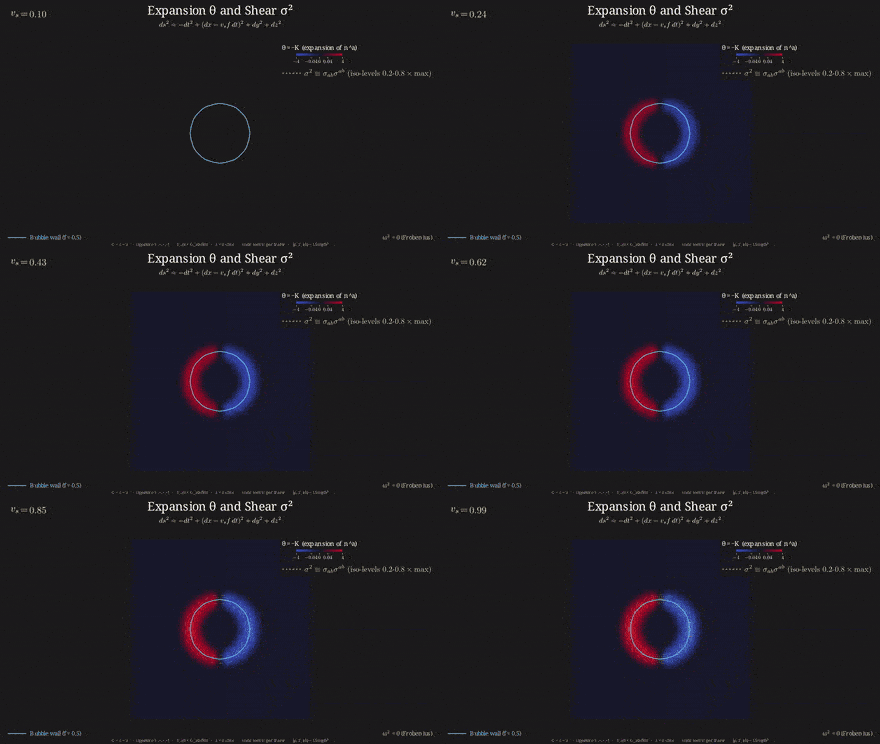
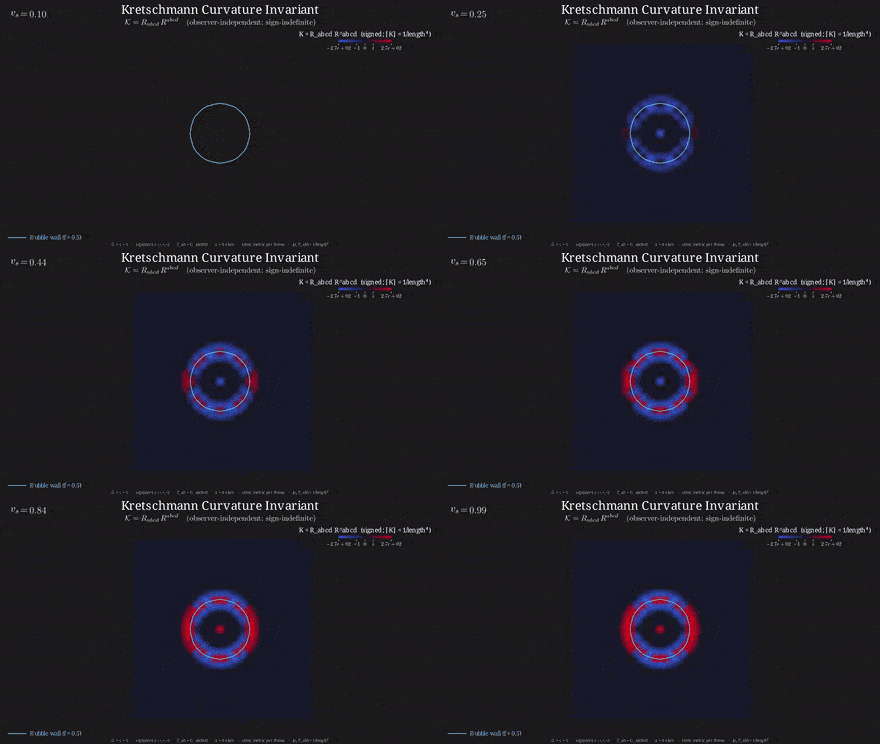
Every scene comes from the same curvature and energy-condition code as the papers. Geometric units on the z = 0 slice; each frame is a frozen metric, a parameter sweep rather than a time evolution.
 |
 |
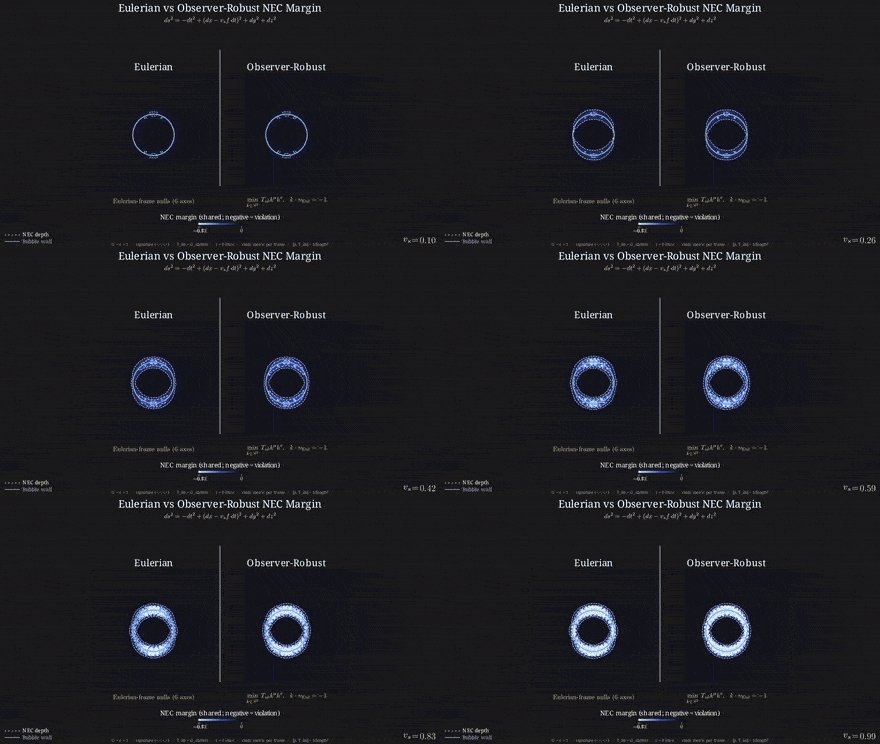 |
| Eulerian kinematics. Expansion θ = −K: space stretches behind the ship (red) and squeezes in front (blue). Shear σ² as iso-contours, with the f = 0.5 wall on top. | Kretschmann invariant. K = RabcdRabcd, the same for every observer. Sign-indefinite in Lorentzian signature, so it dips negative, and spikes on the wall. | Observer-robust NEC. Six axis-aligned Eulerian nulls on the left, the worst case over the whole null sphere on the right (k·nEul = −1). The gap is what observer-robust verification buys. |
The full set: WallAndVelocitySweep / VelocitySweep (dual-layer 3D, ρEul above a NEC-margin slab), BoostRapiditySweep (energy density vs rapidity ζ, deepening as cosh²ζ), EulerianKinematics2D, KretschmannInvariant2D, NECMargin2D / EulerianVsWorstCaseNEC, and WorstCaseNullDirections / WorstCaseBoostDirections.
# System dependencies (Ubuntu/Debian)
sudo apt install texlive-latex-extra texlive-fonts-recommended dvipng cm-super ffmpeg gifsicle

# Python dependencies (Python <= 3.13 recommended for the renderer)
pip install -e ".[manim]"

# Render all scenes (2D via Cairo, 3D via the GPU OpenGL renderer)
python scripts/render_all_scenes.py
Rendered videos and images are written to media/ (not tracked by git). The 3D
scenes render through manim's OpenGL renderer (EGL, headless).
Citation
If you found this work useful, please consider citing:
@article{le2026observer,
  title={Observer-robust energy condition verification for warp drive spacetimes},
  author={Le, An T},
  journal={arXiv preprint arXiv:2602.18023},
  year={2026}
}

@article{le2026boundary,
  title={On the boundary cost of source-consistent warp shells},
  author={Le, An T},
  journal={arXiv preprint arXiv:2605.25417},
  year={2026}
}
1 maintainer

Download files
Download the file for your platform. If you're not sure which to choose, learn more about installing packages.
Source Distribution
Built Distribution
Filter files by name, interpreter, ABI, and platform.
If you're not sure about the file name format, learn more about wheel file names.
Copy a direct link to the current filters
File details
Details for the file warpax-1.4.0.tar.gz.
File metadata
- Download URL: warpax-1.4.0.tar.gz
- Upload date:
- Size: 524.3 kB
- Tags: Source
- Uploaded using Trusted Publishing? Yes
- Uploaded via:
twine/7.0.0 CPython/3.13.14
File hashes
| Algorithm | Hash digest | |
|---|---|---|
| SHA256 |
df5d58a3cdf90b4b5eaf7e4c3de214a14991822195efa72c27614d892abb9f0b
|
|
| MD5 |
40a67d2df4f9eba52567f93ad70e8f44
|
|
| BLAKE2b-256 |
0ad92ef04810e9a3c30253f7da86969dc097d4d194709f451e336aa8d5fd89ac
|
Provenance
The following attestation bundles were made for warpax-1.4.0.tar.gz:
Publisher:
release.yml on anindex/warpax
-
Statement:
-
Statement type:
https://in-toto.io/Statement/v1 -
Predicate type:
https://docs.pypi.org/attestations/publish/v1 -
Subject name:
warpax-1.4.0.tar.gz -
Subject digest:
df5d58a3cdf90b4b5eaf7e4c3de214a14991822195efa72c27614d892abb9f0b - Sigstore transparency entry: 2670375966
- Sigstore integration time:
-
Permalink:
anindex/warpax@6a3f3d55ed380deaecf4f69a04cef90d56106aee -
Branch / Tag:
refs/tags/v1.4.0 - Owner: https://github.com/anindex
-
Access:
public
-
Token Issuer:
https://token.actions.githubusercontent.com -
Runner Environment:
github-hosted -
Publication workflow:
release.yml@6a3f3d55ed380deaecf4f69a04cef90d56106aee -
Trigger Event:
push
-
Statement type:
File details
Details for the file warpax-1.4.0-py3-none-any.whl.
File metadata
- Download URL: warpax-1.4.0-py3-none-any.whl
- Upload date:
- Size: 427.9 kB
- Tags: Python 3
- Uploaded using Trusted Publishing? Yes
- Uploaded via:
twine/7.0.0 CPython/3.13.14
File hashes
| Algorithm | Hash digest | |
|---|---|---|
| SHA256 |
b5b92b78af3dff92165cb56c5a73f100f4be7ff353bcc9a04e2594783d6d92fe
|
|
| MD5 |
fcdc660505fd48e91369d35a71689b1e
|
|
| BLAKE2b-256 |
2b7c55e43fc720ab463489fe744d761ab0b0dbc9c85964bd256d97a751036318
|
Provenance
The following attestation bundles were made for warpax-1.4.0-py3-none-any.whl:
Publisher:
release.yml on anindex/warpax
-
Statement:
-
Statement type:
https://in-toto.io/Statement/v1 -
Predicate type:
https://docs.pypi.org/attestations/publish/v1 -
Subject name:
warpax-1.4.0-py3-none-any.whl -
Subject digest:
b5b92b78af3dff92165cb56c5a73f100f4be7ff353bcc9a04e2594783d6d92fe - Sigstore transparency entry: 2670376042
- Sigstore integration time:
-
Permalink:
anindex/warpax@6a3f3d55ed380deaecf4f69a04cef90d56106aee -
Branch / Tag:
refs/tags/v1.4.0 - Owner: https://github.com/anindex
-
Access:
public
-
Token Issuer:
https://token.actions.githubusercontent.com -
Runner Environment:
github-hosted -
Publication workflow:
release.yml@6a3f3d55ed380deaecf4f69a04cef90d56106aee -
Trigger Event:
push
-
Statement type:













