
warrant-mini
A miniature AI marketing-compliance checker. Give it marketing copy — pasted
text, a .txt/.md file, or a URL — and it reviews the copy against a small
library of real marketing-compliance rules, returning risk-tiered findings
with a reasoning trace and a suggested fix for each.
Inspired by what Warrant does, built as a compact, readable reference implementation.
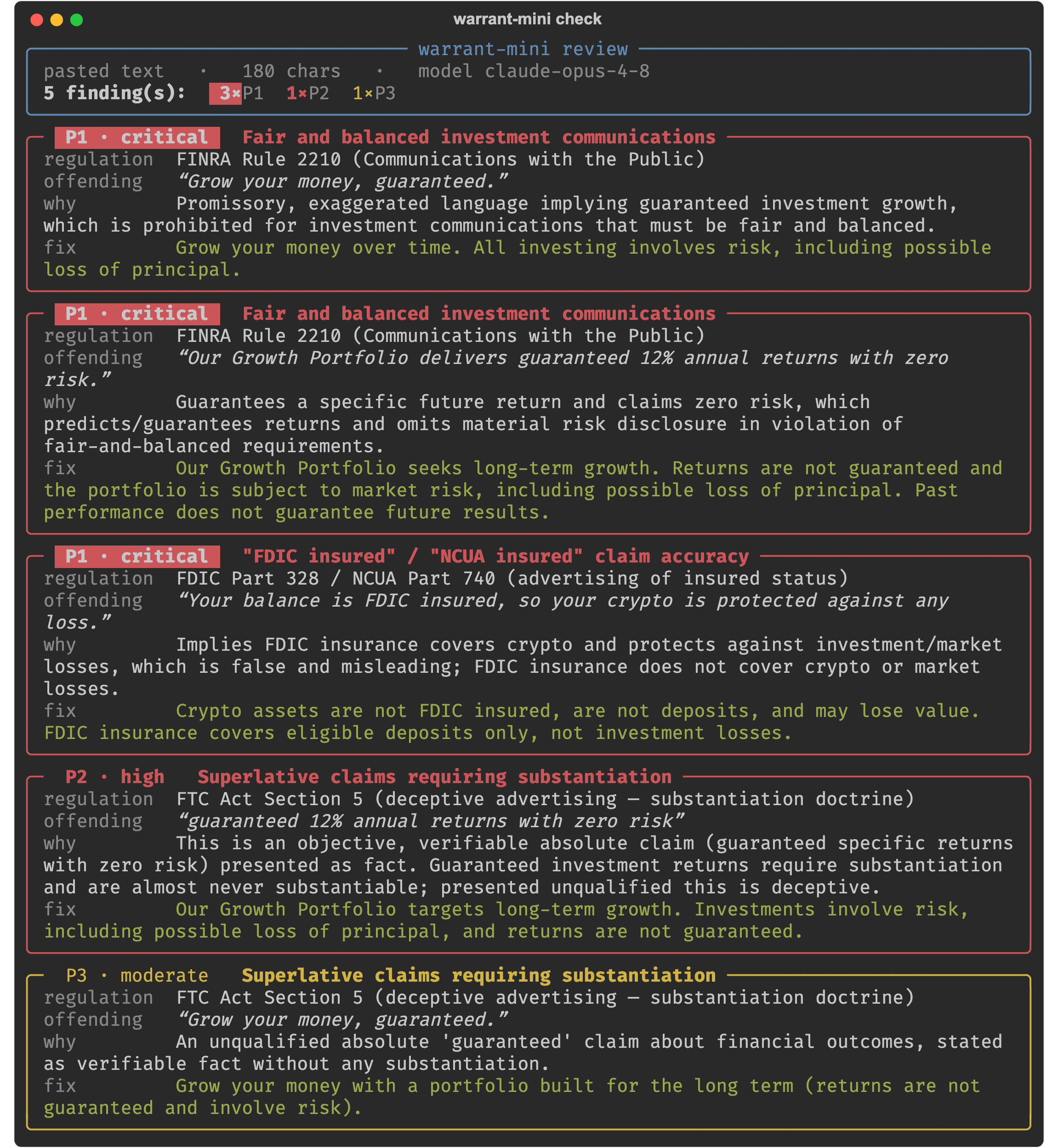
The CLI (warrant-mini check) on a snippet of planted violations:
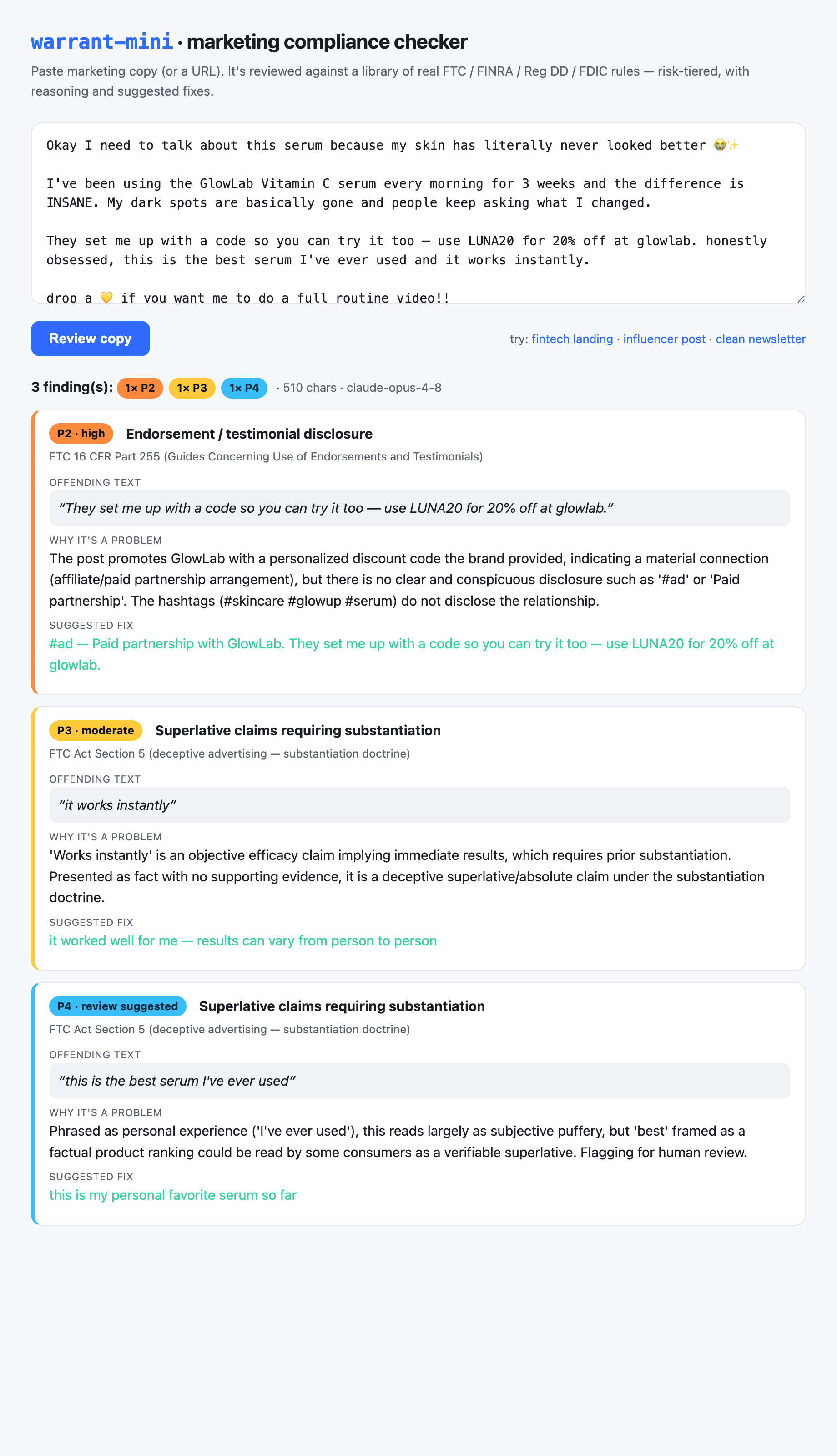
…and the same engine as a web app (warrant-mini serve):
60-second quickstart
# 1. install deps (uses uv)
uv sync

# 2. add your Anthropic API key
cp .env.example .env && $EDITOR .env       # or: export ANTHROPIC_API_KEY=sk-ant-...

# 3. review something
uv run warrant-mini check examples/fintech_landing.md      # planted violations
uv run warrant-mini check examples/clean_newsletter.md     # should stay quiet
uv run warrant-mini check examples/influencer_post.txt     # missing #ad disclosure

# other inputs
uv run warrant-mini check "Guaranteed 20% returns, FDIC insured!"   # literal text
uv run warrant-mini check https://example.com/landing-page          # a URL
uv run warrant-mini check examples/fintech_landing.md --json        # machine-readable

# see the rules it checks against
uv run warrant-mini rules

# or use the web UI
uv run warrant-mini serve            # → http://127.0.0.1:8000
Each finding carries a severity tier:
| Tier | Meaning |
|---|---|
| P1 | Critical — clear legal exposure (e.g. false "FDIC insured", guaranteed returns) |
| P2 | High — e.g. missing required disclosure, undisclosed material connection |
| P3 | Moderate — e.g. unsubstantiated superlative, buried disclaimer |
| P4 | Review suggested — low-confidence / judgment call, flagged for a human |
What it checks (the rule library)
Eight real rules, hardcoded in warrant_mini/rules.yaml
with citations, grouped for focused review passes:
| Group | Rules |
|---|---|
| financial | FINRA Rule 2210 (fair & balanced) · Reg DD / Truth in Savings (APY/APR accuracy) · FDIC/NCUA insured-claim accuracy |
| claims | FTC "free" + negative-option billing · superlative substantiation ("best"/"#1"/"guaranteed") · required-disclaimer proximity |
| disclosure | FTC 16 CFR Part 255 (endorsement / material-connection) · sweepstakes / contest disclosure |
Editing the rule set is a YAML change — no code.
Architecture
input_loader → checker (per-group LLM judge passes) → verify → rich CLI / JSON
     │              │                                     │
 text/file/URL   claude-opus-4-8, structured outputs   drop fabricated findings
input_loader.py— resolves pasted text, a file path, or a URL (fetched and stripped to visible text) into clean plain text.checker.py— runs one LLM judge pass per rule-group, concurrently. Each pass carries only its handful of related rules, which keeps prompts short, improves recall, and isolates a noisy rule from the rest.- Structured outputs — the judge is constrained to a Pydantic schema via
messages.parse(), so every finding is valid JSON — never scraped from prose. rules.yaml/rules.py— the rule library and its loader/validator.cli.py—warrant-mini check(rich, severity-colored report) and--json, pluswarrant-mini rules.
How it avoids hallucinated regulations
Structured output guarantees shape, not truth — so the checker verifies every
finding against reality before showing it (see checker.py):
- Rule grounding. A finding's
rule_idmust be one of the rules actually sent in that pass. A cited rule outside the group is dropped — the model cannot invent a regulation. - Quote grounding. A finding's
quotemust genuinely occur in the reviewed copy (exact, or whitespace-insensitive). Fabricated "offending text" is dropped, and the span shown is always real copy. - Honest severity. The judge is instructed to use P4 "review suggested" whenever it isn't confident a violation is real, rather than inflating an uncertain call into a higher tier.
A real run
warrant-mini check examples/influencer_post.txt (an influencer serum post with
no disclosure) produces:
╭──────────────── warrant-mini review ────────────────╮
│ file: examples/influencer_post.txt · 510 chars       │
│ 3 finding(s):   1×P2  1×P3  1×P4                      │
╰──────────────────────────────────────────────────────╯

 P2 · high   Endorsement / testimonial disclosure
 regulation  FTC 16 CFR Part 255
 offending   “They set me up with a code so you can try it too — use LUNA20…”
 why         Reveals a material connection with the brand (a discount code /
             partnership) with no clear "#ad" or "paid partnership" disclosure.
             Hashtags like #skincare do not satisfy the FTC requirement.
 fix         #ad / Paid partnership with GlowLab — they sent me this serum…

 P3 · moderate   Superlative claims requiring substantiation
 offending   “it works instantly”
 why         An objective, verifiable efficacy claim stated as fact with no
             substantiation.

 P4 · review suggested   Superlative claims requiring substantiation
 offending   “the best serum I've ever used”
 why         Framed as opinion, but combined with the efficacy claims a
             reasonable consumer might read it as an implied factual claim —
             flagged for a human to confirm.
And warrant-mini check examples/clean_newsletter.md returns No compliance
issues found — including correctly not flagging benign puffery like "we think
the new planner is genuinely nicer to use."
Web UI
warrant-mini serve launches a single-page FastAPI app (textarea + results
panel) that calls the exact same checker.review() as the CLI — see
warrant_mini/web.py.
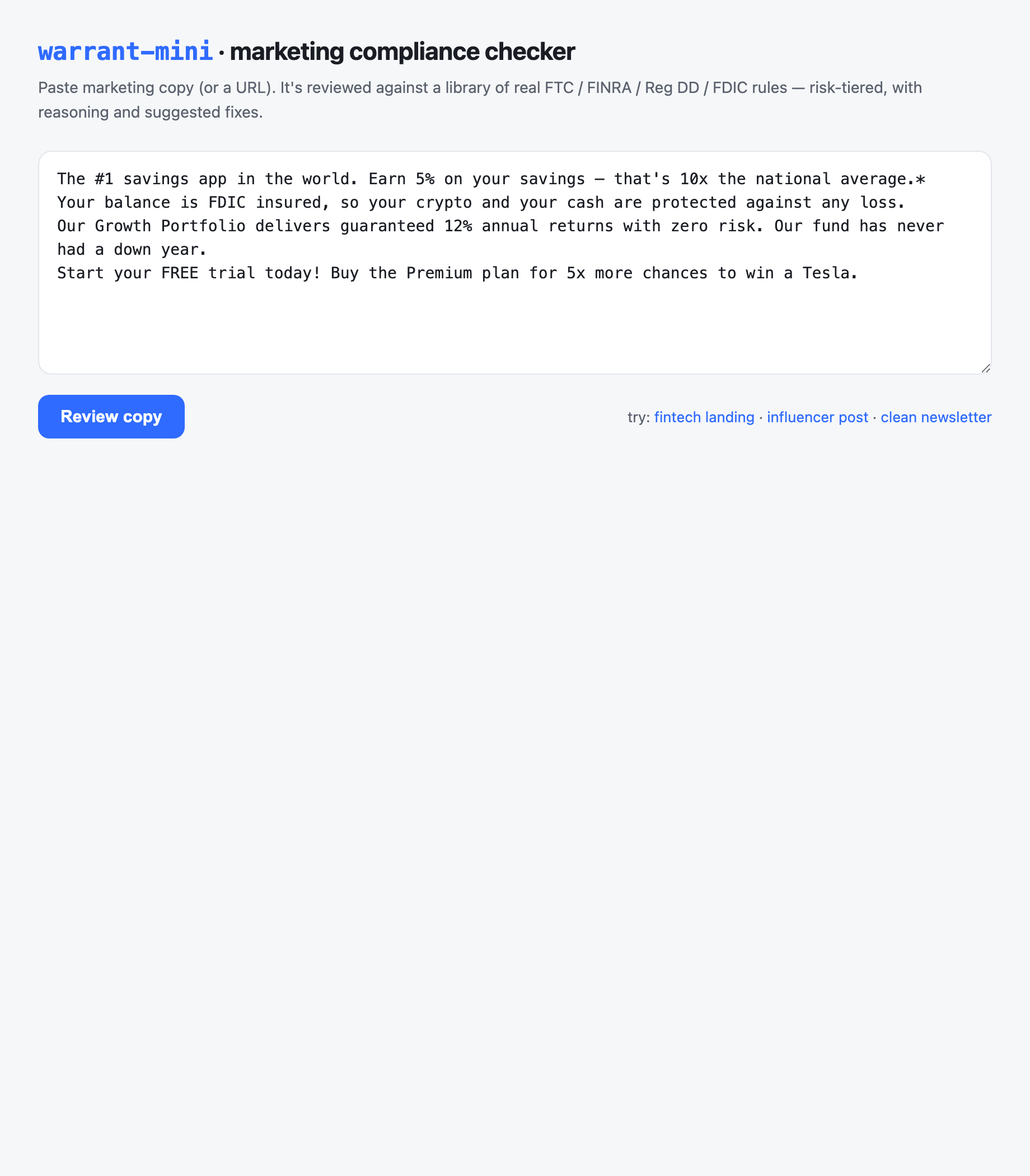
POST /api/review{ "text": "..." }→ the same findings JSON as--json.GET /?example=fintechprefills the textarea with an example.GET /?run=fintechruns the review server-side and returns a rendered results page (works even with JavaScript disabled) — handy for shareable links.
Light and dark themes follow the OS setting.
Networks that inspect TLS
If you're behind a corporate TLS-inspecting proxy (e.g. Zscaler), warrant-mini
verifies certificates against your operating system's trust store (via
truststore) instead of a bundled CA list — so it works behind such proxies with
no extra configuration. See warrant_mini/__init__.py.
Development
uv run pytest        # smoke tests — rule library, judge schema, quote verifier,
                     # input loader (no live API calls)
Swap the model in one place: DEFAULT_MODEL in warrant_mini/checker.py
(claude-opus-4-8 → claude-sonnet-5 for lower cost).
How this was built
An AI-native build: specified once, then implemented end-to-end with Claude Code driving the code, tests, and this README.
- Time: ~2 hours, single session (CLI + web UI + docs).
- Model used to build: Claude Code (Opus).
- Model the app judges with:
claude-opus-4-8(adaptive thinking on). - Workflow:
- Plan-first. Wrote
PLAN.md, locked the design decisions (per-rule-group passes, structured outputs, the anti-hallucination contract), and got sign-off before writing code. - Then executed the plan top to bottom — models → rule library → checker → CLI → examples → tests → README — validating each layer as it landed.
- The key design decision is the verification layer: structured outputs
guarantee valid shape, so the checker separately verifies each finding is
true — dropping any whose
rule_idis out of scope or whosequoteisn't actually in the copy. This is what keeps the tool from inventing regulations. - Live-tested against all three examples, confirming the fintech page lit up
with P1s, the influencer post flagged the missing
#ad, and the clean newsletter stayed quiet (without false-flagging benign puffery). - One real snag: the dev machine sits behind a TLS-inspecting proxy that
breaks Python's default certificate verification. Diagnosed it and fixed it
properly (verify against the OS trust store via
truststore) rather than disabling TLS. - Stretch goal landed: the single-page FastAPI UI, including
server-rendered
?run=deep-links.
- Plan-first. Wrote
- What I'd add with more time: per-rule confidence scores; PDF and URL-batch input; a shareable permalink for each review.
License
MIT © 2026 Vinay Vobbilichetty
This is a demo / portfolio piece, not legal advice. The rule library is a small, illustrative subset of real marketing-compliance obligations.
1 maintainer

Download files
Download the file for your platform. If you're not sure which to choose, learn more about installing packages.
Source Distribution
Built Distribution
Filter files by name, interpreter, ABI, and platform.
If you're not sure about the file name format, learn more about wheel file names.
Copy a direct link to the current filters
File details
Details for the file warrant_mini-0.1.1.tar.gz.
File metadata
- Download URL: warrant_mini-0.1.1.tar.gz
- Upload date:
- Size: 23.8 kB
- Tags: Source
- Uploaded using Trusted Publishing? Yes
- Uploaded via:
twine/7.0.0 CPython/3.13.14
File hashes
| Algorithm | Hash digest | |
|---|---|---|
| SHA256 |
f9d4aa86eb5101b9e735dd9f597e5ff09479100e8b3a50e721e26027b5cf13a4
|
|
| MD5 |
ef932229475264665890ce42ff4327bb
|
|
| BLAKE2b-256 |
0ea2bf4e374fbd2e4bc83a0ff0d58d10cfa4a0f21017c69eab91cfb66de378b8
|
Provenance
The following attestation bundles were made for warrant_mini-0.1.1.tar.gz:
Publisher:
release.yml on vinayvobbili/warrant-mini
-
Statement:
-
Statement type:
https://in-toto.io/Statement/v1 -
Predicate type:
https://docs.pypi.org/attestations/publish/v1 -
Subject name:
warrant_mini-0.1.1.tar.gz -
Subject digest:
f9d4aa86eb5101b9e735dd9f597e5ff09479100e8b3a50e721e26027b5cf13a4 - Sigstore transparency entry: 2459584805
- Sigstore integration time:
-
Permalink:
vinayvobbili/warrant-mini@f9f90c846c536a78020b17bcdfc58ad728776a9b -
Branch / Tag:
refs/tags/v0.1.1 - Owner: https://github.com/vinayvobbili
-
Access:
public
-
Token Issuer:
https://token.actions.githubusercontent.com -
Runner Environment:
github-hosted -
Publication workflow:
release.yml@f9f90c846c536a78020b17bcdfc58ad728776a9b -
Trigger Event:
push
-
Statement type:
File details
Details for the file warrant_mini-0.1.1-py3-none-any.whl.
File metadata
- Download URL: warrant_mini-0.1.1-py3-none-any.whl
- Upload date:
- Size: 25.6 kB
- Tags: Python 3
- Uploaded using Trusted Publishing? Yes
- Uploaded via:
twine/7.0.0 CPython/3.13.14
File hashes
| Algorithm | Hash digest | |
|---|---|---|
| SHA256 |
137c838dd4a0e9450b30e67d1e9af0249353ebfbcfe25b926566758d9020ae43
|
|
| MD5 |
6ae948a24d3dfde1d45f311bd248a611
|
|
| BLAKE2b-256 |
a49f17a48742b40fc4403404361fcc0bdcfb924f72407599870ebd625b282c05
|
Provenance
The following attestation bundles were made for warrant_mini-0.1.1-py3-none-any.whl:
Publisher:
release.yml on vinayvobbili/warrant-mini
-
Statement:
-
Statement type:
https://in-toto.io/Statement/v1 -
Predicate type:
https://docs.pypi.org/attestations/publish/v1 -
Subject name:
warrant_mini-0.1.1-py3-none-any.whl -
Subject digest:
137c838dd4a0e9450b30e67d1e9af0249353ebfbcfe25b926566758d9020ae43 - Sigstore transparency entry: 2459584943
- Sigstore integration time:
-
Permalink:
vinayvobbili/warrant-mini@f9f90c846c536a78020b17bcdfc58ad728776a9b -
Branch / Tag:
refs/tags/v0.1.1 - Owner: https://github.com/vinayvobbili
-
Access:
public
-
Token Issuer:
https://token.actions.githubusercontent.com -
Runner Environment:
github-hosted -
Publication workflow:
release.yml@f9f90c846c536a78020b17bcdfc58ad728776a9b -
Trigger Event:
push
-
Statement type:














