
Hypersonic Waverider Generator

Project description
1. Introduction
Waverider Generator is a python package which can be used to generate hypersonic waveriders based on an efficient parametrisation described in [1].
The method makes use of the oscultating cone inverse design method and four design parameters X1, X2, X3 and X4.
Please consult the paper referenced for any further clarification on the geometrical meaning of these inputs.
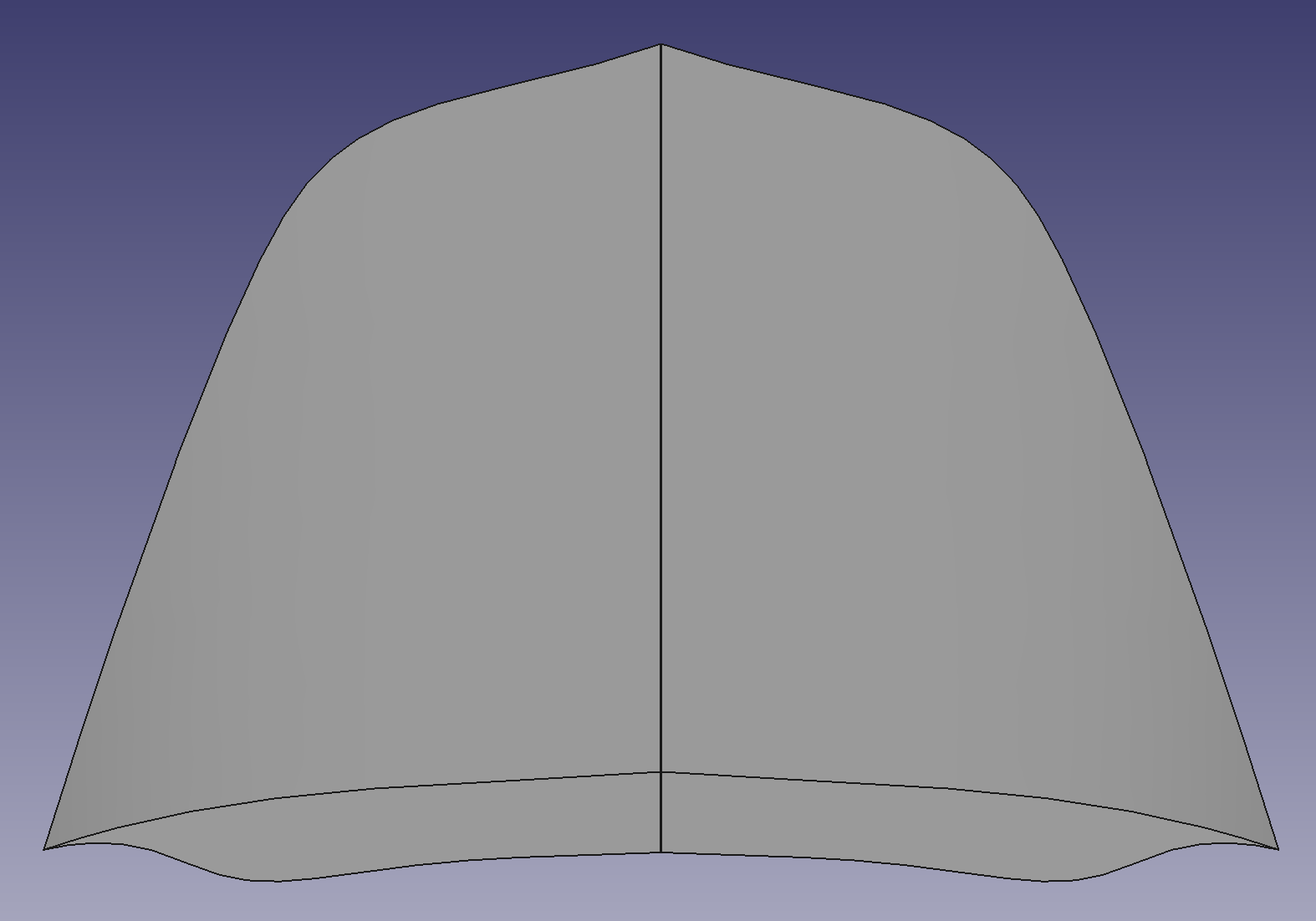
Example of Waverider CAD Export
1.1 Coordinate System
The coordinate system is defined such that:
- x is the streamwise direction
- y is the transverse direction
- z is the spanwise direction
with the origin at the tip of the waverider.
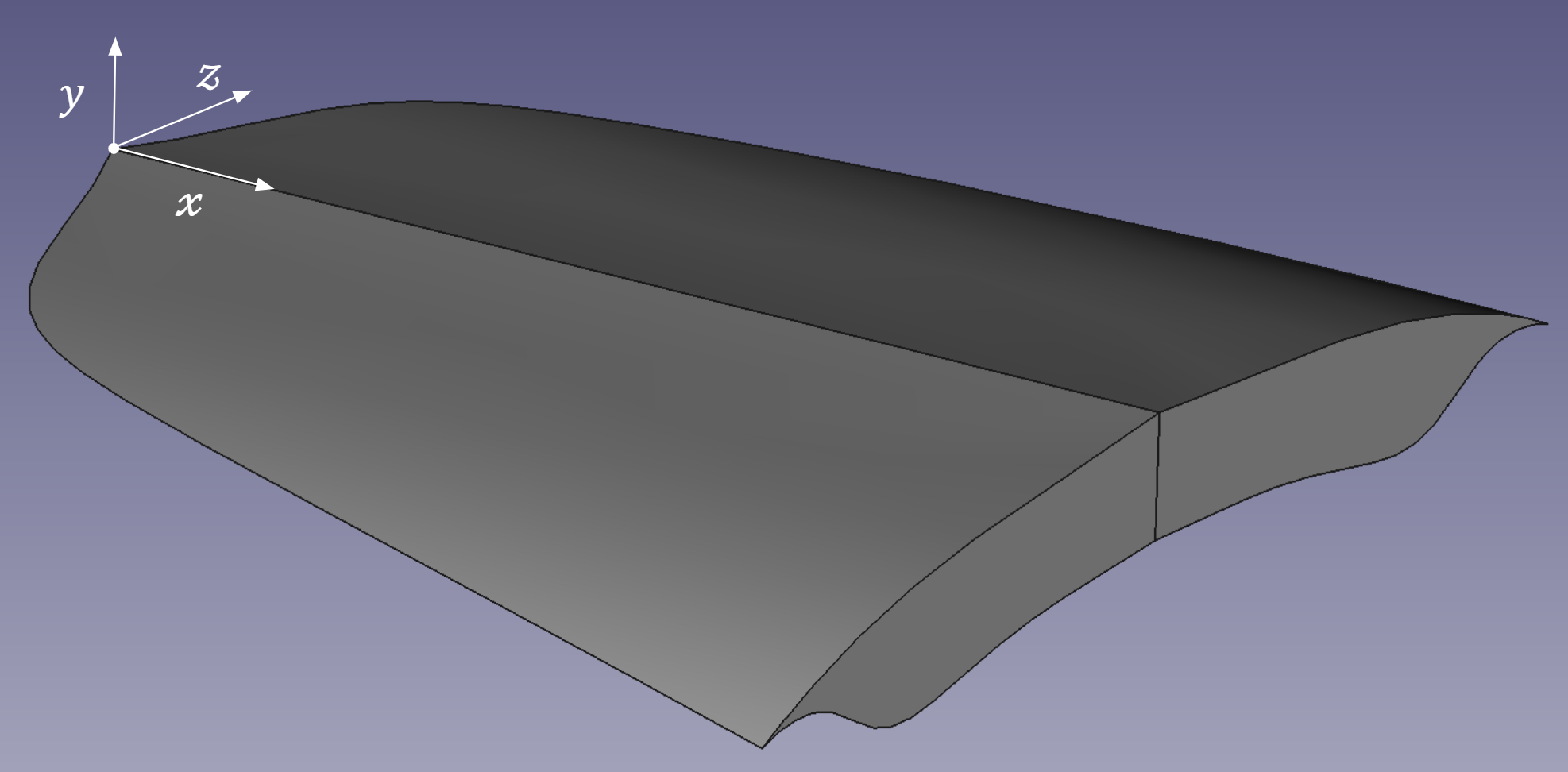
Coordinate System
1.2 Terminology
The terminology for the various curves and parameters referenced in this module can be found in more detail in [2]. The image below summarises the main terms :
![Waverider Terminology (taken from [2])](https://pypi-camo.freetls.fastly.net/17ce06aa9b11de2b4afea2f01961b394c20fb250/68747470733a2f2f6769746875622e636f6d2f6a616465353633382f7761766572696465725f67656e657261746f722f626c6f622f6d61696e2f696d616765732f7761766572696465725f636f6e76656e74696f6e2e7376673f7261773d74727565)
Waverider Terminology (taken from [2])
Where :
- $h$ is the height of the waverider at the symmetry plane
- $w$ is the half-width of the waverider
- $\beta$ is the shock angle
1.3 Flow Field
1.3.1 Oblique Shock
In the flat region of the shockwave, the lower surface is determined via the $\theta$- $\beta$ - $M_{\infty}$ equation, which relates the deflection angle $\theta$ to the shock angle $\beta$ in an oblique shock.
$$ \tan(\theta) = \frac{2 \cot\left(\beta\right) \left(M_{\infty}^2 \sin^2\left(\beta \right) - 1\right)}{M_{\infty}^2 (\gamma + \cos\left(2 \beta\right)) + 2} $$
Where $\gamma=1.4$ is the ratio of specific heats for air and $M_{\infty}$ is the freestream Mach number.
1.3.2 Osculating Cone Theory
In the curved region of the shockwave, the osculating cone theory is used whereby conical flow is locally applied at each osculating plane. The Taylor-Maccoll ODE, which describes conical flow, is solved and the resulting streamlines are propagated until the back of the waverider is reached to produce the lower surface. See [3] for more information on the Osculating Cone Theory.
2. Example Script
An example script is provided here. It goes through the following steps :
-
Import required modules
import matplotlib.pyplot as plt
from matplotlib.gridspec import GridSpec
from waverider_generator import *
-
Define the waverider's geometric parameters using the GeometricParameters dataclass
geo_params = GeometricParameters(X1 = 0.2,
                                 X2 = 0.6,
                                 X3 = 0.2,
                                 X4 = 0.1,
                                 w = 4.2,
                                 h = 1.876)
Where :
X1,X2,X3andX4have the meaning specified in [1]wis the half-width of the waveriderhis the height of the waverider at the symmetry plane
-
Define the waverider's flow parameters using the FlowParameters dataclass
flow_params = FlowParameters(M_design = 5.561,
                             betaDeg = 15,
                             gamma = 1.4)
Where :
M_designis the Design Mach Number (see [2])betaDegis the Shock Angle in degreesgammais the ratio of specific heats (1.4 for air)
-
Instantiate the waverider
waverider = Waverider(geo_params=geo_params, flow_params=flow_params)
-
Build the waverider
streams, curves = waverider.Build(n_planes=50, n_streamline_pts=20, dx_LS_streamline=0.05)
The user is advised to look at the description of the
Buildmethod to understand its I/O structure -
Create and export a CAD Model of the waverider using
streamsand theto_CADmethodsolid = waverider.to_CAD(streams=streams, sides = 'both', export_filename='waverider_example.step')
This will export the model as waverider_example.step in the user's working directory.
The user is advised to look at the description of the
to_CADmethod to understand its I/O structure -
Plot waverider from different angles
See script for this step. The following figure is then produced :
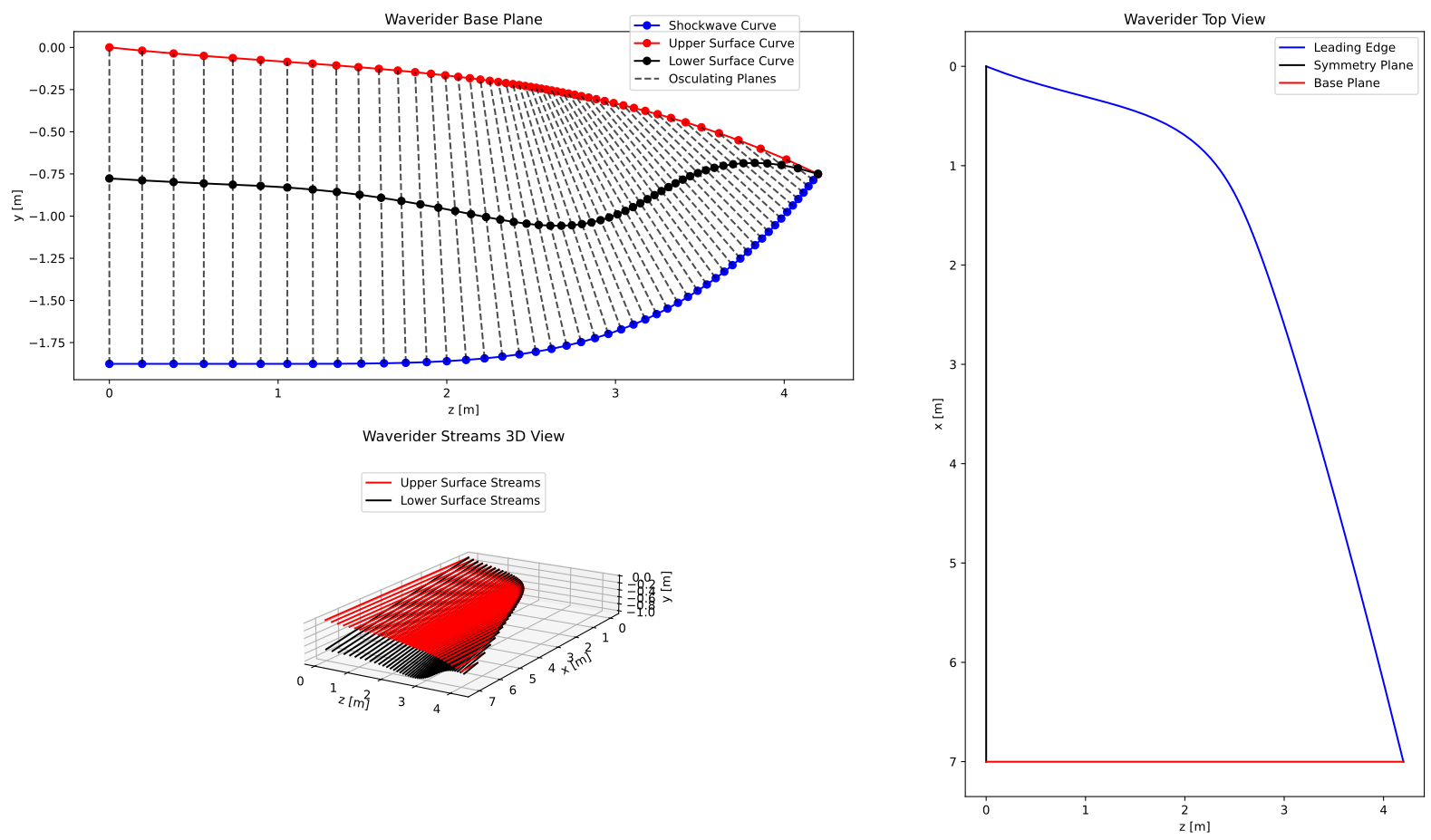
Waverider Example Plots
3. License
MIT License
Copyright (c) 2024 jade5638
Permission is hereby granted, free of charge, to any person obtaining a copy of this software and associated documentation files (the "Software"), to deal in the Software without restriction, including without limitation the rights to use, copy, modify, merge, publish, distribute, sublicense, and/or sell copies of the Software, and to permit persons to whom the Software is furnished to do so, subject to the following conditions:
The above copyright notice and this permission notice shall be included in all copies or substantial portions of the Software.
THE SOFTWARE IS PROVIDED "AS IS", WITHOUT WARRANTY OF ANY KIND, EXPRESS OR IMPLIED, INCLUDING BUT NOT LIMITED TO THE WARRANTIES OF MERCHANTABILITY, FITNESS FOR A PARTICULAR PURPOSE AND NONINFRINGEMENT. IN NO EVENT SHALL THE AUTHORS OR COPYRIGHT HOLDERS BE LIABLE FOR ANY CLAIM, DAMAGES OR OTHER LIABILITY, WHETHER IN AN ACTION OF CONTRACT, TORT OR OTHERWISE, ARISING FROM, OUT OF OR IN CONNECTION WITH THE SOFTWARE OR THE USE OR OTHER DEALINGS IN THE SOFTWARE.
4. Citing
Please use the reference.bib file included to reference this work.
5. References
[1] Jiwon Son, Chankyu Son, and Kwanjung Yee. 'A Novel Direct Optimization Framework for Hypersonic Waverider Inverse Design Methods'. In: Aerospace 9.7 (June 2022), p. 348. issn: 2226-4310. doi: 10.3390/aerospace9070348.
[2] Jade Nassif. 'Multi-objective Multi-point Aerodynamic Optimisation of a Hypersonic Waverider'. Cranfield University, 2024. Available: https://github.com/jade5638/jade_nassif_thesis/blob/main/s422385_Thesis.pdf
[3] Helmut Sobieczky, F Dougherty, and Kevin Jones. “Hypersonic Waverider Design from Given Shock Waves”. In: May 1990
Release history Release notifications | RSS feed


Download files
Download the file for your platform. If you're not sure which to choose, learn more about installing packages.
Source Distribution
Built Distribution
Filter files by name, interpreter, ABI, and platform.
If you're not sure about the file name format, learn more about wheel file names.
Copy a direct link to the current filters
File details
Details for the file waverider_generator-3.0.1.tar.gz.
File metadata
- Download URL: waverider_generator-3.0.1.tar.gz
- Upload date:
- Size: 16.7 kB
- Tags: Source
- Uploaded using Trusted Publishing? No
- Uploaded via: twine/6.2.0 CPython/3.14.0
File hashes
| Algorithm | Hash digest | |
|---|---|---|
| SHA256 |
430060a284bd9b1704eb852c4c5188ec9bafaa8220cc758a6083739b894b15db
|
|
| MD5 |
ce3180daf16f68bb324fc86dc3baeb5a
|
|
| BLAKE2b-256 |
e572732edb5eb172dd447807caeed3649b7ad2fd87c2adba3029410ad5ffc116
|
File details
Details for the file waverider_generator-3.0.1-py3-none-any.whl.
File metadata
- Download URL: waverider_generator-3.0.1-py3-none-any.whl
- Upload date:
- Size: 16.1 kB
- Tags: Python 3
- Uploaded using Trusted Publishing? No
- Uploaded via: twine/6.2.0 CPython/3.14.0
File hashes
| Algorithm | Hash digest | |
|---|---|---|
| SHA256 |
059282c50039687de4f660663bab69a7bf0c9eb26d4d0c08667f7ab706bef62d
|
|
| MD5 |
c64340ccc2c485ffc17fe6a52ffaa3b0
|
|
| BLAKE2b-256 |
5d9fb96d60c4af5e68149d13f52e181f357b460cce53259f8c1fe9fd4a5285ea
|






