
Waygate gives you runtime control of your APIs to toggle features, schedule maintenance, enforce rate limits, and perform rollouts without redeploying.
Verified details
These details have been verified by PyPIProject links
GitHub Statistics
Maintainers

Project description

Waygate gives you runtime control of your APIs to toggle features, schedule maintenance, enforce rate limits, and perform rollouts without redeploying.



[!WARNING] Early Access:
waygateis fully functional and ready to use. We're actively building on it and real-world feedback is invaluable. If you have feedback, feature ideas, or suggestions, open an issue.
Key features
Core (waygate.core)
These features are framework-agnostic and available to any adapter.
| Feature | Description |
|---|---|
| 🚩 Feature flags | Boolean, string, integer, float, and JSON flags with targeting rules, user segments, percentage rollouts, prerequisites, and a live evaluation stream. Built on the OpenFeature standard |
| 🚦 Rate limiting | Per-IP, per-user, per-API-key, or global counters with tiered limits, burst allowance, and runtime mutation |
| ⏰ Scheduled windows | asyncio-native scheduler, maintenance windows activate and deactivate automatically |
| 🔔 Webhooks | Fire HTTP POST on every state change. Built-in Slack formatter and custom formatters supported |
| 📋 Audit log | Every state change is recorded: who, when, what route, old status → new status |
| 🖥️ Admin dashboard | HTMX-powered UI with live SSE updates, no JS framework required |
| 🖱️ REST API + CLI | Full programmatic control from the terminal or CI pipelines, works over HTTPS remotely |
| 🏗️ Waygate Server | Centralised control plane for multi-service architectures. SDK clients sync state via SSE with zero per-request latency |
| 🌐 Multi-service CLI | WAYGATE_SERVICE env var scopes every command; waygate services lists connected services |
| ⚡ Zero-restart control | State changes take effect immediately, no redeployment or server restart needed |
| 🔄 Sync & async | Full support for both async def and plain def route handlers. Use await engine.* or engine.sync.* |
| 🛡️ Fail-open by default | If the backend is unreachable, requests pass through. Waygate never takes down your API |
| 🔌 Pluggable backends | In-memory (default), file-based JSON, or Redis for multi-instance deployments |
Framework adapters
FastAPI (waygate.fastapi) ✅ supported
| Feature | Description |
|---|---|
| 🎨 Decorator-first DX | @maintenance, @disabled, @env_only, @force_active, @deprecated, @rate_limit. State lives next to the route |
| 📄 OpenAPI integration | Disabled / env-gated routes hidden from /docs; deprecated routes flagged; live maintenance banners in the Swagger UI |
| 🧩 Dependency injection | All decorators work as Depends(), enforcing route state per-handler without middleware |
| 🎨 Custom responses | Return HTML, redirects, or any response shape for blocked routes. Set per-route or as an app-wide default on the middleware |
| 🔀 WaygateRouter | Drop-in APIRouter replacement that auto-registers route metadata with the engine at startup |
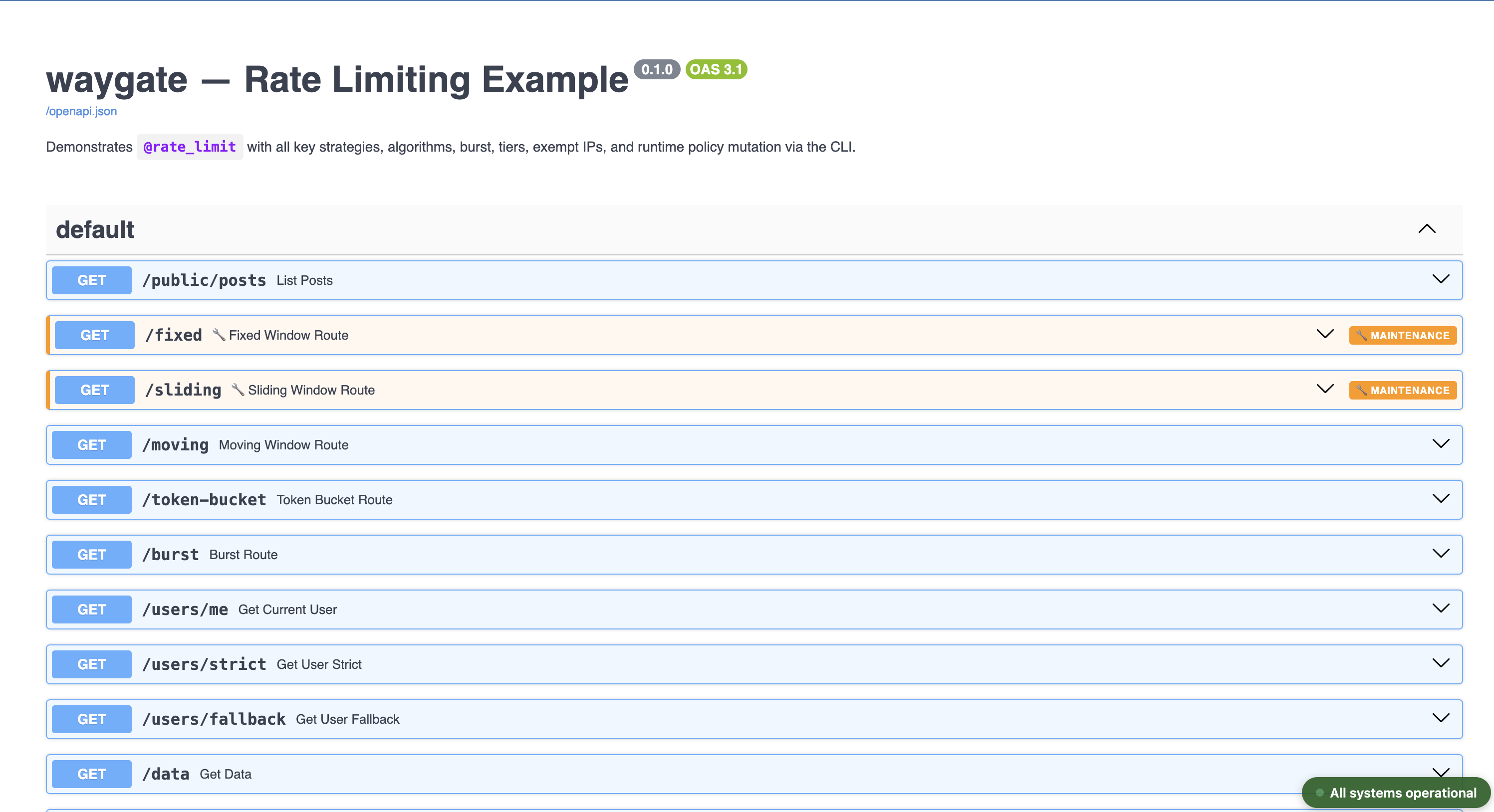
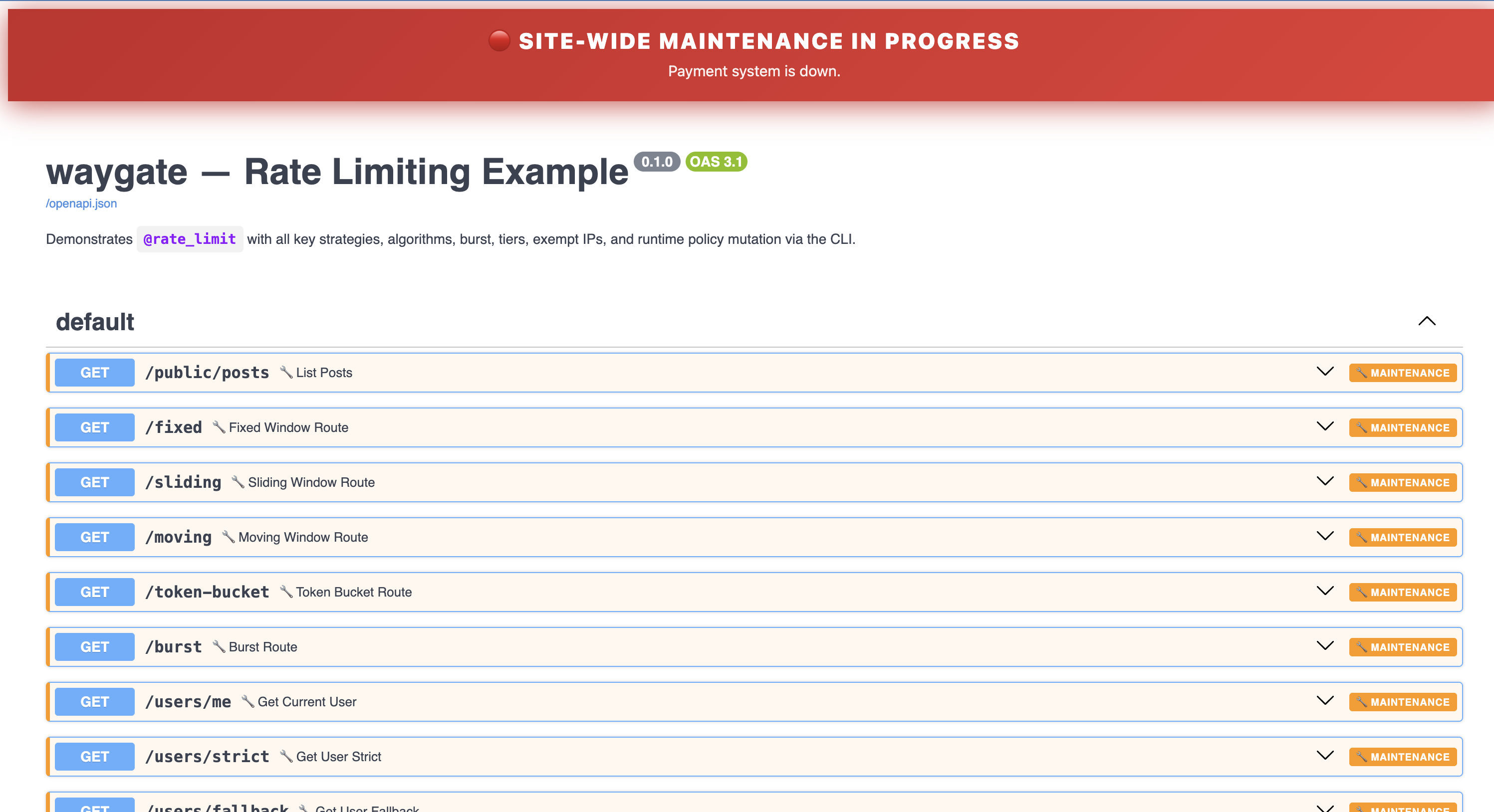
Disabled and env-gated routes hidden from /docs. Maintenance banners injected live.
Install
uv add "waygate[all]"
# or: pip install "waygate[all]"
Quickstart
We currently support FastAPI. More framework adapters are on the way.
from fastapi import FastAPI
from waygate import make_engine
from waygate.fastapi import (
    WaygateMiddleware, WaygateAdmin, apply_waygate_to_openapi,
    maintenance, env_only, disabled, force_active, deprecated,
)

engine = make_engine()

app = FastAPI()
app.add_middleware(WaygateMiddleware, engine=engine)

@app.get("/payments")
@maintenance(reason="DB migration — back at 04:00 UTC")
async def get_payments():
    return {"payments": []}

@app.get("/health")
@force_active
async def health():
    return {"status": "ok"}

apply_waygate_to_openapi(app, engine)
app.mount("/waygate", WaygateAdmin(engine=engine, auth=("admin", "secret")))
GET /payments  → 503  {"error": {"code": "MAINTENANCE_MODE", ...}}
GET /health    → 200  always
Manage routes from the CLI with no code changes or restarts:
waygate config set-url http://localhost:8000/waygate
waygate login admin
waygate status
waygate enable GET:/payments
waygate global enable --reason "Deploying v2" --exempt /health
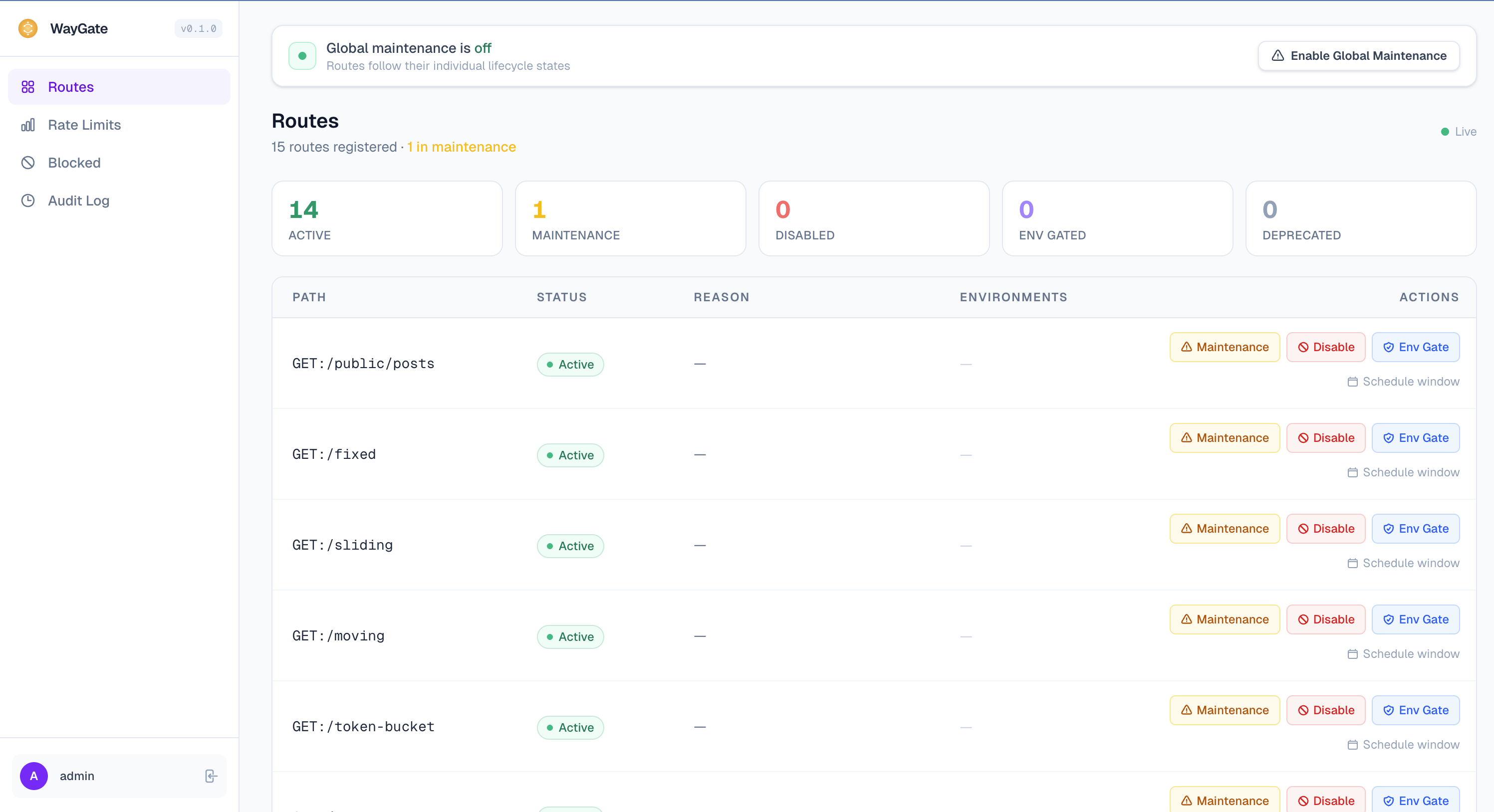
Admin dashboard — route states, audit log, rate limits, and feature flags. No JS framework required.
Decorators
| Decorator | Effect | Status |
|---|---|---|
@maintenance(reason, start, end) |
Temporarily unavailable | 503 |
@disabled(reason) |
Permanently off | 503 |
@env_only("dev", "staging") |
Restricted to named environments | 404 elsewhere |
@deprecated(sunset, use_instead) |
Still works, injects deprecation headers | 200 |
@force_active |
Bypasses all waygate checks | Always 200 |
@rate_limit("100/minute") |
Cap requests per IP, user, API key, or globally | 429 |
Custom responses (FastAPI)
By default, blocked routes return a structured JSON error body. You can replace it with HTML, a redirect, plain text, or custom JSON in two ways:
Per-route: pass response= directly on the decorator:
from starlette.requests import Request
from starlette.responses import HTMLResponse, RedirectResponse
from waygate.fastapi import maintenance, disabled

def maintenance_page(request: Request, exc: Exception) -> HTMLResponse:
    return HTMLResponse(
        f"<h1>Down for maintenance</h1><p>{exc.reason}</p>", status_code=503
    )

@router.get("/payments")
@maintenance(reason="DB migration", response=maintenance_page)
async def payments():
    return {"payments": []}

@router.get("/orders")
@maintenance(reason="Upgrade in progress", response=lambda *_: RedirectResponse("/status"))
async def orders():
    return {"orders": []}
Global default: set once on WaygateMiddleware, applies to every route without a per-route factory:
app.add_middleware(
    WaygateMiddleware,
    engine=engine,
    responses={
        "maintenance": maintenance_page,   # all maintenance routes
        "disabled": lambda req, exc: HTMLResponse(
            f"<h1>Gone</h1><p>{exc.reason}</p>", status_code=503
        ),
    },
)
Resolution order: per-route response= → global responses[...] → built-in JSON. The factory can be sync or async and receives the live Request and the WaygateException that triggered the block.
Rate limiting
from waygate.fastapi import rate_limit

@router.get("/public/posts")
@rate_limit("10/minute")               # 10 req/min per IP
async def list_posts():
    return {"posts": [...]}

@router.get("/users/me")
@rate_limit("100/minute", key="user")  # per authenticated user
async def get_current_user():
    ...

@router.get("/reports")
@rate_limit(                           # tiered limits
    {"free": "10/minute", "pro": "100/minute", "enterprise": "unlimited"},
    key="user",
)
async def get_reports():
    ...
Policies can be mutated at runtime without redeploying (waygate rl and waygate rate-limits are aliases):
waygate rl set GET:/public/posts 20/minute   # raise the limit live
waygate rl reset GET:/public/posts           # clear counters
waygate rl hits                              # blocked requests log
Requires waygate[rate-limit]. Powered by limits.
Feature flags
waygate ships a full feature flag system built on the OpenFeature standard. All five flag types, multi-condition targeting rules, user segments, percentage rollouts, and a live evaluation stream. Managed from the dashboard or CLI with no code changes.
from waygate import (
    FeatureFlag, FlagType, FlagVariation, RolloutVariation,
    TargetingRule, RuleClause, Operator, EvaluationContext,
)

engine.use_openfeature()

# Define a boolean flag with a 20% rollout and individual targeting
await engine.save_flag(
    FeatureFlag(
        key="new-checkout",
        name="New Checkout Flow",
        type=FlagType.BOOLEAN,
        variations=[
            FlagVariation(name="on",  value=True),
            FlagVariation(name="off", value=False),
        ],
        off_variation="off",
        fallthrough=[
            RolloutVariation(variation="on",  weight=20_000),  # 20%
            RolloutVariation(variation="off", weight=80_000),  # 80%
        ],
        targets={"on": ["beta_tester_1"]},   # individual targeting
        rules=[
            TargetingRule(
                description="Enterprise users always get the new flow",
                clauses=[RuleClause(attribute="plan", operator=Operator.IS, values=["enterprise"])],
                variation="on",
            )
        ],
    )
)

# Evaluate in an async route handler
ctx = EvaluationContext(key=user_id, attributes={"plan": user.plan})
enabled = await engine.flag_client.get_boolean_value("new-checkout", False, ctx)

# Evaluate in a sync def handler (thread-safe)
enabled = engine.sync.flag_client.get_boolean_value("new-checkout", False, {"targeting_key": user_id})
Manage flags and segments from the CLI:
waygate flags list
waygate flags eval new-checkout --user user_123
waygate flags disable new-checkout          # kill-switch
waygate flags enable new-checkout
waygate flags stream                        # live evaluation events

waygate segments create beta_users --name "Beta Users"
waygate segments include beta_users --context-key user_123,user_456
waygate segments add-rule beta_users --attribute plan --operator in --values pro,enterprise
Requires waygate[flags].
Framework support
waygate's core is completely framework-agnostic with zero framework imports. Adapters plug into the engine and expose framework-native patterns like decorators, middleware, and routers.
| Framework | Status | Adapter |
|---|---|---|
| FastAPI | ✅ Supported | waygate.fastapi |
| More coming | 🔜 On the way | — |
Want your framework supported? Open an issue.
Backends
Embedded mode (single service)
| Backend | Persistence | Multi-instance | Best for |
|---|---|---|---|
MemoryBackend |
No | No | Development, tests |
FileBackend |
Yes | No (single process) | Simple single-instance prod |
RedisBackend |
Yes | Yes | Load-balanced / multi-worker prod |
For rate limiting in multi-worker deployments, use RedisBackend. Counters are atomic and shared across all processes.
Waygate Server mode (multi-service)
Run a dedicated WaygateServer process and connect each service via WaygateSDK. State is managed centrally; enforcement happens locally with zero per-request network overhead.
# Waygate Server (centralised, runs once)
from waygate.server import WaygateServer
waygate_app = WaygateServer(backend=MemoryBackend(), auth=("admin", "secret"))

# Each service (connects to the Waygate Server)
from waygate.sdk import WaygateSDK
sdk = WaygateSDK(server_url="http://waygate-server:9000", app_id="payments-service")
sdk.attach(app)
| Scenario | Waygate Server backend | SDK rate_limit_backend |
|---|---|---|
| Multi-service, single replica each | MemoryBackend or FileBackend |
not needed |
| Multi-service, multiple replicas | RedisBackend |
RedisBackend (shared counters) |
Documentation
Full documentation at attakay78.github.io/waygate
| Tutorial | Get started in 5 minutes |
| Decorators reference | All decorator options |
| Rate limiting | Per-IP, per-user, tiered limits |
| Feature flags | Targeting rules, segments, rollouts, live events |
| WaygateEngine reference | Programmatic control |
| Backends | Memory, File, Redis, Waygate Server, custom |
| Admin dashboard | Mounting WaygateAdmin |
| CLI reference | All CLI commands |
| Waygate Server guide | Multi-service centralized control |
| Distributed deployments | Multi-instance backend guide |
| Production guide | Monitoring & deployment automation |
License
Project details
Verified details
These details have been verified by PyPIProject links
GitHub Statistics
Maintainers


Download files
Download the file for your platform. If you're not sure which to choose, learn more about installing packages.
Source Distribution
Built Distribution
Filter files by name, interpreter, ABI, and platform.
If you're not sure about the file name format, learn more about wheel file names.
Copy a direct link to the current filters
File details
Details for the file waygate-0.1.0.tar.gz.
File metadata
- Download URL: waygate-0.1.0.tar.gz
- Upload date:
- Size: 1.5 MB
- Tags: Source
- Uploaded using Trusted Publishing? Yes
- Uploaded via: twine/6.1.0 CPython/3.13.7
File hashes
| Algorithm | Hash digest | |
|---|---|---|
| SHA256 |
416f8094706235b896111d92a468f37a16127420b0418af7711fb55c26bb7f16
|
|
| MD5 |
627016bd9ae32bcd422494b8900c31af
|
|
| BLAKE2b-256 |
a4c48006f6d9dcca6125cface782f37bbad149bb7674fe04c5392f9f9283e824
|
Provenance
The following attestation bundles were made for waygate-0.1.0.tar.gz:
Publisher:
release.yml on Attakay78/waygate
-
Statement:
-
Statement type:
https://in-toto.io/Statement/v1 -
Predicate type:
https://docs.pypi.org/attestations/publish/v1 -
Subject name:
waygate-0.1.0.tar.gz -
Subject digest:
416f8094706235b896111d92a468f37a16127420b0418af7711fb55c26bb7f16 - Sigstore transparency entry: 1203584455
- Sigstore integration time:
-
Permalink:
Attakay78/waygate@50ce9badaa1a0cf2b3e56d923ce5f3b7bfae6d12 -
Branch / Tag:
refs/heads/main - Owner: https://github.com/Attakay78
-
Access:
public
-
Token Issuer:
https://token.actions.githubusercontent.com -
Runner Environment:
github-hosted -
Publication workflow:
release.yml@50ce9badaa1a0cf2b3e56d923ce5f3b7bfae6d12 -
Trigger Event:
push
-
Statement type:
File details
Details for the file waygate-0.1.0-py3-none-any.whl.
File metadata
- Download URL: waygate-0.1.0-py3-none-any.whl
- Upload date:
- Size: 298.6 kB
- Tags: Python 3
- Uploaded using Trusted Publishing? Yes
- Uploaded via: twine/6.1.0 CPython/3.13.7
File hashes
| Algorithm | Hash digest | |
|---|---|---|
| SHA256 |
a13a94b32c980be2d2911a5cd03d348b049ad391e17596cd913c15876fe7468f
|
|
| MD5 |
03dc1b2f09f0e8d15237cb194faa74b0
|
|
| BLAKE2b-256 |
3cd0537cbead95fe16d497419fd1b44fbc50a1b539cac2ea58a9e50688f88d5a
|
Provenance
The following attestation bundles were made for waygate-0.1.0-py3-none-any.whl:
Publisher:
release.yml on Attakay78/waygate
-
Statement:
-
Statement type:
https://in-toto.io/Statement/v1 -
Predicate type:
https://docs.pypi.org/attestations/publish/v1 -
Subject name:
waygate-0.1.0-py3-none-any.whl -
Subject digest:
a13a94b32c980be2d2911a5cd03d348b049ad391e17596cd913c15876fe7468f - Sigstore transparency entry: 1203584457
- Sigstore integration time:
-
Permalink:
Attakay78/waygate@50ce9badaa1a0cf2b3e56d923ce5f3b7bfae6d12 -
Branch / Tag:
refs/heads/main - Owner: https://github.com/Attakay78
-
Access:
public
-
Token Issuer:
https://token.actions.githubusercontent.com -
Runner Environment:
github-hosted -
Publication workflow:
release.yml@50ce9badaa1a0cf2b3e56d923ce5f3b7bfae6d12 -
Trigger Event:
push
-
Statement type:






