
wdecorators


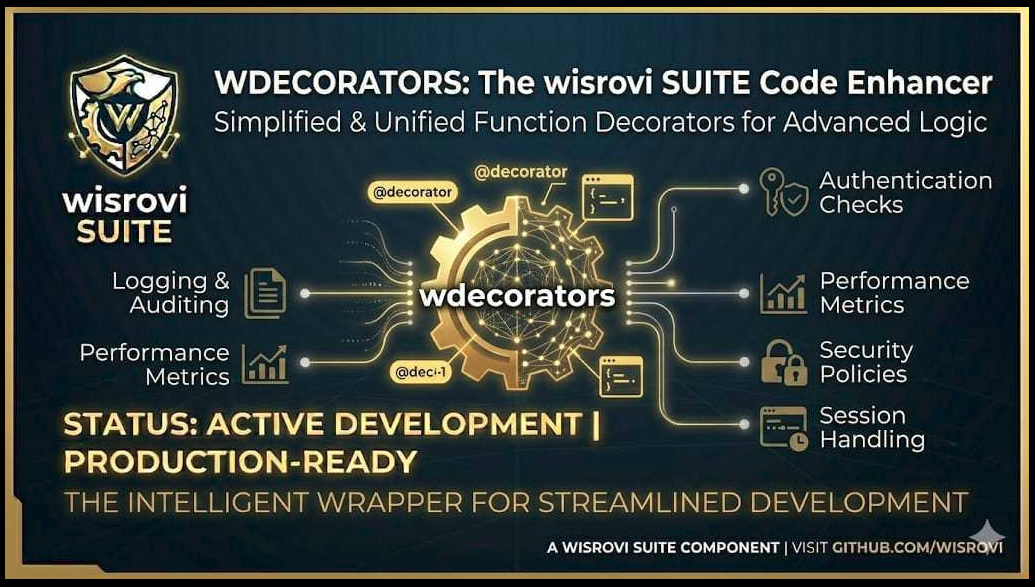
wdecorators is a high-level Python decorator library providing a collection of ready-to-use decorators for performance profiling, resilience (retry, timeout, rate-limiting), debugging, input sanitization, structured logging with Graylog, caching, and periodic task scheduling.
Installation
pip install wdecorators
Optional extras
# For the periodic task scheduler dashboard (FastAPI + Uvicorn + JWT)
pip install wdecorators[scheduler]

# For the Graylog FastAPI middleware
pip install wdecorators[graylog]
Quick Start
from wdecorators import benchmark, retry, time_execution, singleton

@benchmark
def my_function():
    return sum(range(1000))

@retry(times=3)
def unreliable_function():
    import random
    if random.random() < 0.5:
        raise ConnectionError("Network issue")
    return "OK"

@singleton
class Database:
    def __init__(self):
        print("Connecting to database...")

print(my_function())
print(unreliable_function())
db1 = Database()
db2 = Database()
print(db1 is db2)  # True
Decorator Reference
Performance
| Decorator | Description |
|---|---|
@benchmark |
Measures and prints function execution time |
@time_execution |
Same as benchmark (alias) |
@profile_memory |
Traces memory usage with tracemalloc |
@memoize |
In-memory cache keyed by arguments |
@disk_cache(filename) |
Persistent pickle-based cache on disk |
Resilience
| Decorator | Description |
|---|---|
@retry(times) |
Retries on any exception up to times attempts |
@retry_on_exception(retries, delay, exceptions) |
Retries on specific exception types with delay |
@timeout(seconds) |
Raises TimeoutException if execution exceeds limit |
@rate_limit(calls_per_second) |
Limits invocation rate |
@silent_fail |
Silences exceptions and returns None |
@log_exceptions |
Catches exceptions and logs error message |
Debugging
| Decorator | Description |
|---|---|
@debug_arguments |
Prints function arguments on each call |
@trace_execution |
Prints entry/exit trace messages |
@log_return |
Prints the return value |
@count_calls |
Tracks and prints call count |
@validate_types(**types) |
Runtime type checking for keyword arguments |
Security
| Decorator | Description |
|---|---|
@sanitize_input |
HTML-escapes all string arguments |
@require_authentication(user_dict) |
Checks authenticated flag before execution |
Utilities
| Decorator | Description |
|---|---|
@singleton |
Ensures a class has only one instance |
@to_json |
Converts return value to JSON string |
@periodic_execution(interval) |
Runs function periodically in a background thread |
Graylog Logging
| Decorator / Function | Description |
|---|---|
init_logger(name, graylog_host, log_level) |
Configures loguru with Graylog UDP + console sinks |
@log_exceptions(context, enable_raise) |
Logs exceptions to Graylog via loguru |
@log_execution_time(context) |
Logs function duration to Graylog |
LoggingMiddleware |
FastAPI middleware for request/response logging |
Periodic Task Scheduler
| Class / Method | Description |
|---|---|
Periodic_task_sched(auto_database, handle_signals, max_workers) |
Creates a scheduler instance with auto DB, signals, and thread pool |
.set_database(db_config) |
Configures SQLite or PostgreSQL backend |
.periodic_execution(interval, run_at, cron, allow_concurrent, on_success, on_error) |
Decorator to register periodic tasks with cron, async, & callbacks |
.start_api() |
Launches FastAPI dashboard and /metrics Prometheus endpoint |
.stop_all() |
Stops all registered running task executors and thread pools |
.run_forever(poll_interval) |
Safely blocks main thread and handles graceful shutdown on interrupt |
.verify_admin(token) |
JWT-based token verification for API routes |
Examples
Check the examples/ directory for runnable code covering every decorator:
# Run any example
python examples/performance/benchmark_example.py
python examples/resilience/retry_example.py
python examples/periodic_task/full_featured.py
# ... and many more organized by category
Periodic Tasks
from wdecorators import Periodic_task_sched
import asyncio

controller = Periodic_task_sched(auto_database=True, handle_signals=True, max_workers=5)

@controller.periodic_execution(cron="*/1 * * * *", allow_concurrent=False, enable_api=True)
async def async_cron_task():
    print("Async cron task running...")
    await asyncio.sleep(1)

@controller.periodic_execution(run_at=["04:00", "12:00", "20:00"])
def daily_reports():
    print("Daily report task running...")

async_cron_task()
daily_reports()
controller.start_api()

controller.run_forever()
Graylog Structured Logging
from wdecorators import init_logger, log_exceptions, logger

init_logger("my_app", graylog_host="192.168.1.100")

@log_exceptions(context={"send_to_graylog": True})
def process_order(order_id: int):
    logger.bind(send_to_graylog=True).info(f"Processing order {order_id}")
    # ... business logic
Project Structure
wdecorators/
├── wdecorators/
│   ├── __init__.py           # Public API exports
│   ├── general/              # General-purpose decorators
│   ├── graylog/              # Graylog GELF logging integration
│   ├── log_calls/            # Simple call logging decorator
│   └── periodic_scheduller/  # Periodic task scheduler with dashboard & metrics
│       ├── __init__.py
│       └── controller.py
├── examples/                 # Categorized runnable examples
│   ├── debugging/            # Debugging and tracing examples
│   ├── graylog/              # Graylog integration examples
│   ├── performance/          # Benchmarking and caching examples
│   ├── periodic_task/        # Periodic task scheduler examples (basic, advance, daily_schedule, full_featured)
│   ├── resilience/           # Retry, timeout, rate-limiting examples
│   ├── security/             # Input sanitization and authentication examples
│   ├── utilities/            # Singleton, JSON, run_once examples
│   └── validation/           # Runtime type & length validation examples
├── pyproject.toml
└── README.md
Key Technologies
- Python 3.8+: Core runtime.
- FastAPI & Uvicorn: Web dashboard and server for monitoring periodic task schedulers.
- PyJWT & Jinja2: Authentication and templating for scheduler dashboard.
- Loguru: Advanced logging engine with Graylog GELF support.
- SQLite / PostgreSQL: Database backends for task logging and execution history.
- Pytest & Coverage: Unit testing framework and test coverage reporting.
Development
git clone https://github.com/wisrovi/wdecorators.git
cd wdecorators
pip install -e ".[scheduler]"
Code quality
pip install isort black
isort .
black .
License
1 maintainer

Metadata
1 maintainer
Release files for wdecorators 1.1.0
For a detailed explanation of source distributions (sdists) and built distributions (wheels), please see the package formats documentation.
Source distribution (sdist)
| File | Size | Uploaded | Provenance | |
|---|---|---|---|---|
| wdecorators-1.1.0.tar.gz | 71.2 kB | Without provenance | Details |
Built distribution (wheel)
| File | Interpreter | ABI | Platform | Reset |
|---|---|---|---|---|
| wdecorators-1.1.0-py3-none-any.whl | Python 3 | none | any | Details |
Total release size: 122.3 kB
Release files / wdecorators-1.1.0.tar.gz
| Download URL | wdecorators-1.1.0.tar.gz |
|---|---|
| Size | 71.2 kB |
| Tags | Source |
|
SHA-256 checksum How to use checksums |
bad830ea2f5b7578ecb5c780df2f8c8245d845becb2f5f2873029b7508fc332a
|
|
BLAKE2b-256 checksum How to use checksums |
d0eb179ea9fe08e73059f9d96897615a945247a20213fe42896ac7077ae7ecf0
|
| Upload date | |
|
Uploaded using Trusted Publishing? What is trusted publishing? |
No |
| Uploaded via |
twine/7.0.0 CPython/3.13.5
|
Release files / wdecorators-1.1.0-py3-none-any.whl
| Download URL | wdecorators-1.1.0-py3-none-any.whl |
|---|---|
| Size | 51.1 kB |
| Tags | Python 3 |
|
SHA-256 checksum How to use checksums |
2e1f2f458fc849f00fd4b43957ce6b2115eba4cf425f3e5a5adb946ba0ca3ad2
|
|
BLAKE2b-256 checksum How to use checksums |
beabe0e128974e92f1776a47c429ac1057fc1ac5c9cf8c38f647e728c61e1e76
|
| Upload date | |
|
Uploaded using Trusted Publishing? What is trusted publishing? |
No |
| Uploaded via |
twine/7.0.0 CPython/3.13.5
|
Security for wdecorators 1.1.0
Provenance
Provenance describes where a file came from. On PyPI, provenance is shared via attestations, which provide a verifiable record of the build or publishing details. View details, limitations and caveats.
No provenance found
None of the files in this release were uploaded with provenance metadata.
A note on package security
PyPI is a repository for distributing packages, not a service for auditing them. While third-party security researchers and our staff do their best to detect and remove malicious packages, PyPI cannot guarantee the quality, security or suitability of any given package.
To learn more about protecting yourself from malicious actors, visit our package security documentation.














