
Resilient web-fetch MCP server: 3-tier escalation (curl_cffi -> Patchright -> nodriver) that fails honestly, with article-extraction mode and automatic content-type handling (HTML/JSON/PDF/image).
Verified details
These details have been verified by PyPIProject links
GitHub Statistics
Maintainers

Project description
web-fetch-mcp




A Python MCP server using browser fingerprint impersonation, headless Chrome, and multi-tier anti-detection to reliably fetch web pages for AI agents — published on PyPI with CI/CD pipeline and test coverage.
What is this?
web-fetch-mcp is an MCP server that lets AI
assistants (like Claude, Cursor, or any MCP-compatible client) fetch web pages
reliably.
The problem it solves
When an AI agent fetches a web page, many sites return a CAPTCHA, a JavaScript
challenge, or a login wall — but still send HTTP status 200 OK. A naive
fetcher hands this garbage to the AI, which then reasons from nonsense.
How this tool fixes it
web-fetch-mcp detects when a site returns a block page instead of real
content, and either:
- Escalates to a stronger fetching strategy (there are 3 tiers), or
- Fails loudly with a clear error (
FetchBlocked) — never silently returning junk.
Status: Alpha. Core logic is tested, but real-world bypass benchmarks are in progress.
Installation
Requirements: Python 3.11+
pip install web-fetch-mcp
That's it. This installs the web-fetch-mcp command on your system.
Quick Start
1. Run the server
web-fetch-mcp
This starts the MCP server in the background. It doesn't show anything on its own — your AI client talks to it automatically.
2. Register with your MCP client
Add this to your MCP client's configuration (e.g. claude_desktop_config.json,
.cursor/mcp.json, or equivalent):
{
  "mcpServers": {
    "web-fetch": {
      "command": "web-fetch-mcp"
    }
  }
}
3. Use it
Once connected, your AI assistant gains two tools:
| Tool | What it does |
|---|---|
fetch |
Retrieve a web page as markdown, plain text, HTML, or article (main content only) |
screenshot |
Render a page in a real browser and return a PNG image |
Examples your AI can call:
# Get a clean article (strips navigation, ads, etc.)
fetch("https://example.com/blog-post", output="article")

# Get raw JSON from an API
fetch("https://api.github.com/repos/owner/repo")

# Force JavaScript rendering (for single-page apps like React/Vue)
fetch("https://spa-app.example.com", mode="dynamic")

# Take a screenshot of a dashboard
screenshot("https://example.com/dashboard")
How It Works
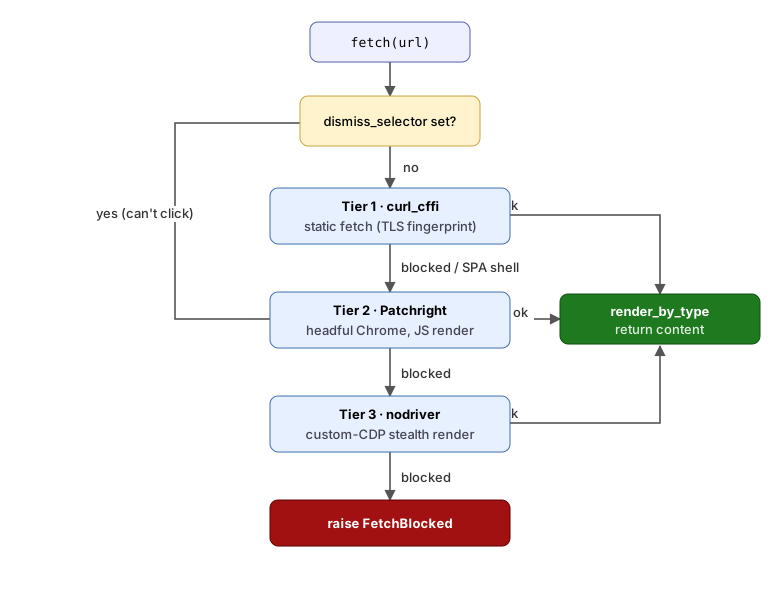
The server uses a 3-tier escalation ladder — it starts cheap and fast, only using expensive browser-based methods when simpler ones get blocked:
Tier 1: curl_cffi        — Fast static fetch (~500ms)
   ↓ (blocked?)
Tier 2: Patchright       — Real Chrome browser, renders JavaScript (~1-3s)
   ↓ (blocked?)
Tier 3: nodriver         — Stealth Chrome, evades automation detection (~2-4s)
   ↓ (still blocked?)
Raise FetchBlocked error — never return garbage to the AI
What each tier handles
| Tier | Engine | What it defeats |
|---|---|---|
| 1 | curl_cffi |
Sites that verify you're a "real browser" by inspecting connection details |
| 2 | Patchright | Sites that need JavaScript to load (React/Vue apps, "please wait" screens) |
| 3 | nodriver | Sites that detect you're using a script-controlled browser instead of a human |
Modes
You can control which tiers are used:
| Mode | Behavior |
|---|---|
auto (default) |
Try all tiers cheapest-first, escalate on failure |
static |
Tier 1 only — fastest, but won't work for JavaScript-heavy sites |
dynamic |
Tier 2 only — opens a real browser to run JavaScript |
stealth |
Tier 3 only — maximum effort to look like a real human browsing |
Output formats
| Format | Use case |
|---|---|
markdown (default) |
Clean, readable text with links preserved |
article |
Main content only (strips nav, sidebars, ads) |
text |
Plain text, no formatting |
html |
Raw rendered HTML |
Non-HTML content is auto-detected: JSON gets pretty-printed, PDFs get text-extracted.
Development Setup
If you want to contribute or modify the code:
git clone https://github.com/Dutta-SD/web-fetch-mcp.git
cd web-fetch-mcp
uv sync                    # install dependencies
uv pip install -e .        # install in editable mode
web-fetch-mcp              # run the server
Run tests:
uv run pytest
Project structure
src/web_fetch_mcp/
├── controller/    → Tool definitions (what the AI client can call)
├── service/       → Retry logic and escalation chain
├── accessor/      → Browser engines (the actual fetching code)
└── core/          → Shared utilities (config, block detection, rendering)
Responsible Use
This tool is for fetching content you are authorized to access. You are
responsible for complying with each site's Terms of Service, robots.txt, and
applicable law. The tool honors Retry-After headers and backs off by default.
It does not solve CAPTCHAs or bypass authentication you don't hold.
Links
- PyPI: https://pypi.org/project/web-fetch-mcp/
- Source: https://github.com/Dutta-SD/web-fetch-mcp
- Issues: https://github.com/Dutta-SD/web-fetch-mcp/issues
Glossary
| Term | What it means |
|---|---|
| MCP | Model Context Protocol — a standard way for AI assistants to use external tools. Think of it like a USB port: any AI that speaks MCP can plug into this server. |
| CAPTCHA | Those "click the traffic lights" puzzles websites use to check you're human. |
| SPA | Single-Page App — a website (like Gmail or Twitter) that loads once and updates dynamically with JavaScript, instead of loading a new page for every click. |
| TLS fingerprint | When your browser connects to a website securely, it leaves a "fingerprint" in how it sets up the connection. Sites use this to tell real browsers from scripts. |
| JavaScript rendering | Many modern websites are blank HTML shells that only fill in content after JavaScript runs. A simple download gets an empty page; you need a real browser to see the content. |
| Bot detection | Techniques websites use to block automated access (scripts, scrapers) while allowing real humans through. |
| stdio | Standard input/output — the basic way programs talk to each other through text streams. Your AI client uses this to communicate with the server behind the scenes. |
| Escalation | Trying progressively stronger methods. Like knocking on a door, then ringing the bell, then calling the person inside. |
FetchBlocked |
The error this tool raises when a website blocks all attempts. It tells the AI "I couldn't get the page" instead of handing it a CAPTCHA page and pretending it's the article. |
License
Project details
Verified details
These details have been verified by PyPIProject links
GitHub Statistics
Maintainers


Download files
Download the file for your platform. If you're not sure which to choose, learn more about installing packages.
Source Distribution
Built Distribution
Filter files by name, interpreter, ABI, and platform.
If you're not sure about the file name format, learn more about wheel file names.
Copy a direct link to the current filters
File details
Details for the file web_fetch_mcp-1.0.0.tar.gz.
File metadata
- Download URL: web_fetch_mcp-1.0.0.tar.gz
- Upload date:
- Size: 42.0 kB
- Tags: Source
- Uploaded using Trusted Publishing? Yes
- Uploaded via: twine/6.1.0 CPython/3.13.12
File hashes
| Algorithm | Hash digest | |
|---|---|---|
| SHA256 |
826b944b594bb987a6a8317e1834ffe858903bfa731f584c560b179f909e67e9
|
|
| MD5 |
512828e22e167046db8dd563ded7cb93
|
|
| BLAKE2b-256 |
8baaeeb86474721fcdb984cba6694bbbdae6d39215d654f3ff91698f85c2026e
|
Provenance
The following attestation bundles were made for web_fetch_mcp-1.0.0.tar.gz:
Publisher:
publish.yml on Dutta-SD/web-fetch-mcp
-
Statement:
-
Statement type:
https://in-toto.io/Statement/v1 -
Predicate type:
https://docs.pypi.org/attestations/publish/v1 -
Subject name:
web_fetch_mcp-1.0.0.tar.gz -
Subject digest:
826b944b594bb987a6a8317e1834ffe858903bfa731f584c560b179f909e67e9 - Sigstore transparency entry: 2009358586
- Sigstore integration time:
-
Permalink:
Dutta-SD/web-fetch-mcp@3c3e3962112d73a323662a00373f4b10e495c17b -
Branch / Tag:
refs/tags/v1.0.0 - Owner: https://github.com/Dutta-SD
-
Access:
public
-
Token Issuer:
https://token.actions.githubusercontent.com -
Runner Environment:
github-hosted -
Publication workflow:
publish.yml@3c3e3962112d73a323662a00373f4b10e495c17b -
Trigger Event:
push
-
Statement type:
File details
Details for the file web_fetch_mcp-1.0.0-py3-none-any.whl.
File metadata
- Download URL: web_fetch_mcp-1.0.0-py3-none-any.whl
- Upload date:
- Size: 40.6 kB
- Tags: Python 3
- Uploaded using Trusted Publishing? Yes
- Uploaded via: twine/6.1.0 CPython/3.13.12
File hashes
| Algorithm | Hash digest | |
|---|---|---|
| SHA256 |
369712f90d58e4a959064dfb9eea2805f79b1c1ea02f7d648ce529fc22bfecd8
|
|
| MD5 |
0797c24f1cc19e89f2edc98e40054571
|
|
| BLAKE2b-256 |
abd9464ceb468886aee0ad1ed14195e832136e1ebdf0035678bc8de778177e4d
|
Provenance
The following attestation bundles were made for web_fetch_mcp-1.0.0-py3-none-any.whl:
Publisher:
publish.yml on Dutta-SD/web-fetch-mcp
-
Statement:
-
Statement type:
https://in-toto.io/Statement/v1 -
Predicate type:
https://docs.pypi.org/attestations/publish/v1 -
Subject name:
web_fetch_mcp-1.0.0-py3-none-any.whl -
Subject digest:
369712f90d58e4a959064dfb9eea2805f79b1c1ea02f7d648ce529fc22bfecd8 - Sigstore transparency entry: 2009358748
- Sigstore integration time:
-
Permalink:
Dutta-SD/web-fetch-mcp@3c3e3962112d73a323662a00373f4b10e495c17b -
Branch / Tag:
refs/tags/v1.0.0 - Owner: https://github.com/Dutta-SD
-
Access:
public
-
Token Issuer:
https://token.actions.githubusercontent.com -
Runner Environment:
github-hosted -
Publication workflow:
publish.yml@3c3e3962112d73a323662a00373f4b10e495c17b -
Trigger Event:
push
-
Statement type:






