
web-search-helper




Search a private corpus from a website, with PHP as the only server. You index the corpus on your machine; one PHP file answers the questions; the page embeds each question in the browser. The corpus is never published: a visitor receives a few sentences of what answers the question, or an honest "I cannot answer" and nothing else.
web-search-helper belongs to the AI Helpers
suite. It works in French and in English out of the box (stopwords, answer
composition, interface), one index per language, and in any other language
with a stopword file. By default no LLM is involved: the answer is made of the
corpus's own sentences. Optionally, a small language model runs in the
visitor's browser and writes the answer from the excerpts, citing them; which
model depends on the visitor's machine and line, as planned by
best-engine-ai-helper.
The Promise
web-search-helper is private by construction. Three honest cases:
- Guaranteed: the corpus is never published. The index lives in a PHP
file that answers an empty 404 when requested by URL, in a folder whose
.htaccessdenies everything.search.phpreturns excerpts of what answers the question, or nothing. The question goes to your own server only, which keeps a salted hash of the visitor's address and the times of its calls of the last day, for the quota, and nothing else. No telemetry, no account, no third-party search service. - The caveats. Model weights travel: sentence-transformers downloads the embedding model once on your machine, and the visitor's browser downloads its twin (about 120 MB) through transformers.js, then keeps it. The optional written answer fetches a larger model (3.1 to 5.6 GB) into the visitor's browser, only when they press its button; to decide whether to offer it, the page first times a slice of its files. And someone patient, with thousands of well-chosen questions, can still collect a good part of the corpus excerpt by excerpt: the protections below make that slow, not impossible.
- Your decision.
check-onlineverifies after each upload that no byte of the corpus is served, and the thresholds that decide when to refuse are yours to measure withcalibrate.
Documentation
Why
A fully client-side search must ship the corpus to the browser, because the browser can only search what it has. That is fine for public documentation and wrong for a manuscript, a course or an internal knowledge base. Encrypting the file does not help: the key has to be in the page too.
Most hosting offers PHP and nothing else: no Python, no Node, no vector database. web-search-helper fits there.
| Where | What runs | Needs |
|---|---|---|
| your machine | cut, embed and index the corpus; measure the thresholds | Python ≥ 3.10, sentence-transformers |
| the server | search.php: BM25 + cosines + fusion + verdict, returns excerpts |
PHP ≥ 7.4 with mbstring |
| the browser | web-search.js: embeds the question (transformers.js), composes an extractive answer, optionally writes one with an in-browser LLM |
an ES-module browser; WebGPU for the written answer |
How it works
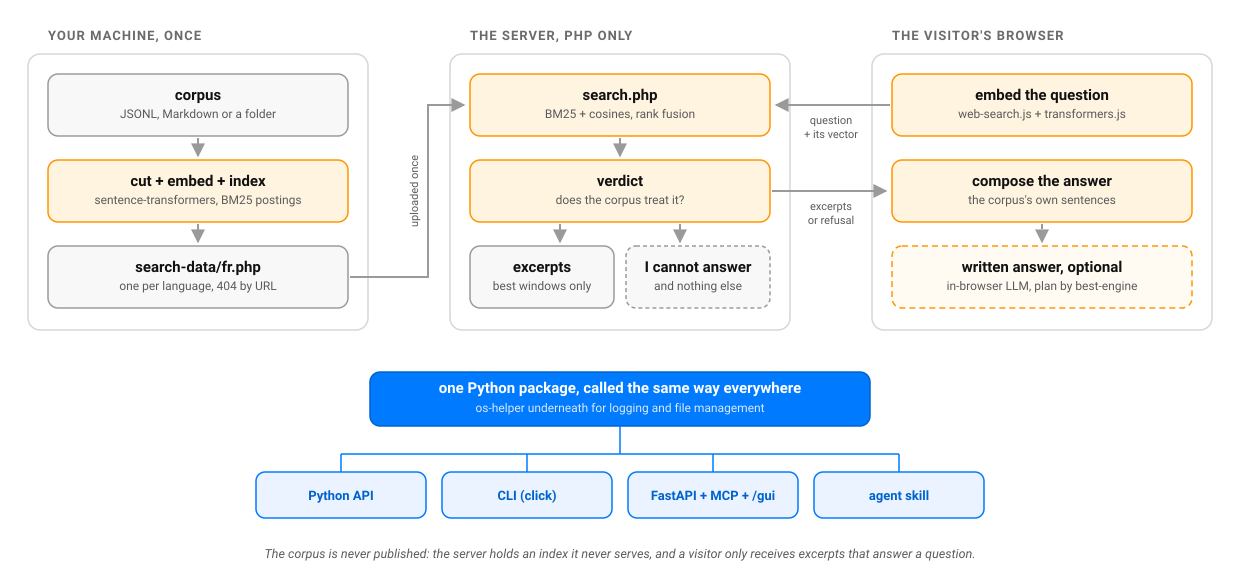
How it searches
- Words: BM25, with a conjunctive pass first (when some passages contain
every word, only they compete) and a timid typo tolerance (
elefantfindséléphant, but only becauseelefantis absent from the corpus). - Meaning: passages are cut into windows the model reads entirely; a passage scores the cosine of its best window. Each section also has a centroid.
- Fusion: reciprocal rank fusion of the two rankings.
- Verdict: the engine answers only when one of three routes says the corpus treats the question: the best window and the best section are close in meaning, or every word was found with a strong BM25, or (for a one-word query) the word appears in enough passages. Otherwise it returns nothing. Ranking always returns something; only an absolute measure can say "no".
The search is exhaustive. ann-router would pick HNSW from 1 000 vectors at a
10 ms budget, but that budget is numpy's, the corpus sizes here are small, and
the verdict judges the absolute best cosine, which an approximate index can
miss. web-search-helper bench measures the PHP time on your index and fails
when it goes over budget.
Protections against scraping
- Nothing is returned when the corpus does not treat the question.
- A passage comes back as an excerpt: its best window and the better of its neighbours, snapped to sentence boundaries. Never the whole passage.
- A quota per address, per hour and per day (salted hash of the address; no other trace kept).
- The index file is a PHP script: requested by URL, it answers an empty 404.
The data folder also gets a
.htaccessthat denies everything, in case.
Someone patient with thousands of well-chosen questions can still collect a good part of the corpus. These measures make that slow, not impossible.
Installation
Two machines, two needs. Where you index (your own computer): Python 3.10 or
later. Where the site is served: PHP 7.4 or later with mbstring, nothing
else; no Python, no database.
pip install web-search-helper                 # engine, PHP export, CLI; hashing embedder only
pip install 'web-search-helper[embed]'        # + sentence-transformers, the real embedder
pip install 'web-search-helper[api,mcp,embed]'  # + the HTTP API, /gui and the MCP server
pip install 'web-search-helper[route]'        # + ann-router's advice next to the PHP timing
From a clone:
git clone https://github.com/warith-harchaoui/web-search-helper.git
cd web-search-helper
pip install -e '.[embed,api,mcp,dev]'
git config core.hooksPath .githooks     # the pre-push gate: ruff, then the full test suite
The tests that compare engine.py with search.php need php on the PATH
(brew install php on macOS, sudo apt install php-cli php-mbstring on
Ubuntu).
Quick start
pip install 'web-search-helper[embed]'

# 1. Index: a .jsonl (one passage per line), a Markdown file or a folder of them.
web-search-helper build corpus/ -o build/fr.php --lang fr

# 2. Measure the thresholds on questions the corpus answers and questions it does not.
web-search-helper calibrate build/fr.php --inside inside.txt --outside outside.txt --write

# 3. Try a question, as the server will answer it.
web-search-helper search build/fr.php "Quelle est la parabole de l'éléphant ?" --explain

# 4. Copy the endpoint, the client and the index into the site; serve it locally.
web-search-helper install site/ build/fr.php build/en.php --demo
web-search-helper serve site/        # http://127.0.0.1:8765/demo.html?lang=fr (or ?lang=en)

# 5. Time the PHP engine; after upload, check that nothing leaks.
web-search-helper bench build/fr.php
web-search-helper check-online https://example.org/search/ --lang fr
JSONL records: {"text": "...", "doc": "Book title", "section": "Chapter 2", "url": "page.html#x", "meta": {...}}.
meta is passed through to the browser untouched.
In the page
<script type="module">
  import { WebSearch, composeAnswer } from './web-search.js';
  const ws = new WebSearch({ endpoint: 'search.php', lang: 'fr' });
  const r = await ws.ask(question, { onLexical: (first) => { /* early answer */ } });
  if (!r.sure) showUnknown();
  else show(await composeAnswer(r, { lang: 'fr', embed: ws }), r.hits);
</script>
ask makes two calls: words only first (instant, before the model has
loaded), then words and meaning. The answer composed by composeAnswer is made
of corpus sentences, verbatim, chosen by maximal marginal relevance; nothing is
generated. Types are in web-search.d.ts. mount(form, output, options) wires
a minimal widget.
A written answer, in the visitor's browser
mount(form, output, { …, writer: true }) adds a button under a sure
result: a small language model, run by transformers.js on WebGPU in the
visitor's browser, rewrites the excerpts into an answer that cites them as
[1], [2]… Nothing leaves the browser and the server does not change.
Which model is not decided in this package. writer-plan.json, written by
best-engine-ai-helper browser plan --usage rag-answer, is an ordered ladder
ranked by scores measured on this very task: Gemma 4 E4B (0.722) then Gemma 4
E2B (0.667), each in q4f16 and q4, with exact files and sizes (3.1 to 5.6 GB).
LFM2 1.2B was measured too (0.167: most of its answers cite nothing) and left
out, so a machine that cannot fetch a Gemma keeps the extractive answer rather
than one it would set aside. scripts/eval_writer.py reruns the measurement on
your own corpus; scripts/make_writer_plan.py rewrites the plan from
best-engine. The page probes the machine (WebGPU,
shader-f16, device memory, storage, mobile, data saver), checks the browser
cache, measures the bandwidth on a Range request to the model's own files, and
takes the first rung it can fetch within max_download_s (180 s). Nothing fits:
no button, and the extractive answer stands. chooseRung is tested against
best-engine's Python browser.choose on 2 251 simulated devices.
The written answer is checked before it is shown: the model only sees a sure
result, it is told to use the excerpts only and to say when they fall short,
and every sentence it writes must find most of its content words in the
excerpts it cites (checkGrounding). Otherwise the page sets the written
answer aside and keeps the extractive one. The excerpts stay listed below it,
verbatim.
import { Writer } from './web-search.js';
const { writer, reason } = await Writer.create('writer-plan.json');  // null when nothing fits
const answer = writer && await writer.write(result, { question, lang: 'fr', onText: show });
if (answer && answer.grounded) show(answer.text);
The suite's other doors
Like every AI Helper, the engine is also reachable over HTTP and MCP, for
agents, scripts and local testing without PHP (search.php stays the
production server):
pip install 'web-search-helper[api,mcp,embed]'
WSH_DATA_DIR=site/search-data web-search-helper-api    # http://127.0.0.1:8040/docs, /gui
WSH_DATA_DIR=site/search-data web-search-helper-mcp    # MCP at http://127.0.0.1:8041/mcp
Routes: POST /query speaks search.php's protocol, so web-search.js can
point at it (that is what /gui does); POST /search takes a plain question
and embeds it server-side; GET /indexes; POST /calibrate (writes
nothing); POST /check-online. The MCP tools are indexes, search,
calibrate and check_online. The agent skill lives in
skills/web-search-helper/; TRIGGERS.md lists what should reach for this
helper and what should not, and a test keeps it identical to the skill's copy.
The API also ships as a container (Dockerfile, docker-compose.yml): it
reads the indexes from ./search-data, mounted read-only, and serves port
8040 with a /health probe. GUI.md describes the /gui page.
docker compose up --build # http://localhost:8040/gui?lang=fr
Bring your own embeddings
A site that already embeds its corpus can keep its vectors and only hand the
engine over: from_vectors(rows, vectors, lang, model) builds the index from
passages (t, c, s, the window ends o, optional u and m) and one
normalised vector per window; vectors_from_int8 reads int8 vectors back the
way a browser would. That is how "Interroger le livre" moved from an
all-in-the-browser search to search.php with the SAME vectors, stopwords and
thresholds, so that only the place of the computation changed.
Python
import web_search_helper as wsh

idx = wsh.build(wsh.read_corpus("corpus/"), wsh.SentenceTransformerEmbedder(), "fr")
wsh.save(idx, "build/fr.php")
print(wsh.search(idx, "the data wall", explain=True))
engine.py is the reference twin of search.php; tests/test_php_parity.py
runs both on the same questions and fails if they disagree.
Limits
- The question's vector is computed by transformers.js in the page and the index by sentence-transformers here: same weights, cosines equal to about 1e-2. Calibration reports its margins; a threshold with less margin than that is fragile.
- One index per language; the page says which language it asks.
- The first question downloads the model in the browser (about 120 MB for the default multilingual MiniLM), then the browser keeps it.
Author
Warith HARCHAOUI, Ph.D.
License
BSD-3-Clause; see LICENSE.
1 maintainer

Metadata
1 maintainer
Release files for web-search-helper 0.3.0
For a detailed explanation of source distributions (sdists) and built distributions (wheels), please see the package formats documentation.
Source distribution (sdist)
| File | Size | Uploaded | Provenance | Actions |
|---|---|---|---|---|
| web_search_helper-0.3.0.tar.gz | 74.1 kB | Without provenance | Details for web_search_helper-0.3.0.tar.gz |
Built distribution (wheel)
| File | Interpreter | ABI | Platform | Actions Reset |
|---|---|---|---|---|
| web_search_helper-0.3.0-py3-none-any.whl | Python 3 | none | any | Details for web_search_helper-0.3.0-py3-none-any.whl |
Total release size: 133.8 kB
Release files / web_search_helper-0.3.0.tar.gz
| Download URL | web_search_helper-0.3.0.tar.gz |
|---|---|
| Size | 74.1 kB |
| Tags | Source |
|
SHA-256 checksum How to use checksums |
a402c3a070da4086e238b44a9c11c17cc8bc09c4de73e61a3f331491561b20cc
|
|
BLAKE2b-256 checksum How to use checksums |
c7ab04778a6fef3694afac7d0e7388212042f8374107c3908c55cd9bb4baaeab
|
| Upload date | |
|
Uploaded using Trusted Publishing? What is trusted publishing? |
No |
| Uploaded via |
twine/7.0.0 CPython/3.13.13
|
Release files / web_search_helper-0.3.0-py3-none-any.whl
| Download URL | web_search_helper-0.3.0-py3-none-any.whl |
|---|---|
| Size | 59.7 kB |
| Tags | Python 3 |
|
SHA-256 checksum How to use checksums |
216ea20bfc6e86d78bfeb05a6606d3b26c0231200bceccb08b4caeb1aac0c26a
|
|
BLAKE2b-256 checksum How to use checksums |
6675c23def6acb747cae4147be20dd06fd82f949274e0f0509cf4b7d29dbd8d2
|
| Upload date | |
|
Uploaded using Trusted Publishing? What is trusted publishing? |
No |
| Uploaded via |
twine/7.0.0 CPython/3.13.13
|
Security for web-search-helper 0.3.0
Provenance
Provenance describes where a file came from. On PyPI, provenance is shared via attestations, which provide a verifiable record of the build or publishing details. View details, limitations and caveats.
No provenance found
None of the files in this release were uploaded with provenance metadata.
A note on package security
PyPI is a repository for distributing packages, not a service for auditing them. While third-party security researchers and our staff do their best to detect and remove malicious packages, PyPI cannot guarantee the quality, security or suitability of any given package.
To learn more about protecting yourself from malicious actors, visit our package security documentation.














