
WebAnalyzer
The open-source reconnaissance dashboard
Run 16 recon & security modules against a domain from one interface — then turn the results into a shareable report.
WebAnalyzer bridges passive OSINT enumeration and active vulnerability assessment, wraps it in a real dashboard, and gives you an executive report at the end. Built for penetration testers, bug bounty hunters, and security researchers.






🖥️ Live Dashboard · ⚡ API & Docs · 📝 Deep-dive Article

Why WebAnalyzer?
Most reconnaissance tooling is a pile of separate CLIs you glue together yourself. WebAnalyzer takes the opposite approach:
- 🎛️ One interface, many tools. WHOIS, DNS, subdomains, WAF fingerprinting, SSL/TLS, CloudFlare origin unmasking, port scanning, content & secret scanning, API testing — selectable per scan, from a CLI or a web dashboard.
- 📊 A dashboard, not just logs. A React command center visualizes scores, findings, network maps, threat intel and attack paths in real time — with results persisted to MySQL so nothing is lost between sessions.
- 📄 Reports you can hand over. Every scan can be exported as JSON, CSV, or a styled executive HTML/PDF security report with remediation advice.
- 🛡️ Built to survive real targets. User-agent rotation, adaptive rate-limit backoff, proxy hooks and WAF-aware pacing keep scans running against protected infrastructure.
WebAnalyzer doesn't try to out-scan
nucleioramass— it gives you a cohesive interface and reporting layer on top of proven reconnaissance techniques.
Quick start
🐳 Docker Compose (recommended — everything in one command)
Spins up the MySQL database, FastAPI backend, and React dashboard together, with all system dependencies (Python, Go, Node, Nmap, Subfinder) baked in.
git clone https://github.com/frkndncr/WebAnalyzer.git
cd WebAnalyzer
docker compose up -d --build
- Dashboard: http://localhost:8080
- API docs: http://localhost:8000/docs
📦 pip (CLI only)
pip install webanalyzer-security
webanalyzer
⚡ Manual (developer mode)
git clone https://github.com/frkndncr/WebAnalyzer.git
cd WebAnalyzer
pip install -r requirements.txt

# Backend
uvicorn api:app --host 0.0.0.0 --port 8000 --reload

# Frontend (in a second terminal)
cd dashboard && npm install && npm run dev   # http://localhost:5173
The database is optional for single scans (results also persist to logs/<domain>/results.json). To enable durable storage, set DB_HOST, DB_NAME, DB_USER, DB_PASSWORD — the schema auto-initializes on first connect.
Hosting a public instance? Set
DEMO_MODE=trueto rate-limit scan requests per client and refuse internal/private/reserved targets (SSRF protection). It's off by default so self-hosted users can scan their own infrastructure. See.env.example.In demo mode the intrusive modules (Nmap, active content testing, subdomain-takeover and origin probing) only run on domains whose owner has proven control by publishing a DNS TXT record (
_webanalyzer.<domain>, shown by the dashboard orGET /api/verify/<domain>). Passive modules (WHOIS, DNS, headers, certificates, archive lookups, ...) stay open to everyone, so a public instance can't be used to port-scan or attack third parties.
What it does

Analysis modules
| Module | What it finds | Risk |
|---|---|---|
| Domain Information | WHOIS, registrar, registration & expiry dates | 🟢 |
| DNS Analysis | A / AAAA / MX / TXT / CNAME records | 🟢 |
| SEO Analysis | Meta tags, Open Graph, indexing signals | 🟢 |
| Web Technologies | Server, frameworks, CMS fingerprinting | 🟢 |
| GEO Analysis | IP geolocation & hosting provider | 🟢 |
| Security Analysis | Headers, SSL/TLS, WAF detection, scoring | 🟡 |
| Subdomain Discovery | Subdomain enumeration (Subfinder) | 🟡 |
| Contact Intelligence | Emails, phones, social profiles | 🟡 |
| Advanced Content Scan | Deep crawl, secrets, JS taint analysis, SSRF | 🟡 |
| Web Archive Spy | Wayback Machine historical secret scraping | 🟡 |
| SSL SAN Association | crt.sh & certificate-based asset mapping | 🟡 |
| Subdomain Takeover | Dangling CNAME / takeover detection | 🔴 |
| CloudFlare Bypass | Origin IP unmasking behind the WAF | 🔴 |
| Nmap Zero-Day Scan | Port scanning & service fingerprinting | 🔴 |
| Phishing Detection | Typosquatted / look-alike domain resolver | 🔴 |
| API Security Scanner | API endpoint discovery & vulnerability testing | 🟣 |
Plus an Attack Path Planner that chains findings into a logical exploit roadmap. See docs/Modules.md for details.
Command line and CI
pip install webanalyzer-security

webanalyzer scan example.com                      # standard preset
webanalyzer scan example.com --passive -f sarif -o out.sarif --fail-on high
webanalyzer scan -l domains.txt -f jsonl | jq .   # one JSON object per domain
webanalyzer modules                               # list the modules
Output as text, json, jsonl, SARIF (GitHub Code Scanning) or markdown; exit code 1 when a finding reaches --fail-on, so a scan can gate a pipeline. There is also a GitHub Action:
- uses: frkndncr/WebAnalyzer@main
  with:
    target: example.com
    upload-sarif: "true"     # findings appear in the repository's Security tab
    fail-on: high
See docs/CI.md for every option, exit codes and other CI systems.
Bulk processing
For large jobs (100s–50K+ domains), WebAnalyzer ships a MySQL-backed queue with worker pools, retries and checkpoint recovery:
python domains-check.py --input domains.json --output validated.json   # pre-validate
python bulk_scan.py --load validated.json --job-name "Security Audit"   # create a job
python bulk_scan.py --job-id 1 --workers 10                             # run it
python bulk_scan.py --stats 1                                           # monitor
Highlighted capabilities
- Origin IP unmasking — historical DNS records, subdomain leakage, and SSL SAN validation to find the real IP behind CloudFlare.
- Secrets & JS analysis — Shannon-entropy secret hunting with a 40+ pattern registry, plus taint tracking of
location.search/.hash→innerHTML/evalDOM-XSS flows. - Heuristic API detection — distinguishes real JSON/XML endpoints from HTML-in-404 noise via headers, server stack and response structure.
- Evasion — session/user-agent rotation, adaptive HTTP 429 backoff, and WAF-aware pacing. See
docs/Features.md.
Architecture
graph LR
    subgraph Interfaces
      CLI[CLI - main.py]
      UI[React Dashboard]
    end
    API[FastAPI backend - api.py]
    ENG[Module engine + bulk processor]
    DB[(MySQL)]
    MODS[16 analysis modules]

    CLI --> ENG
    UI --> API --> ENG --> MODS
    ENG --> DB
    API --> DB
- Backend: Python 3.8+, FastAPI, a module execution framework, and an optional MySQL layer with connection pooling. Bulk mode processes 1K–50K+ domains via a job queue with retry and checkpoint recovery.
- Frontend: React 19 + Vite, a central API client, live polling, and hand-built SVG visualizations.
- Storage: MySQL is the durable source of truth; local JSON is a fallback cache.
Full details in docs/Architecture.md.
⚖️ Legal & ethical use
WebAnalyzer includes modules capable of active security testing (vulnerability scanning, origin unmasking, authentication-bypass checks).
Only scan systems you own or are explicitly authorized to test.
Respect rate limits and terms of service, follow responsible disclosure, and comply with the laws in your jurisdiction. Unauthorized security testing may be illegal. The authors are not liable for misuse. The public demo is provided for evaluation only — do not use it to test systems you don't own.
Contributing
Contributions are welcome — issues, feature requests, and pull requests all help. See CONTRIBUTING.md and the issue templates. Good places to start: a new analysis module (one file - see Writing a module), dashboard improvements, or test coverage.
# Run the backend test suite
pip install pytest && pytest

# Lint the dashboard
cd dashboard && npm install && npm run lint
Documentation
License & author
Released under the MIT License.
Built by Furkan Dinçer — LinkedIn · Instagram · hi@c4softwarestudio.com
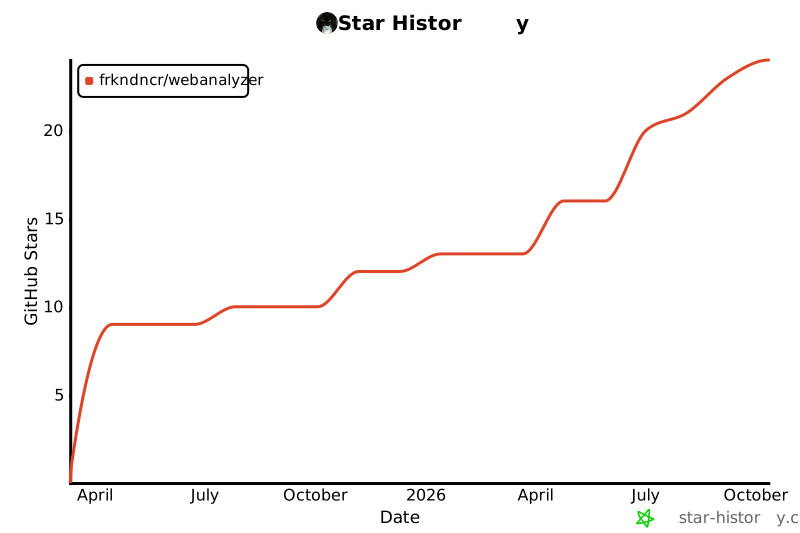
If WebAnalyzer is useful to you, consider giving it a ⭐ — it genuinely helps.
1 maintainer

Metadata
1 maintainer
Release files for webanalyzer-security 3.7.0
For a detailed explanation of source distributions (sdists) and built distributions (wheels), please see the package formats documentation.
Source distribution (sdist)
| File | Size | Uploaded | |
|---|---|---|---|
| webanalyzer_security-3.7.0.tar.gz | 247.2 kB | Details |
Built distribution (wheel)
| File | Interpreter | ABI | Platform | Reset |
|---|---|---|---|---|
| webanalyzer_security-3.7.0-py3-none-any.whl | Python 3 | none | any | Details |
Total release size: 483.6 kB
Release files / webanalyzer_security-3.7.0.tar.gz
| Download URL | webanalyzer_security-3.7.0.tar.gz |
|---|---|
| Size | 247.2 kB |
| Tags | Source |
|
SHA-256 checksum How to use checksums |
37f6b0951d71a7d664c3301351f0415a38f8219ce70809eefdfd68c4d637b07e
|
|
BLAKE2b-256 checksum How to use checksums |
e2252ed194a2029b641cdaf24fbaf0fec9fd7b847b501cb1249fee7ce512e5d4
|
| Upload date | |
|
Uploaded using Trusted Publishing? What is trusted publishing? |
Yes |
| Uploaded via |
twine/7.0.0 CPython/3.13.14
|
Provenance
Provenance describes where a file came from. On PyPI, provenance is shared via attestations, which provide a verifiable record of the build or publishing details. View details, limitations and caveats.


PyPI Publish Attestation
PyPI verified that this artifact, at this checksum, originated from the publisher listed below.
Signed by GitHub Actions, verified by PyPI on Oct 12, 2026.
Transparency logRelease files / webanalyzer_security-3.7.0-py3-none-any.whl
| Download URL | webanalyzer_security-3.7.0-py3-none-any.whl |
|---|---|
| Size | 236.4 kB |
| Tags | Python 3 |
|
SHA-256 checksum How to use checksums |
9c73f3434495f0018fc8ac4d31379968fbcaa6353d403a044a31fb2cc9cc45a3
|
|
BLAKE2b-256 checksum How to use checksums |
ba49b6e0a3e18896fa697dea0d8fbe57543559a7e24df34ec90ecab292cab261
|
| Upload date | |
|
Uploaded using Trusted Publishing? What is trusted publishing? |
Yes |
| Uploaded via |
twine/7.0.0 CPython/3.13.14
|
Provenance
Provenance describes where a file came from. On PyPI, provenance is shared via attestations, which provide a verifiable record of the build or publishing details. View details, limitations and caveats.
PyPI Publish Attestation
PyPI verified that this artifact, at this checksum, originated from the publisher listed below.
Signed by GitHub Actions, verified by PyPI on Oct 12, 2026.
Transparency log













