
Westfall & Laustsen (2006): Height-to-Diameter Model for Maine Tree Species



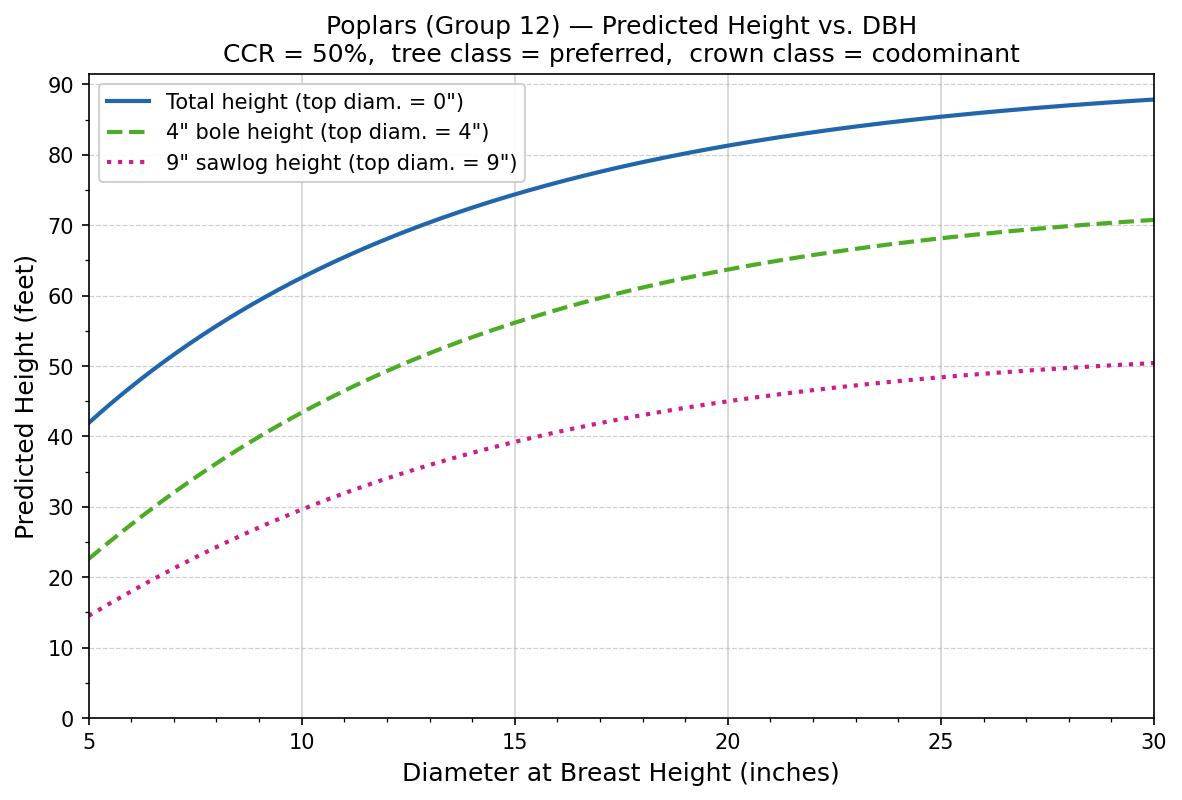
Predicted height vs. diameter at breast height (DBH) for a hypothetical poplar using the allometric model from Westfall and Laustsen (2006).
Overview
This package provides predict_height_westfall, a function that predicts tree height (ft) at a given top diameter using the Chapman-Richards allometric model from Westfall and Laustsen (2006). It supports 18 species groups in Maine. The model is based on the Chapman-Richards growth equation (Richards 1959).
The tree height is estimated a function of:
- Diameter at breast height (DBH, inches)
- Compacted crown ratio (%, 0-100)
- Tree class (
"preferred","acceptable","rough","rotten", or"dead"), - Crown class (
"dominant","codominant","intermediate","overtopped","open grown", or"dead").
Setting top_diam_in=0 (the default) returns total tree height; providing a non-zero top diameter returns the height to that stem diameter, enabling estimation of merchantable bole height.
All value parameters accept either a scalar or an array-like. When any parameter is array-like the inputs are broadcast together and a NumPy array is returned; otherwise a single float is returned.
Model description
Here, we show Equation (2) from Westfall and Laustsen (2006) modified to remove the error term and the random-effects parameters:
$$ \begin{aligned} H_{i} = & \left(\beta_0 D_{i} + \beta_1 CC_{1i} + \beta_2 CC_{2i} + \beta_3 CC_{3i}\right) \ & \cdot \left(1 - \exp\left(-\beta_4 DBH_i\right)\right)^{\beta_5 CR_i + \beta_6 TC_i + \left(\frac{D_{i}}{DBH_i} + 0.01\right)^{\beta_7}} \end{aligned} $$
...where:
$H_{i}$ = tree height (feet) of the $i^{th}$ tree at top diameter $D$.
$D_{i}$ = top-diameter (inches) within the $i^{th}$ tree.
$DBH_i$ = diameter at breast height (inches) of the $i^{th}$ tree.
$CC_{1i}$, $CC_{2i}$, $CC_{3i}$ = The crown class indicators of the $i^{th}$ tree. These are a set of one-hot encoded variables.
$$ CC_{ki} = \begin{cases} k = 1, ; = 1 & \text{intermediate, dead; 0 otherwise} \ k = 2, ; = 1 & \text{dominant, codominant, open grown; 0 otherwise} \ k = 3, ; = 1 & \text{overtopped; 0 otherwise} \end{cases} $$
$TC_i$ = The tree class of the $i^{th}$ tree. TC is an integer coded value between 1 and 3.
$$ TC_i = \begin{cases} 1 & \text{preferred} \ 2 & \text{acceptable} \ 3 & \text{rough/rotten cull, dead} \end{cases} $$
$CR_i$ = compacted crown ratio (%; integers 0 - 100) of the $i^{th}$ tree.
$\beta_0 \text{-} \beta_7$ = the fixed-effects population parameters.
predict_height_westfall
predict_height_westfall(
    species: int | array_like,
    species_id: str,                          # "group" or "fia"
    dbh_in: float | array_like,
    ccr_pct: float | array_like,
    tree_class: str | array_like,
    crown_class: str | array_like,
    top_diam_in: float | array_like = 0.0,
) -> float | numpy.ndarray
Predicts tree height (ft) at a specified top diameter using the Chapman-Richards allometric model.
The species is given by a single species value, and species_id says how to read it: "group" for a species group number (1–18), or "fia" for an FIA species code (which is converted to a group number before prediction).
| Parameter | Type | Description |
|---|---|---|
species |
int or array |
Species identifier. A species group number (1–18) when species_id="group", or an FIA species code when species_id="fia". |
species_id |
str |
How to interpret species: "group" or "fia". Required (no default). |
dbh_in |
float or array |
Diameter at breast height (inches, > 0). |
ccr_pct |
float or array |
Compacted crown ratio (percent, 0–100). |
tree_class |
str or array |
One of "preferred", "acceptable", "rough", "rotten", or "dead". |
crown_class |
str or array |
One of "dominant", "codominant", "intermediate", "overtopped", "open grown", or "dead". |
top_diam_in |
float or array |
Top stem diameter (inches, >= 0) at which to predict height. Defaults to 0.0 for total tree height. |
Returns: Predicted height in feet as a float (scalar inputs) or numpy.ndarray (array inputs).
Species Groups
With species_id="group", the species parameter accepts integers 1–18. The table below lists the species group number, the group name, the species associated with the group, and the FIA species codes (SPCD) that correspond to each of the species. Any of those FIA codes can be passed directly via species with species_id="fia".
| Group | Species Group Name | Species Names | FIA SPCD |
|---|---|---|---|
| 1 | Miscellaneous softwood | Larch (introduced), Norway spruce, Jack pine, Red pine, Pitch pine, Pond pine, Scotch pine | 6212, 91, 105, 125, 126, 128, 130 |
| 2 | Tamarack (native) | Tamarack (native) | 71 |
| 3 | Eastern white pine | Eastern white pine | 129 |
| 4 | White spruce | White spruce | 94 |
| 5 | Black spruce | Black spruce | 95 |
| 6 | Red spruce | Red spruce | 97 |
| 7 | Balsam fir | Balsam fir | 12 |
| 8 | Eastern hemlock | Eastern hemlock | 261 |
| 9 | Northern white-cedar | Northern white-cedar | 241 |
| 10 | Sugar maple | Sugar maple | 318 |
| 11 | Ash | White ash, Black ash, Green ash | 541, 543, 544 |
| 12 | Poplars | Balsam poplar, Eastern cottonwood, Bigtooth aspen, Swamp cottonwood, Quaking aspen | 741, 742, 743, 744, 746 |
| 13 | Miscellaneous hardwood | Shagbark hickory, Black cherry, Scarlet oak, Northern red oak, Black oak, American basswood | 407, 762, 806, 833, 837, 951 |
| 14 | Yellow birch | Yellow birch | 371 |
| 15 | Paper birch | Paper birch | 375 |
| 16 | Other hardwood | Maple, Striped maple, Silver maple, Mountain maple, Norway maple, Ohio buckeye, Serviceberry, Sweet birch, Gray birch, American hornbeam, Butternut, Osage-orange, Apple, Eastern hophornbeam, Pin cherry, Chokecherry, White oak, Swamp white oak, Willow, Black willow, White willow, American mountain-ash, Elm, American elm | 310, 315, 317, 319, 320, 331, 356, 372, 379, 391, 601, 641, 660, 701, 761, 763, 802, 804, 920, 922, 927, 935, 970, 972 |
| 17 | Red maple | Red maple | 316 |
| 18 | American beech | American beech | 531 |
Demonstration calculations
Westfall and Laustsen (2006) provided the following example of how to apply the equations using a poplar tree (species group = 12) with the following attributes:
- dbh = 15.5 in.
- Compacted crown ratio = 40 percent
- Tree class = acceptable (TC = 2)
- Crown class = codominant (CC₁ = 0; CC₂ = 1; CC₃ = 0)
We demonstrate that this implementation reproduces the same results.
1) Prediction of total height
When computing total height, you set the top-height diameter to 0.
$$\begin{aligned} H_{i0} &= \left(-4.2401(0) + 84.2529(0) + 91.5048(1) + 78.7788(0)\right) \ &\quad \cdot \left(1 - \exp(-0.1023 \cdot 15.5)\right) \ &\quad \cdot \exp\left(0.0054(40) + 0.0638(2) + \left(\tfrac{0}{15.5} + 0.01\right)^{0.1422}\right) \ H_{i0} &= (91.5048) \cdot (0.7943) \cdot \exp\left(0.3436 + (0.01)^{0.1422}\right) \ H_{i0} &= 75.0 \text{ ft} \end{aligned}$$
from westfall_2006 import predict_height_westfall

total_height = predict_height_westfall(
    species = 12,
    species_id = "group",
    dbh_in = 15.5,
    ccr_pct = 40,
    tree_class = "acceptable",
    crown_class = "codominant",
    top_diam_in = 0.0,
)
# total_height => 75.0 ft

# Equivalently, using the FIA species code for Quaking aspen:
total_height = predict_height_westfall(
    species = 746,
    species_id = "fia",
    dbh_in = 15.5,
    ccr_pct = 40,
    tree_class = "acceptable",
    crown_class = "codominant",
    top_diam_in = 0.0,
)
# total_height => 75.0 ft
2) Prediction of bole height (4-in. top diameter)
Compute the top height of the 4-in. diameter bole.
$$\begin{aligned} H_{i4} &= \left(-4.2401(4) + 84.2529(0) + 91.5048(1) + 78.7788(0)\right) \ &\quad \cdot \left(1 - \exp(-0.1023 \cdot 15.5)\right) \ &\quad \cdot \exp\left(0.0054(40) + 0.0638(2) + \left(\tfrac{4}{15.5} + 0.01\right)^{0.1422}\right) \ H_{i4} &= (74.5444) \cdot (0.7943) \cdot \exp\left(0.3436 + (0.2681)^{0.1422}\right) \ H_{i4} &= 56.9 \text{ ft} \end{aligned}$$
bole_height = predict_height_westfall(
    species = 12,
    species_id = "group",
    dbh_in = 15.5,
    ccr_pct = 40,
    tree_class = "acceptable",
    crown_class = "codominant",
    top_diam_in = 4.0,
)
# bole_height => 56.9 ft
3) Prediction of sawlog height (9-in. top diameter)
Compute the top height of the 9-in. diameter bole.
$$\begin{aligned} H_{i9} &= \left(-4.2401(9) + 84.2529(0) + 91.5048(1) + 78.7788(0)\right) \ &\quad \cdot \left(1 - \exp(-0.1023 \cdot 15.5)\right) \ &\quad \cdot \exp\left(0.0054(40) + 0.0638(2) + \left(\tfrac{9}{15.5} + 0.01\right)^{0.1422}\right) \ H_{i9} &= (53.3439) \cdot (0.7943) \cdot \exp\left(0.3436 + (0.5906)^{0.1422}\right) \ H_{i9} &= 39.8 \text{ ft} \end{aligned}$$
sawlog_height = predict_height_westfall(
    species = 12,
    species_id = "group",
    dbh_in = 15.5,
    ccr_pct = 40,
    tree_class = "acceptable",
    crown_class = "codominant",
    top_diam_in = 9.0,
)
# sawlog_height => 39.8 ft
Installation
Install the latest release from PyPI:
pip install westfall-2006
Or clone the repository and install as an editable package:
git clone https://github.com/johnkilbride/westfall_height_to_diameter_2006.git
cd westfall_height_to_diameter_2006
pip install -e .
Citation
If you use this library, please cite Westfall and Laustsen (2006).
@article{westfall2006merchantable,
  title={A merchantable and total height model for tree species in Maine},
  author={Westfall, James A and Laustsen, Kenneth M},
  journal={Northern Journal of Applied Forestry},
  volume={23},
  number={4},
  pages={241--249},
  year={2006},
  publisher={Oxford University Press}
}
1 maintainer

Metadata
1 maintainer
Release files for westfall-2006 0.1.3
For a detailed explanation of source distributions (sdists) and built distributions (wheels), please see the package formats documentation.
Source distribution (sdist)
| File | Size | Uploaded | |
|---|---|---|---|
| westfall_2006-0.1.3.tar.gz | 19.1 kB | Details |
Built distribution (wheel)
| File | Interpreter | ABI | Platform | Reset |
|---|---|---|---|---|
| westfall_2006-0.1.3-py3-none-any.whl | Python 3 | none | any | Details |
Total release size: 31.4 kB
Release files / westfall_2006-0.1.3.tar.gz
| Download URL | westfall_2006-0.1.3.tar.gz |
|---|---|
| Size | 19.1 kB |
| Tags | Source |
|
SHA-256 checksum How to use checksums |
d89ab8bb9ecb7ce09ab7f3dbf9bdc2c592de1d2d23b3c56f1c4acfea72cc3c31
|
|
BLAKE2b-256 checksum How to use checksums |
97576b4acb2b4d9af6db0c3849fbfffa6c918c12cc3f4e0c6896cc0df16aeb43
|
| Upload date | |
|
Uploaded using Trusted Publishing? What is trusted publishing? |
No |
| Uploaded via |
twine/7.0.0 CPython/3.13.12
|
Release files / westfall_2006-0.1.3-py3-none-any.whl
| Download URL | westfall_2006-0.1.3-py3-none-any.whl |
|---|---|
| Size | 12.3 kB |
| Tags | Python 3 |
|
SHA-256 checksum How to use checksums |
8f37f3d17d051e625d9b5eba00a5a4042cb05acffce1af880236354f53dc952a
|
|
BLAKE2b-256 checksum How to use checksums |
818d072be2d245559e1f9f032dc611f5fe91a67b13cbd6a2145b7722a0b3ae7b
|
| Upload date | |
|
Uploaded using Trusted Publishing? What is trusted publishing? |
No |
| Uploaded via |
twine/7.0.0 CPython/3.13.12
|














