
This release has been yanked by its maintainers, and will be ignored by installers, except when explicitly specified.
whatitdid
Read any CLI agent's session file and report what the run actually did — step by step, with error bars.


uvx whatitdid demo # opens the browser on real bundled data. No API key needed.
A benchmark hands you two things: a score, and tens of thousands of lines of log. Nothing in between. You know Claude Code got 66.7% and Codex got 61.9%; you have no idea what either of them actually did.
whatitdid labels every step of a run — what kind of move it was, whether it turned up anything new, whether it changed something and then checked — and then compares two rounds against the noise a re-run produces anyway.
whatitdid run session.jsonl --out report.html   # one run
whatitdid watch ./runs --out reports/           # profile each task as the benchmark finishes it
whatitdid compare ./before ./after              # what did the change actually change
whatitdid serve                                 # the web app
What it tells you that a score does not
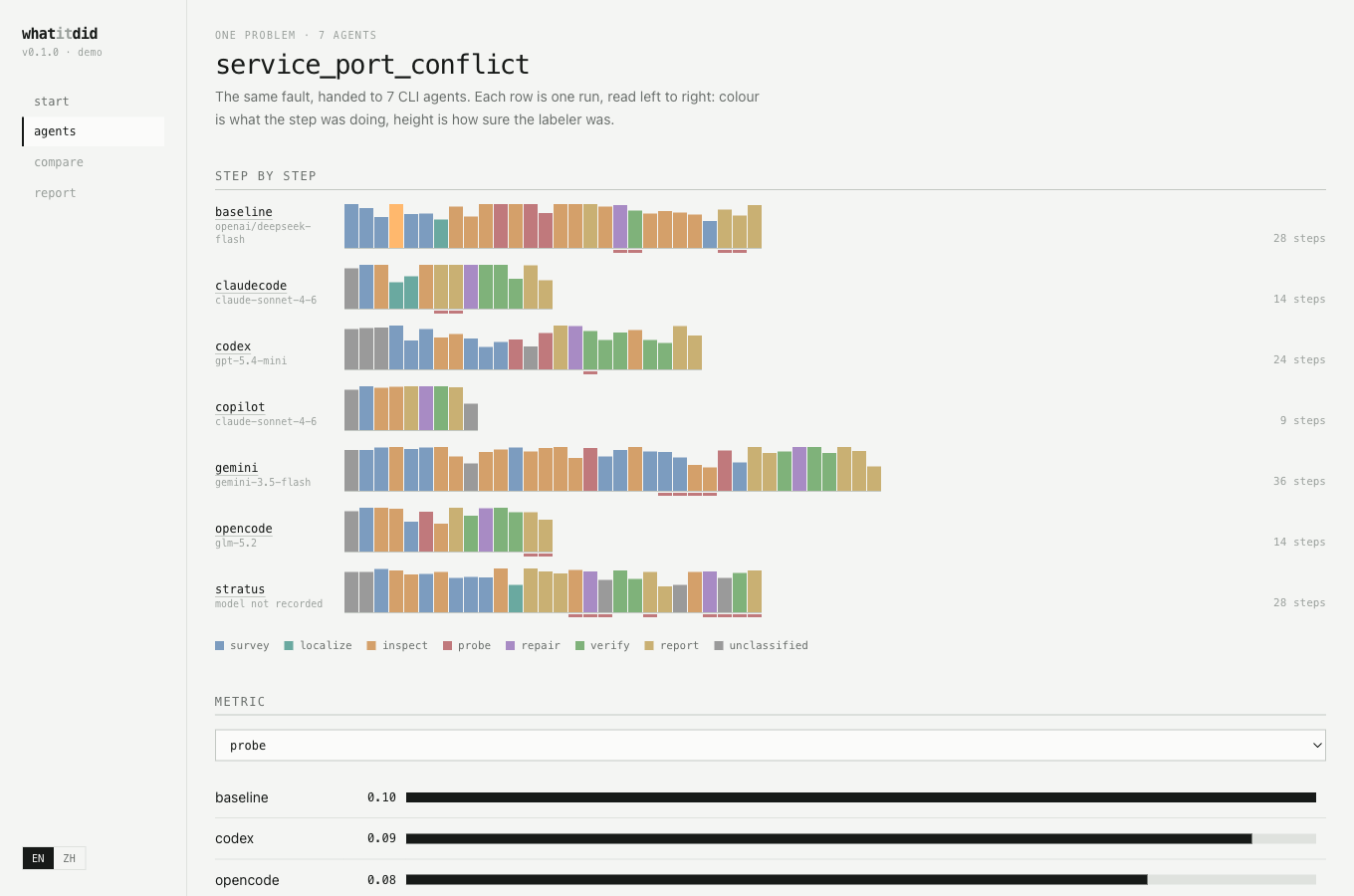
Seven CLI agents, same Kubernetes fault, 153 steps, labelled:
| agent | probe | inspect | report | re-examining | said-and-did |
|---|---|---|---|---|---|
| baseline | 0.10 | 0.42 | 0.12 | 0.70 | 85% |
| claudecode | 0.00 | 0.18 | 0.25 | 0.56 | 62% |
| codex | 0.09 | 0.15 | 0.12 | 0.47 | 73% |
| copilot | 0.00 | 0.22 | 0.26 | 0.36 | 67% |
| gemini | 0.08 | 0.30 | 0.11 | 0.47 | 53% |
| opencode | 0.08 | 0.20 | 0.18 | 0.54 | 67% |
| stratus | 0.00 | 0.24 | 0.18 | 0.63 | 74% |
probe is 0.00 for claudecode, copilot and stratus: across those runs, none of them
ever exercises the system to see how it behaves. They read state and decide. If your
environment punishes an untested fix, that matters more than five points of pass rate.
said-and-did is how often the agent did the thing it had just said it would do, checked
over the next three steps. It ranges from 53% to 85%.
Read this table as a demonstration, not a verdict on these products. It is one run each on one problem — enough to show the instrument works and that the agents differ, nowhere near enough to rank them. Every number here comes from the data bundled in this repository, so you can reproduce it (
uvx whatitdid demo) or disagree with it. Drawing a real conclusion about any of these agents means many problems and repeated runs, and then holding the differences up against the repeat-noise floor below — which is the whole point of the next section.
Why compare is the point
You change something — a prompt, a model, a reasoning effort — and re-run the benchmark. The score moves a couple of points across twenty-odd tasks and the interval straddles zero. You have learned nothing, four hours later.
Real example, same agent and same 21 problems, reasoning effort raised:
diagnosis pass rate   +0.190  (−0.000, +0.429)   crosses zero — says nothing

report                −0.084  (−0.138, −0.038)    5/21 up
said-and-did rate     −0.061  (−0.093, −0.032)    2/21 up   ← 19 of 21 tasks got worse
probe                 +0.056  (+0.020, +0.091)   15/21 up
re-examining          +0.045  (+0.011, +0.083)   15/21 up
The score is 21 binary outcomes. The behaviour is two thousand steps, six questions each — two orders of magnitude more observations from the same compute.
The second hurdle, which everyone skips
A paired bootstrap tells you whether a different draw of tasks would have shown the same thing. It says nothing about whether re-running the same config would have. Agents are not deterministic, and that second wobble is often the larger one.
So whatitdid asks for a repeat-noise floor and refuses to rule without one:
metric              change        95% interval  tasks up  repeat noise  verdict
report              -0.084  (-0.138, -0.038)      5/21             —    ? no repeat baseline
said-and-did rate   -0.061  (-0.093, -0.032)      2/21             —    ? no repeat baseline
probe               +0.056  (+0.020, +0.091)     15/21             —    ? no repeat baseline
survey              +0.023  (-0.009, +0.053)     14/21             —      interval crosses zero
That is the real output for this comparison, because those two rounds have no third run to measure against. The tool says so rather than passing the bootstrap off as a verdict.
Give it repeated runs of the same configuration and the last two columns fill in: each
change is then judged against how far that metric drifts when nothing changed, and anything
smaller is marked within noise however tight its interval looks.
whatitdid compare ./before ./after --repeat ./before-again
No shipped default. A floor measured on someone else's agent, on someone else's tasks, is not your floor — and a wrong floor is worse than none, because it makes noise look like a finding.
Formats
Session files are identified by their contents, not their filename, so you point at whatever the agent wrote and it works:
claudecode · codex · copilot · gemini · opencode · stratus · baseline
No SDK, no instrumentation, no changes to the agent or the benchmark.
The questions
Six per step, answered in one call. One names the kind of move and changes with the domain; the other five are identical across domains, so a coding agent and an ops agent stay comparable on those.
| what kind of move | domain-specific — sre.v1: survey / localize / inspect / probe / repair / verify / report. code.v1: survey / localize / read / reproduce / edit / test / revert / report |
| testing a suspicion | or a routine action it would take whatever the fault was |
| brought new information | or only confirmed what was already visible |
| re-examining | something an earlier step already looked at |
| changed the system | rather than only reading from it |
| how narrowly aimed | 0 = the whole system, 4 = one property of one object |
The set is a file, not a constant — --questions path/to/your.json. It is recorded in
every report, and compare refuses to compare two runs labelled with different sets.
The labeler
Default is Jev, TypeSafe's System One model: several typed questions answered in one parallel pass, probability distributions rather than hard labels, and no text output channel at all.
| Jev | a chat model | |
|---|---|---|
| one 28-step trajectory | 6s / $0.008 | 3.7 min / $0.028 |
| 21-problem benchmark | 2.4 min / $0.36 | 2.8 h / $1.27 |
| labels that flip when the agent's narration is included | 9% | 28% |
| median top-1 probability | 0.88 | 0.70 |
That last row is why this is affordable at all, and the third row is why it is trustworthy across agents. Agents differ 4.5x in how much they narrate; a labeler that reads the narration will score the talkative one as more methodical. whatitdid never shows the agent's own words to the pass that produces the comparable labels — narration is used only for a separate said-and-did check.
Without a Jev key, --labeler chat uses any OpenAI-compatible endpoint. It is slower,
costlier, and biased in the way above; use it for a single run, not for comparing agents.
Keys
Read from TYPESAFE_API_KEY, or ~/.config/whatitdid/typesafe.env (mode 600). The web
app can write one there for you. Nothing is ever committed, logged, or sent anywhere but
the labeling API you chose. Trajectories stay on your machine.
Install
pip install whatitdid
Python 3.11+. From source:
git clone https://github.com/YukunHe304/whatitdid && cd whatitdid
pip install -e ".[dev]"
npm --prefix web install && npm --prefix web run build   # only if you change the web app
pytest
Python
from whatitdid import profile, compare

rep = profile("session.jsonl")
rep.to_html("report.html")
rep.to_dict()        # ids only, no display strings — safe to compare across machines
rep.to_web_dict()    # the above plus step text, for a UI

print(compare(before, after, repeats=[before_again]))
What it is not
It does not run agents or benchmarks — point it at what you already have.
vercel-labs/agent-eval runs them; this
reads what they leave behind.
It does not tell you whether an answer was right. That is your benchmark's job. This tells you how the agent got there.
Licence
Apache-2.0. The trajectory converter derives from Harbor (Apache-2.0) and SREGym (MIT); see NOTICE.
1 maintainer

Metadata
1 maintainer
Release files for whatitdid 0.1.0
For a detailed explanation of source distributions (sdists) and built distributions (wheels), please see the package formats documentation.
Source distribution (sdist)
| File | Size | Uploaded | |
|---|---|---|---|
| whatitdid-0.1.0.tar.gz | 428.7 kB | Details |
Built distribution (wheel)
| File | Interpreter | ABI | Platform | Reset |
|---|---|---|---|---|
| whatitdid-0.1.0-py3-none-any.whl | Python 3 | none | any | Details |
Total release size: 636.1 kB
Release files / whatitdid-0.1.0.tar.gz
| Download URL | whatitdid-0.1.0.tar.gz |
|---|---|
| Size | 428.7 kB |
| Tags | Source |
|
SHA-256 checksum How to use checksums |
161c3ce05372023ec90d43bd872abe73b060b5a3a5d9910a95d34415b9ec25f9
|
|
BLAKE2b-256 checksum How to use checksums |
1639f7f392b6001f57cc85c79294bfb8b14367a7847f78e3aaaacbb547a3a1ef
|
| Upload date | |
|
Uploaded using Trusted Publishing? What is trusted publishing? |
Yes |
| Uploaded via |
twine/7.0.0 CPython/3.13.14
|
Provenance
Provenance describes where a file came from. On PyPI, provenance is shared via attestations, which provide a verifiable record of the build or publishing details. View details, limitations and caveats.


PyPI Publish Attestation
PyPI verified that this artifact, at this checksum, originated from the publisher listed below.
Signed by GitHub Actions, verified by PyPI on Sep 19, 2026.
Transparency logRelease files / whatitdid-0.1.0-py3-none-any.whl
| Download URL | whatitdid-0.1.0-py3-none-any.whl |
|---|---|
| Size | 207.4 kB |
| Tags | Python 3 |
|
SHA-256 checksum How to use checksums |
6efc2fb288ccf81f208e75ff66ba5dc5f1bf618142fb3317edfee6254d89584b
|
|
BLAKE2b-256 checksum How to use checksums |
7af21017e5b14d9fbbe047693057e34a8de0738b9bf30c5886f91b9c78e32cdc
|
| Upload date | |
|
Uploaded using Trusted Publishing? What is trusted publishing? |
Yes |
| Uploaded via |
twine/7.0.0 CPython/3.13.14
|
Provenance
Provenance describes where a file came from. On PyPI, provenance is shared via attestations, which provide a verifiable record of the build or publishing details. View details, limitations and caveats.
PyPI Publish Attestation
PyPI verified that this artifact, at this checksum, originated from the publisher listed below.
Signed by GitHub Actions, verified by PyPI on Sep 19, 2026.
Transparency log












