
A nearly-live implementation of OpenAI's Whisper.

Project description
WhisperLive
A nearly-live implementation of OpenAI's Whisper.
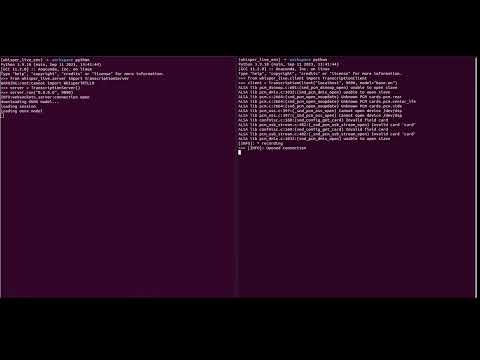
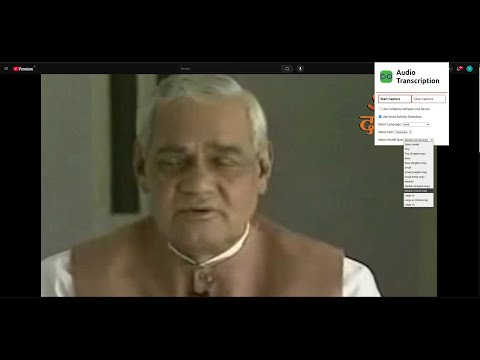
This project is a real-time transcription application that uses the OpenAI Whisper model to convert speech input into text output. It can be used to transcribe both live audio input from microphone and pre-recorded audio files.
- Installation
- Getting Started
- Running the Server
- Running the Client
- Advanced Features
- Browser Extensions
- Whisper Live Server in Docker
- Future Work
- Blog Posts
- Contact
- Citations
Installation
- Install PortAudio (required system dependency for microphone input via PyAudio)
bash scripts/setup.sh
On Debian/Ubuntu this installs portaudio19-dev, on Fedora portaudio-devel, on macOS it uses Homebrew (portaudio).
- Install whisper-live from pip
pip install whisper-live
- Install 3.12 venv on Fedora
sudo dnf install -y python3.12 python3.12-pip
python3.12 -m venv whisper_env
source whisper_env/bin/activate
OpenAI REST interface
Server
python3 run_server.py --port 9090 --backend faster_whisper --max_clients 4 --max_connection_time 600 --enable_rest --cors-origins="http://localhost:8080,http://127.0.0.1:8080"
Client
python3 client_openai.py $AUDIO_FILE
Setting up NVIDIA/TensorRT-LLM for TensorRT backend
- Please follow TensorRT_whisper readme for setup of NVIDIA/TensorRT-LLM and for building Whisper-TensorRT engine.
Getting Started
The server supports 3 backends faster_whisper, tensorrt and openvino. If running tensorrt backend follow TensorRT_whisper readme
Running the Server
- Faster Whisper backend
python3 run_server.py --port 9090 \
                      --backend faster_whisper \
                      --max_clients 4 \
                      --max_connection_time 600

# running with custom model and cache_dir to save auto-converted ctranslate2 models
python3 run_server.py --port 9090 \
                      --backend faster_whisper \
                      --max_clients 4 \
                      --max_connection_time 600 \
                      -fw "/path/to/custom/faster/whisper/model" \
                      -c ~/.cache/whisper-live/
- TensorRT backend. Currently, we recommend to only use the docker setup for TensorRT. Follow TensorRT_whisper readme which works as expected. Make sure to build your TensorRT Engines before running the server with TensorRT backend.
# Run English only model
python3 run_server.py -p 9090 \
                      -b tensorrt \
                      -trt /home/TensorRT-LLM/examples/whisper/whisper_small_en \
                      --max_clients 4 \
                      --max_connection_time 600

# Run Multilingual model
python3 run_server.py -p 9090 \
                      -b tensorrt \
                      -trt /home/TensorRT-LLM/examples/whisper/whisper_small \
                      -m \
                      --max_clients 4 \
                      --max_connection_time 600
Note: The TensorRT backend uses a C++ session by default. If you experience issues (e.g. repeated
CrossAttentionMaskwarnings or crashes), add the--trt_py_sessionflag to use the Python session instead.
- Use
--max_clientsoption to restrict the number of clients the server should allow. Defaults to 4. - Use
--max_connection_timeoptions to limit connection time for a client in seconds. Defaults to 600. - WhisperLive now supports the OpenVINO backend for efficient inference on Intel CPUs, iGPU and dGPUs. Currently, we tested the models uploaded to huggingface by OpenVINO.
-
Docker Recommended: Running WhisperLive with OpenVINO inside Docker automatically enables GPU support (iGPU/dGPU) without requiring additional host setup.
-
Native (non-Docker) Use: If you prefer running outside Docker, ensure the Intel drivers and OpenVINO runtime are installed and properly configured on your system. Refer to the documentation for installing OpenVINO.
-
python3 run_server.py -p 9090 -b openvino
Controlling OpenMP Threads
To control the number of threads used by OpenMP, you can set the OMP_NUM_THREADS environment variable. This is useful for managing CPU resources and ensuring consistent performance. If not specified, OMP_NUM_THREADS is set to 1 by default. You can change this by using the --omp_num_threads argument:
python3 run_server.py --port 9090 \
                      --backend faster_whisper \
                      --omp_num_threads 4
Single model mode
By default, when running the server without specifying a model, the server will instantiate a new whisper model for every client connection. This has the advantage, that the server can use different model sizes, based on the client's requested model size. On the other hand, it also means you have to wait for the model to be loaded upon client connection and you will have increased (V)RAM usage.
When serving a custom TensorRT model using the -trt or a custom faster_whisper model using the -fw option, the server will instead only instantiate the custom model once and then reuse it for all client connections.
If you don't want this, set --no_single_model.
Running the Client
Use the below command to run the client:
python3 run_client.py --files <audio-file-name>
This will connect to the localhost server running on port 9090 by default. Use flags --server and --port to use different configurations. The above command will transcribe audio file provided with --files flag.
Here are the details of client instance implemented in run_client.py script:
lang: Language of the input audio, applicable only if using a multilingual model.translate: If set toTruethen translate from any language toen.model: Whisper model size.use_vad: Whether to useVoice Activity Detectionon the server.save_output_recording: Set to True to save the microphone input as a.wavfile during live transcription. This option is helpful for recording sessions for later playback or analysis. Defaults toFalse.output_recording_filename: Specifies the.wavfile path where the microphone input will be saved ifsave_output_recordingis set toTrue.mute_audio_playback: Whether to mute audio playback when transcribing an audio file. Defaults to False.enable_translation: Start translation thread on the server (from any to any).target_language: Server translation thread's target translation language.
from whisper_live.client import TranscriptionClient
client = TranscriptionClient(
  "localhost",
  9090,
  lang="en",
  translate=False,
  model="small",                                      # also support hf_model => `Systran/faster-whisper-small`
  use_vad=False,
  save_output_recording=True,                         # Only used for microphone input, False by Default
  output_recording_filename="./output_recording.wav", # Only used for microphone input
  mute_audio_playback=False,                          # Only used for file input, False by Default
  enable_translation=True,
  target_language="hi",
)
It connects to the server running on localhost at port 9090. Using a multilingual model, language for the transcription will be automatically detected. You can also use the language option to specify the target language for the transcription, in this case, English ("en"). The translate option should be set to True if we want to translate from the source language to English and False if we want to transcribe in the source language.
- Transcribe an audio file:
client("tests/jfk.wav")
- To transcribe from microphone:
client()
- To transcribe from a RTSP stream:
client(rtsp_url="rtsp://admin:admin@192.168.0.1/rtsp")
- To transcribe from a HLS stream:
client(hls_url="http://as-hls-ww-live.akamaized.net/pool_904/live/ww/bbc_1xtra/bbc_1xtra.isml/bbc_1xtra-audio%3d96000.norewind.m3u8")
Advanced Features
Word-Level Timestamps
Enable per-word timing and confidence scores in transcription segments:
client = TranscriptionClient(
  "localhost", 9090,
  word_timestamps=True,
)
When enabled, each segment in the WebSocket response includes a words array:
{
  "segments": [{
    "start": "0.000", "end": "2.500", "text": "Hello world",
    "words": [
      {"word": "Hello", "start": "0.000", "end": "0.800", "probability": 0.95},
      {"word": " world", "start": "0.900", "end": "2.500", "probability": 0.88}
    ]
  }]
}
Custom Vocabulary / Hotwords
Boost recognition of specific terms (product names, acronyms, domain jargon):
client = TranscriptionClient(
  "localhost", 9090,
  hotwords="WhisperLive,TensorRT,OpenVINO",
)
The hotwords parameter is a comma-separated string passed directly to faster-whisper's keyword boosting. Also available in the REST API via the hotwords form field.
Speaker Diarization
Real-time speaker identification using pyannote.audio embeddings (optional dependency):
pip install pyannote.audio
client = TranscriptionClient(
  "localhost", 9090,
  enable_diarization=True,
  max_speakers=4,
)
When enabled, completed segments include a speaker field:
{"start": "0.000", "end": "2.500", "text": "Hello", "speaker": "SPEAKER_00", "completed": true}
Diarization uses online cosine-similarity clustering of speaker embeddings. If pyannote.audio is not installed, the server logs a warning and continues without diarization.
Batch Inference
Batch multiple client sessions into single GPU calls for higher throughput:
python3 run_server.py --port 9090 --backend faster_whisper \
  --batch_inference --batch_max_size 8 --batch_window_ms 50
Raw PCM Input
Accept raw PCM int16 audio from clients (useful for embedded devices):
python3 run_server.py --port 9090 --backend faster_whisper --raw_pcm_input
Audio is automatically normalized to float32 range [-1.0, 1.0].
Browser Extensions
- Run the server with your desired backend as shown here.
- Transcribe audio directly from your browser using our Chrome or Firefox extensions. Refer to Audio-Transcription-Chrome and https://github.com/collabora/WhisperLive/blob/main/TensorRT_whisper.md
iOS Client
Use WhisperLive on iOS with our native iOS client.
Refer to ios-client and ios-client/README.md for setup and usage instructions.
Whisper Live Server in Docker
-
GPU
- Faster-Whisper
docker run -it --gpus all -p 9090:9090 ghcr.io/collabora/whisperlive-gpu:latest
- TensorRT. Refer to TensorRT_whisper readme for setup and more tensorrt backend configurations.
docker build . -f docker/Dockerfile.tensorrt -t whisperlive-tensorrt
docker run -p 9090:9090 --runtime=nvidia --gpus all --entrypoint /bin/bash -it whisperlive-tensorrt

# Build small.en engine
bash build_whisper_tensorrt.sh /app/TensorRT-LLM-examples small.en        # float16
bash build_whisper_tensorrt.sh /app/TensorRT-LLM-examples small.en int8   # int8 weight only quantization
bash build_whisper_tensorrt.sh /app/TensorRT-LLM-examples small.en int4   # int4 weight only quantization

# Run server with small.en (pick one engine)
python3 run_server.py --port 9090 \
                      --backend tensorrt \
                      --trt_model_path "/app/TensorRT-LLM-examples/whisper/whisper_small_en_float16"
# or int8 / int4:
# --trt_model_path "/app/TensorRT-LLM-examples/whisper/whisper_small_en_int8"
# --trt_model_path "/app/TensorRT-LLM-examples/whisper/whisper_small_en_int4"
- OpenVINO
docker run -it --device=/dev/dri -p 9090:9090 ghcr.io/collabora/whisperlive-openvino -
CPU
- Faster-whisper
docker run -it -p 9090:9090 ghcr.io/collabora/whisperlive-cpu:latest
Future Work
- Add translation to other languages on top of transcription.
Blog Posts
- Transforming speech technology with WhisperLive
- WhisperFusion: Ultra-low latency conversations with an AI chatbot powered by WhisperLive
- Breaking language barriers 2.0: Moving closer towards fully reliable, production-ready Hindi ASR which is used in WhisperLive for hindi.
Contact
We are available to help you with both Open Source and proprietary AI projects. You can reach us via the Collabora website or vineet.suryan@collabora.com and marcus.edel@collabora.com.
Citations
@article{Whisper
  title = {Robust Speech Recognition via Large-Scale Weak Supervision},
  url = {https://arxiv.org/abs/2212.04356},
  author = {Radford, Alec and Kim, Jong Wook and Xu, Tao and Brockman, Greg and McLeavey, Christine and Sutskever, Ilya},
  publisher = {arXiv},
  year = {2022},
}
@misc{Silero VAD,
  author = {Silero Team},
  title = {Silero VAD: pre-trained enterprise-grade Voice Activity Detector (VAD), Number Detector and Language Classifier},
  year = {2021},
  publisher = {GitHub},
  journal = {GitHub repository},
  howpublished = {\url{https://github.com/snakers4/silero-vad}},
  email = {hello@silero.ai}
}
Release history Release notifications | RSS feed


Download files
Download the file for your platform. If you're not sure which to choose, learn more about installing packages.
Source Distribution
Built Distribution
Filter files by name, interpreter, ABI, and platform.
If you're not sure about the file name format, learn more about wheel file names.
Copy a direct link to the current filters
File details
Details for the file whisper_live-0.9.0.tar.gz.
File metadata
- Download URL: whisper_live-0.9.0.tar.gz
- Upload date:
- Size: 99.1 kB
- Tags: Source
- Uploaded using Trusted Publishing? No
- Uploaded via: twine/6.1.0 CPython/3.13.12
File hashes
| Algorithm | Hash digest | |
|---|---|---|
| SHA256 |
947f596197af53f1864f827b7d9485ef9c695d13e29fe929e5c83217c9136c6c
|
|
| MD5 |
9632cafef43d15b69bc256d7b28866e9
|
|
| BLAKE2b-256 |
6f3b95cb0d912d7b37c5806921d7b55d5941d056b3d4c291ea1852ff4b4aff64
|
File details
Details for the file whisper_live-0.9.0-py3-none-any.whl.
File metadata
- Download URL: whisper_live-0.9.0-py3-none-any.whl
- Upload date:
- Size: 107.4 kB
- Tags: Python 3
- Uploaded using Trusted Publishing? No
- Uploaded via: twine/6.1.0 CPython/3.13.12
File hashes
| Algorithm | Hash digest | |
|---|---|---|
| SHA256 |
f8317e0fec36866f92ed77d29508bfc686e50446998bf3cd7a3c1e4499c609c3
|
|
| MD5 |
0f765395f3413e6899b52ecbb0e2e5c7
|
|
| BLAKE2b-256 |
c403bdd18eaca447d5cfd5ceaf09c6f8c0c4168a5291ae7ed2028299f4b9240b
|






