

Next-generation GAMs for Python: flexible smoothing, principled inference, beautiful output.





What is Whittaker?
Whittaker is a Python library for Generalized Additive Models (GAMs), the flexible regression models that replace rigid linear assumptions with smooth, data-driven functions. Whether you're fitting a dose-response curve, modeling spatial patterns, or building prediction intervals, Whittaker gives you the smooth catalog, inference machinery, and diagnostic tools to do it right!
Why Whittaker?
- it works with your dataframe library: Pandas, Polars, PyArrow, or anything supported by Narwhals
- it gives you the full smooth catalog from R's mgcv: thin plate regression splines, cubic splines, P-splines, tensor products, cyclic splines, random effects, factor smooths, and more
- smoothness selection is principled: REML by default, with GCV, ML, and fREML as alternatives
- you get beautiful, interactive plots: partial effects, diagnostics, term comparisons, and prediction intervals, all powered by Altair
- it goes well beyond the mean: distributional regression (GAMLSS), quantile regression, conformal prediction, causal inference, streaming GAMs, and functional regression are all built in
- it offers principled Bayesian inference: variational inference for fast approximate posteriors, and NUTS (No-U-Turn Sampler) MCMC for exact posterior sampling with full convergence diagnostics
What's included
Core GAM fitting:
- GAM: the central class that can fit penalized regression splines with automatic smoothness selection via REML, GCV, or ML. Full summary, diagnostics, and partial-effect visualization
- Formula syntax: R-style formulas like
"y ~ s(x1) + s(x2, k=20) + te(x3, x4) + x5"with smooth terms, tensor products, linear terms, interactions, offsets, and by-variable smooths - Response families: Gaussian, Poisson, Binomial, Gamma, Negative Binomial, Beta, Tweedie, Inverse Gaussian, Cox PH, and more. Each with appropriate link functions and variance structure
- Smooth basis types: TPRS (default), cubic regression splines, P-splines, cyclic variants, shrinkage smooths, thin plate splines, Duchon splines, Gaussian processes, soap film smooths, Markov random fields, random effects, and factor smooths
- Shape constraints: monotone increasing/decreasing, convex, and concave smooths via constrained P-splines with PAVA projection
Prediction and inference:
- Prediction: point estimates, standard errors, confidence intervals (pointwise and simultaneous), prediction intervals, and term-level contributions. All on response or link scale
- Diagnostics:
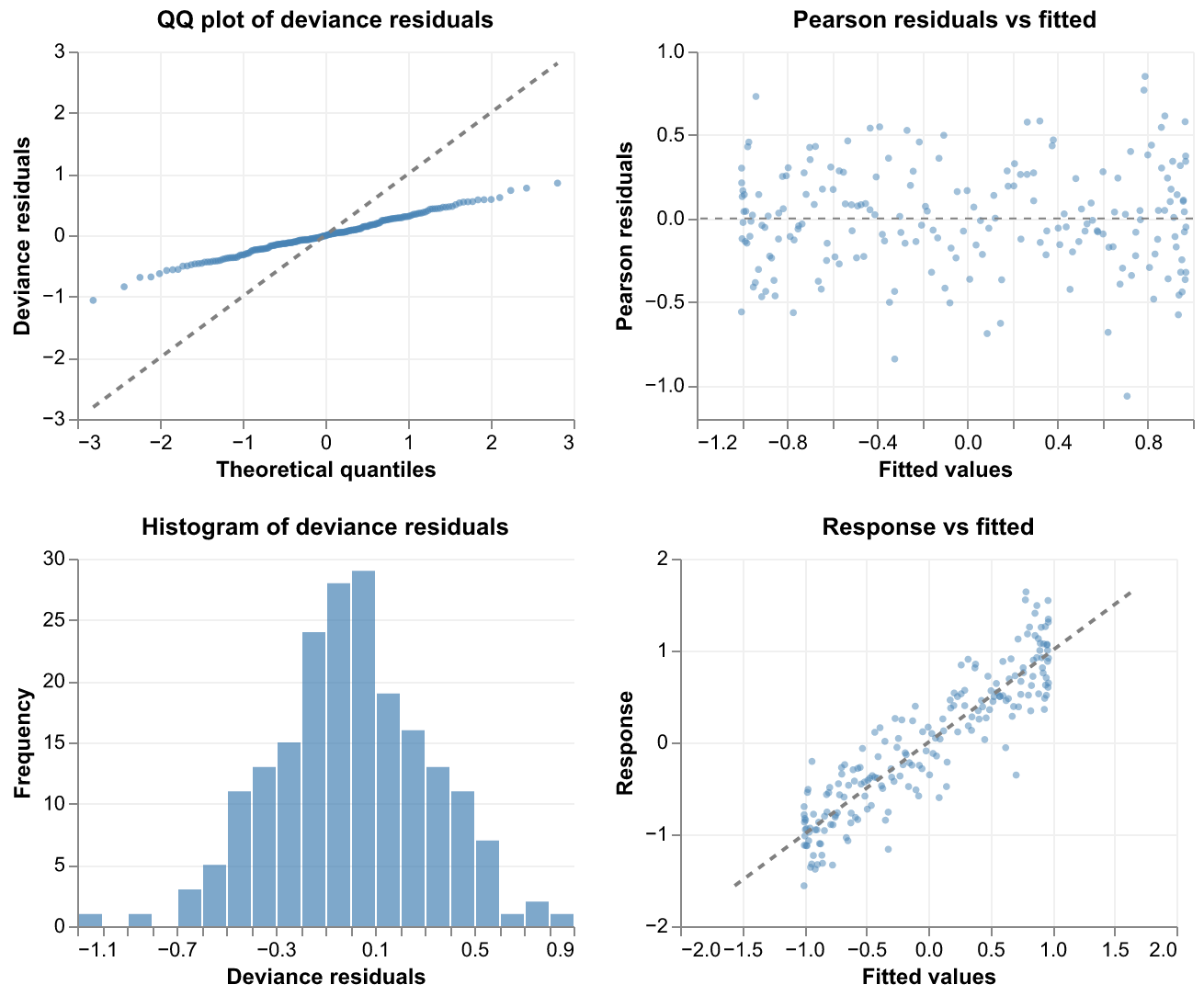
model.summary()for EDF and significance tests,model.check()for basis dimension adequacy (k-index test), concurvity analysis, and residual plots - Cross-validation: k-fold CV with deviance, MSE, or MAE scoring via
cross_validate()
Advanced models:
- Bayesian inference: variational inference (
method="VI") for fast approximate posteriors, and NUTS MCMC (method="MCMC") for exact posterior sampling (both with R-hat, ESS, and divergence diagnostics) - Distributional regression (
GAMLSS): model location, scale, and shape simultaneously (Gaussian, Gamma, and Beta location-scale families, plus zero-inflated Poisson and Negative Binomial) - Quantile regression (
QuantileGAM): fit conditional quantiles with ELF loss, optional non-crossing constraints, and sigma calibration - Conformal prediction (
ConformalPredictor): distribution-free prediction intervals via split, CV+, and jackknife+ methods - Causal inference (
CausalGAM): double/debiased machine learning for ATE and CATE estimation, with mediation analysis - Streaming GAMs (
StreamingGAM): incremental fitting via sufficient statistics with exponential decay for tracking distribution shift - Multi-response GAMs (
MultiResponseGAM): joint fitting of multiple responses with optional residual correlation modeling - Functional regression (
FunctionalGAM): scalar-on-function regression with B-spline or Fourier bases for functional covariates
Scalability and deployment:
- Large datasets:
BigGAM(discretized P-IRLS),PolarsGAM(streaming from Polars/files), andDuckDBGAM(SQL-native streaming) for datasets that exceed memory - Serialization:
save_gam()/load_gam()for compact.npzarchives, andto_mgcv_dict/from_mgcv_dictfor R interoperability - scikit-learn integration:
GAMRegressorandGAMClassifierfor use in pipelines and grid search
Get started
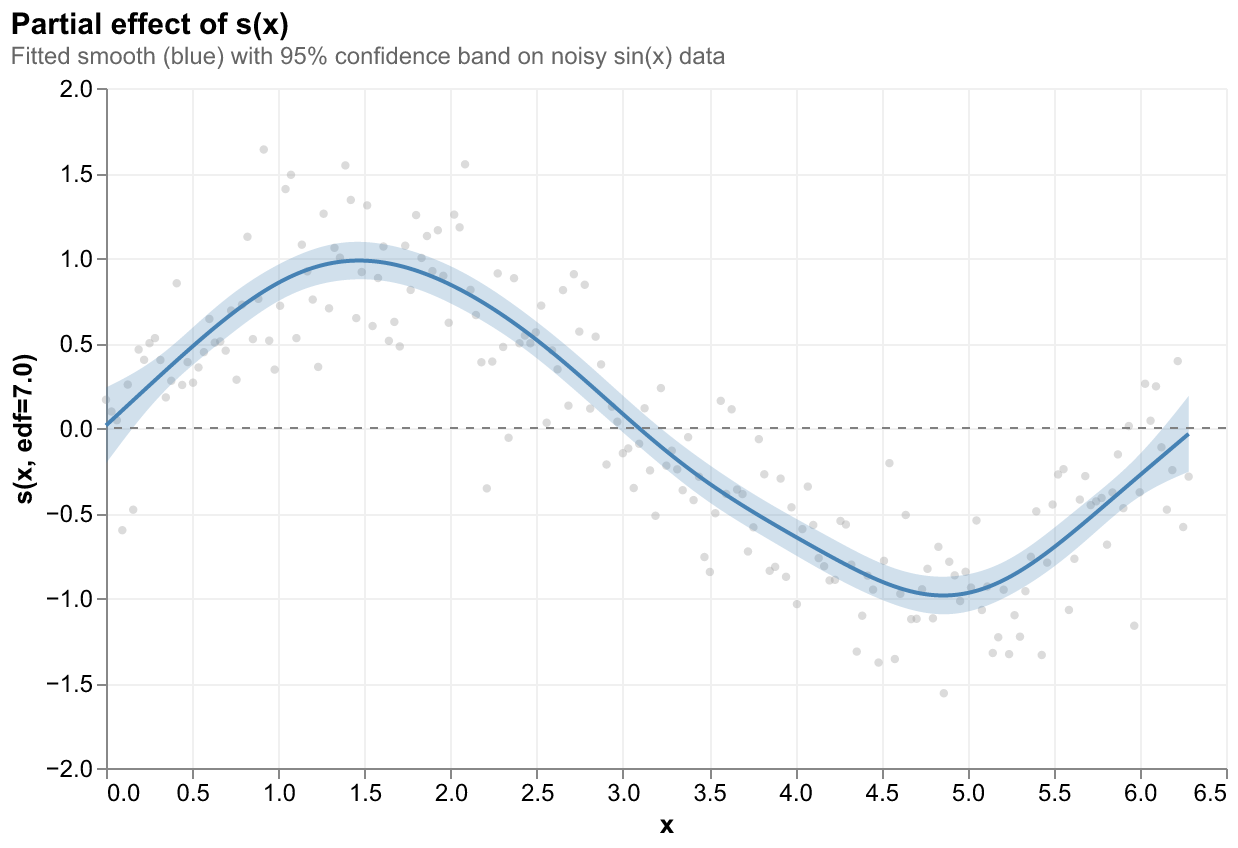
Here's a simple example: fit a smooth to noisy data, inspect the fit, and predict on new observations.
import numpy as np
import whittaker as wk

# Generate some data
rng = np.random.default_rng(23)
x = np.linspace(0, 2 * np.pi, 200)
y = np.sin(x) + rng.normal(0, 0.3, 200)

# Fit a GAM with automatic smoothness selection
model = wk.GAM("y ~ s(x)")
model.fit({"x": x, "y": y}, method="REML")
model.summary()
# Predict with standard errors
preds = model.predict({"x": np.linspace(0, 2 * np.pi, 50)}, se=True)
# Check model adequacy
model.check()
See the user guide for a comprehensive tour of all features, from basic smoothing to distributional regression and causal inference.
See more
A more complete example showing multiple predictors, a non-Gaussian family, and model comparison:
import numpy as np
import whittaker as wk

# Simulate Poisson count data with two smooth effects
rng = np.random.default_rng(23)
n = 500
x1 = rng.uniform(0, 2 * np.pi, n)
x2 = rng.uniform(0, 1, n)
mu = np.exp(0.5 + 0.8 * np.sin(x1) + 2 * x2)
y = rng.poisson(mu).astype(float)

data = {"x1": x1, "x2": x2, "y": y}

# Fit a Poisson GAM
model = wk.GAM("y ~ s(x1) + s(x2)", family=wk.Poisson())
model.fit(data, method="REML")
model.summary()

# Cross-validate to check out-of-sample performance
cv = wk.cross_validate("y ~ s(x1) + s(x2)", data, family=wk.Poisson(), n_folds=5)
print(f"CV score: {cv.cv_score:.4f} (SE: {cv.cv_se:.4f})")

# Predict on new data with confidence intervals
preds = model.predict(
    {"x1": np.linspace(0, 2 * np.pi, 100), "x2": np.full(100, 0.5)},
    interval="confidence", level=0.95,
)

# Save the fitted model for deployment
wk.save_gam(model, "poisson_model.npz")
loaded = wk.load_gam("poisson_model.npz")
Installation
pip install whittaker
For optional backends and visualization:
pip install "whittaker[all]"       # Pandas, Polars, PyArrow, Altair
pip install "whittaker[pl,altair]" # Just Polars and Altair
License
MIT (c) Richard Iannone.
1 maintainer

Metadata
1 maintainer
Release files for whittaker 0.2.0
For a detailed explanation of source distributions (sdists) and built distributions (wheels), please see the package formats documentation.
Source distribution (sdist)
| File | Size | Uploaded | Provenance | Actions |
|---|---|---|---|---|
| whittaker-0.2.0.tar.gz | 3.3 MB | Without provenance | Details for whittaker-0.2.0.tar.gz |
Built distribution (wheel)
| File | Interpreter | ABI | Platform | Actions Reset |
|---|---|---|---|---|
| whittaker-0.2.0-py3-none-any.whl | Python 3 | none | any | Details for whittaker-0.2.0-py3-none-any.whl |
Total release size: 3.6 MB
Release files / whittaker-0.2.0.tar.gz
| Download URL | whittaker-0.2.0.tar.gz |
|---|---|
| Size | 3.3 MB |
| Tags | Source |
|
SHA-256 checksum How to use checksums |
fe0a0d553c267c4d9d41b0ce47da6dbe9595684a4aadf948c64ee124648ddad4
|
|
BLAKE2b-256 checksum How to use checksums |
13e746c729f98324c514e7a3b934b0412264d6b67f7c429ed22be8bb74e8ccf6
|
| Upload date | |
|
Uploaded using Trusted Publishing? What is trusted publishing? |
No |
| Uploaded via |
twine/7.0.0 CPython/3.13.14
|
Release files / whittaker-0.2.0-py3-none-any.whl
| Download URL | whittaker-0.2.0-py3-none-any.whl |
|---|---|
| Size | 328.2 kB |
| Tags | Python 3 |
|
SHA-256 checksum How to use checksums |
cdd4fa408fe0b3d8d57295d9b4debe71c1c13d8ce0271049d90bb1a0b71a87b4
|
|
BLAKE2b-256 checksum How to use checksums |
4cf036bff764d0ccdbc5e2c4b0c5e1fa91de40a0ebe6b24b3448fe069712f6ff
|
| Upload date | |
|
Uploaded using Trusted Publishing? What is trusted publishing? |
No |
| Uploaded via |
twine/7.0.0 CPython/3.13.14
|
Security for whittaker 0.2.0
Provenance
Provenance describes where a file came from. On PyPI, provenance is shared via attestations, which provide a verifiable record of the build or publishing details. View details, limitations and caveats.
No provenance found
None of the files in this release were uploaded with provenance metadata.
A note on package security
PyPI is a repository for distributing packages, not a service for auditing them. While third-party security researchers and our staff do their best to detect and remove malicious packages, PyPI cannot guarantee the quality, security or suitability of any given package.
To learn more about protecting yourself from malicious actors, visit our package security documentation.














