




















Backtest and live — byte-identical, in 10 languages. A streaming-native, event-driven backtester built on the Wickra indicator core.
▶ Live demos: the backtester compiled to WebAssembly, an equity curve building bar by bar — backtest-live.wickra.org; one StrategySpec side by side in Python, Rust, JS and Go — playground.wickra.org; all 514 indicators of the core over a real Binance feed — live.wickra.org. Zero backend, all of them.
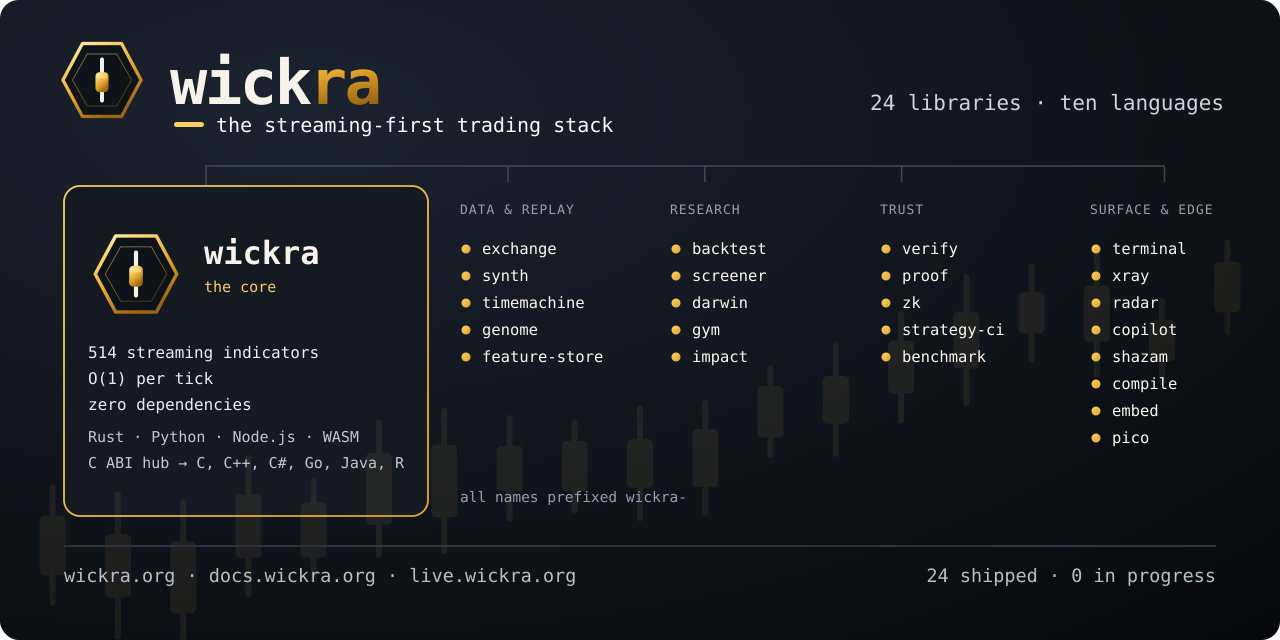
Part of the Wickra ecosystem: the same data-driven core and ten-language binding surface also power wickra-exchange, wickra-terminal, wickra-screener and 20 more — see the full list.
The engine consumes the exact same wickra-core O(1) indicator kernels that
power live Wickra, and a strategy is data (a JSON spec), not code — so a
backtest and a live run over the same spec produce identical signals, across
every Wickra language binding. The same engine, fed live instead of historical
bars, becomes the live bot: backtest ≡ live, by construction.
The strategy spec can reference 495 wickra-core indicators by name — every
backtestable scalar, candle, multi-output, pairwise, derivatives, order-book,
trade, trade-quote and cross-section indicator, with multi-output fields
addressed as "name.field" (macd.signal, bb.upper, adx.plus_di, …). The
registry is generated directly from the wickra-core sources, so it stays in
lock-step with the kernel.
pip install wickra-backtest
import wickra_backtest as wbt

spec = {                                  # a strategy is data, not code
    "symbol": "BTCUSDT", "timeframe": "1h",
    "indicators": {"fast": {"type": "Ema", "params": [12]},
                   "slow": {"type": "Ema", "params": [26]}},
    "entry": {"cross_above": ["fast", "slow"]},
    "exit":  {"cross_below": ["fast", "slow"]},
    "sizing": {"type": "fixed_fraction", "fraction": 0.95},
}

# Backtest: the whole series at once.
report = wbt.run(opens, highs, lows, closes, spec=spec)
print(report["metrics"]["return_pct"], report["metrics"]["sharpe"])

# Live: the same spec, the same engine, one bar at a time. Point `step` at a
# socket instead of an array and nothing else changes.
with wbt.StreamingBacktest(spec=spec) as live:
    for bar in feed:
        live.step(bar.open, bar.high, bar.low, bar.close)
        print(live.num_trades, live.latest_equity())
    report = live.finish()
The two reports are byte-identical. That is the whole claim, and a shared golden corpus holds every one of the ten bindings to it.
Status
0.2.1 — the current release. The engine, the data-driven StrategySpec, the
full execution and cost model, the microstructure feeds and all ten language
bindings are implemented and tested; a shared golden corpus pins the
cross-language equality byte-for-byte.
Documentation
- Strategy spec reference — the full DSL: operands, conditions, sizing, costs, slippage, risk, execution and the report shape.
- Cookbook — six ready-to-run strategies (RSI mean reversion, MACD trend, Bollinger breakout, Donchian breakout, funding carry, order-book imbalance), each validated against the engine.
- Microstructure guide — backtesting on the order book, trades, perpetual funding and market breadth (the differentiator).
- Architecture — crates, data flow and design decisions.
- Benchmarks — throughput methodology and caveats.
- Examples — runnable specs and a sample dataset.
- The JSON Schema for the spec is at
schema/strategy_spec.schema.jsonand is printed bywkbt schema.
Why Wickra Backtest
What it does differently:
- O(1) per tick — years of tick data in seconds, not hours (no recompute-on-every-tick).
- Backtest = live, value-identical across 10 languages — no reimplementation drift, pinned by a shared golden corpus for the OHLCV path and every microstructure feed.
- Microstructure backtesting — replay the order book, trades, perpetual funding and open interest as strategy inputs, not just OHLCV. Most Python backtesters have no place to put them.
- Realistic execution — long/short, market/limit/stop orders, leverage and position caps, five sizing models, intrabar stop-loss / take-profit / trailing stops, maker/taker fees, three slippage models, perpetual funding, liquidation and execution latency.
- Polyglot — the same
StrategySpecruns from Rust, Python, Node.js, WASM, C, C++, C#, Go, Java and R.
| Backtester | Languages | Engine | Strategy is | Book / funding inputs | Latest release |
|---|---|---|---|---|---|
| ★ wickra-backtest | Rust · Python · Node.js · WASM · C · C++ · C# · Go · Java · R | event-driven, O(1)/bar | data (a JSON spec) | yes | unreleased |
| nautilus_trader | Rust · Python | event-driven | code | yes | 2026-08 |
| vectorbt | Python | vectorised | code | — | 2026-07 |
| backtesting.py | Python | vectorised | code | — | 2026-07 |
| zipline-reloaded | Python | event-driven | code | — | 2025-07 |
| backtrader | Python | event-driven | code | — | 2023-04 |
Release dates are the latest published version on PyPI, checked when this table was written; "—" means the feed is not a first-class strategy input, not that the library is bad at what it does. nautilus_trader is the closest comparison and is ahead of this project in places — it is a full trading platform with live venue adapters, and it has shipped for years. The distinction here is narrower and worth stating plainly: a strategy is data rather than code, so the same spec runs unchanged from ten languages and a shared golden corpus pins every one of them to the same report, byte for byte. No other engine in this table offers that because none of them needs to.
Quickstart
A strategy is data — a JSON spec. Run one over a candle file with the wkbt CLI:
cargo run --bin wkbt -- run --data examples/sample.csv --spec examples/ema-cross.json
bars       80
trades     4
return     -2.68%
pnl        -268.21
sharpe     -0.186
max dd     2.68%
win rate   0.0%
fees       37.50
A spec declares named indicators and entry/exit rules over them:
{
  "symbol": "BTCUSDT", "timeframe": "1h",
  "indicators": { "ema_fast": { "type": "Ema", "params": [5] },
                  "ema_slow": { "type": "Ema", "params": [15] } },
  "entry": { "cross_above": ["ema_fast", "ema_slow"] },
  "exit":  { "cross_below": ["ema_fast", "ema_slow"] },
  "sizing": { "type": "fixed_fraction", "fraction": 0.95 },
  "risk": { "trailing_stop_pct": 5.0 }
}
See the cookbook and examples/ for complete
strategies, and the spec reference for the full grammar.
From Rust, the same thing is wickra_backtest::run(&spec, &candles). For live
use, StreamingBacktest::new(&spec, capital) then step(candle) per bar feeds
the same engine one bar at a time — backtest and live are one code path. A
single run_json request bundles candles, the spec and any feeds, and is the
uniform entry point every binding wraps.
Use in any language
Every binding takes the same OHLCV arrays (or a run_json request) and JSON spec
and returns the same report — byte-identical (a dict in Python). Each has a
quickstart:
| Binding | Install | Example |
|---|---|---|
| Rust | cargo add wickra-backtest |
examples/rust |
| Python (PyO3) | pip install wickra-backtest |
examples/python/backtest.py |
| Node.js (napi-rs) | npm install wickra-backtest |
examples/node/backtest.js |
| Browser / WASM | npm install wickra-backtest-wasm |
examples/wasm/backtest.cjs |
| C / C++ (C ABI) | header + library, see bindings/c |
examples/c/streaming.c · cpp_smoke.cpp |
| C# (C ABI) | dotnet add package Wickra.Backtest, see bindings/csharp |
examples/csharp |
| Go (cgo, C ABI) | go get github.com/wickra-lib/wickra-backtest-go, see bindings/go |
examples/go |
| Java (FFM, C ABI) | Maven Central org.wickra:wickra-backtest, see bindings/java |
examples/java |
R (.Call, C ABI) |
R CMD INSTALL bindings/r, see bindings/r |
examples/r/backtest.R |
Every example does the same thing in its own language: read the shared sample
data, run the series both ways, and fail if the two reports differ.
examples/README.md is the cross-language index.
The C, C++, C#, Go, Java and R bindings all call through the same C ABI hub; the golden corpus asserts every language produces the same report, for both the plain OHLCV path and the order-book / trade / derivatives / cross-section feed paths.
Project layout
wickra-backtest/
├── crates/
│   ├── wickra-backtest-core/   engine: spec DSL, registry, rules, execution, portfolio, metrics, report
│   ├── wickra-backtest-data/   loaders (CSV / JSON / JSONL / Parquet) + resampling + Renko/Kagi/PnF
│   ├── wickra-backtest/        facade crate (re-exports the engine + runners)
│   ├── wickra-backtest-cli/    the `wkbt` command-line backtester
│   └── wickra-backtest-bench/  criterion throughput benchmarks
├── bindings/
│   ├── python/   PyO3 + maturin          ├── csharp/  P/Invoke over the C ABI
│   ├── node/     napi-rs                 ├── go/      cgo over the C ABI
│   ├── wasm/     wasm-bindgen            ├── java/    FFM over the C ABI
│   ├── c/        C ABI (cdylib/staticlib + generated header)
│   └── r/        .Call over the C ABI
├── golden/       shared cross-language parity corpus (cases + feed requests)
├── schema/       generated JSON Schema for the strategy spec
├── examples/     runnable strategies + a sample dataset
├── docs/         strategy spec reference + cookbook
└── fuzz/         cargo-fuzz targets (nightly)
Building everything from source
# Rust core + tests + lints
cargo test --workspace --all-features
cargo clippy --workspace --all-targets --all-features -- -D warnings
cargo bench -p wickra-backtest-bench

# Python binding (requires a Rust toolchain + maturin)
cd bindings/python && maturin develop --release && pytest

# Node binding (requires @napi-rs/cli)
cd bindings/node && npm install && npm run build && npm test

# WASM binding (requires wasm-pack)
cd bindings/wasm && wasm-pack build --target nodejs --out-dir pkg && node --test tests/

# C ABI (cdylib + staticlib + generated header)
cargo build -p wickra-backtest-c --release

# C# binding (requires the .NET 8 SDK; links the C ABI above)
dotnet test bindings/csharp/Wickra.Backtest.Tests/Wickra.Backtest.Tests.csproj

# Go binding (requires a C compiler for cgo; links the C ABI above)
cd bindings/go && go test ./...

# Java binding (requires JDK 22+ and Maven; links the C ABI above)
mvn -f bindings/java test

# R binding (requires a C toolchain / Rtools; links the C ABI above)
WKBT_INC="$PWD/bindings/c/include" WKBT_LIB="$PWD/target/debug" R CMD INSTALL bindings/r
The Go, Java and R bindings load the C ABI shared library at run time; put
target/debug (or target/release) on the library path. Fuzzing requires a
nightly toolchain — see fuzz/; the same never-panic invariants are
covered on stable by the property tests.
Testing
Every layer is covered; the commands are in Building from source.
wickra-backtest-core— 113 unit tests: hand-computed round trips (entry at the next open, exit on the signal after it), every sizing model, the cost and slippage models, intrabar stops and liquidation, funding, the rule evaluator, bounded history, and the feed requirements a spec declares. Plus five integration suites: property tests, the shipped example specs, and the three golden runners (batch, streaming, and the microstructure requests).wickra-backtest-data— 17 unit tests over CSV, JSONL, JSON-array and Binance kline decoding, plus the resamplers.bindings/c— 12 Rust tests driving the ABI itself, including the streaming handle's lifecycle and every error path, so a null or finished handle is proven to be reported rather than dereferenced.bindings/python— 21 pytest cases: smoke, streaming, golden parity, completeness of the module and class surface, and the feed path.bindings/node— 19node --testcases, same shape.bindings/wasm— 8node --testcases against the built package.bindings/csharp— 15 xUnit cases.bindings/java— 15 JUnit cases.bindings/go— 15go testcases.bindings/r— 3 script suites.fuzz/— five targets covering the whole untrusted-input surface: the spec parser, the JSON request, the engine loop, the fill model and the data loader.
On top of those, all ten languages replay a shared, language-neutral golden
corpus — four OHLCV cases and five microstructure requests in golden/ — and
assert equality with the Rust reference report. Since the streaming work, each
also replays the corpus one bar at a time and asserts the same report, so
the claim that a backtest and a live loop agree is pinned per language rather
than argued.
What "parity" means here, precisely. The reports are compared byte for byte, not to a tolerance. That is possible because every binding calls the same Rust engine — the arithmetic is not reimplemented anywhere — and because the indicators the corpus names use only IEEE-754 arithmetic, which every conforming platform rounds identically. It is not free, though: a spec can name any indicator in the core, and some of those call a transcendental from the platform's math library (
ln,atan,expand friends). No mainstream libm rounds those correctly, and implementations differ in the last bit — the sibling indicator library measured a one-ulp difference on 24 of 67 bars for a single indicator. A golden case built on one of those would have to compare to a relative tolerance instead. None currently does, and that is a property of the corpus worth keeping deliberately rather than by accident.
Requirements
The minimum supported version per language. The same engine kernel runs behind
every binding; the C-ABI bindings that compile on install — Go (cgo) and R
(.Call) — also need a C compiler, and Java runs with
--enable-native-access=ALL-UNNAMED.
| Language | Package | Minimum supported |
|---|---|---|
| Rust | crates.io · wickra-backtest |
1.86 (MSRV) |
| Python | PyPI · wickra-backtest (abi3 wheel) |
3.9 (tested through 3.13) |
| Node.js | npm · wickra-backtest (N-API 8) |
22 (tested on 22 · 24 LTS) |
| WASM | npm · wickra-backtest-wasm |
any modern JS engine |
| C | wickra_backtest.h + library (releases) |
C99 compiler |
| C++ | the C ABI + optional wickra_backtest.hpp |
C++14 compiler |
| C# | NuGet · Wickra.Backtest |
.NET 8 (net8.0) |
| Go | module · wickra-lib/wickra-backtest-go |
Go 1.23 (cgo) |
| Java | Maven Central · org.wickra:wickra-backtest |
Java 22 (FFM / Panama) |
| R | r-universe · wickrabacktest |
R ≥ 4.1 (Rtools on Win.) |
Benchmarks
O(1) per bar — about 1.7M bars/second on one core (a year of 1-minute bars in ~0.3 s). The cost of a bar is bounded by the indicators the spec configures, never by how much history precedes it. Full tables and how to reproduce them live in BENCHMARKS.md.
Pick your language with eyes open — per-binding throughput
Every binding drives the same Rust engine, so this is not a speed claim — it is the raw cost of crossing each language's FFI boundary, measured with the shared example strategy over 100,000 bars (median of three runs, one development machine). Batch collapses towards the floor; streaming is where the boundary shows — so if you drive a live loop bar by bar, the table tells you which binding keeps up.
| Binding | streaming | ns/bar | batch | ns/bar |
|---|---|---|---|---|
| C | 6,750,000 b/s | 148 | 6,548,000 b/s | 153 |
| C# | 6,188,000 b/s | 162 | 6,315,000 b/s | 158 |
| Go | 4,621,000 b/s | 216 | 6,448,000 b/s | 155 |
| Java | 4,493,000 b/s | 223 | 5,565,000 b/s | 180 |
| WASM | 4,127,000 b/s | 242 | 4,878,000 b/s | 205 |
| Node | 3,438,000 b/s | 291 | 2,530,000 b/s | 395 |
| Python | 1,411,000 b/s | 709 | 1,486,000 b/s | 673 |
| R | 284,000 b/s | 3,527 | 6,213,000 b/s | 161 |
C is the floor: it calls the exported functions directly, with no marshalling of its own, so its ~148 ns/bar is the engine plus a function call — every other row is that number plus what the language adds. Two results are the opposite of what one might assume: Node's batch path is slower than its streaming path (marshalling six JavaScript arrays across napi costs more than 100,000 scalar calls), and WASM beats the native Node binding on both paths. All ten share one verified implementation, so the numbers differ but the values do not. Methodology and the per-binding discussion are in BENCHMARKS.md.
Ecosystem
Part of the Wickra family — each one a data-driven core with a CLI and the same ten-language binding surface:
- wickra — main library (Rust core + Python / Node.js / WASM bindings + a C ABI for C / C++ / C# / Go / Java / R)
- wickra-playground — a polyglot strategy playground: one StrategySpec live side by side in Python, Rust, JS and Go, entirely in the browser
- wickra-exchange — unified market-data + execution across ten crypto exchanges
- wickra-terminal — the trading terminal: a TUI and a browser renderer over the stack
- wickra-screener — parallel multi-symbol screening over 495 streaming indicators
- wickra-xray — market-microstructure explorer: footprint, order-book heatmap, liquidation map, funding/OI divergence
- wickra-radar — perp-universe alert radar: OI delta, funding flip, book imbalance, liquidation clusters, OI/price divergence
- wickra-copilot — local market copilot grounded in real order-book, liquidation and funding microstructure
- wickra-shazam — match an asset's current microstructure fingerprint against its entire history
- wickra-benchmark — reproducible, golden-verified benchmark suite — recompute any (strategy, dataset, report) in ten languages and confirm it byte-for-byte
- wickra-strategy-ci — Jest for trading strategies: golden-pin the report, catch regressions in CI, property-test against fuzzed data
- wickra-verify — confirm or refute a claimed backtest report against its strategy and data, in ten languages
- wickra-proof — Proof-of-Backtest: deterministic (spec, data) → report + blake3 hash, recomputable byte-for-byte in ten languages
- wickra-zk — prove a backtest zero-knowledge — on-chain-verifiable performance without revealing the data or the strategy
- wickra-impact — the backtester that knows you would have moved the market: agent-based fills on the real historical L2 order book
- wickra-darwin — evolutionary strategy search at millions of backtests per second, mutating and crossing JSON specs across the 495-indicator space
- wickra-gym — a Gymnasium-compatible, microstructure-aware backtest environment with O(1) steps for deterministic RL rollouts
- wickra-feature-store — OHLCV and microstructure streams into ML-ready feature matrices over 495 O(1) streaming indicators
- wickra-genome — a vector database of the whole market: every asset a 495-dim live vector, for similarity search, clustering and anomaly detection
- wickra-timemachine — scrub the whole market like a video — every symbol, full order book, rewound to any moment via deterministic re-fold
- wickra-synth — deterministic synthetic market microstructure: OHLCV, order book, trades and funding from a single seed
- wickra-compile — compile a strategy spec into a standalone deployable: a WASM module, a self-contained binary, or a
no_stdartifact - wickra-embed — allocation-free,
no_stdstreaming indicators for bare-metal and HFT, byte-for-byte identical to the core - wickra-pico — the O(1) indicator core running bare-metal on a $5 Raspberry Pi Pico — the LED blinks on the EMA cross
This project's own site is backtest.wickra.org and its in-browser demo backtest-live.wickra.org. The indicator core it is built on documents itself at docs.wickra.org.
Contributing
Contributions are welcome — issues, bug reports, ideas and pull requests all land
at https://github.com/wickra-lib/wickra-backtest. See
CONTRIBUTING.md for the orientation: the engine lives in
crates/wickra-backtest-core, every binding under bindings/<lang> keeps the
golden-corpus parity invariant, and cargo fmt --all +
cargo clippy --workspace --all-targets --all-features -- -D warnings are CI
gates. For larger changes, open an issue first.
Security
Found a security issue? Please don't open a public issue. Report it privately via the repository's Security tab ("Report a vulnerability") or email support@wickra.org. Full policy: SECURITY.md.
License
Licensed under either of
- Apache License, Version 2.0 (LICENSE-APACHE or http://www.apache.org/licenses/LICENSE-2.0)
- MIT license (LICENSE-MIT or http://opensource.org/licenses/MIT)
at your option. Use it, fork it, modify it, redistribute it — commercially or not — file issues, send pull requests; all welcome.
Contribution
Unless you explicitly state otherwise, any contribution intentionally submitted for inclusion in the work by you, as defined in the Apache-2.0 license, shall be dual licensed as above, without any additional terms or conditions.
Disclaimer
Not a trading system. Backtest results are deterministic transforms of the input data — they are not financial advice and are not indicative of future performance. Any use in a live trading context is at your own risk. The software is provided as is, without warranty of any kind; see the license files for the full terms.



Built on Wickra. If it saved you time, the cheapest way to say thanks is to ⭐ the repo.
1 maintainer

Metadata
1 maintainer
Release files for wickra-backtest 0.2.1
For a detailed explanation of source distributions (sdists) and built distributions (wheels), please see the package formats documentation.
Source distribution (sdist)
| File | Size | Uploaded | Provenance | Actions |
|---|---|---|---|---|
| wickra_backtest-0.2.1.tar.gz | 151.8 kB | Without provenance | Details for wickra_backtest-0.2.1.tar.gz |
Built distributions (wheels)
Total release size: 6.3 MB
Release files / wickra_backtest-0.2.1.tar.gz
| Download URL | wickra_backtest-0.2.1.tar.gz |
|---|---|
| Size | 151.8 kB |
| Tags | Source |
|
SHA-256 checksum How to use checksums |
c7cf49bcc8fb7a068a26c32521896dc142f5da08249f1ba98aa9ccafd559d488
|
|
BLAKE2b-256 checksum How to use checksums |
0b324291d1cf276cd9143cd91293c408ea3ada48cde4395d8f1c347aef6ec8d4
|
| Upload date | |
|
Uploaded using Trusted Publishing? What is trusted publishing? |
No |
| Uploaded via |
maturin/1.15.0
|
Release files / wickra_backtest-0.2.1-cp39-abi3-win_arm64.whl
| Download URL | wickra_backtest-0.2.1-cp39-abi3-win_arm64.whl |
|---|---|
| Size | 620.3 kB |
| Tags | CPython 3.9 Windows ARM64 abi3 |
|
SHA-256 checksum How to use checksums |
061ba2e28af06eaad333e7d2157220b1c9c5252fc242b72fdb7e2c51e2e7bf72
|
|
BLAKE2b-256 checksum How to use checksums |
4a38ab89323b9b5f1981dac3253cf00d2499feb0854c0f8c3ac4193864b43762
|
| Upload date | |
|
Uploaded using Trusted Publishing? What is trusted publishing? |
No |
| Uploaded via |
maturin/1.15.0
|
Release files / wickra_backtest-0.2.1-cp39-abi3-win_amd64.whl
| Download URL | wickra_backtest-0.2.1-cp39-abi3-win_amd64.whl |
|---|---|
| Size | 702.0 kB |
| Tags | CPython 3.9 Windows x86-64 abi3 |
|
SHA-256 checksum How to use checksums |
e133b54bee10a6893f38adcb627cb9ff65674da728033906d42555340f47bd2d
|
|
BLAKE2b-256 checksum How to use checksums |
e6c62d6ca8b403c2d29a19d14e6b21691f4b39f31a0c936dceb473b70c1cab70
|
| Upload date | |
|
Uploaded using Trusted Publishing? What is trusted publishing? |
No |
| Uploaded via |
maturin/1.15.0
|
Release files / wickra_backtest-0.2.1-cp39-abi3-musllinux_1_2_x86_64.whl
| Download URL | wickra_backtest-0.2.1-cp39-abi3-musllinux_1_2_x86_64.whl |
|---|---|
| Size | 1.0 MB |
| Tags | CPython 3.9 Linux musl 1.2+ x86-64 abi3 |
|
SHA-256 checksum How to use checksums |
e13ca2c49e47b49214dc908ac12223ffe1c24e89d3d5141365aef54441bd5d20
|
|
BLAKE2b-256 checksum How to use checksums |
a7c6c751ed47eb39de2efa9458397a5920be2425bbf0968a2bc5273fb2ed58ec
|
| Upload date | |
|
Uploaded using Trusted Publishing? What is trusted publishing? |
No |
| Uploaded via |
maturin/1.15.0
|
Release files / wickra_backtest-0.2.1-cp39-abi3-musllinux_1_2_aarch64.whl
| Download URL | wickra_backtest-0.2.1-cp39-abi3-musllinux_1_2_aarch64.whl |
|---|---|
| Size | 890.7 kB |
| Tags | CPython 3.9 Linux musl 1.2+ ARM64 abi3 |
|
SHA-256 checksum How to use checksums |
e37b608c9b74c0531205be1b1a14251884a361045747fd1454af66019584e44d
|
|
BLAKE2b-256 checksum How to use checksums |
a755ea9e782fda424694041a58451c5aacaad974ddb5482a7ea9de2fa0dcf114
|
| Upload date | |
|
Uploaded using Trusted Publishing? What is trusted publishing? |
No |
| Uploaded via |
maturin/1.15.0
|
Release files / wickra_backtest-0.2.1-cp39-abi3-manylinux_2_17_x86_64.manylinux2014_x86_64.whl
| Download URL | wickra_backtest-0.2.1-cp39-abi3-manylinux_2_17_x86_64.manylinux2014_x86_64.whl |
|---|---|
| Size | 785.7 kB |
| Tags | CPython 3.9 Linux glibc 2.17+ x86-64 abi3 |
|
SHA-256 checksum How to use checksums |
8d16133cdc9529d72af138fede93997850d7a5debe20e7308e959d0a49836473
|
|
BLAKE2b-256 checksum How to use checksums |
ef820d738e6a18678e25dcc644ab33de327a2bf9388beb3ff54408340b78b98d
|
| Upload date | |
|
Uploaded using Trusted Publishing? What is trusted publishing? |
No |
| Uploaded via |
maturin/1.15.0
|
Release files / wickra_backtest-0.2.1-cp39-abi3-manylinux_2_17_aarch64.manylinux2014_aarch64.whl
| Download URL | wickra_backtest-0.2.1-cp39-abi3-manylinux_2_17_aarch64.manylinux2014_aarch64.whl |
|---|---|
| Size | 711.4 kB |
| Tags | CPython 3.9 Linux glibc 2.17+ ARM64 abi3 |
|
SHA-256 checksum How to use checksums |
ef45f36e5074e8e4acbe26cac78f9f284fbc63fdad8d6ba8137ec852f21f9d5f
|
|
BLAKE2b-256 checksum How to use checksums |
3107577e3cffb006b8b95ca7903d0b4c7023353b3fff96b7e145a0d0cd78bfb9
|
| Upload date | |
|
Uploaded using Trusted Publishing? What is trusted publishing? |
No |
| Uploaded via |
maturin/1.15.0
|
Release files / wickra_backtest-0.2.1-cp39-abi3-macosx_11_0_arm64.whl
| Download URL | wickra_backtest-0.2.1-cp39-abi3-macosx_11_0_arm64.whl |
|---|---|
| Size | 686.5 kB |
| Tags | CPython 3.9 abi3 macOS 11.0+ ARM64 |
|
SHA-256 checksum How to use checksums |
0b0816620a8c10d9bc66652b88ece714f9e2d6488c3838024eb8817559ab287e
|
|
BLAKE2b-256 checksum How to use checksums |
acd7f284e932a613aa59f0b1d67bff88d3a33a6c55f8b7b2c8caf22c62bfdc8d
|
| Upload date | |
|
Uploaded using Trusted Publishing? What is trusted publishing? |
No |
| Uploaded via |
maturin/1.15.0
|
Release files / wickra_backtest-0.2.1-cp39-abi3-macosx_10_12_x86_64.whl
| Download URL | wickra_backtest-0.2.1-cp39-abi3-macosx_10_12_x86_64.whl |
|---|---|
| Size | 749.6 kB |
| Tags | CPython 3.9 abi3 macOS 10.12+ x86-64 |
|
SHA-256 checksum How to use checksums |
4dd7983e4592e8c3124b3c93d382bea363e0a459d2a2cc659ba9af78d722f40c
|
|
BLAKE2b-256 checksum How to use checksums |
6d44af9926258dc466082c1caf8b0331f05183f565c7143aaca85401ef3264dc
|
| Upload date | |
|
Uploaded using Trusted Publishing? What is trusted publishing? |
No |
| Uploaded via |
maturin/1.15.0
|
Security for wickra-backtest 0.2.1
Provenance
Provenance describes where a file came from. On PyPI, provenance is shared via attestations, which provide a verifiable record of the build or publishing details. View details, limitations and caveats.
No provenance found
None of the files in this release were uploaded with provenance metadata.
A note on package security
PyPI is a repository for distributing packages, not a service for auditing them. While third-party security researchers and our staff do their best to detect and remove malicious packages, PyPI cannot guarantee the quality, security or suitability of any given package.
To learn more about protecting yourself from malicious actors, visit our package security documentation.














