




















One typed API. Ten exchanges. Eight languages. Streaming-native crypto-exchange connectivity — market data and signed order execution — built on the Wickra core.
use wickra_exchange::{Exchange, ExchangeOptions, MarketData, OrderRequest, PaperExchange};

// Offline: fills are simulated, deterministically.
let mut ex = PaperExchange::new().with_balance("USDT", dec!(100_000));
ex.set_price(&market, dec!(20_000));

// Live: same trait, same calls, same order type — only the constructor differs.
let mut ex = Exchange::new("binance", creds, ExchangeOptions::testnet(MarketType::Spot))?;

let order = ex.place_order(&OrderRequest::market_buy(market, dec!(1)))?;
println!("{} filled at {:?}", order.filled_quantity, order.average_price);
▶ Live demos: the backtester compiled to WebAssembly, an equity curve building bar by bar — backtest-live.wickra.org; one StrategySpec side by side in Python, Rust, JS and Go — playground.wickra.org; all 514 indicators of the core over a real Binance feed — live.wickra.org. Zero backend, all of them.
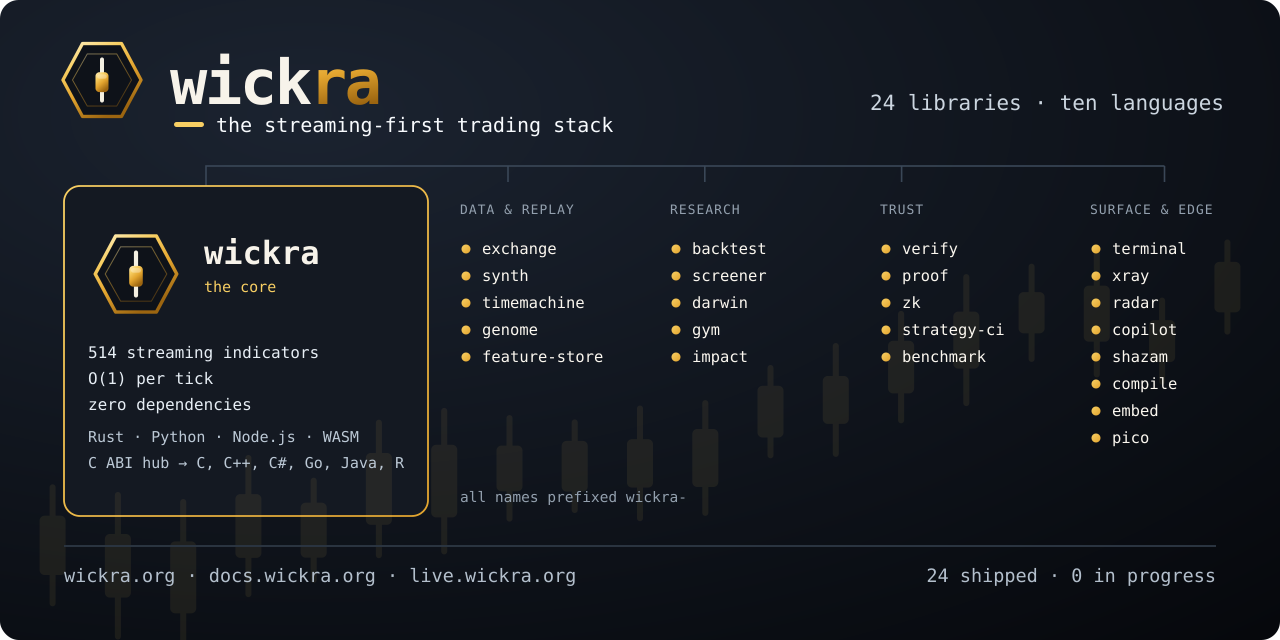
Part of the Wickra ecosystem: the same data-driven core and ten-language binding surface also power wickra-backtest, wickra-terminal, wickra-screener and 20 more — see the full list.
A single, compile-time-typed Exchange trait spans the ten largest venues
(Binance, OKX, Bybit, Coinbase, Upbit, Bitget, Gate.io, Kraken, KuCoin, HTX)
behind bespoke authentication and WebSocket state machines. Market-data streams
are pull-based (poll_events), so the same surface crosses the C ABI to
every binding — including single-threaded R — as trivially as a synchronous
call. Quantities in the order layer are exact Decimal, never f64.
What makes it more than "a typed ccxt" is that it plugs straight into the rest of Wickra:
PaperExchange— a first-classExchangeimplementation that simulates fills through the wickra-backtest engine. The same strategy runs paper ↔ live by swapping the implementation.- Microstructure-native feeds — trades and depth arrive from the venue
streams already shaped for
wickra-core, and one call converts each into the exact input type the indicators consume (Trade,OrderBook,CrossSection) — feeding 514 indicators and the backtester with zero glue. The derivatives channels (funding, open interest, liquidations, positioning, mark/index) are typed too and fold into aDerivativesTick, and all eight futures venues subscribe to them. A venue that publishes no such channel refuses it rather than subscribing to nothing — the matrix says which, and why. The matrix says which channel each venue publishes, and where a venue publishes none it refuses rather than subscribing to nothing. See Derivatives feeds. ReplayExchange— a recorded feed driven through the same trait, so a backtest runs on real recorded microstructure.
The same Exchange API is reachable from Rust, Python, Node.js, C, C++, C#,
Go, Java and R — native PyO3 / napi bindings plus a C ABI hub.
There is also a WASM binding, and it is deliberately smaller than the rest:
wasm32-unknown-unknown has no sockets, so no live venue client can exist there,
and authenticated trading needs raw sockets and secret keys a browser sandbox
forbids. What it does carry is the part that needs neither — the offline
PaperExchange and ReplayExchange, with the same order, balance and event API
the live clients expose. That is enough to run a strategy, or a replay UI, in a
page; the browser-safe slice of public market data remains covered by
wickra-wasm over a browser WebSocket. See
bindings/wasm for what is present and what is not.
Status
0.2.0 — the current release. Ten exchanges behind one typed API — market data and signed execution — the deterministic paper exchange, all ten language bindings, the byte-exact golden corpus, property + fuzz tests, benchmarks and one runnable example per language are in place and green across the full CI matrix (10 languages × 3 OS). ROADMAP.md has what is done, what is open and what is not planned.
⚠️ Real orders move real money. Every signed-execution code path is safety-critical. Use withdrawal-disabled keys, test against exchange testnets first, and never put secret keys in a browser or client.
Documentation
- Exchanges — the ten venues, their market types and the per-exchange capability matrix.
- Authentication — the signing families (HMAC-SHA256/512,
JWT ES256/HS512, passphrase) and how
Credentialsmap onto each. - Streaming — the pull-based event model, the local order-book builder and reconnect/resubscribe semantics.
- Derivatives & advanced orders — the
Derivatives,AdvancedOrders,WsUserDataandWsExecutiontraits, futures routing, and per-venue gaps. - Capability matrix — real per-venue support for spot/futures, positions/leverage/margin, and STP/amend/batch/OCO/WS-order.
- Architecture — crates, traits, the transport abstraction and design decisions.
- Benchmarks — signing / parse / filter-rounding throughput, and what each binding costs to cross.
- Examples — one runnable program per language.
Quickstart
Connect, read a ticker, subscribe to a pull-based stream, and place an order on a testnet:
use wickra_exchange::{Exchange, Credentials, ExchangeOptions, MarketType, OrderRequest};

let creds = Credentials::new("api-key", "api-secret");
let opts = ExchangeOptions::testnet(MarketType::Spot);
let mut ex = Exchange::new("binance", creds, opts)?;

// REST: a typed ticker.
let ticker = ex.ticker("BTC/USDT")?;
println!("last = {}", ticker.last);

// Streaming: subscribe, then drain events from your own loop (pull, not callbacks).
ex.subscribe_trades("BTC/USDT")?;
for event in ex.poll_events() {
    println!("{event:?}");
}

// Signed execution (testnet) with exact Decimal price/qty.
let order = OrderRequest::limit_buy("BTC/USDT", "0.001".parse()?, "20000".parse()?);
let placed = ex.place_order(&order)?;
println!("order id = {}", placed.id);
The same flow is available from every binding — see the per-language quickstarts below.
Exchanges
The ten largest venues by volume, each behind the same Exchange trait. The
signing family drives the per-exchange authentication; everything above it
(symbols, order types, the order-book builder, reconnect) is shared.
| # | Exchange | Spot | USDⓈ-M | COIN-M | Signing family |
|---|---|---|---|---|---|
| 1 | Binance | ✅ | ✅ | ⏳ | HMAC-SHA256 (query string), Ed25519 optional |
| 2 | OKX | ✅ | ✅ | ⏳ | HMAC-SHA256 (ts+method+path+body, b64) + passphrase |
| 3 | Bybit | ✅ | ✅ | ⏳ | HMAC-SHA256 (ts+key+recvWindow+payload) |
| 4 | Coinbase | ✅ | — | — | JWT ES256 / Ed25519 per request |
| 5 | Upbit | ✅ | — | — | JWT HS512 + SHA512 query hash |
| 6 | Bitget | ✅ | ✅ | ⏳ | HMAC-SHA256 (b64) + passphrase |
| 7 | Gate.io | ✅ | ✅ | ⏳ | HMAC-SHA512 (SHA512 payload hash) |
| 8 | Kraken | ✅ | ⏳ | — | HMAC-SHA512 (URI + SHA256(nonce+body)), b64 secret |
| 9 | KuCoin | ✅ | ⏳ | — | HMAC-SHA256 (b64) + signed passphrase |
| 10 | HTX | ✅ | ⏳ | — | HMAC-SHA256 AWS-style (method+host+path+sorted) |
✅ implemented · ⏳ planned · — not offered by the venue. The current state of each cell is tracked in docs/EXCHANGES.md.
Use in any language
| Language | Binding | Quickstart |
|---|---|---|
| Rust | wickra-exchange crate |
this README |
| Python | PyO3 / maturin | bindings/python |
| Node.js | napi-rs | bindings/node |
| C / C++ | C ABI (cbindgen) | bindings/c |
| C# | P/Invoke | bindings/csharp |
| Go | cgo | bindings/go |
| Java | FFM / Panama | bindings/java |
| R | .Call |
bindings/r |
| WASM | wasm-pack | bindings/wasm — paper / replay only |
The C, C++, C#, Go, Java and R bindings all call through the same C ABI hub. The replay corpus asserts every language normalises recorded exchange responses into byte-identical typed structs.
Project layout
wickra-exchange/
├── crates/
│   ├── wickra-exchange-core/   traits + types (Decimal) + credentials + the
│   │                           connectivity machinery (symbol, clock, ratelimiter,
│   │                           orderbook builder, transport, ws, reconcile, feeds)
│   │                           and the per-exchange implementations
│   ├── wickra-exchange/        facade crate (re-exports the public surface)
│   └── wickra-exchange-bench/  criterion signing / parse / filter benchmarks
├── bindings/
│   ├── python/   PyO3 + maturin          ├── csharp/  P/Invoke over the C ABI
│   ├── node/     napi-rs                 ├── go/      cgo over the C ABI
│   ├── c/        C ABI (cdylib + header) ├── java/    FFM over the C ABI
│   ├── r/        .Call over the C ABI    └── wasm/    wasm-pack (paper/replay only)
├── golden/       recorded-response replay corpus + expected normalised structs
├── examples/     one runnable program per language
├── benchmarks/   what each binding costs to cross, one program per language
├── docs/         exchanges, auth, streaming and architecture guides
└── fuzz/         cargo-fuzz targets (nightly)
bindings/wasm/ carries the offline simulators only — see the intro for why.
Building everything from source
# Rust core + tests + lints
cargo test --workspace --all-features
cargo clippy --workspace --all-targets --all-features -- -D warnings
cargo bench -p wickra-exchange-bench

# Python binding (requires a Rust toolchain + maturin)
cd bindings/python && maturin develop --release && pytest

# Node binding (requires @napi-rs/cli)
cd bindings/node && npm install && npm run build && npm test

# C ABI (cdylib + staticlib + generated header)
cargo build -p wickra-exchange-c --release

# C# binding (requires the .NET 8 SDK; links the C ABI above)
dotnet test bindings/csharp/WickraExchange.Tests/WickraExchange.Tests.csproj

# Go binding (requires a C compiler for cgo; links the C ABI above)
cd bindings/go && go test ./...

# Java binding (requires JDK 22+ and Maven; links the C ABI above)
mvn -f bindings/java test

# R binding (requires a C toolchain / Rtools; links the C ABI above)
WKEX_INC="$PWD/bindings/c/include" WKEX_LIB="$PWD/target/debug" R CMD INSTALL bindings/r
Integration tests that hit a live exchange run only against testnets, are
gated behind environment variables and are #[ignore] by default — they never
touch mainnet with real keys. Fuzzing requires a nightly toolchain — see
fuzz/.
Testing
Run the suites with the commands in Building everything from source.
wickra-exchange-core— 669 unit tests. Every venue client is generic over an injected transport, so its request-build, signing, parse and normalise path is exercised offline againstMockHttpTransport/MockWsTransport: queued responses in, recorded requests out.tests/conformance.rs— contracts everyExchangeimplementation must satisfy, not one venue's behaviour: the order lifecycle (place a resting order → query it → find it in open orders → cancel it) againstPaperExchangeandReplayExchange, and object-safety plus naming against all ten venue clients.tests/proptest_invariants.rs— property tests over the shared machinery: filter rounding stays on the step/tick grid, and decimal and symbol parse/format round-trips.tests/golden.rs— the recorded scenarios undergolden/.crates/wickra-exchange/tests/live_public.rs— the other half of the offline suite, and the reason it is not enough on its own. A mock-transport test proves the parser reads what the author believed; it cannot prove that belief matched the venue, because the fixture and the parser were written by the same hand from the same reading. This suite asks the real venue and hands the answer to the real parser — all ten clients, throughticker,klinesandorder_book, with no credentials. It is#[ignore]d and runs nightly fromtestnet.yml, never on a push. A failure means the venue answered and the parser could not read the reply; network errors, geo-blocks and auth errors are skipped out loud, because they say nothing about the code.fuzz/— fivecargo-fuzztargets over everything a remote server can put on the wire: JSON responses, WebSocket frames, order-book diffs, filter rounding and credential/symbol parsing. Nothing may panic, because a panic across the C ABI is undefined behaviour. CI runs each briefly on every push.- Bindings —
pytest(Python),node --test(Node),dotnet test(C#),go test(Go), JUnit (Java) andtestthat(R), each covering construction, the market-data and execution surface, derivatives and replay. - Surface parity —
scripts/check_binding_surface.pyreads the trait methods out ofcrates/wickra-exchange-core/src/traits.rsand holds all seven bindings to them. A method or constructor present in one binding and missing from another fails CI; nothing else compares the bindings to each other. - Examples — every example is built or parsed on each push, the compiled ones against the binding in this tree.
What the offline suites cannot tell you
Every venue test above feeds the client a response the test itself wrote. That
proves the parser handles the shape it was given; it cannot prove the shape is
the one the venue actually sends. Live coverage is deliberately narrow and
deliberately separate: .github/workflows/testnet.yml runs the #[ignore]
integration tests nightly and on demand against public endpoints. They are
#[ignore] by default and gated behind environment variables, so a normal
cargo test never opens a socket and mainnet with real keys is never touched.
Requirements
The minimum supported version per language. The same Rust core runs behind every
binding; the C-ABI bindings that compile on install — Go (cgo) and R (.Call) —
also need a C compiler, and Java runs with --enable-native-access=ALL-UNNAMED.
| Language | Package | Minimum supported |
|---|---|---|
| Rust | crates.io · wickra-exchange |
1.86 (MSRV) |
| Python | PyPI · wickra-exchange (abi3 wheel) |
3.9 (tested through 3.13) |
| Node.js | npm · wickra-exchange (N-API 8) |
22 (tested on 22 · 24 LTS) |
| C | wickra_exchange.h + library (releases) |
C99 compiler |
| C++ | over the C ABI | C++14 compiler |
| C# | NuGet · WickraExchange |
.NET 8 (net8.0) |
| Go | module · wickra-lib/wickra-exchange-go |
Go 1.23 (cgo) |
| Java | Maven Central · org.wickra:wickra-exchange |
Java 22 (FFM / Panama) |
| R | r-universe · wickraexchange |
R ≥ 4.1 (Rtools on Win.) |
Benchmarks
Connectivity throughput is dominated by the network, not the CPU, so the benchmarks measure the CPU-bound work done per request — the part that must not become the bottleneck under load — rather than round-trip latency, which is not reproducible and not ours to measure.
cargo bench -p wickra-exchange-bench
Four groups: request signing (HMAC-SHA256/512 and JWT construction), response
parsing (recorded payloads into the typed structs), filter rounding (a price or
quantity onto a venue's lot/tick/min-notional grid, in Decimal), and
order-book diff application including sequence-gap detection.
Measured figures, the methodology and the machine they were taken on are in BENCHMARKS.md.
Ecosystem
Part of the Wickra family — each one a data-driven core with a CLI and the same ten-language binding surface:
- wickra — main library (Rust core + Python / Node.js / WASM bindings + a C ABI for C / C++ / C# / Go / Java / R)
- wickra-playground — a polyglot strategy playground: one StrategySpec live side by side in Python, Rust, JS and Go, entirely in the browser
- wickra-backtest — event-driven backtester over the Wickra core
- wickra-terminal — the trading terminal: a TUI and a browser renderer over the stack
- wickra-screener — parallel multi-symbol screening over 514 streaming indicators
- wickra-xray — market-microstructure explorer: footprint, order-book heatmap, liquidation map, funding/OI divergence
- wickra-radar — perp-universe alert radar: OI delta, funding flip, book imbalance, liquidation clusters, OI/price divergence
- wickra-copilot — local market copilot grounded in real order-book, liquidation and funding microstructure
- wickra-shazam — match an asset's current microstructure fingerprint against its entire history
- wickra-benchmark — reproducible, golden-verified benchmark suite — recompute any (strategy, dataset, report) in ten languages and confirm it byte-for-byte
- wickra-strategy-ci — Jest for trading strategies: golden-pin the report, catch regressions in CI, property-test against fuzzed data
- wickra-verify — confirm or refute a claimed backtest report against its strategy and data, in ten languages
- wickra-proof — Proof-of-Backtest: deterministic (spec, data) → report + blake3 hash, recomputable byte-for-byte in ten languages
- wickra-zk — prove a backtest zero-knowledge — on-chain-verifiable performance without revealing the data or the strategy
- wickra-impact — the backtester that knows you would have moved the market: agent-based fills on the real historical L2 order book
- wickra-darwin — evolutionary strategy search at millions of backtests per second, mutating and crossing JSON specs across the 514-indicator space
- wickra-gym — a Gymnasium-compatible, microstructure-aware backtest environment with O(1) steps for deterministic RL rollouts
- wickra-feature-store — OHLCV and microstructure streams into ML-ready feature matrices over 514 O(1) streaming indicators
- wickra-genome — a vector database of the whole market: every asset a 514-dim live vector, for similarity search, clustering and anomaly detection
- wickra-timemachine — scrub the whole market like a video — every symbol, full order book, rewound to any moment via deterministic re-fold
- wickra-synth — deterministic synthetic market microstructure: OHLCV, order book, trades and funding from a single seed
- wickra-compile — compile a strategy spec into a standalone deployable: a WASM module, a self-contained binary, or a
no_stdartifact - wickra-embed — allocation-free,
no_stdstreaming indicators for bare-metal and HFT, byte-for-byte identical to the core - wickra-pico — the O(1) indicator core running bare-metal on a $5 Raspberry Pi Pico — the LED blinks on the EMA cross
Docs at docs.wickra.org; the marketing site and in-browser demo at wickra.org.
Contributing
Contributions are welcome — issues, bug reports, ideas and pull requests all land
at https://github.com/wickra-lib/wickra-exchange. See
CONTRIBUTING.md for the orientation: the core lives in
crates/wickra-exchange-core, every binding under bindings/<lang> keeps the
replay-parity invariant, and cargo fmt --all +
cargo clippy --workspace --all-targets --all-features -- -D warnings are CI
gates. For larger changes, open an issue first.
Security
Found a security issue? Please don't open a public issue. Report it privately via the repository's Security tab ("Report a vulnerability") or email support@wickra.org. Full policy: SECURITY.md. The handling of secret key material is documented in THREAT_MODEL.md.
License
Licensed under either of
- Apache License, Version 2.0 (LICENSE-APACHE or http://www.apache.org/licenses/LICENSE-2.0)
- MIT license (LICENSE-MIT or http://opensource.org/licenses/MIT)
at your option. Use it, fork it, modify it, redistribute it — commercially or not — file issues, send pull requests; all welcome.
Contribution
Unless you explicitly state otherwise, any contribution intentionally submitted for inclusion in the work by you, as defined in the Apache-2.0 license, shall be dual licensed as above, without any additional terms or conditions.
Disclaimer
Not a trading system and not financial advice. This library connects to exchanges and can place real orders that risk real capital; any such use is entirely at your own risk. Authentication, order rounding, reconnect handling and rate limiting can fail in ways that lose money — test against testnets, use withdrawal-disabled keys, and review the code before trading. The software is provided as is, without warranty of any kind; see the license files for the full terms.
Built on Wickra. If it saved you time, ⭐ the repo.



Built on Wickra. If it saved you time, the cheapest way to say thanks is to ⭐ the repo.
1 maintainer

Metadata
1 maintainer
Release files for wickra-exchange 0.2.0
For a detailed explanation of source distributions (sdists) and built distributions (wheels), please see the package formats documentation.
Source distribution (sdist)
| File | Size | Uploaded | |
|---|---|---|---|
| wickra_exchange-0.2.0.tar.gz | 459.3 kB | Details |
Built distributions (wheels)
| File | Reset | |||
|---|---|---|---|---|
| wickra_exchange-0.2.0-cp39-abi3-win_arm64.whl | CPython 3.9 | abi3 | Windows ARM64 | Details |
| wickra_exchange-0.2.0-cp39-abi3-win_amd64.whl | CPython 3.9 | abi3 | Windows x86-64 | Details |
| wickra_exchange-0.2.0-cp39-abi3-musllinux_1_2_x86_64.whl | CPython 3.9 | abi3 | Linux musl 1.2+ x86-64 | Details |
| wickra_exchange-0.2.0-cp39-abi3-musllinux_1_2_aarch64.whl | CPython 3.9 | abi3 | Linux musl 1.2+ ARM64 | Details |
| wickra_exchange-0.2.0-cp39-abi3-manylinux_2_17_x86_64.manylinux2014_x86_64.whl | CPython 3.9 | abi3 | Linux glibc 2.17+ x86-64 | Details |
| wickra_exchange-0.2.0-cp39-abi3-manylinux_2_17_aarch64.manylinux2014_aarch64.whl | CPython 3.9 | abi3 | Linux glibc 2.17+ ARM64 | Details |
| wickra_exchange-0.2.0-cp39-abi3-macosx_11_0_arm64.whl | CPython 3.9 | abi3 | macOS 11.0+ ARM64 | Details |
| wickra_exchange-0.2.0-cp39-abi3-macosx_10_12_x86_64.whl | CPython 3.9 | abi3 | macOS 10.12+ x86-64 | Details |
Total release size: 21.6 MB
Release files / wickra_exchange-0.2.0.tar.gz
| Download URL | wickra_exchange-0.2.0.tar.gz |
|---|---|
| Size | 459.3 kB |
| Tags | Source |
|
SHA-256 checksum How to use checksums |
2aedfdc1d88a4fb22300ddecbc6dc27a585cd2c897845c6392627f69d86716e5
|
|
BLAKE2b-256 checksum How to use checksums |
34954d6039dc4a668cf9dc6e9464af8a5ef1097e90dd43752919425faee45f98
|
| Upload date | |
|
Uploaded using Trusted Publishing? What is trusted publishing? |
No |
| Uploaded via |
maturin/1.15.0
|
Release files / wickra_exchange-0.2.0-cp39-abi3-win_arm64.whl
| Download URL | wickra_exchange-0.2.0-cp39-abi3-win_arm64.whl |
|---|---|
| Size | 2.3 MB |
| Tags | CPython 3.9 Windows ARM64 abi3 |
|
SHA-256 checksum How to use checksums |
96b9f417ec570d8e2738a4629c6bf0da86a9fd8130409cd4b651021dc8f7bf22
|
|
BLAKE2b-256 checksum How to use checksums |
c3b7e75ed0cb7b40ecd85a6e1d6d16d10700b4333a519d6117f872ab584a17f1
|
| Upload date | |
|
Uploaded using Trusted Publishing? What is trusted publishing? |
No |
| Uploaded via |
maturin/1.15.0
|
Release files / wickra_exchange-0.2.0-cp39-abi3-win_amd64.whl
| Download URL | wickra_exchange-0.2.0-cp39-abi3-win_amd64.whl |
|---|---|
| Size | 2.5 MB |
| Tags | CPython 3.9 Windows x86-64 abi3 |
|
SHA-256 checksum How to use checksums |
1fa9ae21484904a77f1e2f5f827921cd3ec9286bae96b782f719bd1e0e144f88
|
|
BLAKE2b-256 checksum How to use checksums |
ce6eedff52fa4d27fb31274a35848574f4854ae369443a5ba281fbfbcaf529d7
|
| Upload date | |
|
Uploaded using Trusted Publishing? What is trusted publishing? |
No |
| Uploaded via |
maturin/1.15.0
|
Release files / wickra_exchange-0.2.0-cp39-abi3-musllinux_1_2_x86_64.whl
| Download URL | wickra_exchange-0.2.0-cp39-abi3-musllinux_1_2_x86_64.whl |
|---|---|
| Size | 3.0 MB |
| Tags | CPython 3.9 Linux musl 1.2+ x86-64 abi3 |
|
SHA-256 checksum How to use checksums |
1bda4d8ef56b3f777431def638d783431dafd65d602441d000eedeb5cdc01e8f
|
|
BLAKE2b-256 checksum How to use checksums |
846cfc98228e9524af848d0995aba855cd8fafe254170d91db325eb206f4741f
|
| Upload date | |
|
Uploaded using Trusted Publishing? What is trusted publishing? |
No |
| Uploaded via |
maturin/1.15.0
|
Release files / wickra_exchange-0.2.0-cp39-abi3-musllinux_1_2_aarch64.whl
| Download URL | wickra_exchange-0.2.0-cp39-abi3-musllinux_1_2_aarch64.whl |
|---|---|
| Size | 2.8 MB |
| Tags | CPython 3.9 Linux musl 1.2+ ARM64 abi3 |
|
SHA-256 checksum How to use checksums |
c86e09a16415132cf0be037b56ae62e76c1395b82b9c4919d8cbc6198fcccf5c
|
|
BLAKE2b-256 checksum How to use checksums |
8651f08824042573a0c86f0987404a51d13a342184f791d61d5ab65de044b0d1
|
| Upload date | |
|
Uploaded using Trusted Publishing? What is trusted publishing? |
No |
| Uploaded via |
maturin/1.15.0
|
Release files / wickra_exchange-0.2.0-cp39-abi3-manylinux_2_17_x86_64.manylinux2014_x86_64.whl
| Download URL | wickra_exchange-0.2.0-cp39-abi3-manylinux_2_17_x86_64.manylinux2014_x86_64.whl |
|---|---|
| Size | 2.8 MB |
| Tags | CPython 3.9 Linux glibc 2.17+ x86-64 abi3 |
|
SHA-256 checksum How to use checksums |
7ed15ca28a23023a794b36d3aa529d2431e83ba42229cf3a162502e5c881b05a
|
|
BLAKE2b-256 checksum How to use checksums |
1ed53eddfff1a3f79002cc1fef21b1904abff8664f19527be217bad73825f60f
|
| Upload date | |
|
Uploaded using Trusted Publishing? What is trusted publishing? |
No |
| Uploaded via |
maturin/1.15.0
|
Release files / wickra_exchange-0.2.0-cp39-abi3-manylinux_2_17_aarch64.manylinux2014_aarch64.whl
| Download URL | wickra_exchange-0.2.0-cp39-abi3-manylinux_2_17_aarch64.manylinux2014_aarch64.whl |
|---|---|
| Size | 2.7 MB |
| Tags | CPython 3.9 Linux glibc 2.17+ ARM64 abi3 |
|
SHA-256 checksum How to use checksums |
f6b5ee0bb0b30b87cd839c3411a160ec6c1f861ab502a644c4b5ab8a83e63482
|
|
BLAKE2b-256 checksum How to use checksums |
0b9dca3cf3dc0df16cbc9018bf4322a80f3821c878d425cd9e52f5034e1a31f9
|
| Upload date | |
|
Uploaded using Trusted Publishing? What is trusted publishing? |
No |
| Uploaded via |
maturin/1.15.0
|
Release files / wickra_exchange-0.2.0-cp39-abi3-macosx_11_0_arm64.whl
| Download URL | wickra_exchange-0.2.0-cp39-abi3-macosx_11_0_arm64.whl |
|---|---|
| Size | 2.4 MB |
| Tags | CPython 3.9 abi3 macOS 11.0+ ARM64 |
|
SHA-256 checksum How to use checksums |
03c6b58011ecee8bc54d4e0b0a18a1f46b22f0efcbd6521a31493776d4f8a908
|
|
BLAKE2b-256 checksum How to use checksums |
f612d9949cb2b91f4b669c678f0ca20d3f93e2424b03dc6a6a1a398f0bd1d468
|
| Upload date | |
|
Uploaded using Trusted Publishing? What is trusted publishing? |
No |
| Uploaded via |
maturin/1.15.0
|
Release files / wickra_exchange-0.2.0-cp39-abi3-macosx_10_12_x86_64.whl
| Download URL | wickra_exchange-0.2.0-cp39-abi3-macosx_10_12_x86_64.whl |
|---|---|
| Size | 2.6 MB |
| Tags | CPython 3.9 abi3 macOS 10.12+ x86-64 |
|
SHA-256 checksum How to use checksums |
93c7628b9ff630cc7839f01d639b8d92c978225fa97fa59f6fc2d70490f53aac
|
|
BLAKE2b-256 checksum How to use checksums |
5ec30a9932c53668f195c70e057942520ee68b29bf04ed93de0cbce03e1bb77f
|
| Upload date | |
|
Uploaded using Trusted Publishing? What is trusted publishing? |
No |
| Uploaded via |
maturin/1.15.0
|














