



















Deterministic synthetic market microstructure — OHLCV, order book, trades and funding from a single seed, byte-identical across ten languages.
▶ Live demos: the backtester compiled to WebAssembly, an equity curve building bar by bar — backtest-live.wickra.org; one StrategySpec side by side in Python, Rust, JS and Go — playground.wickra.org; all 515 indicators of the core over a real Binance feed — live.wickra.org. Zero backend, all of them.
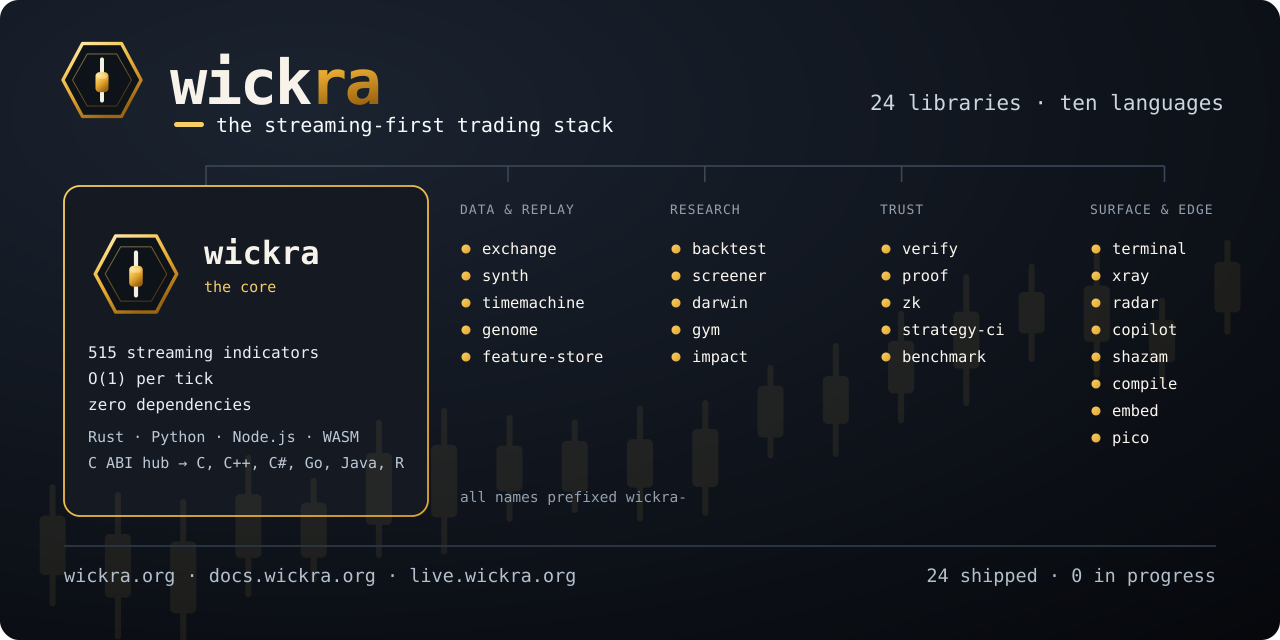
Part of the Wickra ecosystem: the same data-driven core and ten-language binding surface also power wickra-exchange, wickra-backtest, wickra-terminal and 20 more — see the full list.
Wickra Synth is one data-driven core, wickra-synth-core: a serde GenSpec
describes a market regime, a fixed portable PRNG (SplitMix64 seeding
xoshiro256++) drives it, and the core emits OHLCV candles plus order-book
snapshots, trades and funding samples — realistic synthetic
microstructure for tests, training and demos. Because the RNG lives only in
the Rust core and is portable-deterministic, a given seed yields the
byte-for-byte identical stream on every platform and through every language
binding. The output mirrors the JSON shapes of the rest of the ecosystem, so it
drops straight into backtests, screeners and RL environments.
Because the spec is data, not code, the exact same generation crosses the C
ABI and WASM unchanged. The core is exposed as a JSON-over-C-ABI data API
(Synth::command_json) in Rust, Python, Node.js, WASM, C, C++, C#, Go, Java
and R, so a developer in any language draws the same synthetic market.
use wickra_synth_core::{generate, GenSpec};

// A spec is data: a seed, a length, and the regimes the price path walks
// through. Nothing else is random, so the same seed draws the same market
// on every platform and through every binding.
let spec = GenSpec::from_json(spec_json)?;
let out = generate(&spec)?;
println!("{} candles, {} trades", out.candles.len(), out.trades.len());

// Replaying the seed replays the bytes -- that is the whole contract.
assert_eq!(generate(&spec)?, out);
The same generation from the command line:
cargo install wickra-synth
wickra-synth --seed 42 --bars 20 --format json
Status
0.2.3 — the current release. The core, the reference CLI, the ten-language binding surface, the golden corpus and the full CI matrix are in place; the generation model and command protocol are pinned by golden tests.
Documentation
- ARCHITECTURE.md — workspace layout and the core-only-randomness design.
- GENSPEC.md — the input specification, its fields and every validation rule.
- PROTOCOL.md — the
command_jsonboundary all ten bindings forward to. - REGIMES.md — the trend / range / crash / vol price-path formulas.
- MICROSTRUCTURE.md — order book, trades and funding.
- DETERMINISM.md — the PRNG and the fixed draw-order contract.
- Cookbook.md — practical recipes.
Quickstart
cargo install wickra-synth
wickra-synth --seed 42 --bars 20 --format json
Twenty bars of OHLCV, an order book, trades and funding, from nothing but the number 42 — and the same twenty bars on every platform and in every one of the ten languages below. The spec that shaped them is JSON, so the same seed and spec reproduce the same market from any binding.
Use in any language
Every binding forwards the same command_json string to the Rust core, so all
ten draw byte-identical synthetic markets for a given seed.
from wickra_synth import Synth
import json

synth = Synth('{"seed":42,"bars":20,"start_price":100.0,'
              '"regimes":[{"kind":"trend","len":20,"drift":0.002,"vol":0.01}],'
              '"microstructure":{"book_depth":5,"spread_bps":4.0,"trade_rate":8.0}}')
out = json.loads(synth.command('{"cmd":"generate"}'))
print(len(out["candles"]))  # 20
Runnable examples for all ten languages — each printing the same first three
candles — live in examples/.
Project layout
crates/synth-core     the engine: GenSpec, the PRNG, the walk, the microstructure
crates/synth-cli      wickra-synth, the reference consumer
crates/synth-bench    criterion benchmarks
bindings/c            the C ABI hub (cdylib + staticlib) plus the C++ hull
bindings/python       PyO3 / maturin, abi3-py39
bindings/node         napi-rs, per-platform npm packages
bindings/wasm         wasm-bindgen
bindings/csharp       P/Invoke over the hub
bindings/go           cgo over the hub
bindings/java         Foreign Function & Memory API over the hub
bindings/r            .Call glue over the hub
golden/               specs + blessed outputs, the cross-language contract
examples/             one runnable example per language
fuzz/                 cargo-fuzz targets for parse, generate, PRNG and FFI
docs/                 the deep dives; see docs/README.md
Six of the ten reaches go through one C ABI (bindings/c), which is why there
is exactly one place a marshalling bug can live rather than six.
Building everything from source
The core and the CLI need only cargo:
cargo build --workspace
cargo test  --workspace
The bindings each need their own toolchain, and the six that go through the C ABI need it built first:
cargo build --release -p wickra-synth-c          # the hub the six link against

cd bindings/python && maturin develop --release  # Python
cd bindings/node   && npm install && npx napi build --platform --release
cd bindings/wasm   && wasm-pack build --target nodejs
dotnet build bindings/csharp/WickraSynth -c Release
mvn -f bindings/java package
R CMD INSTALL bindings/r                         # WKSYNTH_INC/WKSYNTH_LIB, see below
cmake -S examples/c -B examples/c/build && cmake --build examples/c/build
The R binding downloads a matching prebuilt C ABI by default. To build it
against the one in your tree instead, set WKSYNTH_INC to
bindings/c/include and WKSYNTH_LIB to target/release.
Testing
cargo test --workspace --all-features
cargo test --workspace --no-default-features
Beyond the unit tests, four suites are worth knowing about:
- Golden — every binding replays
golden/specsand must reproducegolden/expectedbyte for byte. That is the cross-language guarantee, and it is checked in all ten reaches, not asserted in the README. - RNG vectors — fixed SplitMix64 and xoshiro256++ reference values. If these move, every seed in the world moves with them.
- Stream equals batch — the reassembled event stream equals the batch output, so the two paths cannot drift apart.
- Property tests — random specs stay finite and well formed, and the same seed gives the same bytes.
Per-binding commands are in CONTRIBUTING.md; the
scripts/check_*.py family holds the version, licence, link and binding-surface
invariants that no compiler checks.
Requirements
The core needs nothing but a Rust toolchain — no system libraries, no BLAS, no Python at build time. Each binding adds only its own runtime:
| Reach | Floor | Where it is declared |
|---|---|---|
| Rust (workspace) | 1.86 | Cargo.toml, rust-version |
| Rust (Node binding build) | 1.88 | bindings/node/Cargo.toml — napi-build needs it |
| Python | 3.9 | bindings/python/pyproject.toml, requires-python (abi3) |
| Node.js | 22 | bindings/node/package.json, engines.node |
| .NET | 8.0 | bindings/csharp/WickraSynth/WickraSynth.csproj |
| Go | 1.23 | bindings/go/go.mod |
| Java | 22 | bindings/java/pom.xml — the Foreign Function & Memory API |
| R | 4.1 | bindings/r/DESCRIPTION, Depends |
scripts/check_version_sync.py holds these numbers against the manifests, so a
floor that moves in one place and not the other is a failing check rather than a
support question.
Benchmarks
Per-generation throughput is tracked in BENCHMARKS.md and
measured by the synth-bench crate (cargo bench -p synth-bench). A shallow
book with light trade flow generates roughly 4.3 million candles per second; the
microstructure, not the price walk, is what the time goes on.
Ecosystem
Wickra Synth is one repository in a family that shares a core and a ten-language binding surface:
- wickra — 515 streaming indicators, the core everything else is built on.
- wickra-backtest — a streaming-native backtester where backtest and live are the same code path.
- wickra-screener — scan thousands of symbols against data-driven conditions.
- wickra-exchange — one typed API over the ten largest crypto exchanges.
- wickra-terminal — a streaming trading terminal over the same core.
Synth is the one that needs no market data at all: it is where the others get a reproducible market to test against. The full list is at github.com/wickra-lib.
Contributing
See CONTRIBUTING.md.
Security
See SECURITY.md and THREAT_MODEL.md. Note the PRNG is a fast non-cryptographic generator for reproducible simulation — it is not suitable for any security or cryptographic purpose.
License
Licensed under either of
- Apache License, Version 2.0 (LICENSE-APACHE or http://www.apache.org/licenses/LICENSE-2.0)
- MIT license (LICENSE-MIT or http://opensource.org/licenses/MIT)
at your option. Use it, fork it, modify it, redistribute it — commercially or not — file issues, send pull requests; all welcome.
Contribution
Unless you explicitly state otherwise, any contribution intentionally submitted for inclusion in the work by you, as defined in the Apache-2.0 license, shall be dual licensed as above, without any additional terms or conditions.
Disclaimer
wickra-synth generates synthetic market data for testing, training and
demonstration. It is not real market data and is not financial advice; it comes
with no warranty.



Built on Wickra. If it saved you time, the cheapest way to say thanks is to ⭐ the repo.
1 maintainer

Metadata
1 maintainer
Release files for wickra-synth 0.2.3
For a detailed explanation of source distributions (sdists) and built distributions (wheels), please see the package formats documentation.
Source distribution (sdist)
| File | Size | Uploaded | Provenance | Actions |
|---|---|---|---|---|
| wickra_synth-0.2.3.tar.gz | 63.2 kB | Without provenance | Details for wickra_synth-0.2.3.tar.gz |
Built distributions (wheels)
Total release size: 2.5 MB
Release files / wickra_synth-0.2.3.tar.gz
| Download URL | wickra_synth-0.2.3.tar.gz |
|---|---|
| Size | 63.2 kB |
| Tags | Source |
|
SHA-256 checksum How to use checksums |
135071bae9b1abda3b99a3dc0bbfc0a2aa1d70afb75920a3afe21ccd8f0d5503
|
|
BLAKE2b-256 checksum How to use checksums |
c213023f6338ffcf54ff1be84773014c540a6985a63bfdd07d7345023c63d93e
|
| Upload date | |
|
Uploaded using Trusted Publishing? What is trusted publishing? |
No |
| Uploaded via |
twine/7.0.0 CPython/3.13.16
|
Release files / wickra_synth-0.2.3-cp39-abi3-win_arm64.whl
| Download URL | wickra_synth-0.2.3-cp39-abi3-win_arm64.whl |
|---|---|
| Size | 181.5 kB |
| Tags | CPython 3.9 Windows ARM64 abi3 |
|
SHA-256 checksum How to use checksums |
eaa176176188973c4566353ecd149beefac7dc1e6700f813cc965fcc9185a178
|
|
BLAKE2b-256 checksum How to use checksums |
f77118b05743c4c257abb6e2b64c8fd45293a2e9f8bbf882a1f48077dd1995c7
|
| Upload date | |
|
Uploaded using Trusted Publishing? What is trusted publishing? |
No |
| Uploaded via |
twine/7.0.0 CPython/3.13.16
|
Release files / wickra_synth-0.2.3-cp39-abi3-win_amd64.whl
| Download URL | wickra_synth-0.2.3-cp39-abi3-win_amd64.whl |
|---|---|
| Size | 192.5 kB |
| Tags | CPython 3.9 Windows x86-64 abi3 |
|
SHA-256 checksum How to use checksums |
c7e6f43bc24bf1b732307b9ca12c0c97d0951109b52537da5e784807d214cb70
|
|
BLAKE2b-256 checksum How to use checksums |
9613c9eee88682d49dfed58c91e5cb5d679559052b13a4c53236fca6c97309a9
|
| Upload date | |
|
Uploaded using Trusted Publishing? What is trusted publishing? |
No |
| Uploaded via |
twine/7.0.0 CPython/3.13.16
|
Release files / wickra_synth-0.2.3-cp39-abi3-musllinux_1_2_x86_64.whl
| Download URL | wickra_synth-0.2.3-cp39-abi3-musllinux_1_2_x86_64.whl |
|---|---|
| Size | 498.0 kB |
| Tags | CPython 3.9 Linux musl 1.2+ x86-64 abi3 |
|
SHA-256 checksum How to use checksums |
da36d57a30bec4a93463d4c2010b174b07fc8c9e2676c666b486171ed2c85f90
|
|
BLAKE2b-256 checksum How to use checksums |
0eecaa27b6d2792f51686c5439967a74000074d328c6c3fd6fc21ecae9cd72e4
|
| Upload date | |
|
Uploaded using Trusted Publishing? What is trusted publishing? |
No |
| Uploaded via |
twine/7.0.0 CPython/3.13.16
|
Release files / wickra_synth-0.2.3-cp39-abi3-musllinux_1_2_aarch64.whl
| Download URL | wickra_synth-0.2.3-cp39-abi3-musllinux_1_2_aarch64.whl |
|---|---|
| Size | 448.9 kB |
| Tags | CPython 3.9 Linux musl 1.2+ ARM64 abi3 |
|
SHA-256 checksum How to use checksums |
3140e3078f2178dbcfddea30869ce2b1430920fdd4352e41178a2e5a7239b008
|
|
BLAKE2b-256 checksum How to use checksums |
9f8be7f3a90118b7e541d917897d9579d1140e24a71272aa2213443c48c2f5bb
|
| Upload date | |
|
Uploaded using Trusted Publishing? What is trusted publishing? |
No |
| Uploaded via |
twine/7.0.0 CPython/3.13.16
|
Release files / wickra_synth-0.2.3-cp39-abi3-manylinux2014_x86_64.manylinux_2_17_x86_64.whl
| Download URL | wickra_synth-0.2.3-cp39-abi3-manylinux2014_x86_64.manylinux_2_17_x86_64.whl |
|---|---|
| Size | 286.1 kB |
| Tags | CPython 3.9 Linux glibc 2.17+ x86-64 abi3 |
|
SHA-256 checksum How to use checksums |
4195c8185e4608e5195494e1c7f3cd3dfc5a2bf1c9fe5c45d4e8503dfeb7fc43
|
|
BLAKE2b-256 checksum How to use checksums |
84168276b3c6aee9dae859ebec264c08ff1ca643e77abd4d7c17f0d7d005d14d
|
| Upload date | |
|
Uploaded using Trusted Publishing? What is trusted publishing? |
No |
| Uploaded via |
twine/7.0.0 CPython/3.13.16
|
Release files / wickra_synth-0.2.3-cp39-abi3-manylinux2014_aarch64.manylinux_2_17_aarch64.whl
| Download URL | wickra_synth-0.2.3-cp39-abi3-manylinux2014_aarch64.manylinux_2_17_aarch64.whl |
|---|---|
| Size | 270.1 kB |
| Tags | CPython 3.9 Linux glibc 2.17+ ARM64 abi3 |
|
SHA-256 checksum How to use checksums |
a71588286143fc7afcb9ea636e28faf4ccd27a5b618107344b04e7bb1738b545
|
|
BLAKE2b-256 checksum How to use checksums |
2fcd01735f0eeb14b1e099bb95929000f0ce7ac0b71bd493983092dabce5a841
|
| Upload date | |
|
Uploaded using Trusted Publishing? What is trusted publishing? |
No |
| Uploaded via |
twine/7.0.0 CPython/3.13.16
|
Release files / wickra_synth-0.2.3-cp39-abi3-macosx_11_0_arm64.whl
| Download URL | wickra_synth-0.2.3-cp39-abi3-macosx_11_0_arm64.whl |
|---|---|
| Size | 256.6 kB |
| Tags | CPython 3.9 abi3 macOS 11.0+ ARM64 |
|
SHA-256 checksum How to use checksums |
7bcce688fa5cabdbcf6b2beaa34fdd4127ed3de026aeee08f76ca0397c4074d2
|
|
BLAKE2b-256 checksum How to use checksums |
08cd7fd31a95efc1b9c11e4ad8659364ab13f9ce09af5cb77cf79ba260e8d1bd
|
| Upload date | |
|
Uploaded using Trusted Publishing? What is trusted publishing? |
No |
| Uploaded via |
twine/7.0.0 CPython/3.13.16
|
Release files / wickra_synth-0.2.3-cp39-abi3-macosx_10_12_x86_64.whl
| Download URL | wickra_synth-0.2.3-cp39-abi3-macosx_10_12_x86_64.whl |
|---|---|
| Size | 275.7 kB |
| Tags | CPython 3.9 abi3 macOS 10.12+ x86-64 |
|
SHA-256 checksum How to use checksums |
a0d7b5685455d93ed2f1bda51691624d30a2d1a8d0256569c65738f28ce4f032
|
|
BLAKE2b-256 checksum How to use checksums |
98c117b80cee1ea6a8d4ca5da4e3b7c4fa0ae321d84d57068ef0e068012111fe
|
| Upload date | |
|
Uploaded using Trusted Publishing? What is trusted publishing? |
No |
| Uploaded via |
twine/7.0.0 CPython/3.13.16
|
Security for wickra-synth 0.2.3
Provenance
Provenance describes where a file came from. On PyPI, provenance is shared via attestations, which provide a verifiable record of the build or publishing details. View details, limitations and caveats.
No provenance found
None of the files in this release were uploaded with provenance metadata.
A note on package security
PyPI is a repository for distributing packages, not a service for auditing them. While third-party security researchers and our staff do their best to detect and remove malicious packages, PyPI cannot guarantee the quality, security or suitability of any given package.
To learn more about protecting yourself from malicious actors, visit our package security documentation.














