
Streaming-first technical indicators: incremental, fast, install-free.

Project description
















Streaming-first technical indicators. Install with pip install wickra — no system dependencies.
Wickra is a multi-language technical-analysis library with a Rust core and native bindings for Python, Node.js and WebAssembly, plus a C ABI that C, C++, C# / .NET, Go, Java, R and any other C-capable language links against. Every indicator is a state machine that updates in O(1) per new data point, so live trading bots and historical backtests share the exact same implementation.
import numpy as np
import wickra as ta

# Batch: classic TA-Lib-style usage
prices = np.linspace(100, 200, 1000)
rsi = ta.RSI(14)
values = rsi.batch(prices)              # numpy array, NaN during warmup

# Streaming: same indicator, fed tick by tick
rsi = ta.RSI(14)
for price in live_feed:
    value = rsi.update(price)           # O(1) — no recomputation over history
    if value is not None and value > 70:
        print("overbought")
Documentation
Full documentation lives at docs.wickra.org:
- Quickstarts — Rust, Python, Node, WASM, C, C#, Go, Java, R.
- Indicators — a per-indicator deep dive (formula, parameters, warmup) for every one of the 514 indicators; start at the indicators overview.
- Reference — warmup periods, streaming vs batch, indicator chaining, the data layer.
- Guides — Cookbook, TA-Lib migration, FAQ.
Why Wickra
Most TA libraries are fast, or multi-language, or broad. Wickra refuses to pick. It's the streaming-first engine built for the workload the others treat as an afterthought — live, tick-by-tick data — without giving up the breadth of a full batch library, and without making you reimplement your indicators four times to get there.
- The biggest streaming-native catalogue, period. 514 indicators across 24 families — candlesticks, harmonic & chart patterns, market profile, market breadth, Renko/Kagi/Point&Figure bars, Ehlers DSP cycles, risk/performance metrics — every single one updating in O(1) per tick. TA-Lib ships ~150 and none of them stream.
- One Rust core, five first-class targets. Native Python · Node.js · WebAssembly · Rust plus a C ABI for C / C++, C# / .NET, Go, Java, R and any other C-capable language — identical math, identical results, zero per-language reimplementation and zero GIL bottleneck.
- Correct by construction, not by hope. Every
updatevalidates its input, runs a real warmup, and returns anOptionso a single bad tick can't silently poison state.batch == streamingis bit-exact, fuzzed and 100 %-line-covered for all 514 indicators. - Orders of magnitude faster where it counts. In streaming Wickra is 11–56× faster than the only other incremental peer and thousands of times faster than recompute-on-every-tick libraries. On batch it wins several rows outright and trades the simple recurrences (SMA, EMA, MACD) for its guarantees — and the losses are shown, not hidden.
- Install in one line, anywhere.
pip install wickra/npm install wickra— precompiled wheels and binaries, no C toolchain, none of TA-Lib's setup pain. macOS · Linux · Windows. - Batteries included. Indicator chaining, a streaming OHLCV CSV reader, and a live Binance kline feed ship in the box.
- Truly permissive. MIT OR Apache-2.0 — drop it straight into commercial and closed-source work.
Every other library forces one of those compromises. Wickra doesn't:
| Library | Install | Streaming | Languages | Indicators | Active |
|---|---|---|---|---|---|
| ★ Wickra | clean | yes, O(1) | Rust · Python · Node · WASM · C · C# · Go · Java · R | 514 | yes |
| kand | clean | yes | Python · WASM · Rust | ~60 | yes |
| ta-rs | clean | yes | Rust only | ~30 | stale |
| yata | clean | partial | Rust only | ~35 | yes |
| TA-Lib | yes (C deps) | no | many bindings | ~150 | barely |
| pandas-ta | clean | no | Python | ~130 | slow |
| finta | clean | no | Python | ~80 | stale |
| talipp | clean | yes | Python | ~40 | yes |
Broad, multi-language, streaming-native and honest about its trade-offs — at the same time. That's the combination no one else ships.
Why Wickra exists
Wickra started as a personal itch. The existing TA libraries never quite fit the projects I was building, so I decided to build one from the ground up — partly to learn, partly because I genuinely enjoy taking something that already exists and trying to do it differently (and, ideally, better). It's open source because the useful version of that itch is the one other people can build on too.
Benchmarks
Wickra updates every indicator in O(1) per tick. In streaming — the
workload it is built for — it is 11–56× faster than the only other incremental
peer and thousands of times faster than recompute-on-every-tick libraries.
Batch is competitive: it wins several rows outright and trades a few µs
elsewhere for None-warmup, NaN-safety and bit-exact batch == streaming.
Full tables (Rust + Python, streaming + batch) and how to reproduce them live in BENCHMARKS.md.
Indicators
514 streaming-first indicators across twenty-four families. Every one passes the
batch == streaming equivalence test, reference-value tests, and reset
semantics tests. Each has a per-indicator deep dive (formula, parameters,
warmup) at docs.wickra.org.
| Family | Indicators |
|---|---|
| Moving Averages | SMA, EMA, WMA, DEMA, TEMA, HMA, KAMA, SMMA, TRIMA, ZLEMA, T3, VWMA, ALMA, McGinley Dynamic, FRAMA, VIDYA, JMA, Alligator, EVWMA, SWMA, GMA, EHMA, Median MA, Adaptive Laguerre, GD, Holt-Winters |
| Momentum Oscillators | RSI (Wilder), Anchored RSI, Stochastic, CCI, ROC, Williams %R, MFI, Awesome Oscillator, MOM, CMO, TSI, PMO, StochRSI, Ultimate Oscillator, RVI, PGO, KST, SMI, Laguerre RSI, Connors RSI, Inertia, ROC Percentage (ROCP), ROC Ratio (ROCR), ROC Ratio 100 (ROCR100), Disparity Index, Fisher RSI, RSX, Dynamic Momentum Index, Stochastic CCI, RMI, Derivative Oscillator, Elder Ray, Intraday Momentum Index, QQE |
| Trend & Directional | MACD, MACD Fixed (MACDFIX), MACD Extended (MACDEXT), ADX (+DI/-DI), ADXR, Aroon, TRIX, Aroon Oscillator, Vortex, Random Walk Index, Trend Intensity Index, Wave Trend Oscillator, Mass Index, Choppiness Index, Vertical Horizontal Filter, Plus DM, Minus DM, Plus DI, Minus DI, DX, TTM Trend, Trend Strength Index, Qstick, Polarized Fractal Efficiency, Wave PM, Gator Oscillator, Kase Permission Stochastic |
| Price Oscillators | PPO, DPO, Coppock, Accelerator Oscillator, Balance of Power, APO, AO Histogram, CFO, Zero-Lag MACD, Elder Impulse, STC, TSF Oscillator, MACD Histogram, PPO Histogram |
| Volatility & Bands | ATR, Bollinger Bands, Keltner Channels, Donchian Channels, NATR, StdDev, Ulcer Index, Historical Volatility, Bollinger Bandwidth, %B, True Range, Chaikin Volatility, RVI (Relative Volatility Index), Parkinson Volatility, Garman-Klass Volatility, Rogers-Satchell Volatility, Yang-Zhang Volatility, Volatility Cone |
| Bands & Channels | MA Envelope, Acceleration Bands, STARC Bands, ATR Bands, Hurst Channel, LinReg Channel, Standard Error Bands, Double Bollinger Bands, TTM Squeeze, Fractal Chaos Bands, VWAP StdDev Bands, Quartile Bands, Bomar Bands, Median Channel, Projection Bands, Projection Oscillator |
| Trailing Stops | Parabolic SAR, Parabolic SAR Extended (SAREXT), SuperTrend, Chandelier Exit, Chande Kroll Stop, ATR Trailing Stop, HiLo Activator, Volty Stop, Yo-Yo Exit, Donchian Channel Stop, Percentage Trailing Stop, Step Trailing Stop, Renko Trailing Stop, Kase DevStop, Elder SafeZone, ATR Ratchet, NRTR, Time-Based Stop, Modified MA Stop |
| Volume | OBV, VWAP (cumulative + rolling), ADL, Volume-Price Trend, Chaikin Money Flow, Chaikin Oscillator, Force Index, Ease of Movement, Klinger Volume Oscillator, Volume Oscillator, NVI, PVI, Williams A/D, Anchored VWAP, Demand Index, TSV, VZO, Market Facilitation Index, Volume RSI, Williams Accumulation/Distribution, Twiggs Money Flow, Trade Volume Index, Intraday Intensity Index, Better Volume, Volume-Weighted MACD |
| Price Statistics | Typical Price, Median Price, Weighted Close, Linear Regression, Linear Regression Slope, Z-Score, Linear Regression Angle, Variance, Coefficient of Variation, Skewness, Kurtosis, Standard Error, Detrended StdDev, R², Median Absolute Deviation, Autocorrelation, Hurst Exponent, Pearson Correlation, Beta, Pairwise Beta, Pair Spread Z-Score, Lead-Lag Cross-Correlation, Cointegration, Relative Strength A-vs-B, Spearman Correlation, Mid Price, Mid Point, Average Price, Linear Regression Intercept, Time Series Forecast, Rolling Correlation, Rolling Covariance, OU Half-Life, Spread Hurst, Distance SSD, Beta-Neutral Spread, Variance Ratio, Granger Causality, Kalman Hedge Ratio, Spread Bollinger Bands, Spread AR(1) Coefficient, Jarque-Bera, Rolling Min-Max Scaler, Shannon Entropy, Sample Entropy, Kendall Tau |
| Ehlers / Cycle (DSP) | MAMA, FAMA, Fisher Transform, Inverse Fisher Transform, SuperSmoother, Hilbert Dominant Cycle, Hilbert Phasor, Hilbert DC Phase, Hilbert Trend Mode, Sine Wave, Decycler, Decycler Oscillator, Roofing Filter, Center of Gravity, Cybernetic Cycle, Adaptive Cycle, Empirical Mode Decomposition, Ehlers Stochastic, Instantaneous Trendline, Highpass Filter, Reflex, Trendflex, Correlation Trend Indicator, Adaptive RSI, Universal Oscillator, Adaptive CCI, Bandpass Filter, Even Better Sinewave, Autocorrelation Periodogram |
| Pivots & S/R | Classic Pivots, Fibonacci Pivots, Camarilla, Woodie Pivots, DeMark Pivots, Williams Fractals, ZigZag, Central Pivot Range, Murrey Math Lines, Andrews Pitchfork, Volume-Weighted Support/Resistance, Pivot Reversal |
| DeMark | TD Setup, TD Sequential, TD DeMarker, TD REI, TD Pressure, TD Combo, TD Countdown, TD Lines, TD Range Projection, TD Differential, TD Open, TD Risk Level, TD Camouflage, TD Clop, TD Clopwin, TD Propulsion, TD Trap, TD D-Wave, TD Moving Averages |
| Ichimoku & Charts | Ichimoku Kinko Hyo (Tenkan, Kijun, Senkou A/B, Chikou), Heikin-Ashi, Heikin-Ashi Oscillator, Three Line Break, Smoothed Heikin-Ashi, Equivolume, CandleVolume |
| Alt-Chart Bars | Renko (box-size bricks), Kagi (reversal-amount lines), Point & Figure (X/O columns), Range, Tick, Volume, Dollar, Imbalance, Run, Three-Line Break |
| Candlestick Patterns | Doji, Hammer, Inverted Hammer, Hanging Man, Shooting Star, Engulfing, Harami, Morning/Evening Star, Three White Soldiers/Black Crows, Piercing Line/Dark Cloud Cover, Marubozu, Tweezer, Spinning Top, Three Inside Up/Down, Three Outside Up/Down, Two Crows, Upside Gap Two Crows, Identical Three Crows, Three Line Strike, Three Stars in the South, Abandoned Baby, Advance Block, Belt-hold, Breakaway, Counterattack, Doji Star, Dragonfly Doji, Gravestone Doji, Long-Legged Doji, Rickshaw Man, Evening Doji Star, Morning Doji Star, Gap Side-by-Side White, High-Wave, Hikkake, Modified Hikkake, Homing Pigeon, On-Neck, In-Neck, Thrusting, Separating Lines, Kicking, Kicking by Length, Ladder Bottom, Mat Hold, Matching Low, Long Line, Short Line, Rising Three Methods, Falling Three Methods, Upside Gap Three Methods, Downside Gap Three Methods, Stalled Pattern, Stick Sandwich, Takuri, Closing Marubozu, Opening Marubozu, Tasuki Gap, Unique Three River, Concealing Baby Swallow, Tristar, Harami Cross, Tower Top/Bottom, Dumpling Top, New Price Lines, Frying Pan Bottom |
| Chart Patterns | Double Top / Bottom, Triple Top / Bottom, Head and Shoulders, Triangle (asc/desc/sym), Wedge (rising/falling), Flag / Pennant, Rectangle / Range, Cup and Handle |
| Harmonic Patterns | AB=CD, Gartley, Butterfly, Bat, Crab, Shark, Cypher, Three Drives |
| Fibonacci | Fibonacci Retracement, Fibonacci Extension, Fibonacci Projection, Auto-Fibonacci, Golden Pocket, Fibonacci Confluence, Fibonacci Fan, Fibonacci Arcs, Fibonacci Channel, Fibonacci Time Zones |
| Microstructure | Order-Book Imbalance (Top-1 / Top-N / Full), Microprice, Quoted Spread, Depth Slope, Signed Volume, Cumulative Volume Delta, Trade Imbalance, Effective Spread, Realized Spread, Kyle's Lambda, Footprint, Order Flow Imbalance, VPIN, Amihud Illiquidity, Roll Measure, Trade-Sign Autocorrelation, Hasbrouck Information Share |
| Derivatives | Funding Rate, Funding Rate Mean, Funding Rate Z-Score, Funding Basis, Open-Interest Delta, OI / Price Divergence, OI-Weighted Price, Long/Short Ratio, Taker Buy/Sell Ratio, Liquidation Features, Term-Structure Basis, Calendar Spread, Estimated Leverage Ratio, OI-to-Volume Ratio, Perpetual Premium Index, Funding-Implied APR, Open-Interest Momentum |
| Market Profile | Value Area (POC / VAH / VAL), Volume Profile (histogram), TPO Profile, Initial Balance, Opening Range, Naked POC, Single Prints, Profile Shape, High/Low Volume Nodes, Composite Profile |
| Market Breadth | Advance/Decline Line, Advance/Decline Ratio, Advance/Decline Volume Line, McClellan Oscillator, McClellan Summation Index, TRIN / Arms Index, Breadth Thrust, New Highs - New Lows, High-Low Index, Percent Above Moving Average, Up/Down Volume Ratio, Bullish Percent Index, Cumulative Volume Index, Absolute Breadth Index, TICK Index |
| Risk / Performance | Sharpe Ratio, Sortino Ratio, Calmar Ratio, Omega Ratio, Max Drawdown, Average Drawdown, Drawdown Duration, Pain Index, Value at Risk, Conditional Value at Risk (CVaR), Profit Factor, Gain/Loss Ratio, Recovery Factor, Kelly Criterion, Treynor Ratio, Information Ratio, Alpha (Jensen) |
| Seasonality & Session | Session VWAP, Session High/Low, Session Range, Average Daily Range, Overnight Gap, Overnight/Intraday Return, Turn-of-Month, Seasonal Z-Score, Time-of-Day Return Profile, Day-of-Week Profile, Intraday Volatility Profile, Volume-by-Time Profile |
Every candlestick pattern emits a signed per-bar value — +1.0 bullish,
−1.0 bearish, 0.0 none — so the family drops straight into a feature matrix
as one column each. Doji is direction-less by default (+1.0 / 0.0);
construct it in signed mode (Doji::new().signed(), Doji(signed=True),
new Doji(true)) for a dragonfly / gravestone ±1 reading.
Adding a new indicator means implementing one trait in Rust; every binding inherits it automatically (the C ABI — and the C#, Go, Java and R bindings generated from it — regenerate from the core).
Languages
| Binding | Install | Example |
|---|---|---|
| Python (PyO3) | pip install wickra |
examples/python/backtest.py |
| Node.js (napi-rs) | npm install wickra |
examples/node/backtest.js |
| Browser / WASM | npm install wickra-wasm |
examples/wasm/index.html |
| Rust | cargo add wickra |
examples/rust/src/bin/backtest.rs |
| C / C++ (C ABI) | header + library, see bindings/c |
examples/c/streaming.c |
| C# / .NET (C ABI) | dotnet add package Wickra, see bindings/csharp |
examples/csharp/streaming |
| Go (cgo, C ABI) | go get github.com/wickra-lib/wickra/bindings/go, see bindings/go |
examples/go/streaming |
| Java (FFM, C ABI) | Maven Central org.wickra:wickra, see bindings/java |
examples/java (Streaming) |
R (.Call, C ABI) |
R CMD INSTALL bindings/r, see bindings/r |
examples/r/streaming.R |
Each binding ships several runnable examples (streaming, backtest, live feed);
examples/README.md is the full cross-language index.
The wickra-core crate is unsafe-forbidden, so the native bindings are
memory-safe end to end. The C ABI runs the same safe core; only its thin FFI
boundary uses unsafe, and the caller owns handle lifetimes (_new / _free).
Rust API
use wickra::{Indicator, BatchExt, Chain, Ema, Rsi, Sma};

// Streaming or batch — same trait, same code.
let mut sma = Sma::new(14)?;
let out: Vec<Option<f64>> = sma.batch(&[1.0, 2.0, 3.0, 4.0, 5.0]);

let mut rsi = Rsi::new(14)?;
for price in live_feed {
    if let Some(v) = rsi.update(price) {
        println!("RSI = {v}");
    }
}

// Compose indicators: RSI(7) on top of EMA(14).
let mut chain = Chain::new(Ema::new(14)?, Rsi::new(7)?);
chain.update(price);
Live data sources
wickra-data (separate crate, opt-in) ships:
- A streaming OHLCV CSV reader.
- A tick-to-candle aggregator with arbitrary timeframes.
- A candle resampler for multi-timeframe analysis (1m → 5m → 1h on the fly).
- A Binance Spot WebSocket kline adapter (feature
live-binance).
use wickra::{Indicator, Rsi};
use wickra_data::live::binance::{BinanceKlineStream, Interval};

let mut stream = BinanceKlineStream::connect(&["BTCUSDT".into()], Interval::OneMinute).await?;
let mut rsi = Rsi::new(14)?;
while let Some(event) = stream.next_event().await? {
    if event.is_closed {
        if let Some(v) = rsi.update(event.candle.close) {
            println!("RSI = {v:.2}");
        }
    }
}
A Python live-trading example using the public websockets package lives at
examples/python/live_trading.py.
Project layout
wickra/
├── crates/
│   ├── wickra-core/         core engine + all 514 indicators
│   ├── wickra/              top-level facade crate (publishes on crates.io) + benches/
│   ├── wickra-data/         CSV reader, tick aggregator, live exchange feeds
│   └── wickra-bench/        internal cross-library benchmark harness (not published)
├── bindings/
│   ├── python/              PyO3 + maturin (publishes on PyPI)
│   ├── node/                napi-rs (publishes on npm)
│   ├── wasm/                wasm-bindgen (browsers, bundlers, Node)
│   ├── c/                   C ABI (cdylib + staticlib) + generated include/wickra.h
│   ├── csharp/              .NET binding over the C ABI (publishes on NuGet)
│   ├── go/                  Go binding over the C ABI via cgo (module tag)
│   ├── r/                   R binding over the C ABI via .Call (R package)
│   └── java/                Java binding over the C ABI via the FFM API (Maven Central)
├── examples/                examples/README.md indexes every language
│   ├── data/                real BTCUSDT OHLCV datasets, one per timeframe
│   ├── rust/                Rust workspace member (`wickra-examples`)
│   ├── python/              backtest, live trading, parallel assets, multi-tf
│   ├── node/                streaming, backtest, live trading (load `wickra`)
│   ├── wasm/                browser demo for `wickra-wasm`
│   ├── c/                   C smoke + streaming, C++ RAII wrapper
│   ├── csharp/              streaming, backtest, strategies (load `Wickra`)
│   ├── go/                  streaming, backtest, strategies (cgo binding)
│   ├── r/                   streaming, backtest, strategies (.Call binding)
│   └── java/                streaming, backtest, strategies (FFM binding)
└── .github/workflows/       CI and release pipelines
Wickra's own regression benchmarks live in crates/wickra/benches/; the
cross-library comparison against kand, ta-rs and yata lives in the internal
crates/wickra-bench/ crate. Runnable Rust examples live in the workspace member
crate at examples/rust/. There is no top-level benches/ directory.
Building everything from source
# Rust core + tests
cargo test --workspace
cargo clippy --workspace --all-targets -- -D warnings
cargo bench -p wickra           # Wickra's own regression benchmarks
cargo bench -p wickra-bench     # cross-library comparison (kand, ta-rs, yata)

# Python binding (requires Rust toolchain + maturin)
cd bindings/python
maturin develop --release
pytest

# WASM binding (requires wasm-pack + wasm32-unknown-unknown target)
wasm-pack build bindings/wasm --target web --release --features panic-hook

# Node binding (requires @napi-rs/cli)
cd bindings/node && npm install && npm run build && npm test

# C ABI (cdylib + staticlib + generated header)
cargo build -p wickra-c --release
cmake -S examples/c -B examples/c/build -DWICKRA_LIB_DIR="$PWD/target/release"
cmake --build examples/c/build && ctest --test-dir examples/c/build --output-on-failure

# C# / .NET binding (requires the .NET 8 SDK; links the C ABI above)
dotnet test bindings/csharp/Wickra.Tests/Wickra.Tests.csproj

# Go binding (requires a C compiler for cgo; links the C ABI above)
cp target/release/libwickra.so bindings/go/lib/   # .dylib on macOS, wickra.dll on Windows
cd bindings/go && go test ./...

# R binding (requires a C toolchain / Rtools; links the C ABI above)
WICKRA_INCLUDE_DIR="$PWD/bindings/c/include" WICKRA_LIB_DIR="$PWD/target/release" \
  R CMD INSTALL bindings/r

# Java binding (requires JDK 22+ and Maven; links the C ABI above)
mvn -f bindings/java test
Testing
Every layer is covered; run the suites with the commands in Building everything from source.
wickra-core: unit tests per indicator — textbook reference values (Wilder RSI, Bollinger Bands, MACD, ATR, Stochastic),batch == streamingequivalence,resetsemantics, NaN/Inf handling, and property tests. A catalogue-wide property harness (tests/invariants.rs) additionally assertsbatch == streaming,reset == fresh, and non-finite-input rejection for every indicator and bar-builder.wickra-data: unit tests for CSV decoding, the tick aggregator, the resampler, and the Binance payload parser.bindings/python: pytest covering smoke checks, streaming/batch equivalence, reference values, lifecycle, input validation, and dict/tuple candle inputs.bindings/node:node --testcases for batch, streaming, and reference values across all indicators.bindings/wasm:wasm-bindgen-testcases for constructors, equivalence, and reference values.bindings/c: Rust unit tests over the FFI boundary, plus C and C++ smoke tests and offline examplectests run on the three OSes.bindings/csharp:dotnet testcases covering one indicator per FFI archetype (scalar/batch, multi-output, bars, profile, array input) plus SMA reference values.bindings/go:go testcases covering one indicator per FFI archetype (scalar/batch, multi-output, bars, profile, array input), reset, and lifecycle.bindings/r:testthatcases covering one indicator per FFI archetype (scalar/batch, multi-output, bars, profile, array input), reset, and validation.bindings/java: JUnit cases covering one indicator per FFI archetype (scalar/batch, multi-output, bars, profile, array input) plus batch equivalence.
The four C-ABI bindings (C#, Go, Java, R) additionally replay a shared,
language-neutral golden fixture (testdata/golden/*.csv, generated by
cargo run -p wickra-examples --bin gen_golden) and assert exact parity with the
Rust reference outputs across every archetype (SMA, EMA, RSI, ATR, MACD, ADX,
Beta), catching FFI wiring bugs the math-only core tests cannot see.
Contributing
Contributions are very welcome — issues, bug reports, ideas, and pull requests all land in the same place: https://github.com/wickra-lib/wickra.
A short orientation for first-time contributors:
- Adding an indicator. Implement the
Indicatortrait incrates/wickra-core/src/indicators/<name>.rs, wire it intoindicators/mod.rsand the crate root, and add reference-value tests, abatch == streamingequivalence test, and (where it makes sense) a proptest. The four bindings inherit your indicator automatically once you expose it in the language wrappers. - Fixing a numeric bug. Add a failing test that pins the textbook value
first, then fix the math. Property tests in
crates/wickra-corecatch most regressions; please don't disable them. - Improving a binding. Each binding lives under
bindings/<lang>with its own tests; please keep thebatch == streaminginvariant. - Style.
cargo fmt --all+cargo clippy --workspace --all-targets -- -D warningsare CI gates; running them locally before pushing keeps reviews short.
For larger architectural changes, open an issue first so we can sketch the shape together before you invest the time.
License
Licensed under either of
- Apache License, Version 2.0 (LICENSE-APACHE or http://www.apache.org/licenses/LICENSE-2.0)
- MIT license (LICENSE-MIT or http://opensource.org/licenses/MIT)
at your option. Use it, fork it, modify it, redistribute it — commercially or not — file issues, send pull requests; all welcome.
Contribution
Unless you explicitly state otherwise, any contribution intentionally submitted for inclusion in the work by you, as defined in the Apache-2.0 license, shall be dual licensed as above, without any additional terms or conditions.
Disclaimer
Wickra is an indicator toolkit, not a trading system. Values it computes are deterministic transforms of the input data — they are not financial advice and they do not predict the market. Any use of this library in a production trading context is at your own risk.
The library is provided as is, without warranty of any kind; see LICENSE for the full terms.



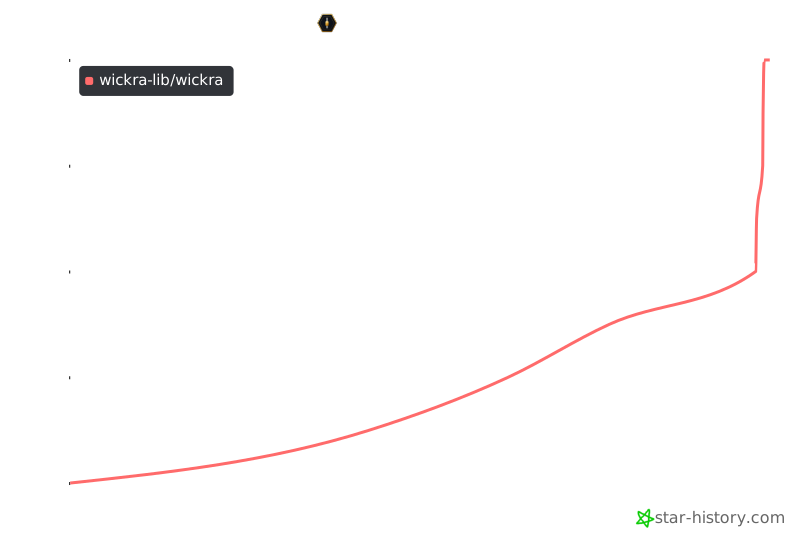
If Wickra saved you time, the cheapest way to say thanks is to ⭐ the repo.
Release history Release notifications | RSS feed


Download files
Download the file for your platform. If you're not sure which to choose, learn more about installing packages.
Source Distribution
Built Distributions
Filter files by name, interpreter, ABI, and platform.
If you're not sure about the file name format, learn more about wheel file names.
Copy a direct link to the current filters
File details
Details for the file wickra-0.8.9.tar.gz.
File metadata
- Download URL: wickra-0.8.9.tar.gz
- Upload date:
- Size: 968.9 kB
- Tags: Source
- Uploaded using Trusted Publishing? No
- Uploaded via: maturin/1.14.0
File hashes
| Algorithm | Hash digest | |
|---|---|---|
| SHA256 |
45bf59dbc7047bdf428b5a9fddbb3079e089b1c8ff1872c0db0aac589dd2a64f
|
|
| MD5 |
6192cc6bcc1e897be74723b3cc56ee41
|
|
| BLAKE2b-256 |
beaa7a40be6d860492dd48119b34434ee3ee118a0cc2602ecdb3e1da15b758c7
|
File details
Details for the file wickra-0.8.9-cp39-abi3-win_arm64.whl.
File metadata
- Download URL: wickra-0.8.9-cp39-abi3-win_arm64.whl
- Upload date:
- Size: 1.4 MB
- Tags: CPython 3.9+, Windows ARM64
- Uploaded using Trusted Publishing? No
- Uploaded via: maturin/1.14.0
File hashes
| Algorithm | Hash digest | |
|---|---|---|
| SHA256 |
6df12c45aca1d7913d1997f8116bbb74ace1f6f321dccd0e753a818a19a1731b
|
|
| MD5 |
f30d13194a712e55d207452486b4ebe3
|
|
| BLAKE2b-256 |
556d865970b8bcb93b436b5e3816503f80ba8c0fe8562764657060373c30c31c
|
File details
Details for the file wickra-0.8.9-cp39-abi3-win_amd64.whl.
File metadata
- Download URL: wickra-0.8.9-cp39-abi3-win_amd64.whl
- Upload date:
- Size: 1.6 MB
- Tags: CPython 3.9+, Windows x86-64
- Uploaded using Trusted Publishing? No
- Uploaded via: maturin/1.14.0
File hashes
| Algorithm | Hash digest | |
|---|---|---|
| SHA256 |
9d5362298f9e0502b53120465bb56d870bd4d82269ea376b7e2eefeff21bac04
|
|
| MD5 |
2ea9d6922e8f2cd969c146eaf539bf55
|
|
| BLAKE2b-256 |
7afdb88e2e3ef4c72db8e5abe4ea32197590ab86272ee2ebd74183e023e5b471
|
File details
Details for the file wickra-0.8.9-cp39-abi3-musllinux_1_2_x86_64.whl.
File metadata
- Download URL: wickra-0.8.9-cp39-abi3-musllinux_1_2_x86_64.whl
- Upload date:
- Size: 2.1 MB
- Tags: CPython 3.9+, musllinux: musl 1.2+ x86-64
- Uploaded using Trusted Publishing? No
- Uploaded via: maturin/1.14.0
File hashes
| Algorithm | Hash digest | |
|---|---|---|
| SHA256 |
07fe5c02e25d0bbb0e0df66fb1c0b55168863874d2fefe3719cac4f5fdbd6c76
|
|
| MD5 |
435f1e3a9d83a9670840977f12ee2740
|
|
| BLAKE2b-256 |
36119bfa33d1151393d7e25cc1242ef117cb1c6aeb22f0171eb5079b5e2afe2d
|
File details
Details for the file wickra-0.8.9-cp39-abi3-musllinux_1_2_aarch64.whl.
File metadata
- Download URL: wickra-0.8.9-cp39-abi3-musllinux_1_2_aarch64.whl
- Upload date:
- Size: 1.8 MB
- Tags: CPython 3.9+, musllinux: musl 1.2+ ARM64
- Uploaded using Trusted Publishing? No
- Uploaded via: maturin/1.14.0
File hashes
| Algorithm | Hash digest | |
|---|---|---|
| SHA256 |
fea3da6ad942220a0a80b324308937f5c3a01b61432b0f13df69a37b1b79fb4c
|
|
| MD5 |
145cce996378287cea66d392016b32d9
|
|
| BLAKE2b-256 |
264c38456df25de206493d63869013473e6d9e4f5e4a1644bb0a8be0860f2870
|
File details
Details for the file wickra-0.8.9-cp39-abi3-manylinux_2_17_x86_64.manylinux2014_x86_64.whl.
File metadata
- Download URL: wickra-0.8.9-cp39-abi3-manylinux_2_17_x86_64.manylinux2014_x86_64.whl
- Upload date:
- Size: 1.8 MB
- Tags: CPython 3.9+, manylinux: glibc 2.17+ x86-64
- Uploaded using Trusted Publishing? No
- Uploaded via: maturin/1.14.0
File hashes
| Algorithm | Hash digest | |
|---|---|---|
| SHA256 |
3fa85d6907fdbc20049f7033aba2db4202ef2a80a0a003393dac5351944d91b0
|
|
| MD5 |
ba50544616955a17b4938914dbae0f9b
|
|
| BLAKE2b-256 |
a40d0db2d15d647d3427f9dd231800c84a28cd2bcb16845768fb467ec5cc9f25
|
File details
Details for the file wickra-0.8.9-cp39-abi3-manylinux_2_17_aarch64.manylinux2014_aarch64.whl.
File metadata
- Download URL: wickra-0.8.9-cp39-abi3-manylinux_2_17_aarch64.manylinux2014_aarch64.whl
- Upload date:
- Size: 1.6 MB
- Tags: CPython 3.9+, manylinux: glibc 2.17+ ARM64
- Uploaded using Trusted Publishing? No
- Uploaded via: maturin/1.14.0
File hashes
| Algorithm | Hash digest | |
|---|---|---|
| SHA256 |
a516a0c2f7d3d816ff00f5dabadbeda74e7cf4d02aec29e150ad945ca35d98f3
|
|
| MD5 |
f3d58b43f3f27cae11ced955a7a1012a
|
|
| BLAKE2b-256 |
a58a4741cfacb8528ee45d6f51adc2b2fab91ddd0004dfd0c19b48f84610c1ff
|
File details
Details for the file wickra-0.8.9-cp39-abi3-macosx_11_0_arm64.whl.
File metadata
- Download URL: wickra-0.8.9-cp39-abi3-macosx_11_0_arm64.whl
- Upload date:
- Size: 1.5 MB
- Tags: CPython 3.9+, macOS 11.0+ ARM64
- Uploaded using Trusted Publishing? No
- Uploaded via: maturin/1.14.0
File hashes
| Algorithm | Hash digest | |
|---|---|---|
| SHA256 |
69e27b195309f0504d2406991abcb16738f106d5f82ce3ee8d393924d3fbb986
|
|
| MD5 |
59604ee68838e823480b1652611ad432
|
|
| BLAKE2b-256 |
e5c3e3a5a0a1e81eddccd9a14e9e0396a14bc91f440a8c6bdd281948e331eeb9
|
File details
Details for the file wickra-0.8.9-cp39-abi3-macosx_10_12_x86_64.whl.
File metadata
- Download URL: wickra-0.8.9-cp39-abi3-macosx_10_12_x86_64.whl
- Upload date:
- Size: 1.7 MB
- Tags: CPython 3.9+, macOS 10.12+ x86-64
- Uploaded using Trusted Publishing? No
- Uploaded via: maturin/1.14.0
File hashes
| Algorithm | Hash digest | |
|---|---|---|
| SHA256 |
5d2770322d0863fcb40c7ae97cf6543c256b469f42f7cb78c789094d427cfc7a
|
|
| MD5 |
0f709ac515f3bcfcc099750270c46326
|
|
| BLAKE2b-256 |
3acc12f2b4d26331e48571f0906a0b46433c5322ecfdec7b7717f1bfc9c78ca0
|






