
willitbreak
Will this dependency upgrade break code you actually wrote?




Dependabot opens eleven pull requests. The changelog for one of them lists forty breaking changes. Thirty-nine are about parts of the library you have never imported, and the fortieth is on line 218 of a file you forgot existed.
There is no good way to find that out today. So people merge and hope, or read the whole changelog, or upgrade in a branch and wait for the test suite to maybe catch it.
pip install willitbreak
willitbreak urllib3 --to 2.2.1
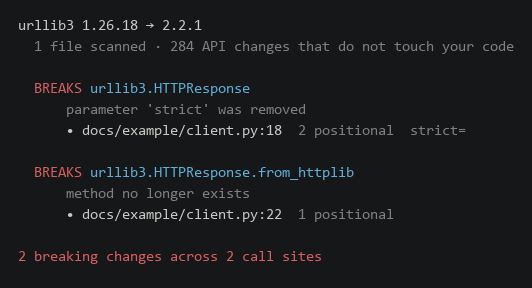
284 API changes in that release. Two of them touch this code. Those two come with file and line numbers; the rest are a number you can ignore.
No dependencies. Python 3.9+.
Why this isn't just a changelog
Every other tool in this space is built for the people publishing a library, so it can tell you what changed but not whether you used any of it. griffe — the most capable of them — puts it plainly in its own documentation: users must review the reported breakages and assess their own codebase for impacts.
That assessment is the work. This does it.
their API diff          your source            what you get
──────────────────      ─────────────────      ─────────────────────
284 things changed  ×   217 call sites     =   2 problems, with line numbers
What it takes seriously
Never guessing. A checker that cries wolf gets uninstalled after the second false alarm, and then catches nothing at all. So resolution stops the moment it would have to assume:
client = pkg.Client()
client.get(timeout=5)  # resolved: pkg.Client.get

thing = make_it()
thing.get(timeout=5)  # not reported — origin unprovable

c = pkg.Client()
c = something_else()
c.get(timeout=5)  # not reported — the name was rebound
The same applies to arguments. f(**options) might be passing the parameter
that was removed, or might not, so it is never claimed as a break.
The condition attached to every change. A removed keyword only matters to code that passes it. A parameter that lost its default only matters to code that omits it — pass it positionally and you are fine. A parameter that became keyword-only only breaks callers who passed it positionally. Each of those is checked against the actual call:
urllib3 1.26.18 → 2.2.1
  1 file scanned · 284 API changes that do not touch your code

  BREAKS urllib3.HTTPResponse
      parameter 'strict' was removed
      • docs/example/client.py:18  2 positional  strict=

  BREAKS urllib3.HTTPResponse.from_httplib
      method no longer exists
      • docs/example/client.py:22  1 positional

2 breaking changes across 2 call sites
Where libraries really live. Almost every package implements in
pkg/_client.py and exposes in pkg/__init__.py. A tool that only looked at
where a class was defined would report pkg._client.Client and never match
the pkg.Client everyone writes, so re-export chains are followed to a fixed
point.
Not importing anything. Both versions are downloaded and read as source. Importing a package to inspect it means executing it, and the version you are asking about is by definition not the one installed — it may not even import on your interpreter.
In CI
- run: pip install willitbreak
- run: willitbreak urllib3 --to ${{ matrix.candidate }} src/
Exit 2 means this upgrade breaks something you wrote. Exit 1 is reserved
for the tool itself failing, so a pipeline can tell those apart and act
differently on each. Exit 0 means the changes do not reach your code.
Isn't this what mypy does?
Partly, and it is worth being honest about the overlap. If a package ships type information, you install the new version, and your code is annotated, mypy will flag a removed attribute.
The differences that matter:
- You have to install the upgrade first. That is the thing you were trying to evaluate, and on a conflict it may not install at all.
- It reports everything, not what changed. A pre-existing error and one introduced by this upgrade look identical.
- It needs types. Untyped packages, and
**kwargs-heavy APIs, are exactly where signature changes hide.
This answers a narrower question — what does this specific version bump do to me — without touching your environment.
Options
| Flag | What it does |
|---|---|
--from VERSION |
Upgrade from this (default: the version installed here) |
--to VERSION |
Upgrade to this (default: latest on PyPI) |
--all |
List every API change, including ones you never touch |
--json |
Machine-readable, for a bot that files the summary |
--import-name NAME |
When the import name differs from the package name |
--cache DIR |
Where downloaded versions live (WILLITBREAK_CACHE) |
--ascii |
No non-ASCII characters |
--color |
auto, always, never. NO_COLOR is honoured |
Paths default to the current directory:
willitbreak httpx --to 0.28.0 src/ tests/
As a library
from willitbreak import check

outcome = check("urllib3", "1.26.18", "2.2.1", ["src"])
for finding in outcome.breaking:
    print(finding.change.detail)
    for reference in finding.references:
        print("   ", reference.source)
Honest limits
- Resolution is one level deep. An instance stored on
self, handed through a factory, or returned from a helper is not tracked, and is silently skipped rather than guessed at. - A package whose API is built at runtime cannot be read from source. Modules that will not parse are reported, never quietly dropped.
- Changed behaviour behind an unchanged signature is invisible to this and to every other static tool. Read the changelog for those.
Development
git clone https://github.com/CAOShurong/willitbreak
cd willitbreak
python -m unittest discover -s tests
The suite runs entirely offline against packages built on disk, so it is fast and does not depend on PyPI being up. Regenerate this README, which is produced by running the tool for real:
python docs/build_docs.py
python docs/build_docs.py --check   # what CI runs
CI runs on Ubuntu, Windows and macOS across Python 3.9–3.14, checks this README still matches the output, and verifies the exit codes.
Verify a release
Starting with v0.1.2, every GitHub release includes a SHA256SUMS manifest and
GitHub build-provenance attestations for the wheel and source distribution:
sha256sum --check SHA256SUMS
gh attestation verify willitbreak-0.1.2-py3-none-any.whl \
  --repo CAOShurong/willitbreak
License
MIT. See LICENSE.
1 maintainer

Release files for willitbreak 0.1.2
For a detailed explanation of source distributions (sdists) and built distributions (wheels), please see the package formats documentation.
Source distribution (sdist)
| File | Size | Uploaded | |
|---|---|---|---|
| willitbreak-0.1.2.tar.gz | 64.1 kB | Details |
Built distribution (wheel)
| File | Interpreter | ABI | Platform | Reset |
|---|---|---|---|---|
| willitbreak-0.1.2-py3-none-any.whl | Python 3 | none | any | Details |
Total release size: 95.2 kB
Release files / willitbreak-0.1.2.tar.gz
| Download URL | willitbreak-0.1.2.tar.gz |
|---|---|
| Size | 64.1 kB |
| Tags | Source |
|
SHA-256 checksum How to use checksums |
052162deec9346600360c6e575731d71e519e3b7c0bea45b1fd5155fd743c3ba
|
|
BLAKE2b-256 checksum How to use checksums |
b95d30ea991b2f9d224aafb931ea0438e2190d7e791ad84b60424908efa50248
|
| Upload date | |
|
Uploaded using Trusted Publishing? What is trusted publishing? |
Yes |
| Uploaded via |
twine/7.0.0 CPython/3.13.14
|
Provenance
Provenance describes where a file came from. On PyPI, provenance is shared via attestations, which provide a verifiable record of the build or publishing details. View details, limitations and caveats.


PyPI Publish Attestation
PyPI verified that this artifact, at this checksum, originated from the publisher listed below.
Signed by GitHub Actions, verified by PyPI on Aug 11, 2026.
Transparency logRelease files / willitbreak-0.1.2-py3-none-any.whl
| Download URL | willitbreak-0.1.2-py3-none-any.whl |
|---|---|
| Size | 31.1 kB |
| Tags | Python 3 |
|
SHA-256 checksum How to use checksums |
21ca5fe7891199766d4e0111efb10b21a72ef8ded6352b792a49b621730c97c0
|
|
BLAKE2b-256 checksum How to use checksums |
bbe322be27e35f1ba2b3bd4633ca19152911c806ea34df2aec8b17d0ee446afd
|
| Upload date | |
|
Uploaded using Trusted Publishing? What is trusted publishing? |
Yes |
| Uploaded via |
twine/7.0.0 CPython/3.13.14
|
Provenance
Provenance describes where a file came from. On PyPI, provenance is shared via attestations, which provide a verifiable record of the build or publishing details. View details, limitations and caveats.
PyPI Publish Attestation
PyPI verified that this artifact, at this checksum, originated from the publisher listed below.
Signed by GitHub Actions, verified by PyPI on Aug 11, 2026.
Transparency log













