
Windcode
A safe, extensible terminal coding agent that understands real repositories, edits code, runs commands, and verifies its work.









English · 中文
Overview
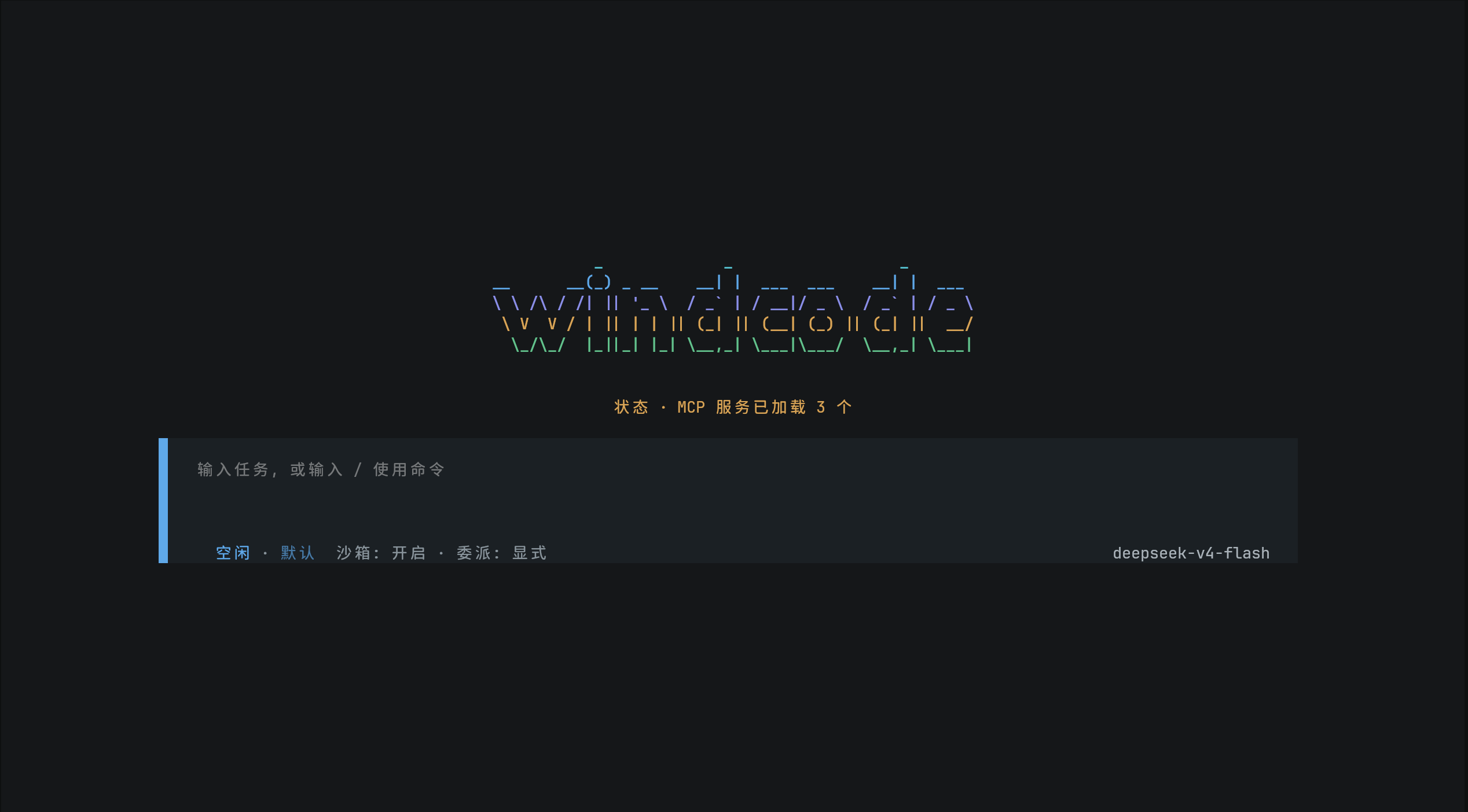
Windcode is a terminal coding agent for real software repositories. It can inspect a project, edit files, run commands and tests, and ask for approval before high-risk operations. It combines a Textual-based TUI with multi-provider model access, subagent collaboration, MCP, Skills, Plugins, recoverable sessions, long-term memory, and an asynchronous Python SDK.
Windcode is designed for auditable development work rather than isolated code-generation demos. Permission decisions, process isolation, run budgets, session persistence, and trace events are built into the runtime so a task can move from discussion to implementation and verification in a single workspace.
- For: developers and teams bringing AI into daily engineering workflows.
- Interfaces: an interactive terminal UI and an asynchronous Python SDK.
- Principles: safe by default, observable, recoverable, and open to extension.
Demo
Features
Coding workspace
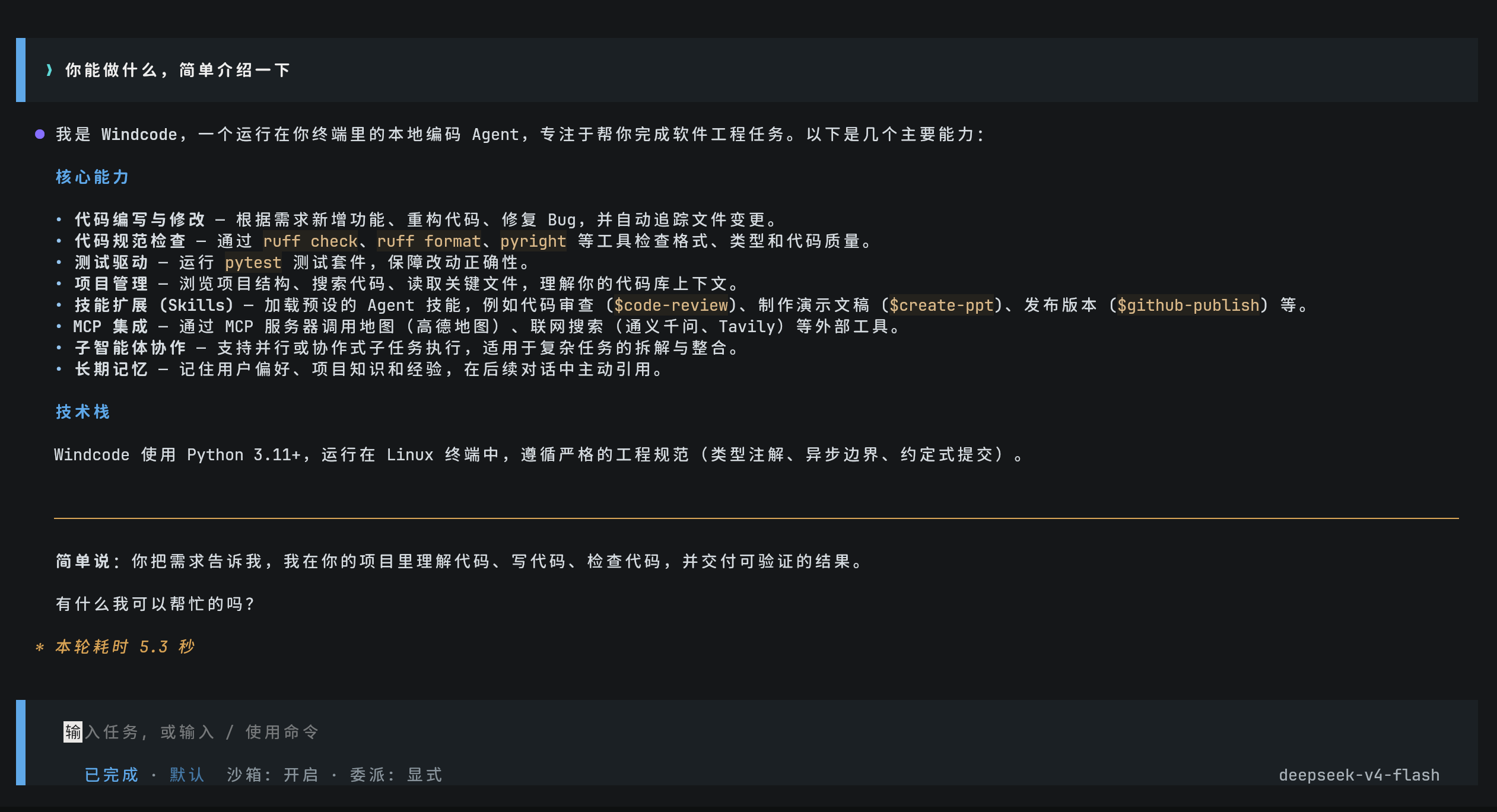
- Discuss a task, inspect and search files, apply patches, run shell commands, test, and build from one TUI.
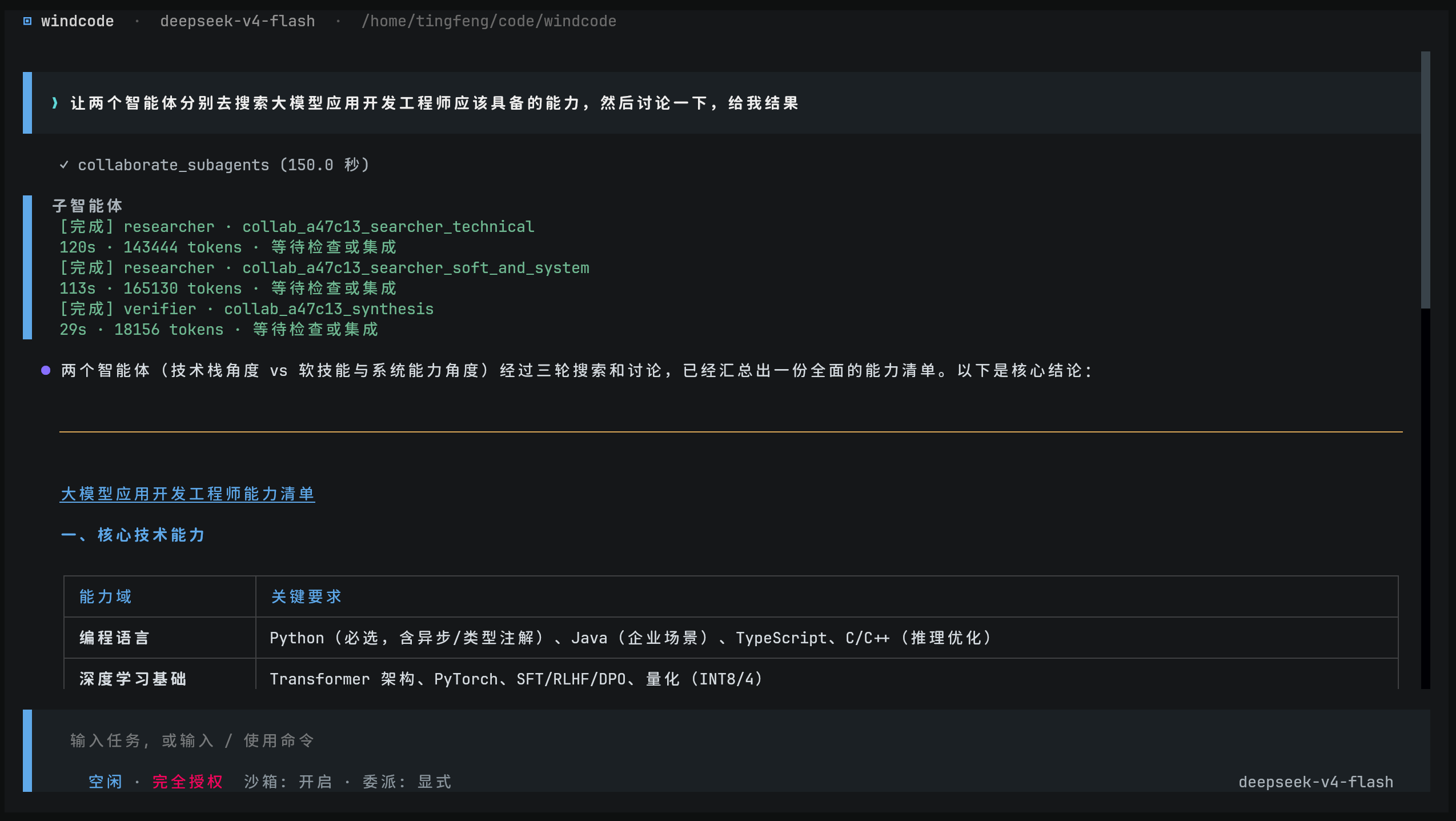
- See tool calls, reasoning state, elapsed time, token use, approvals, and subagent progress as they happen.
- Queue tasks, cancel active runs, retry model streams, and recover from idle network streams.
- Manage providers, extensions, long-term memory, sessions, and history from built-in screens.
- Enter the TUI even when a provider is missing or invalid, then repair the connection through
/modelwithout restarting the application. - Use the asynchronous SDK to subscribe to structured events, answer approvals, cancel runs, compact context, and coordinate subagents.
Models and reliable execution
- Native adapters for Anthropic Messages, OpenAI Responses, and OpenAI-compatible APIs.
- Presets for OpenAI, DeepSeek, Moonshot AI, SiliconFlow, OpenRouter, Zhipu AI, Alibaba Cloud, Groq, Mistral, xAI, and Google Gemini, plus custom compatible endpoints.
- Primary providers, explicit fallback chains, streaming text/reasoning/tool calls, retries, and model fallback.
- Add, edit, disconnect, select, and query models from
/model; store API keys in a dedicated credential store or provide them through environment variables. - Automatic retry when a model stream stays idle beyond
model_stream_idle_timeout_seconds. - Automatic context compaction at the configured threshold, with
/compactfor manual compaction.
Multi-agent collaboration
explicitandproactivedelegation modes with researcher, worker, and verifier roles.- Parallel independent tasks and structured
division,negotiation, orhybridcollaboration. - Controlled messaging, synchronized rounds, cancellation, timeouts, and aggregate budgets.
- Isolated Git worktrees for write tasks, followed by commit, changed-file, and verification checks.
- Role-filtered tools, MCP servers, Skills, permissions, and sandbox boundaries for every child; recursive subagent creation is disabled.
MCP, Skills, Hooks, and Plugins
- MCP over stdio and Streamable HTTP, including Tools, Resources, Resource Templates, and Prompts.
- Direct injection for small tool catalogs and on-demand
search_mcp_toolsdiscovery for large catalogs. - Project Skills in
.windcode/skills/<skill-name>/SKILL.mdand user Skills in~/.windcode/skills/<skill-name>/SKILL.md, with$skill-nameactivation. - Local plugins declared through
.windcode-plugin/plugin.toml, combining Skills, MCP servers, Hooks, and custom commands. - Hooks across session, run, tool policy, approval, compaction, and subagent lifecycle events.
Sessions, memory, and observability
- Incrementally persisted sessions and events, resumable conversations, and history rewind.
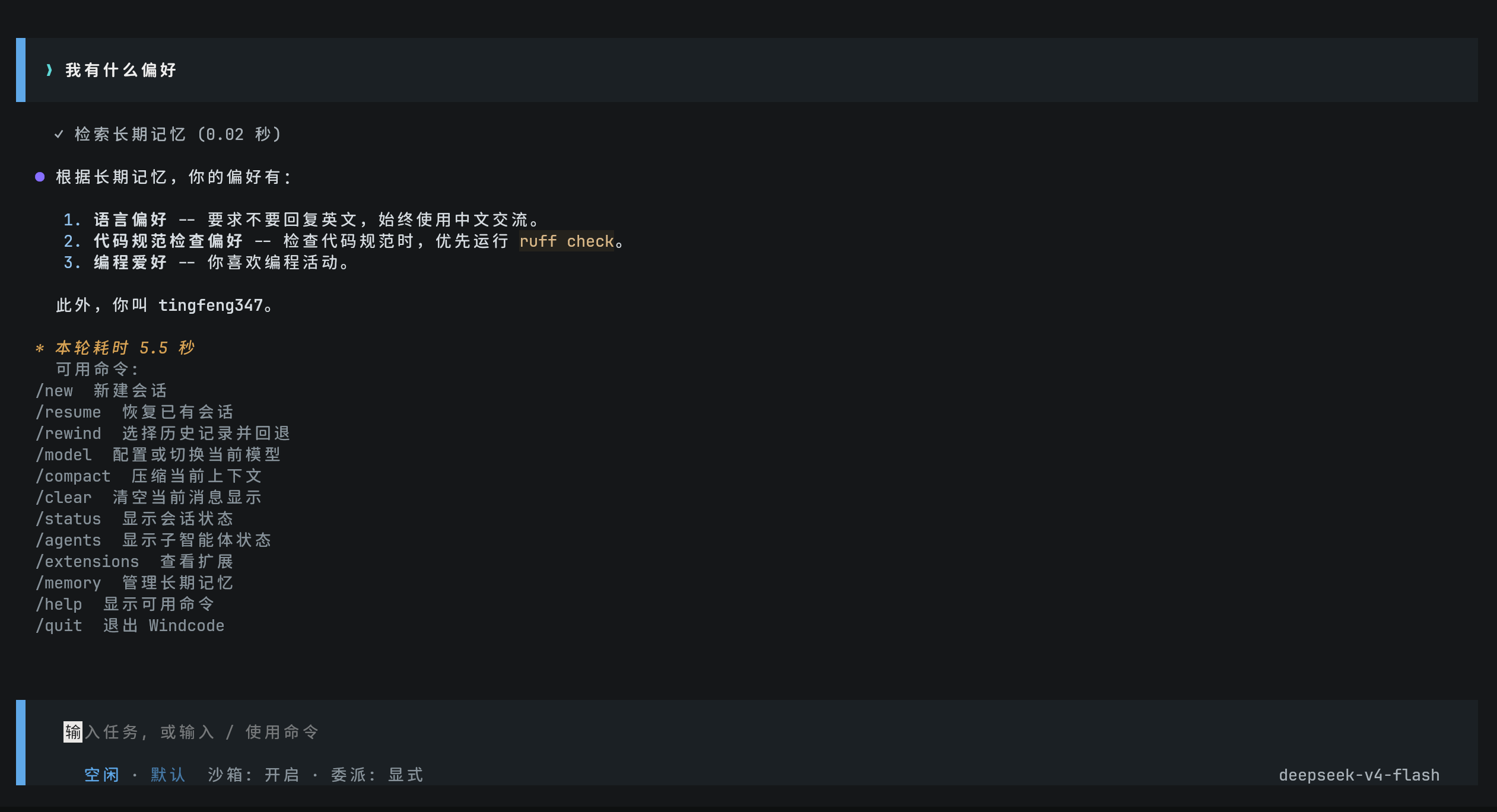
- Long-term user profiles, project knowledge, engineering experiences, SOPs, and references with review, activation, search, rejection, and forgetting workflows.
- Trace events for models, tools, approvals, extensions, and subagents with retention controls.
- Session artifacts for large tool results, keeping context compact without losing provenance.
Permissions, sandboxing, and platforms
plan,default,accept_edits, andfull_accesspermission modes, switchable during a run.- Risk decisions based on side effects, parsed commands, working directories, network access, and sandbox state, including one-time approvals and project command-prefix rules.
- Bubblewrap on Linux and Seatbelt on macOS with
read_only,workspace_write, anddanger_full_accesspresets. - PowerShell without an OS sandbox on Windows. Sandbox presets deterministically fall back to
danger_full_access, while permission modes and dangerous-command checks remain active.
Quick Start
Requirements: Linux, macOS, or Windows; Python 3.11+; and
uv.
Install the command from PyPI:
uv tool install windcode
windcode /path/to/project
Or install the npm CLI wrapper (requires Node.js 20+ and
uv):
pnpm add --global windcode
windcode /path/to/project
Or install it into the current Python environment:
uv pip install windcode
Run from source:
uv sync --frozen --all-groups
uv run windcode /path/to/project
Container image
Run a published image from GitHub Container Registry with an interactive TTY and a mounted project:
docker run --rm -it -v "$PWD:/workspace" ghcr.io/tingfeng347/windcode:0.4.2
See the GHCR guide for image login, persistence, and runtime details.
Connect a model
The first launch does not require a configured model. Enter /model in the TUI to connect a
provider. For file-based configuration, start from .windcode/config.toml.example.
primary_provider = "primary"

[providers.primary]
protocol = "openai_compatible"
model = "your-model"
base_url = "https://example.com/v1"
api_key_env = "MODEL_API_KEY"
Provide secrets through an environment variable or the Windcode credential store, never through project configuration:
export MODEL_API_KEY="..."
uv run windcode .
If a provider is absent, invalid, or has unreadable credentials, Windcode keeps the TUI and extension system available and explains how to reconnect. Only invalid TOML or unrelated base configuration errors prevent startup.
Common startup options:
--config FILE
--model PROVIDER_OR_MODEL
--resume SESSION_ID
--permission-mode plan|default|accept_edits|full_access
--sandbox / --no-sandbox
Commands and Shortcuts
/new                         Start a new session
/resume [SESSION_ID]         Resume a session
/rewind                      Rewind to an earlier user message
/model [PROVIDER_ALIAS]      Manage or switch models and providers
/memory [ACTION]             Manage long-term memory
/extensions [ACTION] [ID]    Manage extensions, plugins, and trust
/compact                     Compact the current context
/clear                       Clear the visible message history
/agents                      View subagents
/status                      View runtime status
/help                        List built-in and plugin commands
/quit                        Exit Windcode

Shift+Tab                    Cycle the permission mode
Esc twice                    Interrupt the active run
MCP Server
Streamable HTTP example:
[extensions]
enabled = true

[extensions.mcp_servers.example]
transport = "streamable_http"
url = "https://example.com/mcp"
enable = true
required = false
stdio example:
[extensions.mcp_servers.local-example]
transport = "stdio"
command = "uvx"
args = ["example-mcp-server"]
enable = true
required = false
Disabled servers do not connect, enter tool search, or appear in model context. required only
controls eager startup for an enabled server; a failed server reports degraded status without
blocking ordinary conversation. No MCP server is enabled by default.
Subagent Configuration
[subagents]
mode = "explicit" # explicit | proactive
max_tasks = 8
max_concurrent = 4
max_model_steps = 20
max_tool_calls = 50
max_runtime_seconds = 900
max_total_model_steps = 80
max_total_tool_calls = 200
explicit exposes delegation only when the user asks for subagents or parallel work. proactive
allows the model to split complex work when useful. Per-task, concurrency, and aggregate budgets
apply together.
Run Budgets and Stream Timeouts
[budgets]
max_model_steps = 40
max_tool_calls = 100
max_runtime_seconds = 1800
model_stream_idle_timeout_seconds = 60
shell_timeout_seconds = 120
A model stream that produces no event before the idle deadline enters the network retry and fallback path. Manual interruption is recorded as cancellation, not as a provider failure.
Local State
Windcode stores memory, sessions, traces, extension state, and worktrees under one selected root:
[storage]
project_state_root = ".windcode"
user_storage_root = "~/.windcode"
User configuration is read from ~/.windcode/config.toml; project configuration in
.windcode/config.toml has higher precedence. Project configuration and runtime state under
.windcode/ should not be committed.
API keys are stored in auth.json under the user storage root rather than in TOML. Windcode does
not echo credential values in project configuration or error messages.
Troubleshooting
No model provider is configured
This is recoverable. Extensions, MCP, Skills, sessions, and memory remain available. Run /model,
select a preset or custom endpoint, enter the model ID and API key, and save.
Provider configuration or credentials are invalid
Windcode temporarily disables the unavailable model connection and continues to the welcome
screen. Repair the provider through /model; the updated connection takes effect without a
restart. Invalid TOML must be corrected in the file reported by the terminal.
License
1 maintainer

Download files
Download the file for your platform. If you're not sure which to choose, learn more about installing packages.
Source Distribution
Built Distribution
Filter files by name, interpreter, ABI, and platform.
If you're not sure about the file name format, learn more about wheel file names.
Copy a direct link to the current filters
File details
Details for the file windcode-0.4.3.tar.gz.
File metadata
- Download URL: windcode-0.4.3.tar.gz
- Upload date:
- Size: 486.4 kB
- Tags: Source
- Uploaded using Trusted Publishing? Yes
- Uploaded via:
twine/7.0.0 CPython/3.13.14
File hashes
| Algorithm | Hash digest | |
|---|---|---|
| SHA256 |
b444a7b1c5dc88109c61f7247c67403365205fe3e2c7e359d6a8c27e7dd2dc6b
|
|
| MD5 |
0415b1e51798cefb12d8c53d187b8642
|
|
| BLAKE2b-256 |
c235cb5a269df2a5a7bcf469e68a642e9af97515c715d7bfe9a1b722c5209d2c
|
File details
Details for the file windcode-0.4.3-py3-none-any.whl.
File metadata
- Download URL: windcode-0.4.3-py3-none-any.whl
- Upload date:
- Size: 295.7 kB
- Tags: Python 3
- Uploaded using Trusted Publishing? Yes
- Uploaded via:
twine/7.0.0 CPython/3.13.14
File hashes
| Algorithm | Hash digest | |
|---|---|---|
| SHA256 |
a1a79780507608f455b0a239b0661aae51bdb08a8c4e8e4a8852d77e2e3bbae5
|
|
| MD5 |
bffd775364be8e3b92791e9511505cb3
|
|
| BLAKE2b-256 |
72437f7403f5165cae572b2b9a8b2060213cb529ec01879fcc6ba5d962a68a14
|














