
Lightweight MCP Server for interacting with Windows Operating System.

Project description
🪟 Windows-MCP






Windows-MCP is a lightweight, open-source project that enables seamless integration between AI agents and the Windows operating system. Acting as an MCP server bridges the gap between LLMs and the Windows operating system, allowing agents to perform tasks such as file navigation, application control, UI interaction, QA testing, and more.
mcp-name: io.github.CursorTouch/Windows-MCP
Updates
- Added VM support for Windows-MCP. Check (windowsmcp.io)[https://windowsmcp.io/] for more details.
- Windows-MCP reached
2M+ Usersin Claude Desktop Extensiosn. - Try out 🪟Windows-Use, an agent built using Windows-MCP.
- Windows-MCP is now available on PyPI (thus supports
uvx windows-mcp) - Windows-MCP is added to MCP Registry
Supported Operating Systems
- Windows 7
- Windows 8, 8.1
- Windows 10
- Windows 11
🎥 Demos
https://github.com/user-attachments/assets/d0e7ed1d-6189-4de6-838a-5ef8e1cad54e
https://github.com/user-attachments/assets/d2b372dc-8d00-4d71-9677-4c64f5987485
✨ Key Features
-
Seamless Windows Integration
Interacts natively with Windows UI elements, opens apps, controls windows, simulates user input, and more. -
Use Any LLM (Vision Optional) Unlike many automation tools, Windows-MCP doesn't rely on any traditional computer vision techniques or specific fine-tuned models; it works with any LLMs, reducing complexity and setup time.
-
Rich Toolset for UI Automation
Includes tools for basic keyboard, mouse operation and capturing window/UI state. -
Lightweight & Open-Source
Minimal dependencies and easy setup with full source code available under MIT license. -
Customizable & Extendable
Easily adapt or extend tools to suit your unique automation or AI integration needs. -
Real-Time Interaction
Typical latency between actions (e.g., from one mouse click to the next) ranges from 0.2 to 0.9 secs, and may slightly vary based on the number of active applications and system load, also the inferencing speed of the llm. -
DOM Mode for Browser Automation
Specialuse_dom=Truemode for State-Tool that focuses exclusively on web page content, filtering out browser UI elements for cleaner, more efficient web automation.
🛠️Installation
Note: When you install this MCP server for the first time it may take a minute or two because of installing the dependencies in pyproject.toml. In the first run the server may timeout ignore it and restart it.
Prerequisites
- Python 3.13+
- UV (Package Manager) from Astra, install with
pip install uvorcurl -LsSf https://astral.sh/uv/install.sh | sh Englishas the default language in Windows preferred else disable theApp-Toolin the MCP Server for Windows with other languages.
Install in Claude Desktop
- Install Claude Desktop and
npm install -g @anthropic-ai/mcpb
- Configure the extension:
Option A: Install from PyPI (Recommended)
Use uvx to run the latest version directly from PyPI.
Add this to your claude_desktop_config.json:
{
  "mcpServers": {
    "windows-mcp": {
      "command": "uvx",
      "args": [
        "windows-mcp"
      ]
    }
  }
}
Option B: Install from Source
- Clone the repository:
git clone https://github.com/CursorTouch/Windows-MCP.git
cd Windows-MCP
- Add this to your
claude_desktop_config.json:
{
  "mcpServers": {
    "windows-mcp": {
      "command": "uv",
      "args": [
        "--directory",
        "<path to the windows-mcp directory>",
        "run",
        "windows-mcp"
      ]
    }
  }
}
-
Open Claude Desktop and enjoy! 🥳
-
Enjoy 🥳.
For additional Claude Desktop integration troubleshooting, see the MCP documentation. The documentation includes helpful tips for checking logs and resolving common issues.
Install in Perplexity Desktop
-
Install Perplexity Desktop:
-
Clone the repository.
git clone https://github.com/CursorTouch/Windows-MCP.git

cd Windows-MCP
- Open Perplexity Desktop:
Go to Settings->Connectors->Add Connector->Advanced
- Enter the name as
Windows-MCP, then paste the following JSON in the text area.
Option A: Install from PyPI (Recommended)
{
  "command": "uvx",
  "args": [
    "windows-mcp"
  ]
}
Option B: Install from Source
{
  "command": "uv",
  "args": [
    "--directory",
    "<path to the windows-mcp directory>",
    "run",
    "windows-mcp"
  ]
}
- Click
Saveand Enjoy 🥳.
For additional Claude Desktop integration troubleshooting, see the Perplexity MCP Support. The documentation includes helpful tips for checking logs and resolving common issues.
Install in Gemini CLI
- Install Gemini CLI:
npm install -g @google/gemini-cli
-
Configure the server in
%USERPROFILE%/.gemini/settings.json: -
Navigate to
%USERPROFILE%/.geminiin File Explorer and opensettings.json. -
Add the
windows-mcpconfig in thesettings.jsonand save it.
{
  "theme": "Default",
  ...
  "mcpServers": {
    "windows-mcp": {
      "command": "uvx",
      "args": [
        "windows-mcp"
      ]
    }
  }
}
Note: To run from source, replace the command with uv and args with ["--directory", "<path>", "run", "windows-mcp"].
- Rerun Gemini CLI in terminal. Enjoy 🥳
Install in Qwen Code
1. Install Qwen Code:npm install -g @qwen-code/qwen-code@latest
-
Configure the server in
%USERPROFILE%/.qwen/settings.json: -
Navigate to
%USERPROFILE%/.qwen/settings.json. -
Add the
windows-mcpconfig in thesettings.jsonand save it.
{
  "mcpServers": {
    "windows-mcp": {
      "command": "uvx",
      "args": [
        "windows-mcp"
      ]
    }
  }
}
Note: To run from source, replace the command with uv and args with ["--directory", "<path>", "run", "windows-mcp"].
- Rerun Qwen Code in terminal. Enjoy 🥳
Install in Codex CLI
1. Install Codex CLI:npm install -g @openai/codex
-
Configure the server in
%USERPROFILE%/.codex/config.toml: -
Navigate to
%USERPROFILE%/.codex/config.toml. -
Add the
windows-mcpconfig in theconfig.tomland save it.
[mcp_servers.windows-mcp]
command="uvx"
args=[
  "windows-mcp"
]
Note: To run from source, replace the command with uv and args with ["--directory", "<path>", "run", "windows-mcp"].
- Rerun Codex CLI in terminal. Enjoy 🥳
🖥️ Modes
Windows-MCP supports two operating modes: Local (default) and Remote.
Local Mode (Default)
In local mode, Windows-MCP runs directly on your Windows machine and exposes its tools to the connected MCP client. This is the standard setup for personal use.
# Runs with stdio transport (default)
uvx windows-mcp

# Or with SSE/Streamable HTTP for network access
uvx windows-mcp --transport sse --host localhost --port 8000
uvx windows-mcp --transport streamable-http --host localhost --port 8000
No additional environment variables are needed. The MCP client connects directly to the server.
Remote Mode
In remote mode, Windows-MCP acts as a proxy that connects to the windowsmcp.io enabling cloud-hosted Windows automation. This is designed for scenarios where the MCP client is remote and connects through the dashboard, which routes requests to a Windows VM running Windows-MCP.
Required environment variables:
| Variable | Description |
|---|---|
MODE |
Set to remote |
SANDBOX_ID |
The sandbox/VM identifier from the dashboard |
API_KEY |
Your Windows-MCP API key |
Example configuration:
{
  "mcpServers": {
    "windows-mcp": {
      "command": "uvx",
      "args": [
        "windows-mcp"
      ],
      "env": {
        "MODE": "remote",
        "SANDBOX_ID": "your-sandbox-id",
        "API_KEY": "your-api-key"
      }
    }
  }
}
Transport Options
| Transport | Flag | Use Case |
|---|---|---|
stdio (default) |
--transport stdio |
Direct connection from MCP clients like Claude Desktop, Cursor, etc. |
sse |
--transport sse --host HOST --port PORT |
Network-accessible via Server-Sent Events |
streamable-http |
--transport streamable-http --host HOST --port PORT |
Network-accessible via HTTP streaming (recommended for production) |
🔨MCP Tools
MCP Client can access the following tools to interact with Windows:
Click: Click on the screen at the given coordinates.Type: Type text on an element (optionally clears existing text).Scroll: Scroll vertically or horizontally on the window or specific regions.Move: Move mouse pointer or drag (set drag=True) to coordinates.Shortcut: Press keyboard shortcuts (Ctrl+c,Alt+Tab, etc).Wait: Pause for a defined duration.Snapshot: Combined snapshot of default language, browser, active apps and interactive, textual and scrollable elements along with screenshot of the desktop. Supportsuse_dom=Truefor browser content extraction (web page elements only) anduse_vision=Truefor including screenshots.App: To launch an application from the start menu, resize or move the window and switch between apps.Shell: To execute PowerShell commands.Scrape: To scrape the entire webpage for information.MultiSelect: Select multiple items (files, folders, checkboxes) with optional Ctrl key.MultiEdit: Enter text into multiple input fields at specified coordinates.Clipboard: Read or set Windows clipboard content.Process: List running processes or terminate them by PID or name.SystemInfo: Get system information including CPU, memory, disk, network stats, and uptime.Notification: Send a Windows toast notification with a title and message.LockScreen: Lock the Windows workstation.Registry: Read, write, delete, or list Windows Registry values and keys.
🤝 Connect with Us
Stay updated and join our community:
-
📢 Follow us on X for the latest news and updates
-
💬 Join our Discord Community
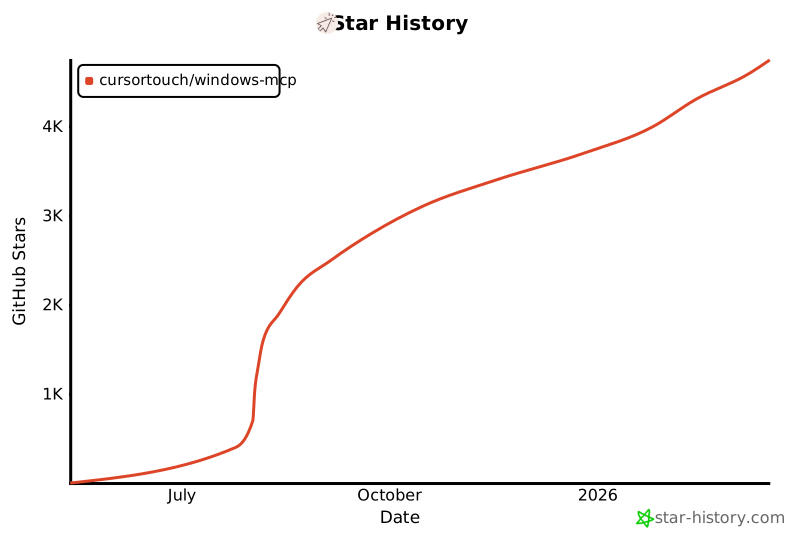
Star History
👥 Contributors
Thanks to all the amazing people who have contributed to Windows-MCP! 🎉

We appreciate every contribution, whether it's code, documentation, bug reports, or feature suggestions. Want to contribute? Check out our Contributing Guidelines!
🔒 Security
Important: Windows-MCP operates with full system access and can perform irreversible operations. Please review our comprehensive security guidelines before deployment.
For detailed security information, including:
- Tool-specific risk assessments
- Deployment recommendations
- Vulnerability reporting procedures
- Compliance and auditing guidelines
Please read our Security Policy.
📊 Telemetry
Windows-MCP collects usage data to help improve the MCP server. No personal information, no tool arguments, no outputs are tracked.
To disable telemetry, add the following to your MCP client configuration:
{
  "mcpServers": {
    "windows-mcp": {
      "command": "uvx",
      "args": [
        "windows-mcp"
      ],
      "env": {
        "ANONYMIZED_TELEMETRY": "false"
      }
    }
  }
}
For detailed information on what data is collected and how it is handled, please refer to the Telemetry and Data Privacy section in our Security Policy.
📝 Limitations
- Selecting specific sections of the text in a paragraph, as the MCP is relying on a11y tree. (⌛ Working on it.)
Type-Toolis meant for typing text, not programming in IDE because of it types program as a whole in a file. (⌛ Working on it.)- This MCP server can't be used to play video games 🎮.
🪪 License
This project is licensed under the MIT License - see the LICENSE file for details.
🙏 Acknowledgements
Windows-MCP makes use of several excellent open-source projects that power its Windows automation features:
Huge thanks to the maintainers and contributors of these libraries for their outstanding work and open-source spirit.
🤝Contributing
Contributions are welcome! Please see CONTRIBUTING for setup instructions and development guidelines.
Made with ❤️ by CursorTouch
Citation
@software{
  author       = {CursorTouch},
  title        = {Windows-MCP: Lightweight open-source project for integrating LLM agents with Windows},
  year         = {2024},
  publisher    = {GitHub},
  url={https://github.com/CursorTouch/Windows-MCP}
}


Download files
Download the file for your platform. If you're not sure which to choose, learn more about installing packages.
Source Distribution
Built Distribution
Filter files by name, interpreter, ABI, and platform.
If you're not sure about the file name format, learn more about wheel file names.
Copy a direct link to the current filters
File details
Details for the file windows_mcp-0.6.8.tar.gz.
File metadata
- Download URL: windows_mcp-0.6.8.tar.gz
- Upload date:
- Size: 1.5 MB
- Tags: Source
- Uploaded using Trusted Publishing? No
- Uploaded via: uv/0.9.24 {"installer":{"name":"uv","version":"0.9.24","subcommand":["publish"]},"python":null,"implementation":{"name":null,"version":null},"distro":null,"system":{"name":null,"release":null},"cpu":null,"openssl_version":null,"setuptools_version":null,"rustc_version":null,"ci":null}
File hashes
| Algorithm | Hash digest | |
|---|---|---|
| SHA256 |
59dbf459b441bab3b38a20aa4828babf1d242e1d016a68da0b18ef9fd5a3f06c
|
|
| MD5 |
de098bf01b82dfae21f00a4a09d7c90c
|
|
| BLAKE2b-256 |
0bba63d944f5113e4481fa3b9a82fcf51abb2d4e26dc7f68b68c504ea20c518b
|
File details
Details for the file windows_mcp-0.6.8-py3-none-any.whl.
File metadata
- Download URL: windows_mcp-0.6.8-py3-none-any.whl
- Upload date:
- Size: 126.5 kB
- Tags: Python 3
- Uploaded using Trusted Publishing? No
- Uploaded via: uv/0.9.24 {"installer":{"name":"uv","version":"0.9.24","subcommand":["publish"]},"python":null,"implementation":{"name":null,"version":null},"distro":null,"system":{"name":null,"release":null},"cpu":null,"openssl_version":null,"setuptools_version":null,"rustc_version":null,"ci":null}
File hashes
| Algorithm | Hash digest | |
|---|---|---|
| SHA256 |
dcc9fe2f38aa537418d215b3429410aca670ca72ef966e352ac49fff8876f780
|
|
| MD5 |
aff4a2f3a87a0170636da7691878b230
|
|
| BLAKE2b-256 |
e77f23c9ff6277cfdcaa31ab610d1dec6a65d4f4c901ec743e39efda4da286b8
|






