
See how your codebase really fits together, and prove it.
Wirehouse maps a repository from its code and turns it into a 3D warehouse you can walk:
services are shipping containers, databases are silos, auth is a security gate, and every pipe is
a connection found in the code, with the file and line that prove it. Trace where a request goes,
take a guided tour, and share it all as one offline HTML file.




Try the live demo · Quick start · Why Wirehouse · How to use · How it works
The warehouse of fastapi/full-stack-fastapi-template, described by a coding agent.
Open it yourself (one 1.2 MB HTML file) ·
MP4

Why Wirehouse
Architecture diagrams go stale the day they are drawn, and reading a new codebase file by file tells you what is there but not how it fits together. Wirehouse rebuilds the map from the code every time, and holds it to one rule: nothing is drawn that the code does not show.
- A map you can check. Every connection found in the code carries the file and line it was found at, linked to your code host at the exact commit that was scanned. What an agent adds must cite real code or it is left out, inferred links say so, and a Checks panel lists anything that was dropped and why.
- Current in seconds, not a drawing to maintain. Re-run it after a change; descriptions are
cached by a hash of the code, so only what changed is described again.
--againstshows exactly which blocks, connections and files a change touched. - One file, nothing to host. The page is a single offline HTML file with everything inlined: no server, no account, no telemetry, no network loads. Email it, attach it to a pull request, or publish it on GitHub Pages.
- Answers real questions. What does this service reach? Trace it, with hop counts. How does a request get to the database? Walk the route stop by stop. Where do I start? Take the tour, then go find things with quests.
- Your agent, or no agent. The
/wirehouseskill uses the openSKILL.mdformat and works with Claude Code, Codex, Cursor, OpenCode, Gemini CLI, GitHub Copilot and any agent that reads files. Without one, the CLI still draws the full map with rule-based descriptions. - Safe to share. Real
.envfiles are never read, credential-looking text is cut from every output, and--shareremoves your local paths before you publish.
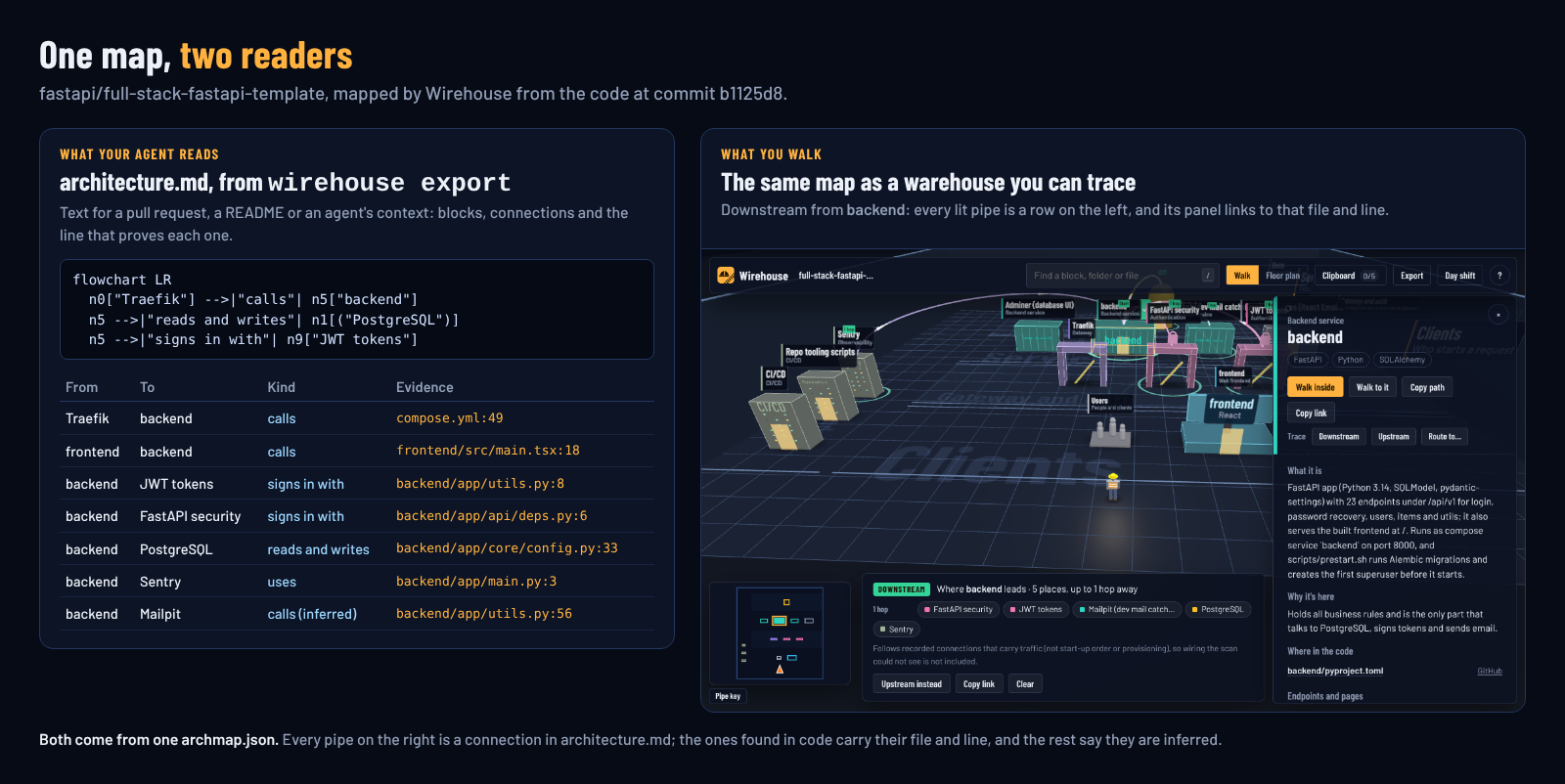
The same map as text for your agent or your pull request (wirehouse export), and as a place to walk.
How it compares
| Hand-drawn diagram | Mermaid in the docs | Wirehouse | |
|---|---|---|---|
| Built from the code | no | no | yes |
| File and line behind each connection | no | no | yes |
| Stays current without redrawing | no | no | yes |
| Follows env vars, compose, Terraform and CI, not just imports | by hand | by hand | yes |
| Shows what a change touched | no | in the diff | yes (--against) |
| Guided tours and traces for newcomers | no | no | yes |
| Text for a README or pull request | no | yes | yes (wirehouse export) |
What you can do
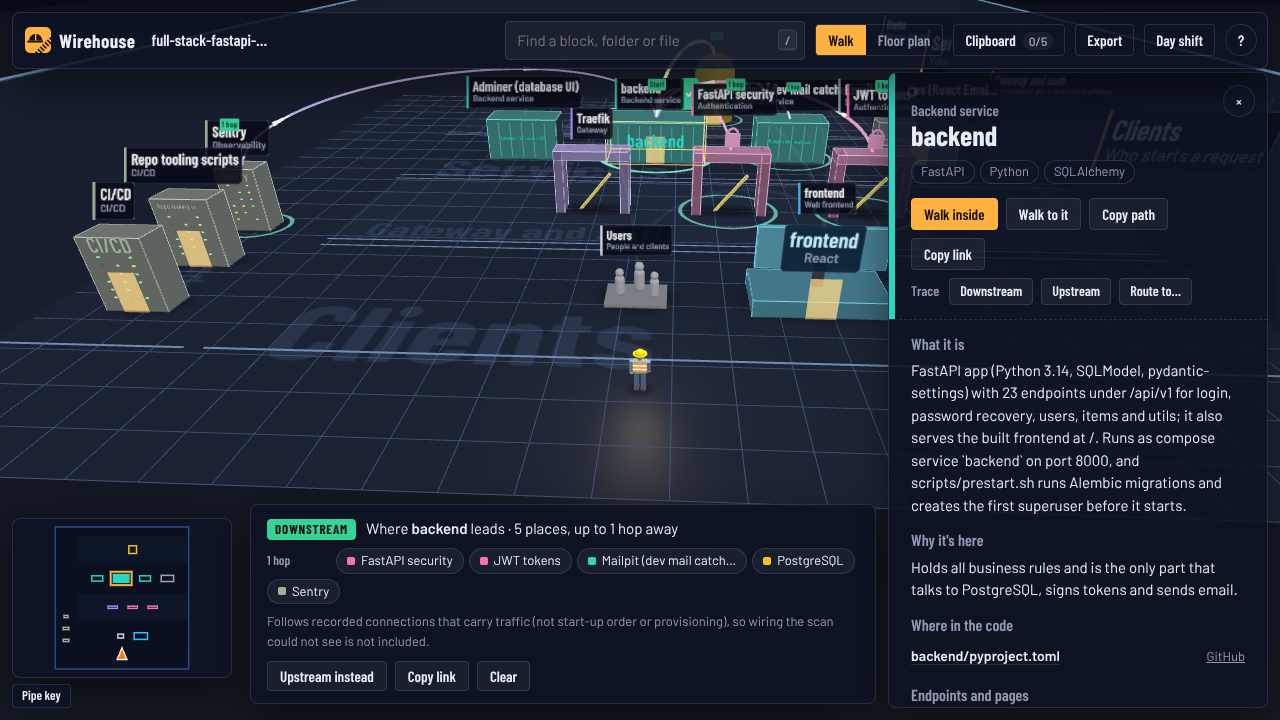 Trace everything a block leads to, or everything that leads to it, with hop counts. File precise. |
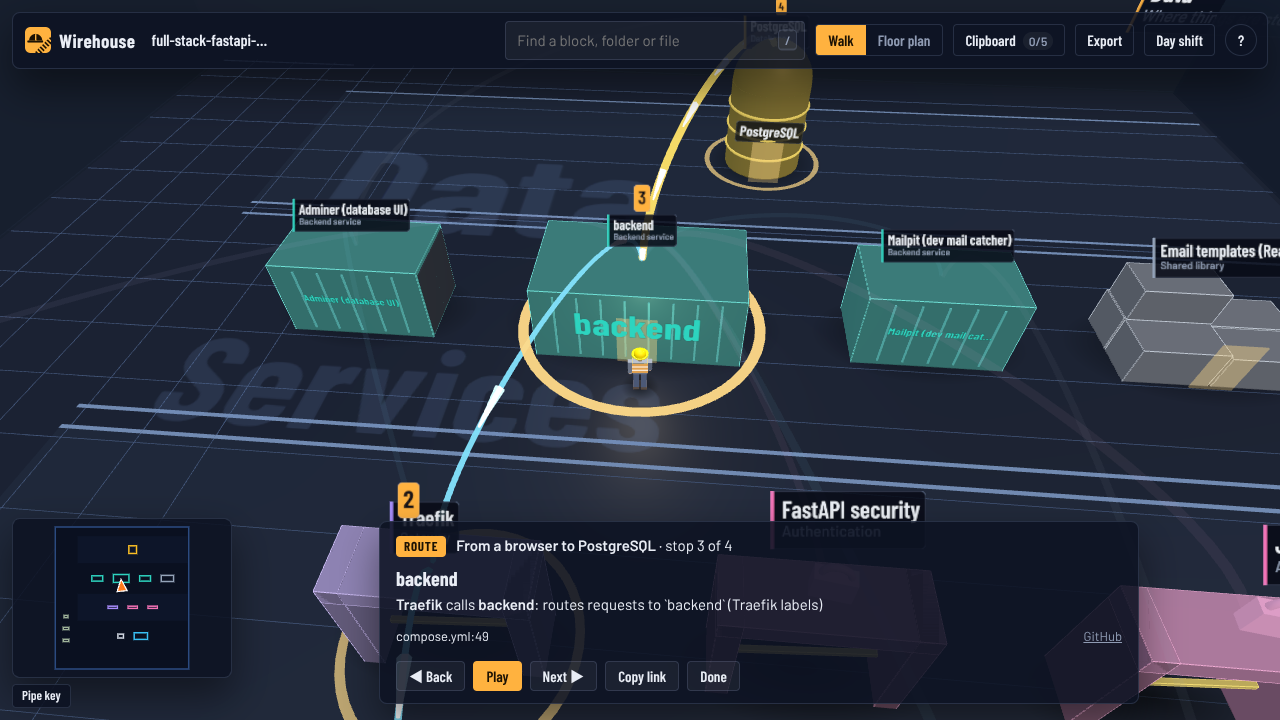 Walk a route from A to B, hop by hop, with the code behind each step. |
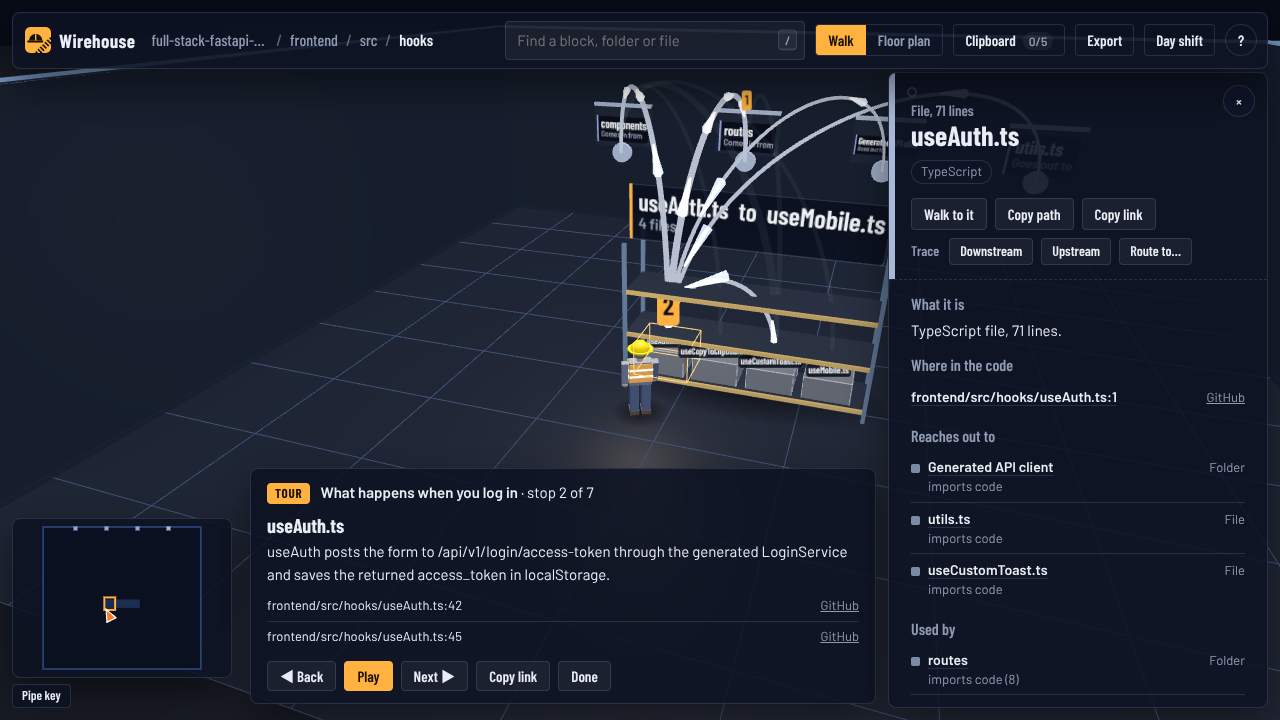 Guided tours and quests written by your agent from the real code, stop by stop with file and line. |
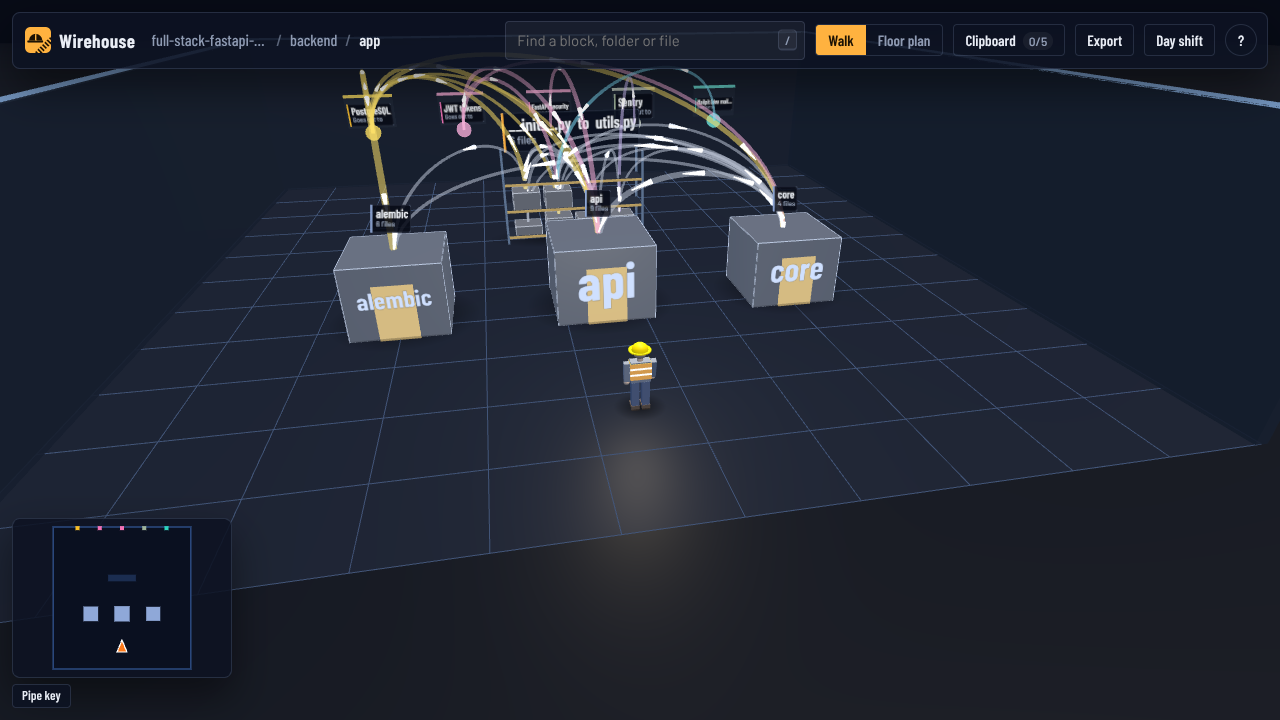 Walk into any block. Folders are crates, files sit on racks with aisle signs, connections leave through wall ports. |
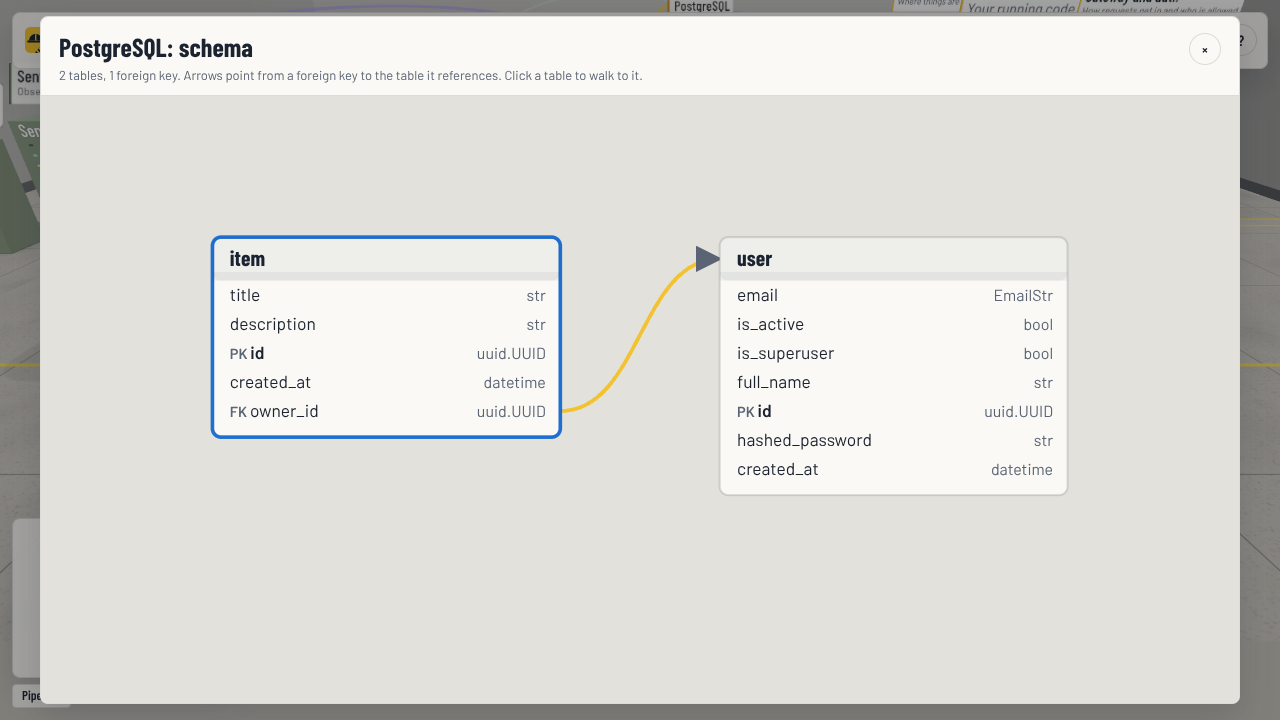 Database rooms with columns, keys and a schema diagram. |
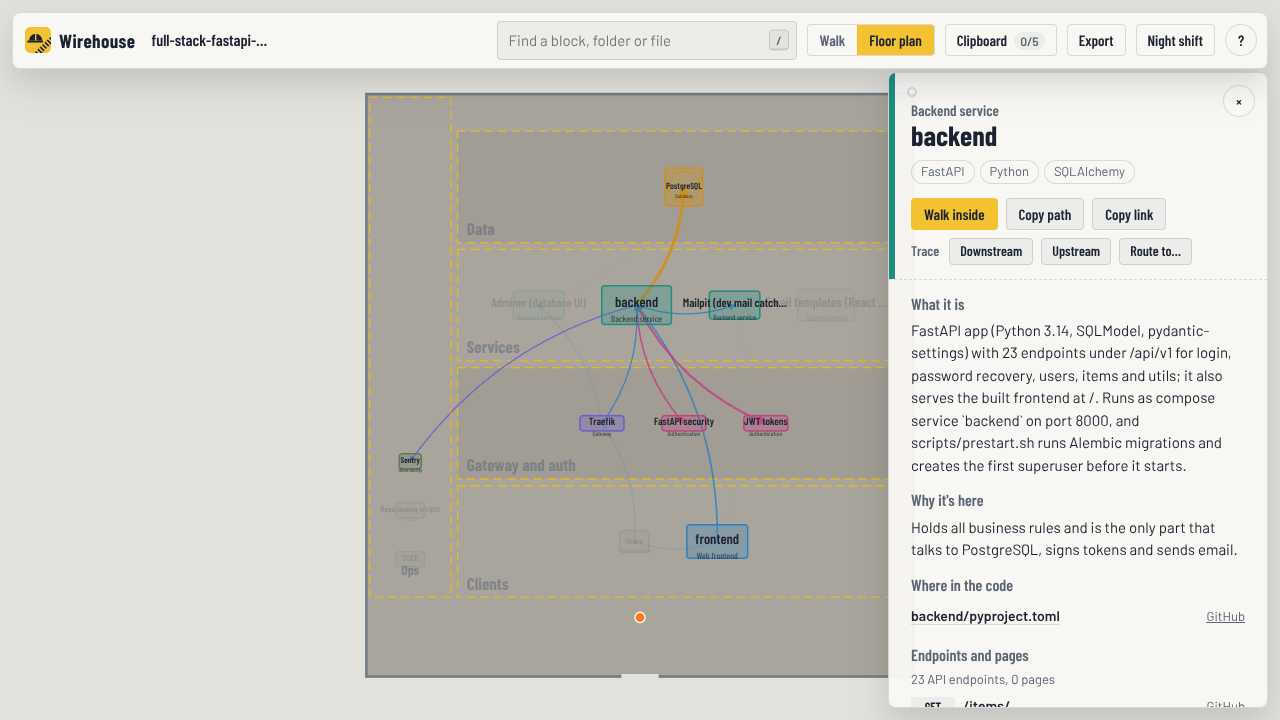 Floor plan in 2D for a quick overview, fully keyboard accessible. |
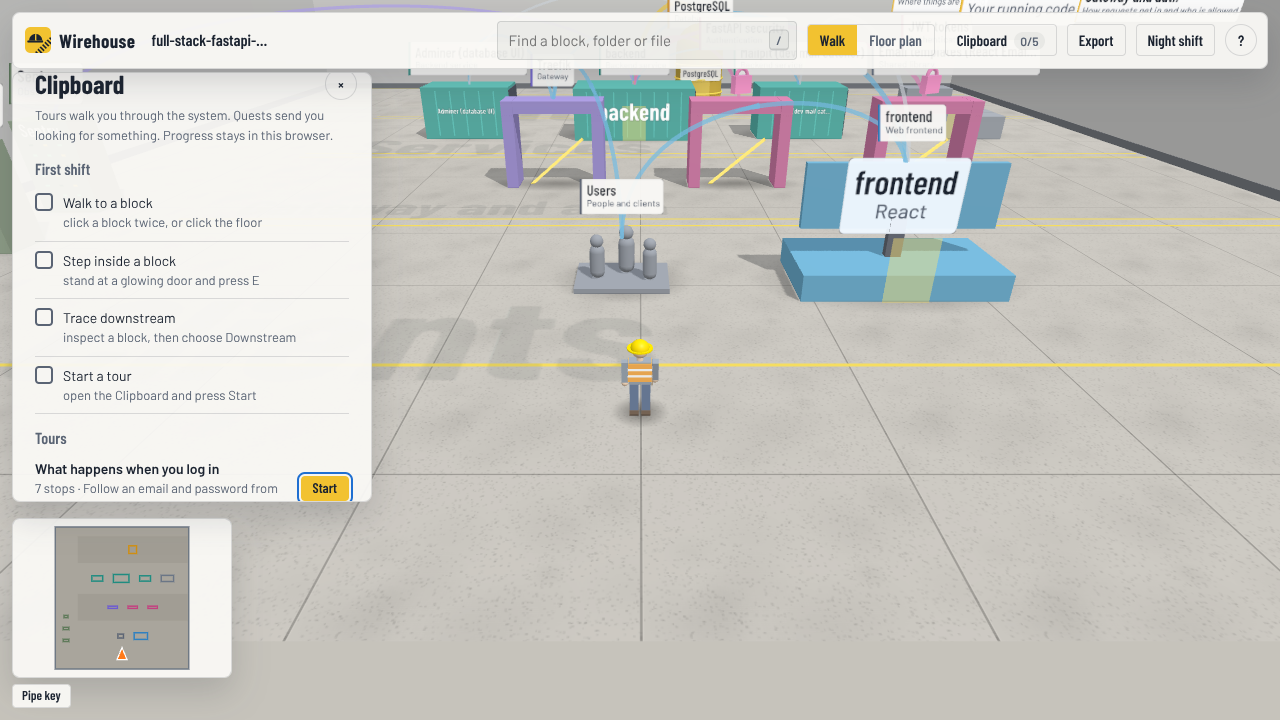 The Clipboard: a first-shift checklist, tours, quests and what you have inspected so far. |
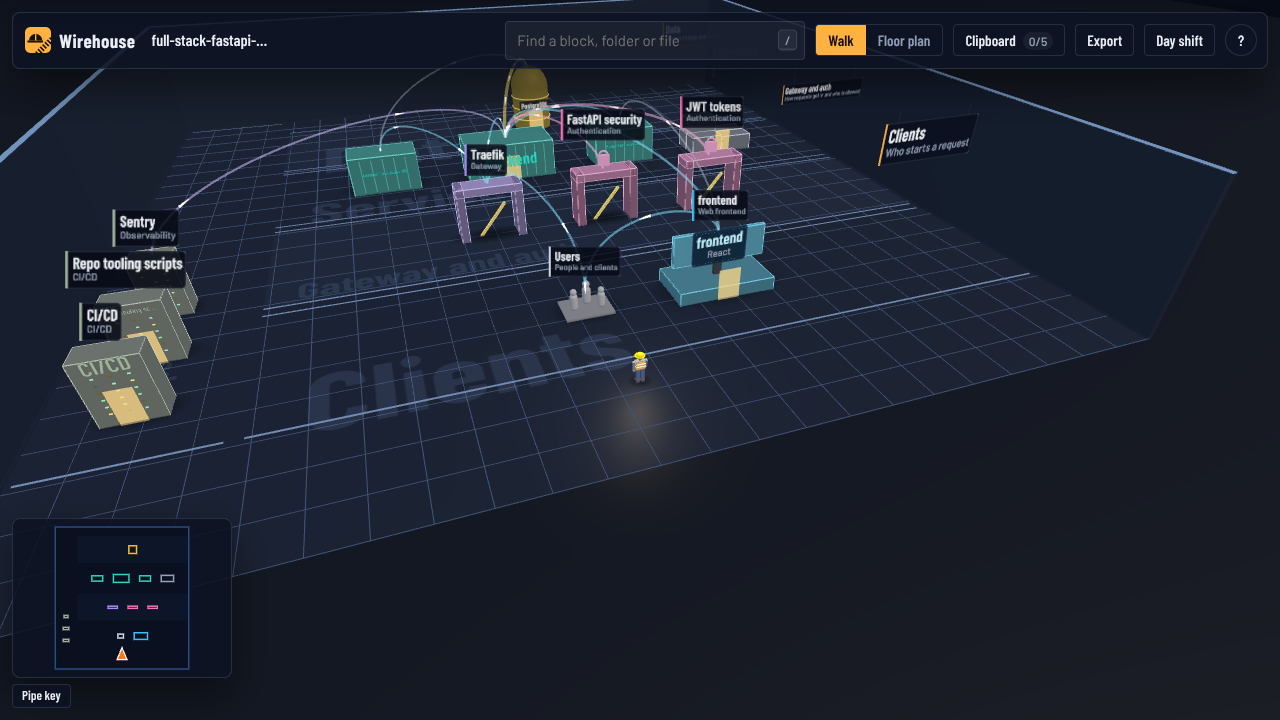 Night and day shift lighting; the page adapts its resolution to keep slower laptops responsive. |
Also: search that walks you to anything, links that reopen the exact view, commit-pinned links to GitHub, GitLab, Bitbucket and Azure DevOps, pictures or 1200 × 630 share cards of what you are looking at, and optional sound.
Quick start
Requires Python 3.11+.
pip install "git+https://github.com/creyes-git/wirehouse"
wirehouse install          # adds the wirehouse skill to the coding agents on this machine
Then, in your coding agent, inside any project:
/wirehouse
(Or just ask: "map this project with wirehouse".) The agent scans the project, reads the code to
describe every block and connection, writes tours and quests, and opens
wirehouse-out/wirehouse.html.
Works with your agent
Wirehouse ships as a skill in the open SKILL.md format. wirehouse install writes it to the
shared ~/.agents/skills folder and to the skills folder of every agent it finds in your home
folder:
| Agent | Skill folder |
|---|---|
| Codex and other agents that read the shared folder | ~/.agents/skills (written unless you pick --agent or --dir) |
| Claude Code | ~/.claude/skills |
| Cursor | ~/.cursor/skills |
| OpenCode | ~/.config/opencode/skills |
| Gemini CLI | ~/.gemini/skills |
| Antigravity | ~/.gemini/antigravity/skills |
| GitHub Copilot | ~/.copilot/skills |
Pick agents with wirehouse install --agent cursor --agent opencode, add any other skills folder
with --dir <folder>, or run wirehouse install --print and paste the instructions into an agent
that has no skills support. Restart the agent if it was already open.
No agent? The CLI draws the same map with rule-based descriptions and a starter tour:
wirehouse build path/to/project --open
How to use
1. Make a map
| Command | What it does |
|---|---|
/wirehouse [path] |
In your agent: scan, describe, render and open. Add --quick to skip the descriptions. |
wirehouse build <path> [--open] |
Scan and render in one go, reusing any descriptions from earlier runs. |
wirehouse scan <path> |
Detect structure only: writes archmap.raw.json and the agent's worklist enrich-brief.md. |
wirehouse render <path> [--open] |
Merge enrichment.json and write wirehouse.html. |
--share |
(build, render) Leave out local paths before you publish the page. |
--strict |
(build, render) Exit with an error when the checks left parts of the enrichment out, for CI. |
--against <map> |
(build, render) Compare with an earlier archmap.json: the page and the export show what changed. |
-o <folder> |
Write somewhere other than <path>/wirehouse-out/. |
wirehouse export <path> |
Write architecture.md: a Mermaid diagram, the blocks and every connection with its file and line. --format mermaid writes only the diagram (architecture.mmd). |
wirehouse install |
Add the skill to your agents (--agent, --dir, --print; see above). |
Descriptions are cached by a hash of the code they describe, so re-running /wirehouse after a
change only asks the agent about what changed. Add wirehouse-out/ to your .gitignore.
2. Walk around
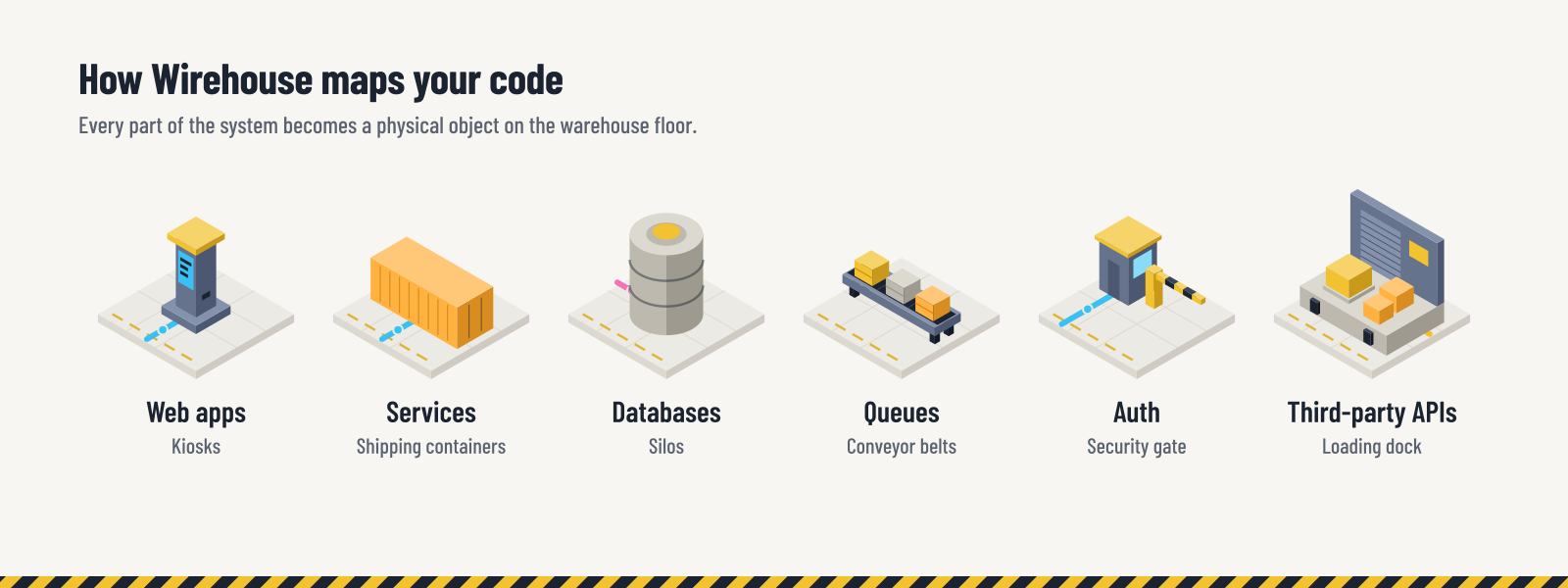
The floor is laid out from the entrance to the back: Clients, Gateway and auth (shown even when empty, because "no auth found" is worth knowing), Services, Data, and the Loading dock for third-party providers. Ops (CI/CD, Terraform, Kubernetes, hosting, observability) runs down the left side.
| Do this | To |
|---|---|
W A S D / arrows (Shift to run, Space to jump) |
walk the worker around |
| Drag, scroll | look around, zoom |
| Click a block, rack item or pipe | open its inventory tag: description, code locations, endpoints, connections |
| Click it again, or the floor, or the minimap | walk there |
E / Q |
walk into the block in front of you / step back out |
/ |
search everything and walk straight to it |
P |
switch between walking and the 2D floor plan |
T |
switch between night shift and day shift |
R |
route from the inspected block: pick an end point and walk it |
C |
the Clipboard: tours and quests |
X |
export a picture or a share card |
V |
changes since an earlier map, when the page has them |
Space , . |
during a tour or route: play or pause, back, next |
Esc |
back out one step: close, pause, stop, clear |
? |
show the controls |
Pipe colors: calls (blue), reads and writes (amber), sign-in (pink), messages (red), code imports (grey), provisioning (green), foreign keys (tan). The pipe key in the bottom-left corner is also a filter: switch a kind off to hide it everywhere, traces included. Switching off imports gives you runtime-only reach.
3. Trace and route
Inspect a block and press Downstream (where it leads) or Upstream (what leads to it). Rings and badges mark every place it reaches, with the number of hops, and the trace bar lists them so you can jump to any of them.
- Traces follow recorded connections only: what the scanner found plus what your agent added
with evidence. That is the map's reach, not a promise about runtime impact. Start-up order
(
depends_on) and provisioning are left out, because they are not traffic. - They are file precise: a trace from
web/lib/payments.tsfollows that file's connections, not the whole frontend's. A connection that points at a whole block (an env var naming a service) reaches everything inside it. - Hops count block boundaries, so a chain of imports inside one service does not make something look further away.
Press R (or Route to…) and pick an end point: Wirehouse finds the shortest recorded path and the worker walks it stop by stop, showing the file and line behind each hop. If the blocks connect but the files do not line up, the route says it is loose.
4. Tours and quests
Open the Clipboard (C). Tours walk the worker through the system in the order things
really happen ("What happens when you log in"). Quests send you looking ("Where are passwords
hashed?") and tick off when you inspect the answer. Progress stays in your browser.
Your agent writes them during /wirehouse. You can add your own to
wirehouse-out/enrichment.json:
{
  "tours": [
    {"id": "login", "title": "What happens when you log in", "stops": [
      {"node": "unit:js:frontend", "text": "The login form posts the email and password.",
       "evidence": [{"file": "frontend/src/routes/login.tsx", "line": 42}]}
    ]},
    {"id": "request", "title": "Follow a request to the database", "route": ["actor:users", "res:postgres"]}
  ],
  "quests": [
    {"question": "Where are passwords hashed?", "answer": ["file:backend/app/core/security.py"],
     "hint": "Look in the backend's core folder.", "explain": "...",
     "evidence": [{"file": "backend/app/core/security.py", "line": 20}]}
  ]
}
wirehouse render checks every node id, file and line, and prints one line per problem:
error [evidence/line-out-of-range] tours[login].stops[0]: `frontend/src/routes/login.tsx` has 30 lines, cited line 42 -> open the file and cite the line the claim is based on
Invalid parts are left out of the page, never guessed, and the page's Checks button lists what was left out and why, so a reader knows it is missing rather than never written. Without enrichment, Wirehouse makes a main-floor tour, a follow-a-request route and a few quests from what it found.
5. Database rooms
Walk into a database to see its tables on racks, with foreign keys as pipes between them. The inventory tag lists each table's columns and keys, and Open schema diagram draws them all. Columns are read from SQL migrations, Prisma, SQLAlchemy, SQLModel, Django, Drizzle and TypeORM.
6. Review a change
Keep a copy of wirehouse-out/archmap.json from before a change (for example from main), then build
with --against it:
wirehouse build . --against ../main-map/archmap.json
Changes (V) lists the blocks, connections and files that are new, changed or removed, and
Show on the floor badges them in every room and lights the new pipes. A block counts as changed only
when the code inside it did. Removed things are listed, not drawn: they are no longer in the code.
wirehouse export adds the same list to architecture.md.
7. Share it
- The address bar always describes the view (
#room=,#focus=,#trace=down~<id>,#route=<from>~<to>&stop=2,#tour=<id>&stop=3,#plan=1), and Copy link copies it. - Code links go to your code host at the exact commit that was scanned, so they keep working when the file is shared. Files with uncommitted changes are marked.
- Export (
X) saves or copies a picture of the view, or a 1200 × 630 share card describing the route, trace or tour on screen. - The page is a single file with everything inlined. Email it, attach it to a pull request, or
host it anywhere static. Use
--shareso it does not include your local folder paths.
How it works
flowchart LR
  A[scan<br/>honours .gitignore] --> B[per-file facts<br/>imports · env · URLs · endpoints · tables]
  B --> C[units<br/>apps and packages]
  C --> D[infra<br/>compose · Docker · Terraform · K8s · CI]
  D --> E[archmap.raw.json]
  E --> F{{your agent reads the code<br/>enrichment.json}}
  F --> G[checks<br/>ids · files · lines · secrets]
  G --> H[wirehouse.html<br/>one offline file]
- Scan walks the repo, honours
.gitignore, skips build output and dependency folders, and never opens real.envfiles (templates like.env.exampleare fine). - Detectors find imports, env var reads, URLs, HTTP endpoints (FastAPI, Flask, Django, Express, NestJS, Next.js, ASP.NET, Go routers), tables and columns, apps and packages, and infrastructure.
- Build maps about 115 technology signatures to blocks. Env values wire things together:
API_URL=http://api:8000links the code that reads it to theapiservice, andDATABASE_URL=postgresql://...@db/...links it to the Postgres container. Connections are kept at file level and rolled up to whatever level you are looking at. - Enrichment: your agent reads the code and writes descriptions, connection notes, corrections (each with file:line evidence), tours and quests. Entries carry a content hash, so later runs only ask about code that changed.
- Checks: every citation is verified against the scan, and secret-looking text is removed.
- Render inlines Three.js, the fonts, the data and the app into one HTML file of about 1 MB.
Output in wirehouse-out/ |
What it is |
|---|---|
archmap.raw.json |
What the rules found |
enrich-brief.md |
The agent's worklist |
enrichment.json |
Descriptions, corrections, tours and quests, kept between runs |
archmap.json |
The merged data behind the page |
wirehouse.html |
The warehouse |
architecture.md / .mmd |
The map as text, from wirehouse export |
What it detects
- JavaScript / TypeScript: Next.js, React, Vue, Svelte, Nuxt, Remix, Astro, Angular, Express, Fastify, NestJS, Hono, Electron, React Native; tsconfig path aliases.
- Python: FastAPI, Flask, Django, Starlette, Litestar, Celery, RQ, Streamlit and more.
- .NET: ASP.NET Core, Worker services, Azure Functions, Blazor, WPF, MAUI; EF Core and connection strings.
- Go: modules from
go.mod, Gin, Echo, chi, Fiber, gorilla/mux, gRPC,net/http(including Go 1.22"GET /path"patterns), cobra CLIs; GORM and ent; drivers and SDKs for the databases, queues and providers below. - Data: Postgres, MySQL, SQL Server, SQLite, MongoDB, Redis, queues, object storage and search, with tables and columns from SQL, Prisma, SQLAlchemy, SQLModel, Django, Drizzle and TypeORM.
- Infra: docker-compose (including override files), Dockerfiles, Terraform (AWS, Azure, GCP), Kubernetes, GitHub Actions and other CI, Nginx, Caddy, Traefik, Vercel, Netlify, Fly.
- Third parties: Stripe, Clerk, Auth0, Supabase, Firebase, OpenAI, Anthropic, Sentry and about a hundred more.
Missing your stack? Tell us where the map is wrong.
Privacy and safety
- Runs locally. No network requests, no telemetry, and the page loads nothing from the network.
- Never reads real
.envfiles. Env values, passwords, connection strings, column defaults and credentials inside git remotes are never written to the output. - Text written by the agent is checked for credential-looking strings, which are removed.
- Scanning a repository you did not write is safe: the scan never follows links out of the project,
never runs commands named by the repository's own git config, and an
enrichment.jsonthat came with the repository is applied only with a warning, with every block or connection it removes listed under Checks.
See SECURITY.md to report a problem.
Limits
- Detection is regex based. It favours precision over recall: it would rather miss a connection than draw a wrong one, and the agent's pass adds what it misses (with evidence).
- Wiring that only exists at runtime (service discovery, URLs built on the fly, DI containers) is found only when it shows up in env vars, config or literals, so traces cannot see it either.
- Very large rooms (hundreds of files in one folder) render fine but get dense; search is the fastest way around.
- The page needs WebGL for the 3D view; the floor plan works without it.
Roadmap
- Change review from git:
--against mainthat scans the other branch itself, without a saved map. - History: a timeline of how each block changed, from git.
- More stacks: Java/Kotlin (Spring), Ruby on Rails, PHP (Laravel).
- Bigger repos: instanced rendering for rooms with thousands of files.
Ideas welcome in Discussions.
Contributing
Contributions are welcome, and the most useful one is a project where the map is wrong. See CONTRIBUTING.md for setup, the ground rules and where things live, and please follow the Code of Conduct.
pip install -e ".[dev]" && python -m pytest
Acknowledgements
- Three.js (MIT) renders the warehouse, and the
Barlow typeface (SIL Open Font License) labels it. Both are
vendored in
wirehouse/render/vendor/with their licenses. - Trace, route, links-into-a-view and evidence-first validation were inspired by Archify (MIT) and its "truth before spectacle" principle.
- The demo maps fastapi/full-stack-fastapi-template (MIT).
License
MIT © Carlos Reyes
1 maintainer

Metadata
1 maintainer
Release files for wirehouse 0.3.1
For a detailed explanation of source distributions (sdists) and built distributions (wheels), please see the package formats documentation.
Source distribution (sdist)
| File | Size | Uploaded | Provenance | Actions |
|---|---|---|---|---|
| wirehouse-0.3.1.tar.gz | 489.7 kB | With provenance | Details for wirehouse-0.3.1.tar.gz |
Built distribution (wheel)
| File | Interpreter | ABI | Platform | Actions Reset |
|---|---|---|---|---|
| wirehouse-0.3.1-py3-none-any.whl | Python 3 | none | any | Details for wirehouse-0.3.1-py3-none-any.whl |
Total release size: 949.2 kB
Release files / wirehouse-0.3.1.tar.gz
| Download URL | wirehouse-0.3.1.tar.gz |
|---|---|
| Size | 489.7 kB |
| Tags | Source |
|
SHA-256 checksum How to use checksums |
5e55cedc9af2a9f786cc8bcc3a4f73ac29615c983406737bb6b4b1f95c6a4de4
|
|
BLAKE2b-256 checksum How to use checksums |
ef6657acc36a62c30c5377addc8061149b835fab54ba7c9d9bced57940d8238e
|
| Upload date | |
|
Uploaded using Trusted Publishing? What is trusted publishing? |
Yes |
| Uploaded via |
twine/7.0.0 CPython/3.13.16
|
Provenance
Provenance describes where a file came from. On PyPI, provenance is shared via attestations, which provide a verifiable record of the build or publishing details. View details, limitations and caveats.


PyPI Publish Attestation
PyPI verified that this artifact, at this checksum, originated from the publisher listed below.
Signed by GitHub Actions, verified by PyPI on Oct 21, 2026.
Transparency logRelease files / wirehouse-0.3.1-py3-none-any.whl
| Download URL | wirehouse-0.3.1-py3-none-any.whl |
|---|---|
| Size | 459.5 kB |
| Tags | Python 3 |
|
SHA-256 checksum How to use checksums |
2eff7f1431dd10e23cccdfcd46fc0968a3cea1d9706f44e6083b18aa0ba99d87
|
|
BLAKE2b-256 checksum How to use checksums |
3e1f0827d4e34ffc2790619171d533951633b3a6df1eba5bea3c2f6c158f725b
|
| Upload date | |
|
Uploaded using Trusted Publishing? What is trusted publishing? |
Yes |
| Uploaded via |
twine/7.0.0 CPython/3.13.16
|
Provenance
Provenance describes where a file came from. On PyPI, provenance is shared via attestations, which provide a verifiable record of the build or publishing details. View details, limitations and caveats.
PyPI Publish Attestation
PyPI verified that this artifact, at this checksum, originated from the publisher listed below.
Signed by GitHub Actions, verified by PyPI on Oct 21, 2026.
Transparency logSecurity for wirehouse 0.3.1
Provenance
Provenance describes where a file came from. On PyPI, provenance is shared via attestations, which provide a verifiable record of the build or publishing details. View details, limitations and caveats.
Full provenance
All 2 files in this release have been uploaded with provenance metadata.
Attestation for wirehouse-0.3.1.tar.gz
PyPI Publish Attestation
PyPI verified that this artifact, at this checksum, originated from the publisher listed below.
Signed by GitHub Actions, verified by PyPI on Oct 21, 2026.
Transparency logA note on package security
PyPI is a repository for distributing packages, not a service for auditing them. While third-party security researchers and our staff do their best to detect and remove malicious packages, PyPI cannot guarantee the quality, security or suitability of any given package.
To learn more about protecting yourself from malicious actors, visit our package security documentation.













