





WizCraft - CLI-Based Dataset Preprocessing Tool
WizCraft is a beginner-friendly CLI that audits messy CSV files, explains what needs attention, and creates repeatable preprocessing recipes for machine-learning workflows.
Use it when you want to:
- Check a dataset before modeling.
- Spot missing values, IDs, text-heavy columns, date columns, outliers, duplicates, leakage risks, and target imbalance.
- Export a report as terminal output, JSON, HTML, or Markdown.
- Save safe preprocessing steps as a recipe and replay them on future CSV files.
60-Second Quickstart
pip install wiz-craft
wizcraft sample titanic --out titanic.csv
wizcraft doctor titanic.csv --target Survived --write-recipe titanic.recipe.json --markdown titanic-report.md
wizcraft apply titanic.csv --recipe titanic.recipe.json --out titanic-clean.csv
That creates a sample dataset, audits it, writes a Markdown report, saves a preprocessing recipe, and applies the recipe to create a cleaned CSV.
Check out the Contribution Guide if you want to contribute to this project
Table of Contents
- Features
- 60-Second Quickstart
- Getting Started
- Sample Datasets
- Dataset Doctor
- Tasks
- Replayable Recipes
- Roadmap
- Contributing to the Project
Features
- Load and preprocess your dataset effortlessly through a Command Line Interface (CLI).
- View dataset statistics, null value counts, and perform data imputation.
- Encode categorical variables using one-hot encoding.
- Normalize and standardize numerical features for better model performance.
- Download the preprocessed dataset with your desired modifications.
- Save preprocessing recipes and replay them on future CSV files.
- Audit datasets with
wizcraft doctor, detect modeling risks, and generate suggested cleaning recipes. - Detect free-form text columns so review, feedback, comment, notes, and description fields are not treated like ordinary categorical values.
- Create bundled demo CSVs with
wizcraft sample. - Export Dataset Doctor reports as terminal output, JSON, HTML, or Markdown.
Getting Started
Installation
Install WizCraft from PyPI:
pip install wiz-craft
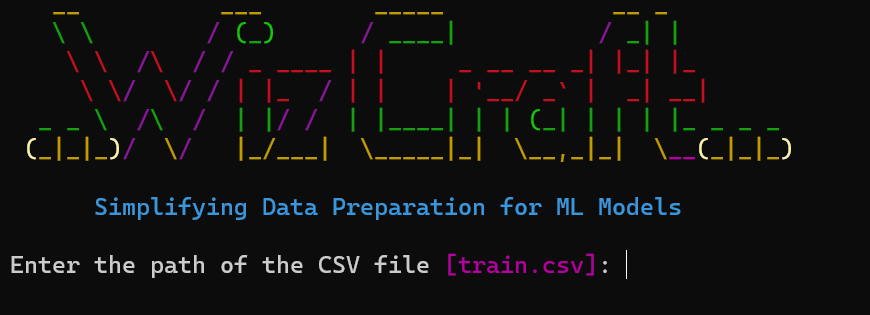
Start the interactive CLI with a CSV file:
wizcraft dataset.csv
You can also launch WizCraft and choose a CSV from the current directory:
wizcraft
WizCraft can still be used from Python:
from wizcraft.preprocess import Preprocess

wiz_obj = Preprocess(csv_file="dataset.csv")
wiz_obj.start()
Follow the on-screen prompts to select the target variable and perform preprocessing tasks.
Create a sample CSV:
wizcraft sample customers --out customers.csv
Audit a dataset and generate a suggested recipe:
wizcraft doctor train.csv --target Survived --write-recipe recipe.json
Export the same audit as JSON, HTML, or Markdown:
wizcraft doctor train.csv --target Survived --json report.json --html report.html --markdown report.md
Replay a saved recipe on another CSV:
wizcraft apply new-data.csv --recipe cleaned.recipe.json --out new-data-clean.csv
Sample Datasets
WizCraft ships with small demo datasets so new users can try the CLI immediately:
wizcraft sample
wizcraft sample titanic --out titanic.csv
wizcraft sample customers --out customers.csv
Available samples:
titanic: passenger survival dataset with missing values, duplicates, outliers, categorical columns, and review text.customers: customer churn dataset with IDs, dates, missing values, text feedback, outliers, and categorical columns.
Dataset Doctor
wizcraft doctor audits a CSV and surfaces common machine-learning data quality issues before you start modeling:
wizcraft doctor train.csv --target Survived
The doctor currently checks for:
- Column types, including numeric, categorical, datetime, text-like, ID-like, and mostly-empty columns
- Missing values
- Duplicate rows
- ID-like columns
- Constant and near-constant columns
- Text-heavy columns that should use NLP preprocessing instead of one-hot encoding
- Categorical columns that need encoding, while skipping columns detected as free-form text
- Date/datetime columns that may need feature extraction
- Numeric outliers using the IQR rule
- Imbalanced target columns
- Likely modeling task: binary classification, multiclass classification, or regression
- Possible target leakage from suspicious names or highly target-correlated numeric columns
You can write a suggested recipe and apply it later:
wizcraft doctor train.csv --target Survived --write-recipe recipe.json
wizcraft apply train.csv --recipe recipe.json --out train-clean.csv
You can also use Doctor output in automation:
wizcraft doctor train.csv --target Survived --format json
wizcraft doctor train.csv --target Survived --html report.html
wizcraft doctor train.csv --target Survived --markdown report.md
Features Available
Data Description
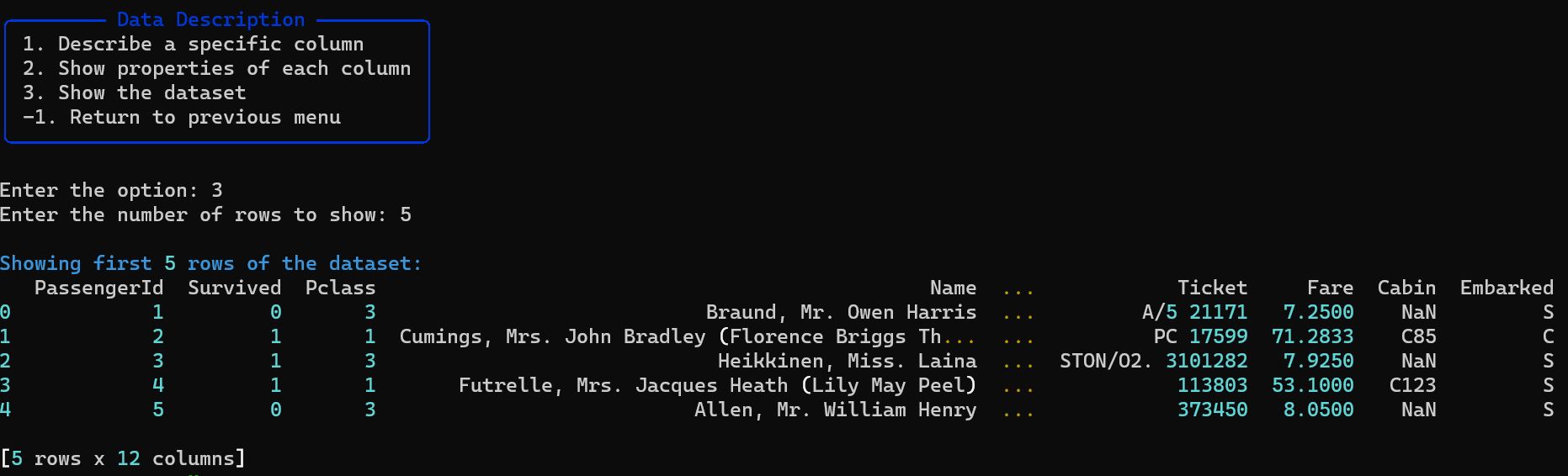
- View statistics and properties of numeric columns.
- Explore unique values and statistics of categorical columns.
- Display a snapshot of the dataset.
Handle Null Values
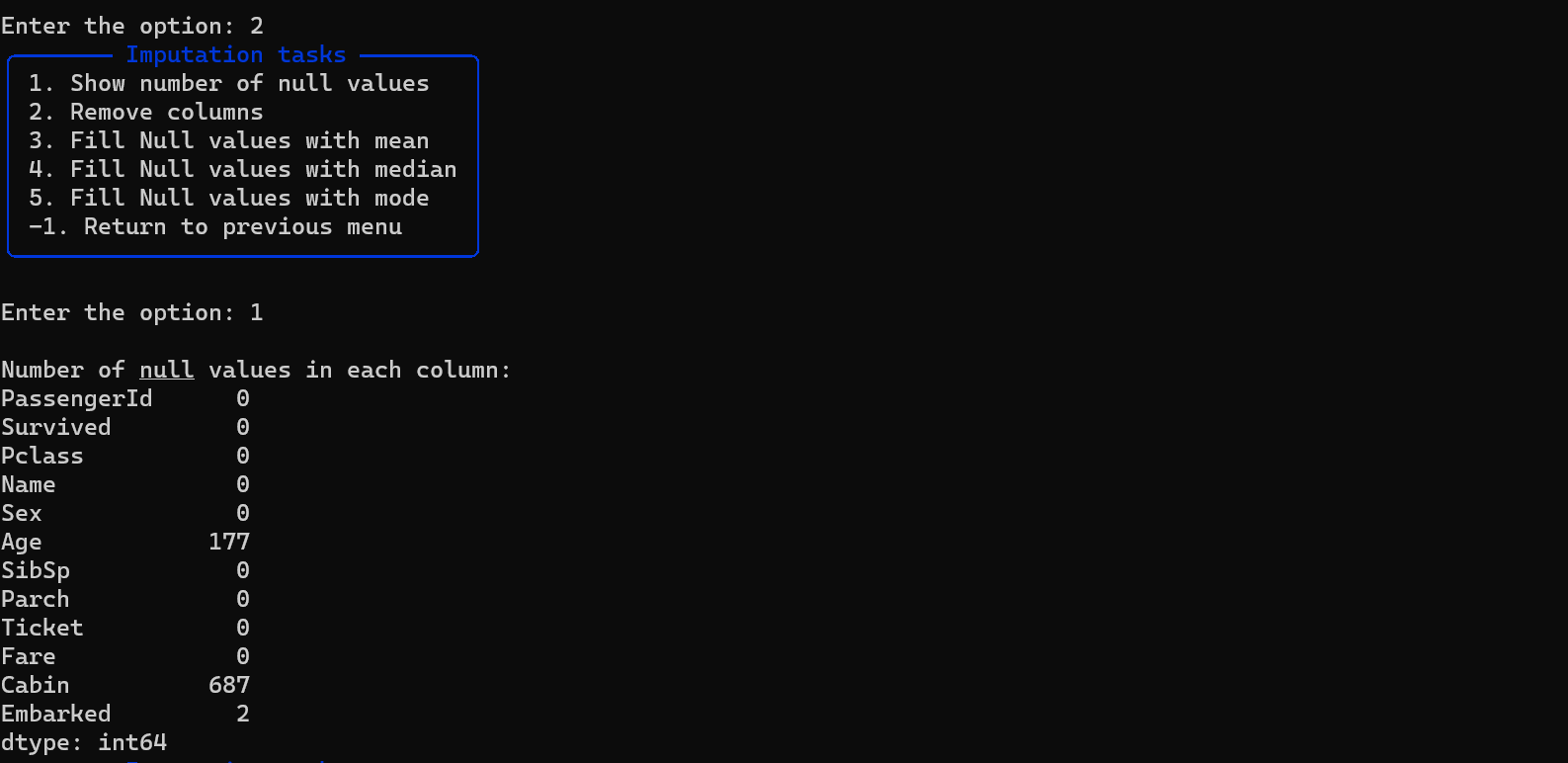
- Show NULL value counts in each column.
- Remove specific columns or fill NULL values with mean, median, mode, or K-nearest neighbors.
Encode Categorical Values
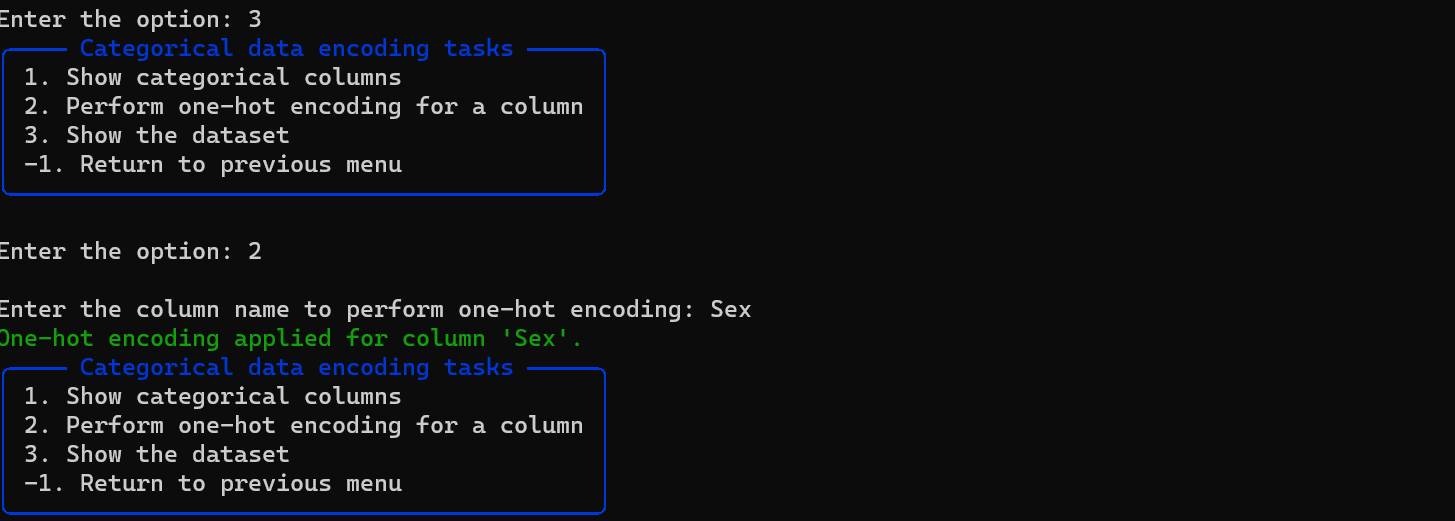
- Identify and list categorical columns.
- Perform one-hot encoding on categorical columns.
- Skip text-heavy columns such as reviews, comments, notes, feedback, messages, and descriptions so they can be handled with NLP-specific preprocessing.
Feature Scaling
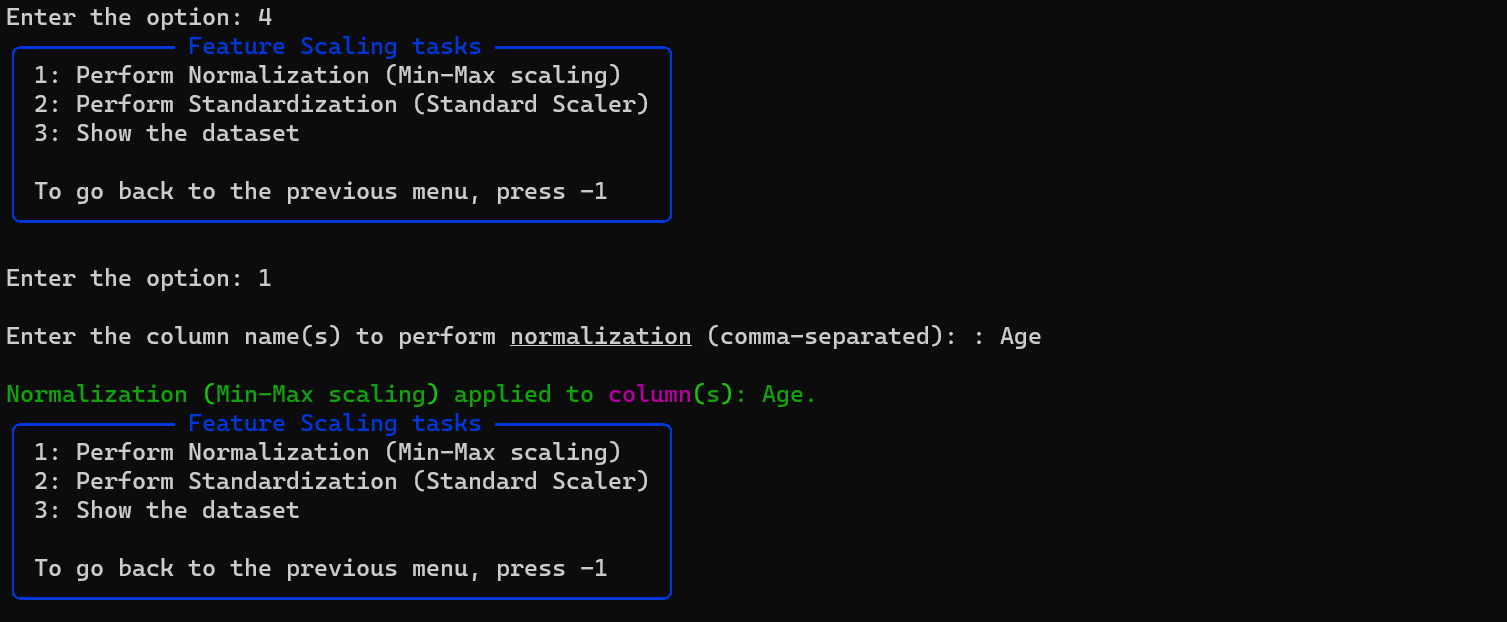
- Normalize (Min-Max scaling) or standardize (Standard Scaler) numerical columns.
Save Preprocessed Dataset
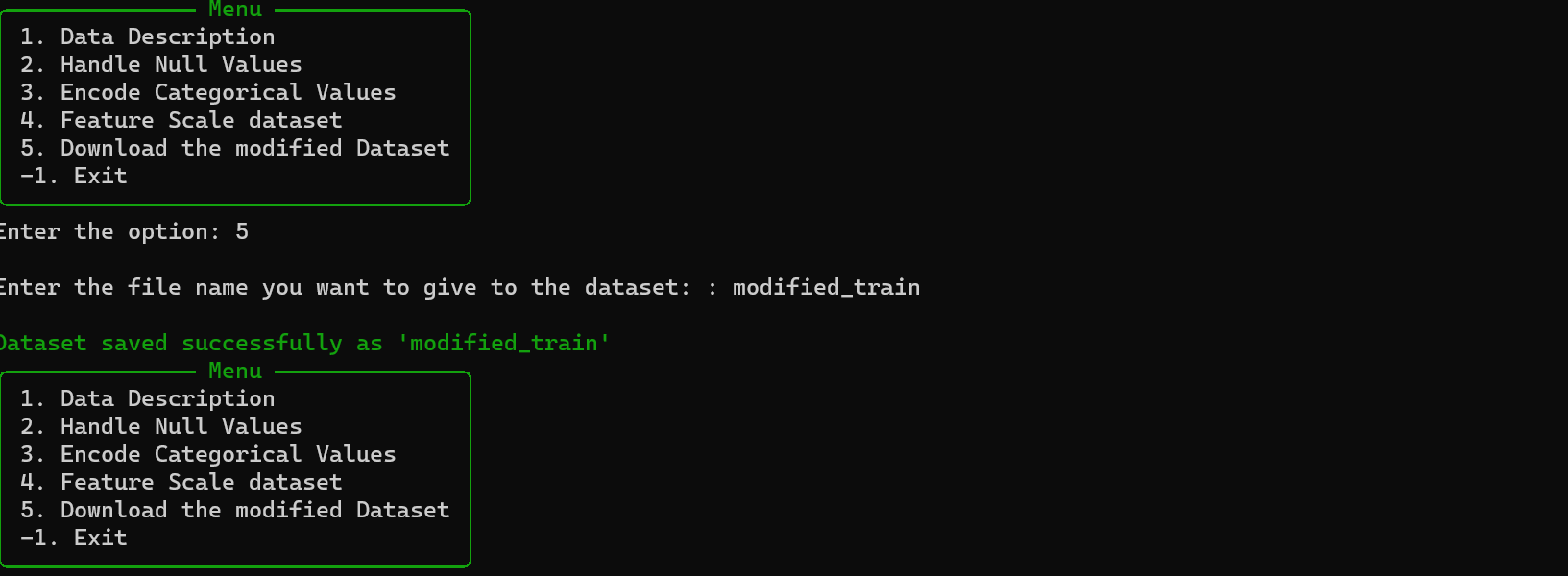
- Download the modified dataset with applied preprocessing steps.
- Save a replayable
.recipe.jsonfile for the same preprocessing flow.
Replayable Recipes
WizCraft can now save the preprocessing steps you perform interactively. A recipe is a small JSON file that can be applied again later:
wizcraft apply raw-data.csv --recipe cleaned.recipe.json --out cleaned-data.csv
Recipes currently support:
- Removing columns
- Filling null values with mean, median, mode, or K-nearest neighbors
- One-hot encoding categorical columns
- Normalizing or standardizing numeric columns
Roadmap
WizCraft is being rebuilt around three ideas: a friendly first-time CLI, dataset health checks, and repeatable preprocessing recipes.
Current priorities:
- Non-interactive commands for automation and notebooks.
- Exportable scikit-learn preprocessing pipelines.
- Cleaner terminal tables, validation, and error messages.
- Example datasets, tutorials, and good first issues for new contributors.
See ROADMAP.md for the full direction.
Contributing to the Project
Check out the Contribution Guide if you want to contribute to this project
1 maintainer

Release files for wiz-craft 1.4.0
For a detailed explanation of source distributions (sdists) and built distributions (wheels), please see the package formats documentation.
Source distribution (sdist)
| File | Size | Uploaded | |
|---|---|---|---|
| wiz_craft-1.4.0.tar.gz | 29.0 kB | Details |
Built distribution (wheel)
| File | Interpreter | ABI | Platform | Reset |
|---|---|---|---|---|
| wiz_craft-1.4.0-py3-none-any.whl | Python 3 | none | any | Details |
Total release size: 56.1 kB
Release files / wiz_craft-1.4.0.tar.gz
| Download URL | wiz_craft-1.4.0.tar.gz |
|---|---|
| Size | 29.0 kB |
| Tags | Source |
|
SHA-256 checksum How to use checksums |
96fe4ec933200a3a151df7c04caa9a13960c85586c948709b69d21ac1e20be42
|
|
BLAKE2b-256 checksum How to use checksums |
daca53f149bc2da7a0bfcb7f750bd581eb80892a3c9a014f1912dc13ca1ffdca
|
| Upload date | |
|
Uploaded using Trusted Publishing? What is trusted publishing? |
Yes |
| Uploaded via |
twine/6.1.0 CPython/3.13.14
|
Provenance
Provenance describes where a file came from. On PyPI, provenance is shared via attestations, which provide a verifiable record of the build or publishing details. View details, limitations and caveats.


PyPI Publish Attestation
PyPI verified that this artifact, at this checksum, originated from the publisher listed below.
Signed by GitHub Actions, verified by PyPI on Jul 21, 2026.
Transparency logRelease files / wiz_craft-1.4.0-py3-none-any.whl
| Download URL | wiz_craft-1.4.0-py3-none-any.whl |
|---|---|
| Size | 27.1 kB |
| Tags | Python 3 |
|
SHA-256 checksum How to use checksums |
4819281104edeb4e9cf384176e55f7de17262d5dc6b84fb0a264ad056ccb6115
|
|
BLAKE2b-256 checksum How to use checksums |
351e7df76324cead0cc8581b4e77ab14a2a0242ccf04fdb54fb8da24b0f9b199
|
| Upload date | |
|
Uploaded using Trusted Publishing? What is trusted publishing? |
Yes |
| Uploaded via |
twine/6.1.0 CPython/3.13.14
|
Provenance
Provenance describes where a file came from. On PyPI, provenance is shared via attestations, which provide a verifiable record of the build or publishing details. View details, limitations and caveats.
PyPI Publish Attestation
PyPI verified that this artifact, at this checksum, originated from the publisher listed below.
Signed by GitHub Actions, verified by PyPI on Jul 21, 2026.
Transparency log













