
🐨 wombat-gate
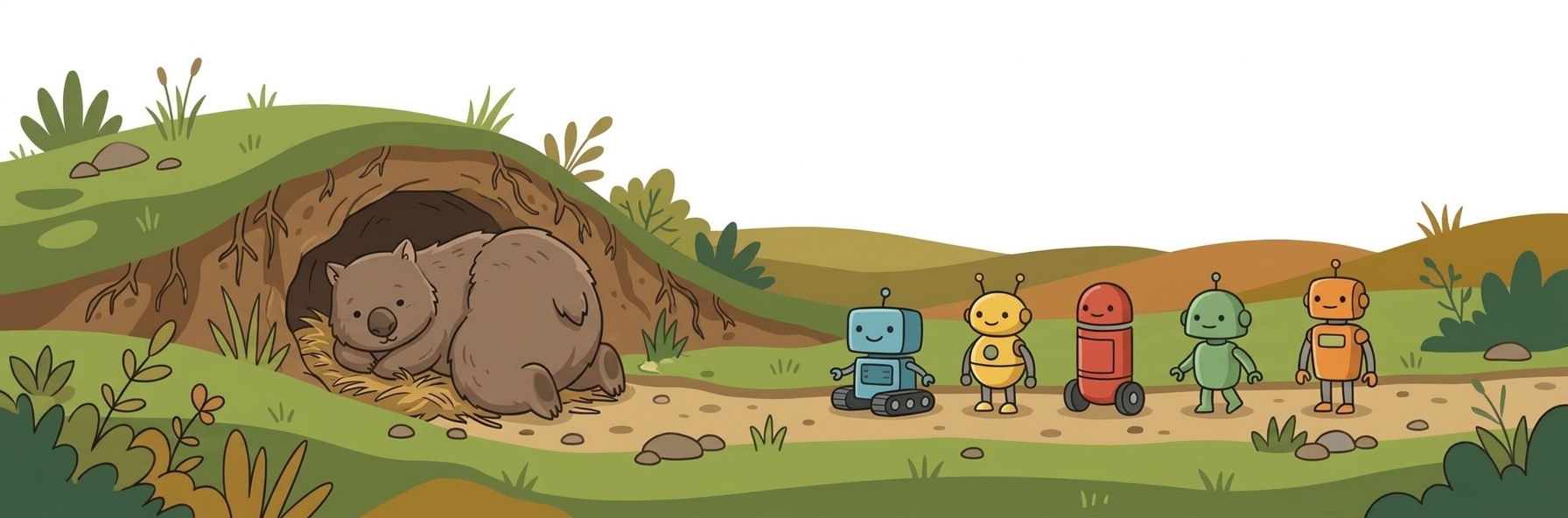
One at a time through the burrow. A commit queue for AI agents sharing one git repository: they wait their turn, and each commits only its own files.
🌐 English · 中文
🚀 Quick start
pipx install git+https://github.com/liyifreddy/wombat-gate

wombat-gate commit -m "fix parser" -- src/parser   # commit only these paths, in turn
wombat-gate run -- git push                        # push
wombat-gate who                                    # who is in the burrow
One file, Python ≥ 3.8, standard library only. Linux, macOS and WSL.
In Claude Code, install the plugin (CLI + guard hook + rules for the agent):
/plugin marketplace add liyifreddy/wombat-gate
/plugin install wombat-gate@wombat-gate
😩 The problem
Put a few Claude Code sessions (or any agents) in one checkout and this happens fast:
- 🧺 Commits take other people's files.
git add -A,git commit -aor a baregit commitsweeps in whatever a neighbour has staged. It bit us twice in two days. - 🥊 Lock fights. Every index write needs
.git/index.lock; the second agent getsindex.lock: File exists. In our self-test, 8 writers × 15 commits landed 1–10 of 120. - 🐢 Every commit checks the whole tree. On our 22k-file repo on a WSL-mounted Windows drive, one commit took 30–70 s and a busy queue waited 6 minutes. When memory runs low, those floods of disk requests fail first and take the drive down with them.
- 💣 Whole-tree commands. Agents reach for
git stash,git reset --hard,git checkout -- .and throw away each other's work.

Before: everyone in the burrow at once. After: one at a time, each crate on its own shelf.
✨ What you get
- ✅ Your paths, nothing else.
wombat-gate commit -m MSG -- PATH...commits exactly those paths. Whatever others staged stays put. - ✅ A queue, not errors. Everyone waits for one lock and goes in turn. Self-test: 120 of 120 commits land; median wait 0.14 s on an idle machine.
- ✅ No whole-tree scan. Only your paths are touched. That 22k-file repo went from 30–70 s to 3 s on its first real commit.
- ✅ A guard hook that stops whole-tree git commands in Claude Code (tested on 197 commands).
- ✅ Hands off other people's locks. If another git process holds one, it waits and retries.
- ✅ Cleans up after itself. If a wombat-gate gets killed while holding
index.lock, the next commit spots its own leftover and removes it. Anyone else's lock is only reported:wombat-gate doctorsays how old it is, who has it open, and what to do. - ✅ A timing log: queue wait, lock hold and every git step, one JSON line per commit.
- ✅ One-line install as a Claude Code plugin, with the hook and a skill that teaches the agent the rules.
🕳️ Why a wombat
When a wombat is chased, it dives into its burrow and plugs the hole with its bottom — a hard plate of bone that no fox can bite through. One wombat per burrow; everyone else waits outside. (Wombats also leave cube-shaped poo on rocks to say mine. We feel the same about our directories.)
  agent A ──┐                                      ┌──▶ commit A's paths only
  agent B ──┼──▶ queue ──▶ take lock ──▶ write ────┤
  agent C ──┘    (wait)    (local disk)            └──▶ release ──▶ next in line
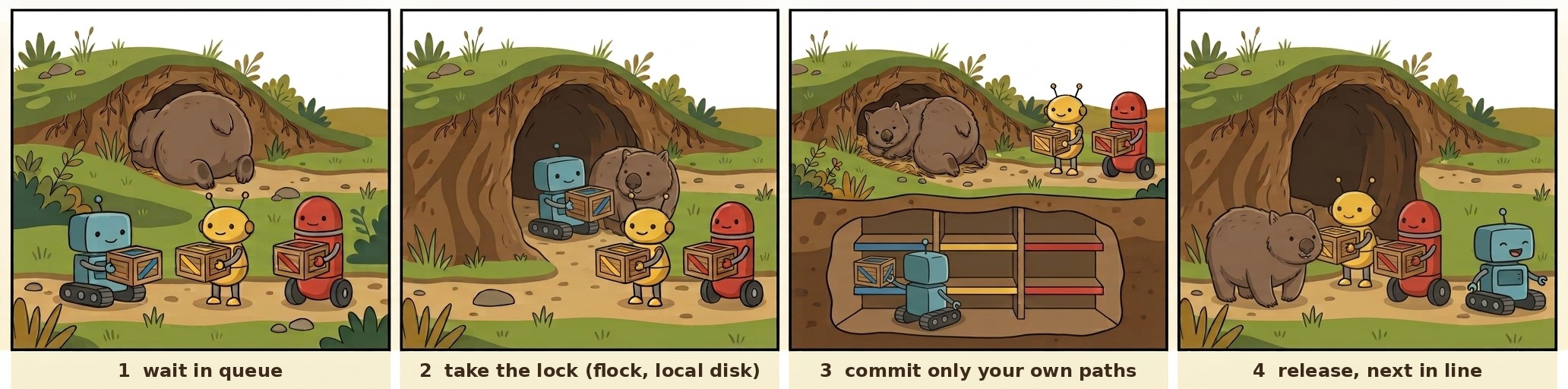
- Wait in queue — agents line up outside.
- Take the lock — one goes in. The lock lives under
~/.local/state, outside the repo, on a local disk (wombat-gate warns if it isn't). - Commit only your own paths — it puts down its own crate and nothing else.
- Release, next in line — out it comes; the next one goes in.
Illustrations generated with Google Gemini and edited by the author.
🧭 Under the hood
- No stuck locks. If the holder dies, the kernel drops the lock. Nothing to clean up.
- Path checks.
., the repo root, globs and:pathspecs are refused, so nobody commits the whole tree by accident. - Why it's fast. Your paths are staged in a private copy of the index and grafted
onto
HEAD. The branch moves only if nobody else moved it, and git's own index lock is held the whole time. Every self-test run checks the result against plaingit commit. - Status for your paths only:
wombat-gate status -- PATH.... - Human-only flags (
--allow-broad,run --unsafe) are refused inside agents.
The step-by-step version is in the reference.
🛠️ Usage
wombat-gate commit -m "parser: handle empty input" -- src/parser tests/test_parser.py
wombat-gate commit -n -m "..." -- src/parser   # dry run
wombat-gate status -- src/parser               # status of your paths only
wombat-gate run -- git push                    # push, fetch, tag, log, ... (an allow-list)
wombat-gate who                                # who is in the burrow
wombat-gate log -n 50                          # recent timings (--stats: p50 / p95)
wombat-gate doctor                             # git lock files: in use, stale, or ours
wombat-gate claim --as agent-7 -- src/parser   # reserve your paths at start; overlaps are refused (exit 7)
wombat-gate claims                             # who reserved what, and the isolated worktrees
wombat-gate release --as agent-7               # hand the paths back when you are done
wombat-gate isolate --as agent-7               # your own worktree + branch beside the repo
wombat-gate integrate --as agent-7 --check 'make test' --done   # rebase, check, fast-forward, clean up
Set WOMBAT_SESSION=agent-7 (or --session / --as) so who can tell you who is in there.
🔀 Three ways to work: which one to pick (0.9)
| Your situation | Use | What happens |
|---|---|---|
| Small edits, agents on different files, one shared checkout | commit -- <paths> only |
Commits queue through one lock; each takes only its own paths. |
| Agents in parallel on separate parts of one checkout | claim at start, release at the end |
The second agent to claim an overlapping path (same path, or a parent / child directory) is told at once who holds it and gets exit 7 — before anyone writes a line. commit notes paths outside your claims. |
| Agents in parallel on the same code | isolate, then integrate --done |
Each agent gets its own worktree and branch beside the repo. Hand-in rebases onto the current target, runs your checks, fast-forwards, then removes the worktree and the merged branch. A conflict stops in that agent's worktree and lists the files. |
Compared with "one worktree per agent" (what OpenCode, Codex and similar tools offer): their worktrees keep agents apart while they work, and the collision shows up at merge time. wombat-gate adds three things:
- Overlap is reported at the start.
claim(andisolate -- <paths>) checks every live session's reservations across all worktrees of the repository, so two agents heading for the same directory find out before they start, not when merging. - Hand-in is checked.
integraterebases onto the target as it is now, runs the required checks, and fast-forwards only if the target has not moved since; if it has, it rebases and checks again (--attempts, default 3). The queue is held only for a moment at the start and at the fast-forward, so other agents keep committing during long checks. - Clean-up is automatic and safe.
--doneremoves the worktree and deletes the branch only when the branch is merged and the worktree is clean; nothing is forced.
Reservations of a session whose agent process has exited are dropped the next time anyone looks; isolated worktrees are never dropped automatically (they may hold work) — claims marks their owner as gone.
Exit codes, settings and every refused command are in the reference.
🤖 With Claude Code
-
Install the plugin (see Quick start). It brings the CLI, the guard hook and a skill with the rules.
-
Tell your sessions the rules, e.g. in
CLAUDE.md:Commit with
wombat-gate commit -m "..." -- <your paths>; push withwombat-gate run -- git push. Nogit add -A,git commit -aorgit stash. -
Mark Claude Code as an agent in
.claude/settings.json, so the human-only flags (--allow-broad,run --unsafe) stay off:{ "env": { "WOMBAT_NO_ESCAPES": "1" } }.
Running many sessions? The playbook covers naming, task cards, review chains and unattended runs.
⚠️ Limits
- Only processes that use wombat-gate queue. Switch every agent over.
- The lock must be on a local disk. Windows-side git can't see a WSL lock.
- Commits get fast;
git statusandgit logon a slow disk don't. - Two agents changing the same file in one checkout: the first commit takes both changes.
Give agents separate paths (
claim), or separate worktrees (isolate). - Claims are advisory: they warn and refuse overlapping claims, but do not stop a commit.
- One machine only.
The full list is in the reference.
✅ Self-test
python3 selftest_wombat_gate.py               # 1–7 min depending on load, throw-away repos on a local disk
python3 selftest_wombat_gate.py --mutants     # 44 past bugs put back; each must turn a check red
bash hooks/selftest_guard.sh                  # 197 commands the guard must block or let through
python3 selftest_release.py                   # 0.8 regressions: deletions, renames, integrate (25)
python3 selftest_isolate.py                   # 0.9: claims, isolated worktrees, integrate without holding the queue (23)
Every fast commit is compared with what plain git commit does on a copy of the repo.
📍 Status
-
0.9.0 candidate —
claim/release/claims,isolateworktrees withintegrate --done, andintegrateno longer holds the queue during rebase and checks. -
0.8.0 — staged deletion/rename support, reviewed file counts, checked worktree integration and release checks. See CHANGELOG.
-
0.7.0 — cleans up its own stale
index.lock;doctor; timing p50 / p95. -
0.6.2 — before / after picture, language switch.
-
0.6.1 — illustrated README, a tiny wombat in
--help, pipx packaging, PyPI workflow. -
0.6.0 — fast commits (private index + tree graft + compare-and-swap).
How it's built and why: DESIGN.md.
📄 License
MIT — see LICENSE.
Staged deletions, renames and reviewed counts (0.8)
Name both old and new paths for a rename, including when git mv or git rm has already staged the change. HEAD entries missing from the index are handled as deletions when the path is also absent on disk. A path still present on disk is staged from disk, as before.
wombat-gate commit -n --expect-files 2 -m 'rename notes' -- '旧目录/笔记.md' 'notes.md'
wombat-gate commit    --expect-files 2 -m 'rename notes' -- '旧目录/笔记.md' 'notes.md'
The preview shows one row per changed path, with both ends of a rename on separate rows. Filenames are JSON-quoted UTF-8, so embedded newlines cannot create extra rows. The summary 删 N / 改名 N / 改 N means deleted paths excluding rename sources / rename pairs / other changed paths (including additions). A rename is two rows but one pair. --expect-files N checks the count again under the queue lock and refuses mismatches (exit 2); use the number of explicitly named changed files for a move. Directories expand recursively, so use the expanded file count rather than the number of directory arguments. Without the flag, the original recursive commit API remains available. Other agents' staging stays outside the selected paths.
Integrate a worktree branch
From the target worktree, rebase the committed source branch onto the current target HEAD, run the named checks in the source worktree, then fast-forward:
wombat-gate integrate -n --rebase topic --check 'python3 tests/run_all.py'
wombat-gate integrate    --rebase topic --check 'python3 tests/run_all.py' --check 'python3 tests/regression.py'
wombat-gate integrate    --as agent-7   --check 'python3 tests/run_all.py' --done   # a worktree made by isolate
The source must already be checked out in a separate worktree and have no tracked changes or nonignored untracked files. At least one --check is required. Commands are split into argv without a shell: no pipes, redirection or shell expansion; --check-timeout defaults to 600 seconds per command. The repository's common queue is held twice, briefly: to validate and note the target, and to fast-forward once the target is confirmed unchanged. Rebase and checks run outside it, so other sessions keep committing; if the target moved meanwhile, integrate rebases and checks again, up to --attempts (default 3, or WOMBAT_INTEGRATE_ATTEMPTS). The target may have unrelated staged/unstaged work; overlapping tracked, untracked or ignored paths are refused. Ignored source files that target changes would overwrite are also refused. Checks must leave source HEAD and tracked/nonignored files unchanged.
Conflicts stop in the source worktree with the rebase state preserved; inspect it there and explicitly continue or abort before retrying. Failed checks leave the rebased source branch available and do not advance the target. Source branches containing merge commits require manual review. A target that keeps moving past the attempt limit, a target that switched branch, an in-progress operation or unsafe overlap stops integration. There is no automatic stash, force update or conflict resolution. Branches and worktrees are removed only by --done (or isolate --done), only for a worktree made by isolate, and only when its branch is merged and the worktree is clean; ignored files inside it (caches, build output) go with it. Only cooperating processes share the queue; ordinary Git processes still need coordination.
Platform status
| Platform | CLI support | This candidate's evidence |
|---|---|---|
| Linux | Supported (Python ≥3.8, Git, POSIX flock/signals) | Full suite runs on WSL's Linux kernel/ext4; separate native Linux host not tested. Linux CI configured, not yet run remotely. |
| WSL | Supported with Linux Git/Python; queue state on Linux local disk | Locally tested on WSL2. Stress fixtures on ext4; source on a Windows mount. Do not mix Windows Git writers with the WSL queue. |
| macOS | POSIX CLI supported; /proc-based lock opener diagnostics are limited |
Not tested locally. Portable regression/guard/packaging CI configured. |
| Native Windows | Unsupported: fcntl/flock and POSIX signal timers required | Not tested; use WSL. A Windows Git process does not join the WSL lock. |
All platforms require Git with worktree and merge/rebase --no-autostash support for integrate (local validation: Git 2.43.0). No claim of independent testing on every platform is implied.
Claude Code, Codex and OpenCode Go
The CLI works independently of a model/provider. These examples provide instructions plus explicit agent markers. Only the existing Claude Code plugin installs its guard hook; the Codex/OpenCode instructions are not a shell-enforcement hook.
Claude Code: install the plugin described above; add this project .claude/settings.json setting (merge it with existing settings), and put the commit rule in CLAUDE.md:
{"env": {"WOMBAT_NO_ESCAPES": "1", "WOMBAT_SESSION": "claude-task"}}
At start, claim your assigned paths with `wombat-gate claim --as <session> -- <paths>` and stop if it reports an overlap; release them when done. Commit only assigned files through wombat-gate. Preview a move with --expect-files N, name both old and new paths, and use the same count for the real commit. Stop if the file list differs. Integrate only a reviewed branch with the task's required --check commands. Ask before pushing or publishing when the task requires approval.
Codex: put that same rule in the repository's AGENTS.md (official instructions guide). Start it with:
WOMBAT_NO_ESCAPES=1 WOMBAT_SESSION=codex-task codex
# Example command for the agent:
WOMBAT_NO_ESCAPES=1 wombat-gate commit -n --expect-files 1 -m 'fix parser' -- src/parser.py
OpenCode Go: Go is a provider plan; the local OpenCode CLI uses the same project AGENTS.md rule (official rules guide). Start your configured OpenCode client with:
WOMBAT_NO_ESCAPES=1 WOMBAT_SESSION=opencode-task opencode
# Example command for the agent:
WOMBAT_NO_ESCAPES=1 wombat-gate commit --expect-files 1 -m 'fix parser' -- src/parser.py
The shared skill also describes the workflow. Agent instruction/configuration examples were checked against documentation; all three full interactive clients were not launched in this validation. CLI marker and path protections are exercised in self-tests.
Release setup and the diagnosed PyPI invalid-publisher failure: publishing guide. A maintainer must configure the matching Trusted Publisher; changing YAML alone cannot create it.
1 maintainer

Metadata
1 maintainer
Release files for wombat-gate 0.9.0
For a detailed explanation of source distributions (sdists) and built distributions (wheels), please see the package formats documentation.
Source distribution (sdist)
| File | Size | Uploaded | Provenance | Actions |
|---|---|---|---|---|
| wombat_gate-0.9.0.tar.gz | 114.1 kB | With provenance | Details for wombat_gate-0.9.0.tar.gz |
Built distribution (wheel)
| File | Interpreter | ABI | Platform | Actions Reset |
|---|---|---|---|---|
| wombat_gate-0.9.0-py3-none-any.whl | Python 3 | none | any | Details for wombat_gate-0.9.0-py3-none-any.whl |
Total release size: 156.8 kB
Release files / wombat_gate-0.9.0.tar.gz
| Download URL | wombat_gate-0.9.0.tar.gz |
|---|---|
| Size | 114.1 kB |
| Tags | Source |
|
SHA-256 checksum How to use checksums |
20f845ea04b3e3091d8e950dc92e67acb0ab4ac81d3c21c301ea7dc8f0f70ebd
|
|
BLAKE2b-256 checksum How to use checksums |
b43876372126f0ce4e25680cbe1fdf625c2a4a205c6b148294510b9e04d470fe
|
| Upload date | |
|
Uploaded using Trusted Publishing? What is trusted publishing? |
Yes |
| Uploaded via |
twine/7.0.0 CPython/3.13.16
|
Provenance
Provenance describes where a file came from. On PyPI, provenance is shared via attestations, which provide a verifiable record of the build or publishing details. View details, limitations and caveats.


PyPI Publish Attestation
PyPI verified that this artifact, at this checksum, originated from the publisher listed below.
Signed by GitHub Actions, verified by PyPI on Nov 5, 2026.
Transparency logRelease files / wombat_gate-0.9.0-py3-none-any.whl
| Download URL | wombat_gate-0.9.0-py3-none-any.whl |
|---|---|
| Size | 42.7 kB |
| Tags | Python 3 |
|
SHA-256 checksum How to use checksums |
b83e7829ce960bf059a1d19007d4d565b8c8f4262ba79400103433e85184bc5d
|
|
BLAKE2b-256 checksum How to use checksums |
b6c7614565368d6c2700534768c509cb07d9e0e21e30af767ef960f4ca3e62f7
|
| Upload date | |
|
Uploaded using Trusted Publishing? What is trusted publishing? |
Yes |
| Uploaded via |
twine/7.0.0 CPython/3.13.16
|
Provenance
Provenance describes where a file came from. On PyPI, provenance is shared via attestations, which provide a verifiable record of the build or publishing details. View details, limitations and caveats.
PyPI Publish Attestation
PyPI verified that this artifact, at this checksum, originated from the publisher listed below.
Signed by GitHub Actions, verified by PyPI on Nov 5, 2026.
Transparency logSecurity for wombat-gate 0.9.0
Provenance
Provenance describes where a file came from. On PyPI, provenance is shared via attestations, which provide a verifiable record of the build or publishing details. View details, limitations and caveats.
Full provenance
Both files in this release have been uploaded with provenance metadata.
Attestation for wombat_gate-0.9.0.tar.gz
PyPI Publish Attestation
PyPI verified that this artifact, at this checksum, originated from the publisher listed below.
Signed by GitHub Actions, verified by PyPI on Nov 5, 2026.
Transparency logA note on package security
PyPI is a repository for distributing packages, not a service for auditing them. While third-party security researchers and our staff do their best to detect and remove malicious packages, PyPI cannot guarantee the quality, security or suitability of any given package.
To learn more about protecting yourself from malicious actors, visit our package security documentation.














